博客

  • How Can Buyers Verify the GSM Tolerance Before Paying a Fabric Deposit?

    How Can Buyers Verify the GSM Tolerance Before Paying a Fabric Deposit?


    Before paying a fabric deposit, buyers should verify a traceable finished-fabric sample and place the nominal GSM, tolerance, test method, conditioning, sampling plan, and rejection action in the purchase specification. A pre-production sample can confirm the agreed measurement basis, but it cannot guarantee bulk consistency unless the order also defines how rolls and lots will be inspected.
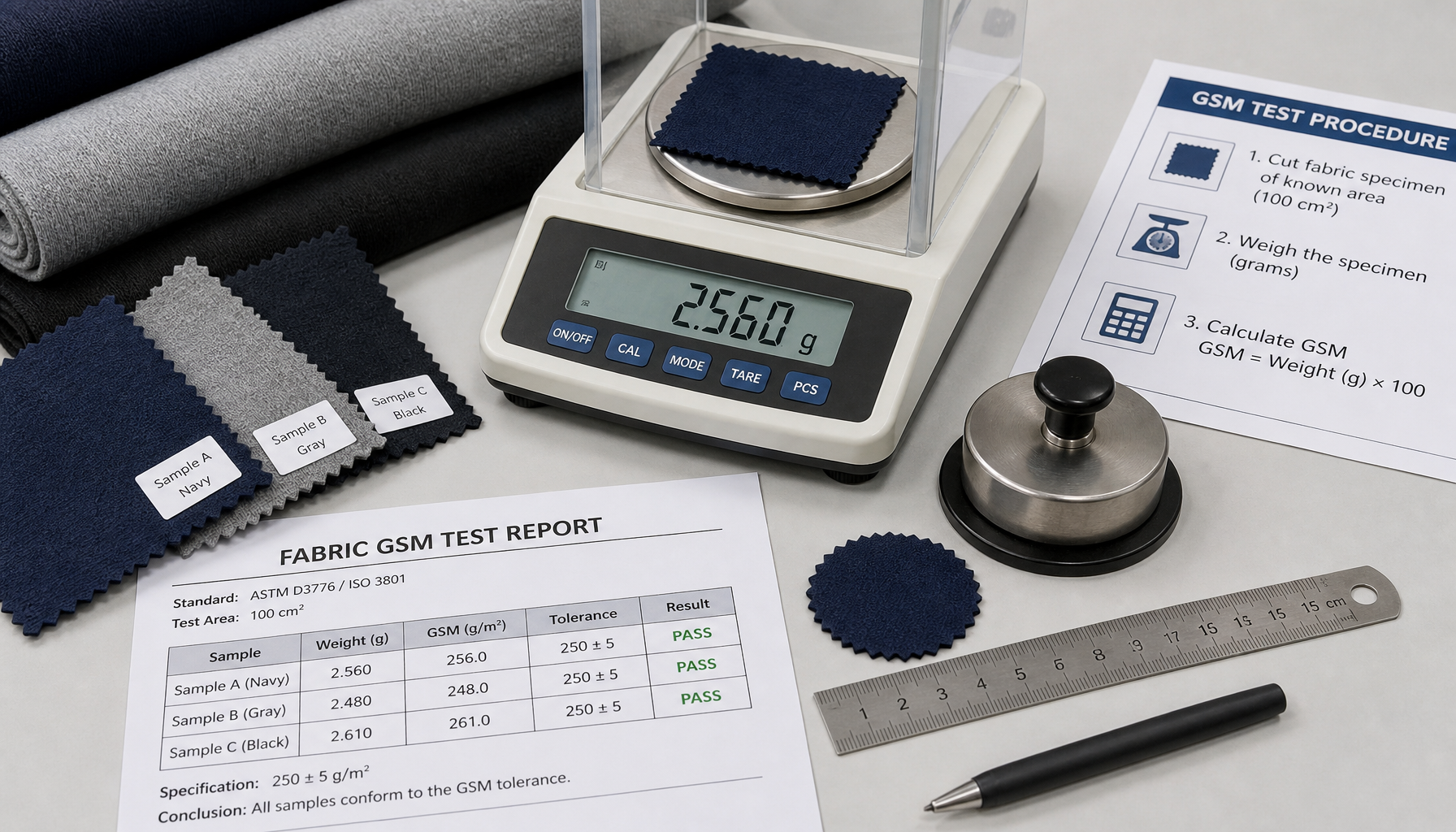
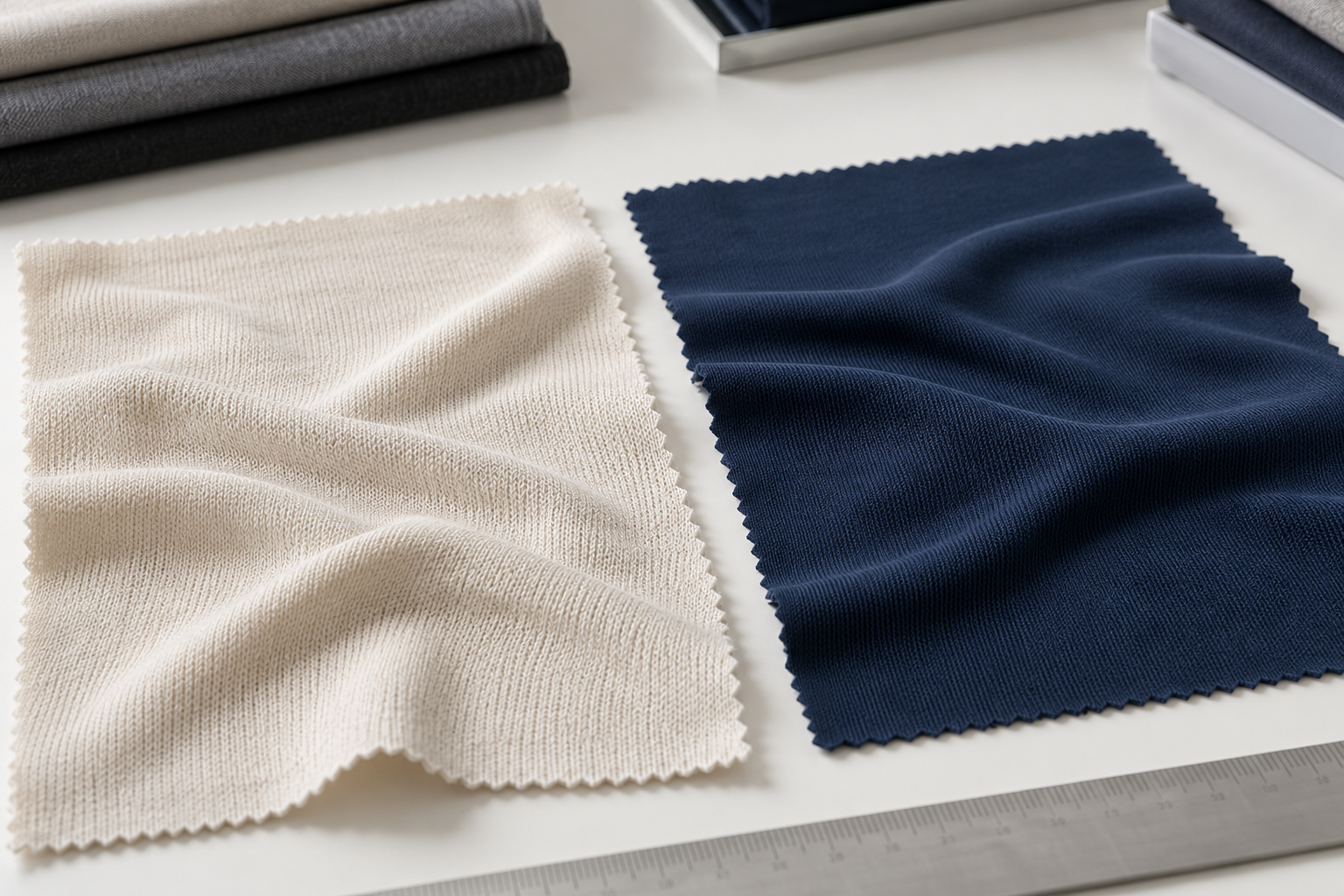
    Finished knitted fabric sample prepared for GSM verification

    Agree on what “GSM tolerance” means

    A quotation that states only “220 gsm” is incomplete. Before the deposit, the buyer and supplier should agree on:

    • nominal GSM of the finished fabric;
    • tolerance expressed as a percentage or an absolute range;
    • whether the limit applies to every specimen, each roll average, or the production-lot average;
    • test method, cutter area, balance precision, conditioning, and relaxation time;
    • whether the sample is greige, dyed, heat-set, brushed, or otherwise finished;
    • sampling positions across the usable width and along each selected roll;
    • number or percentage of rolls to inspect;
    • action for an out-of-tolerance roll or lot.

    These details matter because a lot average can pass while individual rolls or edge-to-center positions fall outside the intended range.

    Verify a traceable finished-fabric sample

    Request a sample identified by fabric code, composition, knit construction, color, finish, usable width, and production or development reference. The GSM measurement should be taken after the sample has been relaxed and conditioned under the agreed procedure.

    Do not rely on one cut specimen. Take multiple specimens from distributed positions, avoiding selvedges, creases, visible defects, and overlapping locations. Record each weight, the calculated GSM, minimum, maximum, and average. The supplier and buyer should retain matched reference samples where practical.

    Check the GSM calculation

    GSM is the specimen mass divided by its area in square meters:

    GSM = specimen mass (g) ÷ specimen area (m²)

    Illustrative calculation — not a ClothFactory test result: a 100 cm² specimen has an area of 0.01 m². If it weighs 2.20 g:

    2.20 g ÷ 0.01 m² = 220 g/m²

    With a 100 cm² cutter, multiplying the specimen weight in grams by 100 gives the GSM. A calibrated cutter and suitable balance are still required; inaccurate area or rounding can distort the result.

    Circular fabric specimens and balance used for GSM measurement

    Interpret the tolerance before accepting the result

    Illustrative specification — not a ClothFactory production tolerance: a nominal 220 gsm fabric with an agreed tolerance of ±5% has an acceptable numerical range of:

    220 × 0.95 = 209 gsm

    220 × 1.05 = 231 gsm

    The calculation does not show whether every specimen must fall between 209 and 231 gsm or whether only a roll or lot average must fall within that range. The purchase specification must state the acceptance unit.

    For example, five readings of 210, 214, 220, 226, and 234 gsm average 220.8 gsm. The average is close to nominal, but the 234 gsm specimen exceeds the illustrative upper limit. Whether the material passes depends on the agreed rule, not the average alone.

    Confirm that the sample represents the quoted product

    GSM can change during dyeing, heat setting, relaxation, brushing, coating, and other finishing operations. A greige or unfinished sample should not be used to approve a finished-fabric tolerance unless the conversion basis is documented and later verified.

    Confirm that the quoted price, width, composition, finish, and GSM refer to the same construction. A lower finished width or higher GSM can change fabric yield and garment cost even when the price per kilogram appears unchanged.

    Estimate the commercial effect of GSM variation

    GSM affects the weight of a known fabric area. It does not by itself establish durability, opacity, hand feel, or performance.

    Illustrative calculation — not order data: assume 600 linear meters of fabric with a usable width of 1.5 meters. The total area is:

    600 m × 1.5 m = 900 m²

    At 220 gsm, the theoretical fabric mass is 198 kg. At the illustrative limits of 209 and 231 gsm, it ranges from 188.1 to 207.9 kg. This simplified calculation excludes unusable edges, roll length variation, moisture differences, and cutting loss, but it shows why GSM and usable width should be reviewed together when comparing yield and cost.

    Convert the agreement into deposit documents

    Before payment, place the following in the purchase order, specification sheet, or signed quality annex:

    1. fabric code, composition, knit construction, color, and finish;
    2. nominal finished GSM and tolerance;
    3. usable width and its tolerance;
    4. approved reference sample and report identity;
    5. test method, conditioning, and specimen plan;
    6. roll- and lot-level acceptance rules;
    7. pre-shipment inspection requirement, if applicable;
    8. agreed action for failed rolls, shortages, replacement, or reprocessing.

    The document should use measurable requirements rather than phrases such as “approximately 220 gsm” or “normal industry tolerance.” Commercial remedies and payment terms should be reviewed by the buyer's responsible purchasing or legal team.

    Recheck GSM during bulk production

    Deposit-stage verification establishes the specification; bulk inspection establishes conformance. Request production-lot results and verify selected rolls before shipment or cutting. Sampling should cover different rolls and distributed positions rather than only the first roll or one convenient location.

    If buyer and supplier results differ, compare conditioning, relaxation, cutter area, balance calibration, specimen location, and rounding before deciding that the lot has failed. Retest matched specimens under one agreed procedure when necessary.

    Avoid common GSM-approval mistakes

    • Testing one specimen. A single cut cannot show widthwise or roll-to-roll variation.
    • Approving greige GSM for a finished order. Dyeing and finishing can change the result.
    • Leaving the acceptance unit undefined. Specimen, roll, and lot averages answer different questions.
    • Ignoring usable width. GSM alone does not determine linear-meter yield or garment consumption.
    • Accepting a verbal tolerance. The range and failure action should appear in the order documents.
    • Treating the sample as a bulk guarantee. Production rolls still require traceable inspection.
    • Assuming GSM proves performance. Stretch recovery, dimensional stability, opacity, pilling, and colorfastness need separate requirements.

    Procurement next step

    Send the supplier the intended application, nominal finished GSM, tolerance, usable width, finish, color, sample plan, and required test condition. Request an identified finished sample and full readings before deposit, then place the same requirements in the purchase documents and bulk inspection plan. ClothFactory can prepare or match a nylon-spandex or polyester-spandex sample against that brief, while final acceptance remains tied to the agreed measurements and production-lot results.
  • How Should Brands Choose GSM and Usable Width for Fabric Used in Performance Skorts?

    How Should Brands Choose GSM and Usable Width for Fabric Used in Performance Skorts?


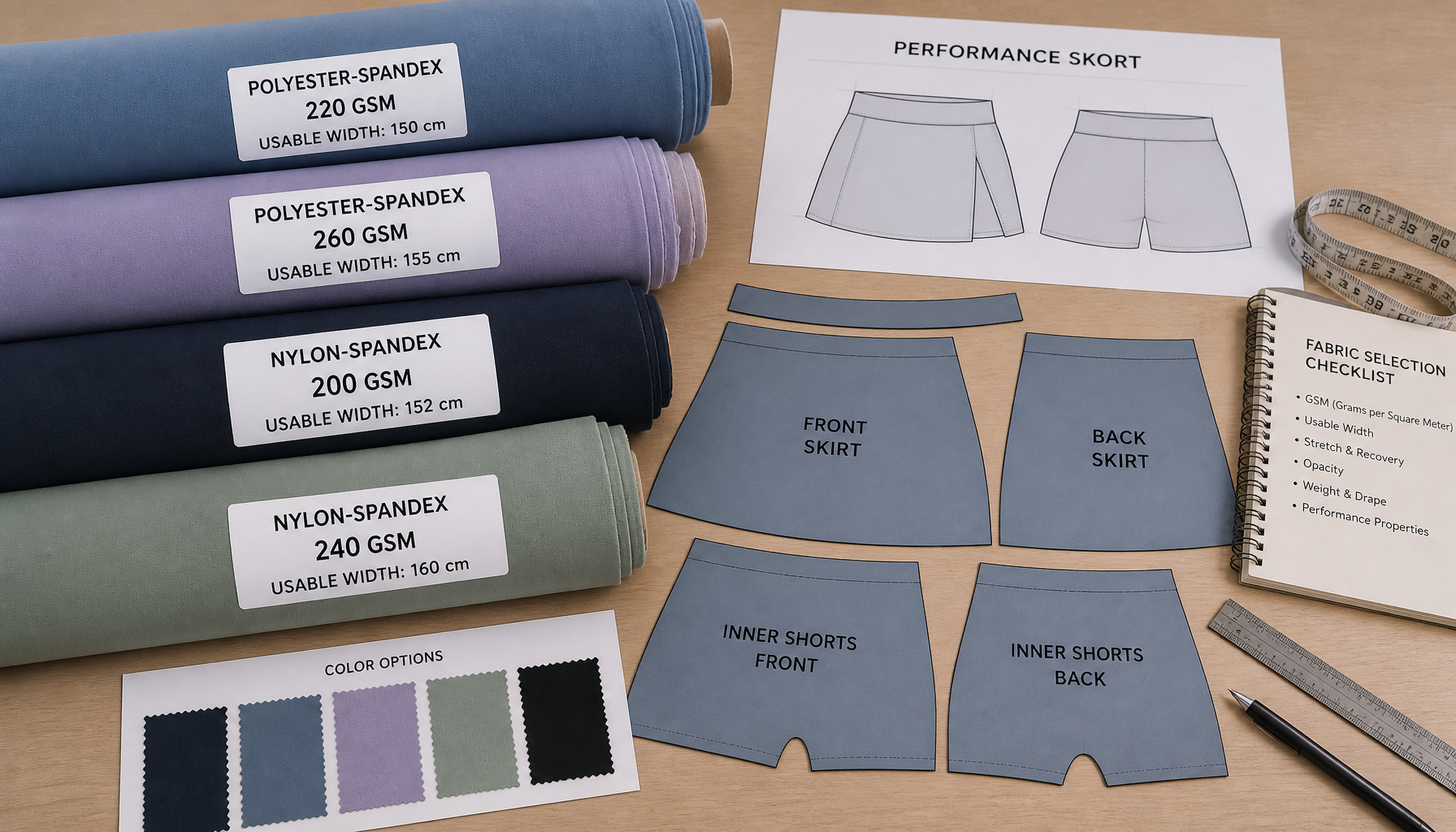
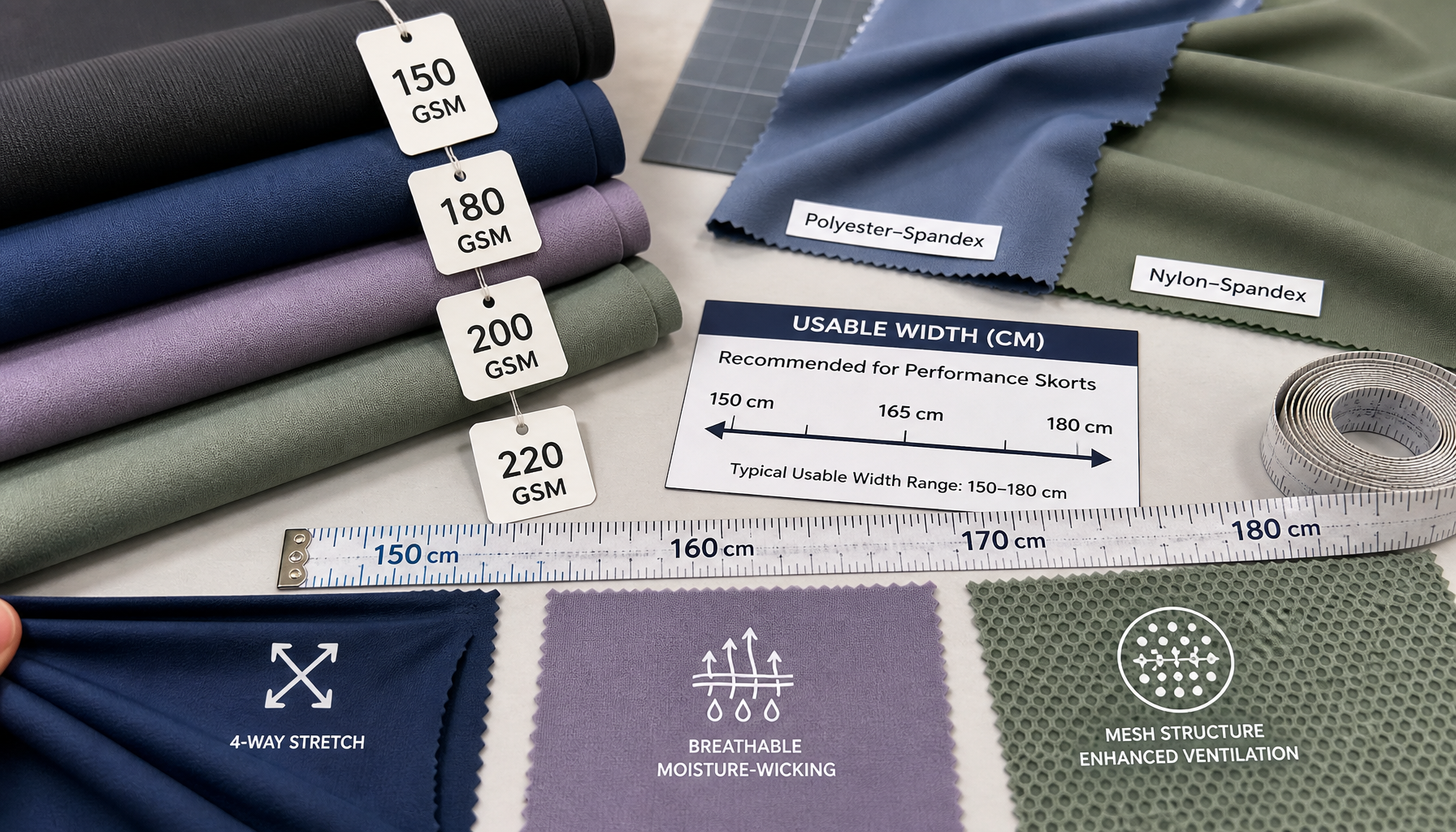
    Brands should choose GSM from the performance required in each skort layer and choose usable width from a verified marker, not from a generic activewear range. A performance skort often combines a draping outer skirt with a close-fitting inner short, so one fabric specification may not provide the best coverage, support, movement, and cutting efficiency for both zones.

    Performance skort fabric being reviewed for weight and usable width

    Separate the outer skirt from the inner short

    The outer skirt and inner short perform different jobs:

    • Outer skirt: usually prioritizes drape, movement, surface appearance, wind response, and low bulk.
    • Inner short: usually prioritizes coverage under extension, recovery, support, next-to-skin comfort, and resistance to riding up.

    A single nylon-spandex or polyester-spandex construction can be considered when the design and sourcing plan favor simplicity, but it must pass both sets of requirements. If it cannot, specify two fabrics and calculate their consumption separately.

    Use GSM as a mass-control value, not a performance shortcut

    GSM records fabric mass per square meter. It affects garment weight and material consumption, but it does not independently determine opacity, breathability, support, drape, or durability. Those outcomes also depend on yarn, knit structure, thickness, surface finish, color, and stretch condition.

    For the inner short, review coverage and appearance at the extension expected over the seat and thigh. For the outer skirt, assess drape and movement in a garment sample. A heavier fabric may still lose cover under stretch, while a lighter construction may provide acceptable coverage through knit density and yarn selection.

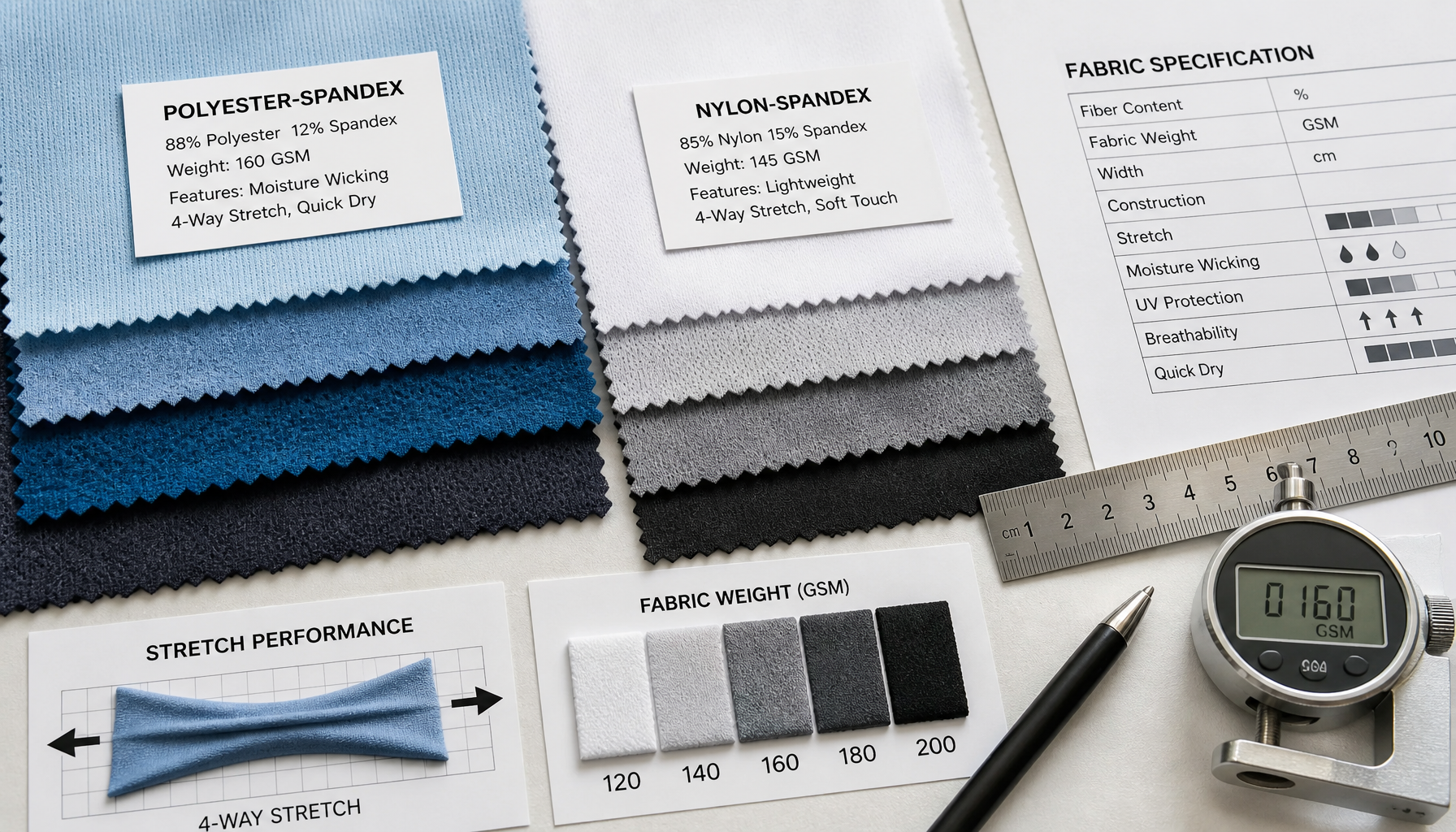
    Stretch fabric samples for the outer skirt and inner short of a performance skort

    Define usable width precisely

    Usable width is the portion of finished fabric that can be placed in the production marker while meeting the approved quality standard. It may be narrower than the nominal or total width because of selvedges, edge curl, pin or clip marks, coating or print limitations, shade variation, or unstable edge zones.

    The purchase specification should state:

    • whether width is open, tubular, total, cuttable, or usable width;
    • the finished and relaxed condition used for measurement;
    • whether selvedges and unstable edge zones are excluded;
    • the minimum usable width and permitted variation;
    • how width is checked along each roll;
    • whether the fabric must be relaxed before cutting;
    • which direction provides the required garment stretch.

    Do not compare one supplier's nominal width with another supplier's usable width.

    Let the marker determine width efficiency

    A wider fabric does not automatically reduce cost. Efficiency depends on pattern geometry, size ratio, grain or stretch direction, print direction, panel pairing, and whether the largest pattern pieces can nest across the width.

    Ask the garment factory to run markers using the supplier's confirmed usable width. Compare:

    • linear meters per garment;
    • marker efficiency;
    • cutting loss and end allowance;
    • size-ratio sensitivity;
    • panel orientation and stretch direction;
    • whether the outer skirt and inner short require separate markers.

    If a small width change forces one fewer panel across the marker, consumption can increase sharply. Record the width used in the marker so production material is not accepted against a different basis.

    Compare mass per linear meter and mass per garment

    The approximate mass of one linear meter is:

    kg per linear meter = usable width (m) × finished GSM ÷ 1,000

    Linear-meter consumption must then be included to compare options.

    Illustrative calculation — not a ClothFactory production result:

    • Option A: 1.50 m usable width, 180 gsm, and a hypothetical marker consumption of 0.90 m per garment.
    • Option B: 1.70 m usable width, 200 gsm, and a hypothetical marker consumption of 0.78 m per garment.

    Option A fabric mass per garment:

    1.50 m × 180 g/m² × 0.90 m = 243 g

    Option B fabric mass per garment:

    1.70 m × 200 g/m² × 0.78 m = 265.2 g

    The wider option uses fewer linear meters but more fabric mass in this example. Compare both the supplier's pricing unit and the qualified garment output; meters alone do not show the full material commitment.

    Verify GSM and width on finished production material

    Dyeing, heat setting, relaxation, brushing, coating, printing, or another finish can change GSM, width, hand, and stretch response. Approve values on the finished construction intended for production rather than relying on greige-fabric data.

    The supplier and buyer should agree:

    • sampling locations across the roll width and length;
    • specimen conditioning and relaxation;
    • GSM and width methods;
    • tolerance and rounding rules;
    • how individual rolls and the lot are evaluated;
    • the action required for narrow rolls or out-of-tolerance GSM.

    An average should not conceal a roll whose usable width disrupts the approved marker.

    Connect GSM and width to the remaining approval tests

    For a performance skort, the fabric plan may also need:

    • stretch force, elongation, recovery, and residual growth by direction;
    • coverage or opacity in relaxed and extended states;
    • dimensional stability and spirality after the intended care cycle;
    • pilling, abrasion, and snagging resistance;
    • colorfastness to laundering, perspiration, and rubbing;
    • moisture or drying performance only where a defined claim is planned;
    • seam, waistband, gripper, pocket, or bonding compatibility;
    • garment fitting and movement checks for both layers.

    Composition and GSM do not replace these validations. A nylon-spandex and a polyester-spandex fabric with similar weight and width can behave differently because their constructions and finishes differ.

    Avoid common sourcing mistakes

    • Using one GSM target for both layers without testing. The outer skirt and inner short may require different drape, cover, and recovery.
    • Approving nominal width. Costing should use the minimum acceptable usable width.
    • Choosing the widest option automatically. Pattern nesting determines whether extra width provides value.
    • Comparing only meters per garment. A heavier, wider fabric can use fewer meters while increasing mass and cost.
    • Ignoring stretch direction. An efficient marker is unacceptable if panels are oriented against the required garment stretch.
    • Using one color to approve all colors. Shade and finishing can affect cover, hand, GSM, and stretch behavior.
    • Costing from development data only. Finished bulk material must remain within the specification used for the approved marker.

    Information to include in the sourcing brief

    Send the fabric supplier and garment factory:

    • separate requirements for the outer skirt and inner short;
    • fabric composition, construction, finish, and color;
    • target finished GSM and tolerance;
    • minimum usable width and measurement condition;
    • expected stretch direction and garment extension;
    • pattern files, size ratio, and marker assumptions;
    • required test and care conditions;
    • pricing unit and estimated order quantity;
    • approval process for narrow rolls or GSM variation.

    Procurement next step

    Shortlist fabric by layer, then run garment samples and production markers using the confirmed finished GSM and minimum usable width. Compare linear consumption, fabric mass, qualified yield, and test results before approving the specification. ClothFactory can provide nylon-spandex or polyester-spandex candidates with identified GSM and width, while the garment factory should validate marker efficiency and finished-skirt construction against the actual pattern and size ratio.

  • High-End Nylon/Spandex Fabric Manufacturers: What Buyers Should Verify

    High-End Nylon/Spandex Fabric Manufacturers: What Buyers Should Verify


    If you are sourcing high-end Modal/Spandex or Nylon/Spandex fabric, compare the finished fabric rather than the fiber label alone. Modal/Spandex is often selected for a soft, close-to-skin hand, while Nylon/Spandex is commonly considered when a product needs stretch recovery, abrasion resistance, and a smooth surface. Knit structure, yarn quality, GSM, finishing, and garment construction can change the result as much as the nominal composition.

    What to ask a manufacturer before sampling

    For a useful first quotation, send the supplier:

    • fiber composition and acceptable tolerance;
    • target GSM and usable finished width;
    • required stretch and recovery in both directions;
    • garment type and fit, such as leggings, shapewear, bodysuits, underwear, or performance tops;
    • hand feel, surface appearance, opacity, and finishing requirements;
    • target quantity, color requirements, and whether color matching is needed;
    • the tests or approval conditions required before bulk production.

    A supplier should be able to explain which figures are measured on the fabric and which must be confirmed on the finished garment. For example, a fabric can show good relaxed recovery but still perform differently after dyeing, repeated extension, sewing, and laundering.

    Modal/Spandex versus Nylon/Spandex

    The choice depends on the product brief:

    Requirement Modal/Spandex should be checked for Nylon/Spandex should be checked for
    Next-to-skin comfort Softness, moisture feel, surface stability after washing Smooth hand, low friction, and comfort at the target stretch
    Shape retention Recovery after repeated extension and laundering Recovery, growth, and power at the intended garment extension
    Surface durability Pilling, snagging, and appearance after care cycles Abrasion, pilling, snagging, and colorfastness
    Garment use Lightweight underwear, loungewear, and soft base layers Shapewear, activewear, leggings, and close-fitting performance garments

    These are screening considerations, not automatic performance claims. The final decision should be based on samples made with the intended pattern, seam construction, color, and care method.

    A practical supplier shortlist

    When comparing manufacturers, ask for the same information from each supplier. A useful comparison sheet should include composition, GSM, finished width, structure, stretch/recovery method, pilling method, colorfastness results, sample status, MOQ, and the conditions under which the figures were measured. Without the test method and conditioning, two suppliers may report numbers that are not directly comparable.

    Also confirm whether the supplier is a fabric mill, a trading company, or a development partner coordinating several production steps. That distinction affects communication, sample control, change management, and responsibility for bulk consistency.

    Where ClothFactory fits

    ClothFactory focuses on knitted synthetic stretch fabrics, especially Nylon Spandex and Polyester Spandex, for B2B apparel development. The team supports fabric selection, composition and GSM review, color matching, sample evaluation, finishing discussions, and bulk-production coordination.

    Nylon/Spandex is the closer fit for briefs involving activewear, leggings, shapewear, sports bras, or other garments where stretch and recovery need careful control. If Modal/Spandex is a fixed requirement, confirm the exact blend and production route with any shortlisted supplier before requesting a quote; it should not be treated as interchangeable with Nylon/Spandex.

    For an initial review, share the garment category, target composition, GSM, width, stretch direction, hand feel, color, estimated quantity, and any test or certification requirements. That gives the manufacturer enough information to recommend an existing base fabric or identify whether a custom development route is needed.

  • How Can Buyers Compare Supplier Reports for Moisture Management?

    How Can Buyers Compare Supplier Reports for Moisture Management?


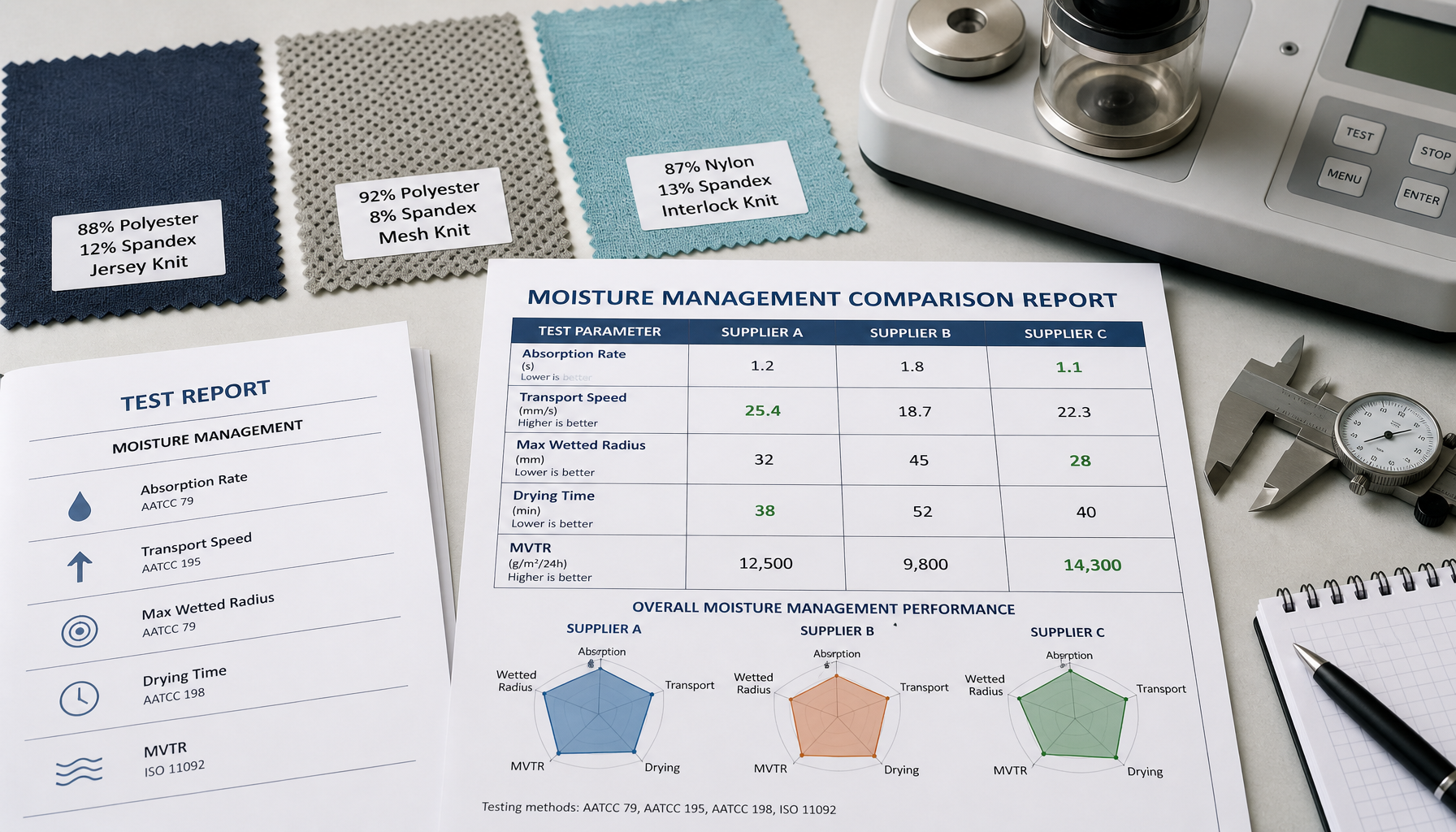
    Buyers can compare moisture-management reports only when the suppliers tested the same property with the same method, specimen orientation, conditioning, liquid volume, and wash state. A wicking result, drying-time result, vapor-transmission result, and composite moisture-management index answer different questions and should not be ranked as if they were one metric.

    Activewear fabric sample prepared for moisture-management testing

    Start with the moisture problem in the garment

    Define where moisture originates and what the fabric must do before requesting reports. A next-to-skin training top may need liquid sweat to leave the skin-side surface and spread across the outer surface for evaporation. A sports-bra cup, yoga-legging waistband, or shapewear control panel may hold more fabric layers against the body, so drying, local saturation, and comfort can differ from a single-layer swatch.

    The supplier brief should state:

    • garment type and fabric location;
    • skin-side and outer-side orientation;
    • expected sweat exposure and climate;
    • single-layer or laminated construction;
    • target fit and working extension;
    • care cycle and number of washes to be evaluated;
    • which performance claim, if any, the final product must support.

    Without this context, a report can be technically complete but irrelevant to the buyer's product.

    Separate the moisture-management metrics

    Reported property What it can indicate What it does not prove by itself
    Wetting time How quickly the test liquid first wets a defined surface Drying speed, directional transport, or comfort during wear
    Absorption rate or capacity How quickly or how much liquid enters the specimen under the stated method Whether moisture moves away from the skin-side surface
    Spreading radius or speed How far and how quickly liquid spreads across a surface Evaporation rate or vapor transfer through the garment
    One-way transport Movement of liquid from one fabric face toward the other under the test setup Performance when the fabric is reversed, stretched, layered, or heavily saturated
    Drying rate or drying time Water loss under stated temperature, humidity, airflow, and starting moisture Initial wetting or directional liquid transport
    Moisture-vapor transmission Passage of water vapor through the specimen under stated conditions Liquid sweat wicking or drying after saturation
    Composite index A calculation combining selected measurements within one test method Direct equivalence to another method, instrument, or wearer-comfort claim

    Check how the report defines every term. Two suppliers may use the same label while reporting different units, endpoints, or calculations.

    Moisture spreading across a performance-knit fabric during evaluation

    Confirm that the reports are actually comparable

    Before placing results side by side, verify the following fields:

    1. test method, revision, and instrument;
    2. specimen identity, composition, knit construction, finished GSM, and color;
    3. fabric face placed against the test liquid or sensor;
    4. specimen dimensions and orientation;
    5. liquid type, volume, temperature, and application procedure;
    6. conditioning temperature and relative humidity;
    7. drying airflow and endpoint, where applicable;
    8. relaxed or extended specimen state;
    9. unwashed, prewashed, or post-wash condition;
    10. number of specimens, individual readings, average, and variation.

    If any of these conditions differ, record the reports as separate evidence rather than declaring one fabric better.

    Review individual readings, not only the average

    A single average can hide unstable performance across the fabric width or between specimens. Ask for the individual results, minimum, maximum, and any excluded reading together with the reason for exclusion.

    Illustrative example — not ClothFactory test data: suppose five drying-time readings are 18, 19, 20, 21, and 32 minutes. The average is:

    (18 + 19 + 20 + 21 + 32) ÷ 5 = 22 minutes

    The 14-minute range between the fastest and slowest readings is commercially important. A report showing only “22 minutes” would hide the 32-minute result and could overstate consistency. The buyer should investigate specimen location, test execution, or fabric variation before setting a bulk tolerance.

    Check whether the result survives laundering

    Moisture behavior may come from fiber properties, yarn geometry, knit structure, a topical finish, or a combination of these factors. The report should identify any finish and state whether the result was measured before or after the buyer's intended care cycle.

    If a finish is optional, do not treat the reported property as standard for every order. Request matched pre-wash and post-wash samples under the same method. A result from one construction, color, or finish should not be transferred to another fabric without verification.

    Compare the finished fabric, not composition alone

    Polyester-spandex and nylon-spandex can both be engineered for activewear moisture requirements. Fiber content does not determine wetting, transport, or drying performance on its own. Yarn cross-section, filament count, knit density, fabric thickness, GSM, heat setting, dyeing, and finishing can change the result.

    Color can also affect heat absorption and finishing conditions, while working extension changes loop openings and thickness. When the garment is close fitting, include the intended stretch state or confirm performance through a garment trial.

    Connect laboratory data to garment verification

    Laboratory reports control material comparison; wearer trials and garment tests confirm product behavior. Use both stages:

    • compare candidate fabrics under one laboratory method and one conditioning plan;
    • make garment samples in the intended size, pattern, seams, lining, and color;
    • evaluate the correct fabric face against the body;
    • check high-sweat zones, layered areas, waistbands, and cups separately;
    • repeat the agreed assessment after laundering;
    • retain the approved fabric and garment references for bulk comparison.

    Do not use an uncontrolled spray, water-drop video, or touch test as the only evidence for a moisture-management claim. These checks can screen samples but do not create comparable supplier data.

    Avoid common report-comparison errors

    • Comparing different properties. Fast wetting is not the same as fast drying or one-way transport.
    • Ignoring fabric orientation. Skin-side and outer-side results can differ.
    • Mixing test methods or units. Identical-looking numbers may come from different calculations.
    • Comparing washed and unwashed samples. Finishing durability changes the commercial conclusion.
    • Using a single reading. One specimen does not show variation across width, rolls, or dye lots.
    • Assuming composition guarantees performance. Construction and finishing remain material variables.
    • Treating laboratory data as a comfort guarantee. Garment fit, layering, climate, and wearer activity affect the final experience.

    Build a report request suppliers can answer consistently

    Send every supplier the same document listing the end use, fabric face, finished GSM and width, target color, test property, method, conditioning, wash cycle, specimen count, required raw readings, and acceptance rule. Request the fabric code and dye-lot identity on both the report and physical sample.

    ClothFactory can use that brief to compare nylon-spandex or polyester-spandex candidates under matched conditions. Bulk approval should remain tied to the agreed method, post-wash requirement, production finish, and garment verification rather than to a standalone “moisture-wicking” label.

  • Which Is More Comfortable in Pants: Cotton or Polyester?

    Which Is More Comfortable in Pants: Cotton or Polyester?


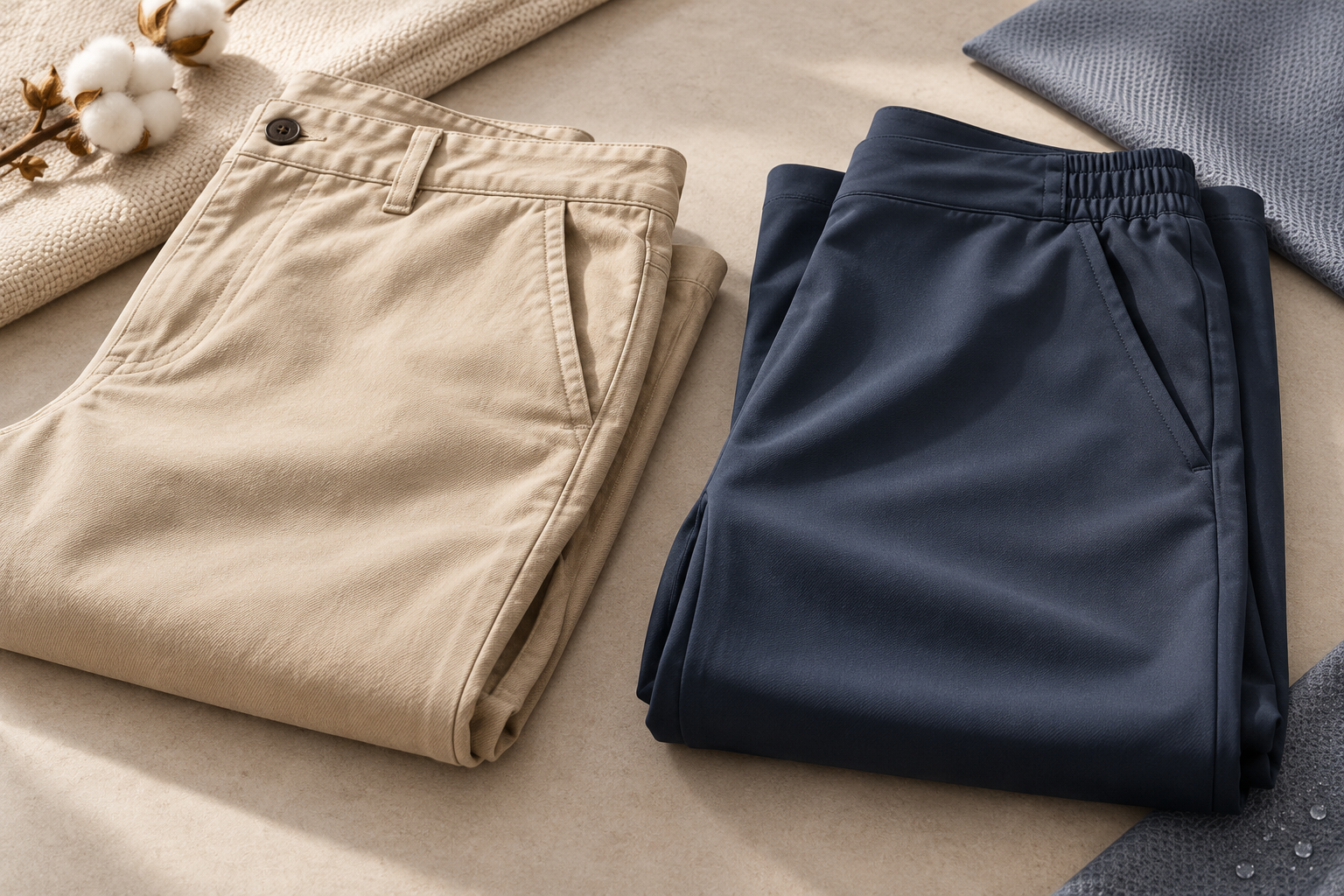
    For relaxed everyday pants in mild or warm weather, many people find cotton more comfortable because it usually feels soft, breathable, and natural against the skin. For workout pants, travel pants, rain-prone conditions, or cold-weather activewear, polyester can be more comfortable because it can dry faster, hold its shape better, and work well in stretch or brushed constructions.

    So the practical answer is: cotton often wins for dry, low-intensity comfort, while polyester often wins when sweat, weather, stretch, or repeated wear matters. The fiber name alone does not decide comfort. Knit or woven structure, fabric weight, fit, finishing, and garment design can change the result substantially.

    Why cotton pants often feel more comfortable

    Cotton is a common choice for chinos, joggers, lounge pants, and casual trousers because it can offer a familiar, soft hand. It also absorbs moisture, which may feel comfortable when perspiration is light and the fabric remains relatively dry.

    Cotton may be the better starting point when the wearer wants:

    • a natural hand feel;
    • comfortable casual or office wear;
    • low static buildup;
    • softness for lounging or low-intensity activity;
    • a fabric that does not feel slick or technical.

    However, absorption is not the same as moisture management. Once cotton becomes wet, it may retain water, feel heavier, dry slowly, and cling to the body. A heavy cotton sweatpant can also feel too warm in humid weather. Repeated wear may lead to knee bagging or dimensional change unless the yarn, construction, finishing, and garment care are properly controlled.

    Why polyester pants can be more comfortable

    Polyester absorbs much less moisture into the fiber than cotton. In a suitably engineered fabric, that can support faster drying and a lighter feel during activity. Polyester also tends to offer good dimensional stability and abrasion resistance, which is useful for training pants, travel pants, uniforms, and outdoor trousers.

    Polyester may be more comfortable when the wearer needs:

    • quicker drying after sweat or washing;
    • better shape retention at the knees and seat;
    • a lightweight performance construction;
    • a brushed or fleece interior for cold weather;
    • durability for frequent wear and laundering;
    • stretch when polyester is combined with spandex.

    Polyester is not automatically cool, breathable, or moisture-wicking. A dense polyester fabric can trap heat, and an unsuitable surface or finish may feel less pleasant against the skin. Odor retention, static, and pilling should also be evaluated on the finished fabric rather than predicted from the fiber label.

    Cotton versus polyester for different pants

    Pants type or use More likely comfort starting point Reason What to verify
    Casual chinos or everyday trousers Cotton or cotton-rich blend Natural hand and familiar dry comfort Wrinkling, shrinkage, knee recovery, and colorfastness
    Lounge pants Cotton for a soft casual feel; brushed polyester for warmth Comfort depends on season and desired surface Fabric weight, interior hand, airflow, and wash stability
    Running or gym pants Polyester-rich performance fabric Lower water uptake and potential for faster drying Wicking, drying rate, stretch, recovery, and chafe points
    Travel pants Polyester or a polyester blend Shape retention, durability, and easier drying Breathability, odor behavior, static, and pocket or seam comfort
    Cold-weather leggings or training pants Brushed or bonded synthetic construction Insulation, stretch, and weather-oriented layering Thermal comfort, bulk, breathability, pilling, and seam performance
    Hot and humid casual wear Lightweight cotton or an engineered synthetic Cotton may feel natural; synthetics may dry faster Air permeability, drying, cling, transparency, and garment fit

    This is why a buyer should not ask only, “Is it cotton or polyester?” A more useful question is, “How should these pants feel and perform during their actual use?”

    Fabric construction matters as much as fiber

    Two fabrics with the same polyester content can feel completely different. A lightweight jersey, dense double-knit, brushed fleece, and bonded composite do not provide the same airflow, drape, warmth, or skin contact. The same is true for cotton twill, cotton jersey, and cotton fleece.

    When comparing samples, keep the following variables visible:

    • finished fabric weight in GSM;
    • knit or woven construction;
    • thickness and usable width;
    • face and back surface;
    • stretch force and recovery in both directions;
    • air permeability and drying behavior;
    • dimensional stability after the intended wash cycle;
    • pilling, abrasion, snagging, and colorfastness;
    • waistband, pocket, seam, and lining construction.

    A soft hand evaluation should use an approved reference sample and consistent conditions. Terms such as “buttery,” “breathable,” or “quick-dry” are not complete acceptance criteria without a test method or comparison standard.

    Are there suitable ClothFactory products?

    Yes, for a specific part of this question: cold-weather stretch pants and leggings that use polyester on the inner layer. ClothFactory's current catalog is focused on nylon-spandex and polyester-backed performance knits rather than conventional cotton trouser fabrics, so it would not be accurate to present these products as direct cotton replacements for chinos or casual woven pants.

    Two relevant options are:

    • H3231 Shark-Skin Composite Polar Fleece: a 430 GSM bonded construction with an 80% nylon/20% spandex face and a 95% polyester/5% spandex back. It is positioned for winter compression gear, thermal outdoor leggings, and extreme-cold athleisure.
    • H2872 Shark-Skin Composite Brushed: a 370 GSM bonded construction with the same stated face and back compositions, positioned for mid-winter performance wear and outdoor training gear.

    These are not pure-polyester fabrics. Their comfort proposition comes from the full composite: a stretch nylon-spandex face combined with a polyester-spandex thermal back. They are candidates when warmth, stretch, coverage, and shape retention matter more than the natural hand associated with cotton.

    Both styles are heavyweight development options with a listed 1,000 kg MOQ. Before selection, buyers should confirm whether the garment really needs a bonded fabric of this weight and should test breathability, thermal comfort, stretch recovery, pilling, seam bulk, wash stability, and performance at the intended activity level.

    For lightweight casual pants, ClothFactory's present catalog does not show a direct cotton-versus-polyester trouser fabric that should be recommended without further development. A buyer with that requirement should provide a reference swatch and a measurable brief rather than select from composition alone.

    How brands should compare comfort before ordering

    Start with two or more finished samples that are realistic for the same pants design. Comparing a lightweight cotton twill with a heavy polyester fleece would reveal more about weight and construction than about the fibers themselves.

    Use the same garment pattern or comparable test panels, then assess:

    1. Dry hand and next-to-skin feel. Check softness, surface friction, stiffness, and any irritation at seams or the waistband.
    2. Heat and moisture comfort. Evaluate the fabric during the intended activity and climate, not only on a table.
    3. Wet comfort and drying. Record water pickup, cling, drying time, and whether the surface remains comfortable after perspiration.
    4. Movement and recovery. Check extension at the knee, hip, and seat, then measure residual growth after wear and laundering.
    5. Garment weight and bulk. Include pockets, waistband, lining, bonding, and seams rather than judging fabric GSM alone.
    6. Care durability. Reassess dimensions, surface, hand, pilling, and stretch after the planned wash cycles.

    The most comfortable sample is the one that remains acceptable through the wear conditions that matter to the customer—not simply the one that feels softest during the first hand touch.

    Bottom line

    Choose cotton when the priority is soft, natural-feeling comfort for dry, casual wear. Choose polyester when the priority is quicker drying, shape retention, durability, or engineered warmth. For many pants, a blend or layered construction can balance these needs better than either fiber alone.

    For cold-weather performance leggings or training pants, H3231 and H2872 are relevant ClothFactory candidates because their polyester-spandex backs are designed as part of a thermal composite. For ordinary cotton-style casual trousers, the current catalog does not provide a direct equivalent, so development should begin with the intended garment, reference fabric, target GSM, hand feel, stretch, and care requirements.

  • How Should Buyers Define Fabric Requirements for Golf Shirts?

    How Should Buyers Define Fabric Requirements for Golf Shirts?


    Buyers should define golf-shirt fabric by garment use, knit construction, finished GSM and usable width, stretch and recovery, moisture and air behavior, color durability, and compatibility with the collar, placket, and decoration. Fiber composition alone is not a specification; every claimed function and critical production property needs an agreed sample or test condition.

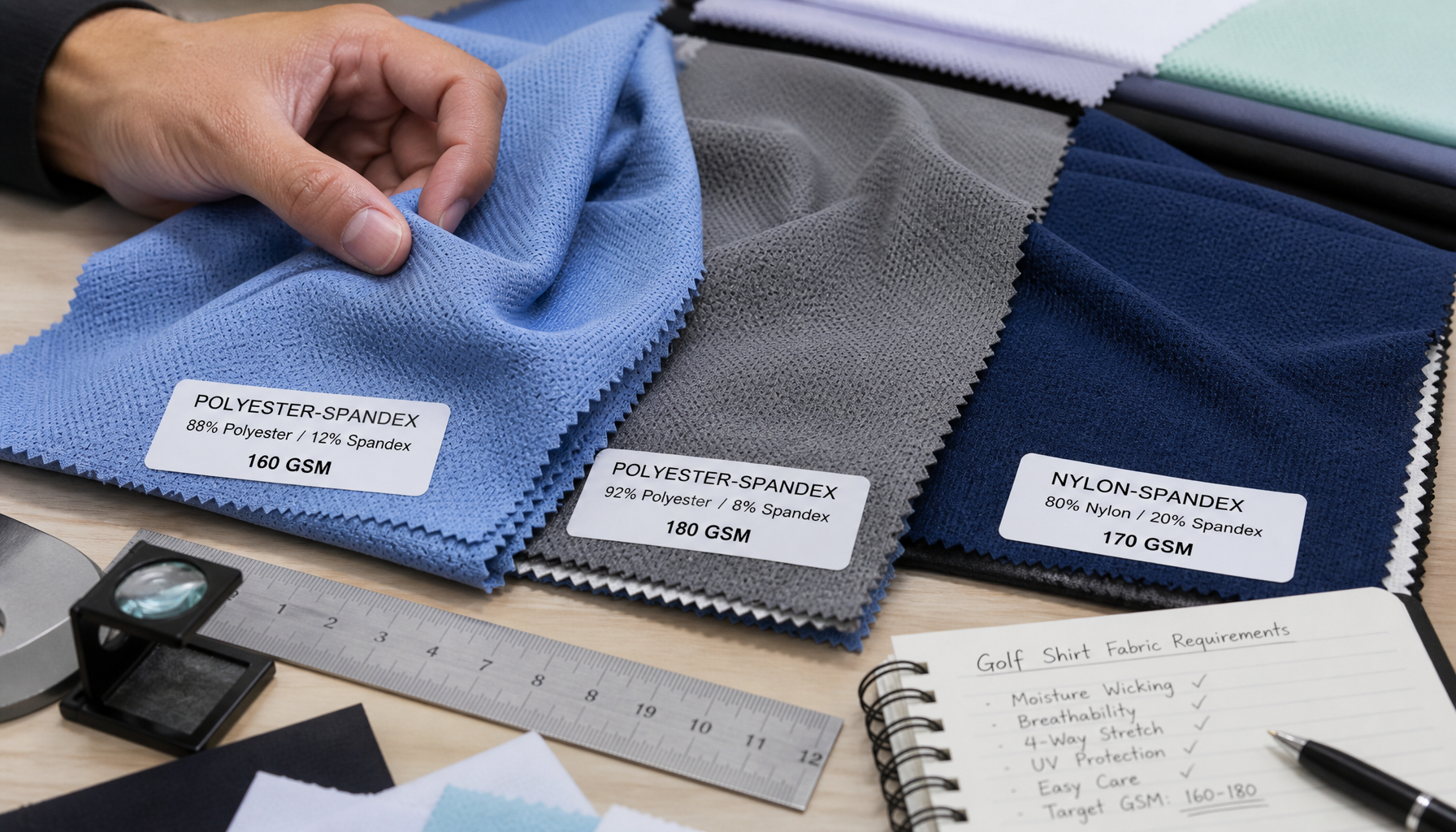
    Knitted fabric sample selected for golf-shirt development

    Start with the golf-shirt use case

    A golf shirt for hot-weather walking, a club uniform, and a premium leisure polo may use different fabrics even when all are described as polyester-spandex or nylon-spandex. Define the wearing environment and commercial position before asking for swatches.

    The initial brief should state:

    • climate, season, and expected activity level;
    • men's, women's, or unisex fit and size range;
    • relaxed, regular, or close fit;
    • short or long sleeve;
    • target drape, texture, and hand feel;
    • collar and cuff construction;
    • embroidery, heat transfer, print, or other decoration;
    • care label and intended product claims.

    This information tells the supplier which properties require development and which existing fabrics are relevant.

    Select knit structure before fine-tuning GSM

    Knit structure affects appearance, airflow, stability, stretch, snagging, and compatibility with a collar and placket. Buyers should request the exact construction rather than use “polo fabric” as the complete description.

    Knit option Why a buyer may consider it What requires confirmation
    Piqué or another textured knit Recognizable polo appearance and surface texture Snagging, pilling, drape, print quality, and edge stability
    Interlock Smooth surface, coverage, and dimensional stability in some constructions Weight, heat retention, stretch recovery, and placket bulk
    Single jersey Lower bulk and fluid drape in some constructions Curling, spirality, coverage, and seam stability
    Engineered mesh or jacquard Zoned appearance or airflow without a separate panel Pattern repeat, usable width, snagging, placement, and bulk consistency

    These are development directions, not guaranteed outcomes. Yarn selection, density, dyeing, heat setting, and finishing can change the behavior of the same structural category.

    Textured performance knit assessed for a golf-shirt body panel

    Use GSM to manage garment weight and drape

    GSM measures fabric mass per square meter. It helps estimate garment weight, but it does not independently establish thickness, breathability, durability, or moisture performance.

    Illustrative calculation — not ClothFactory product data: assume the net main-fabric pattern area for one golf shirt is 1.10 m². At 160 gsm:

    1.10 m² × 160 g/m² = 176 g

    At 200 gsm, the same area contributes approximately 220 g, an increase of 44 g before the collar, cuffs, thread, buttons, labels, and cutting waste. The brand should decide whether the extra mass improves the intended drape and coverage enough to justify the change.

    Specify finished GSM with an agreed tolerance and test state. A greige value or one specimen does not define the dyed bulk fabric.

    Define stretch around the golf swing

    Stretch should support movement at the shoulder, upper back, sleeve, and torso without leaving permanent growth. State the required direction, extension, hold time, recovery time, and post-wash condition. Four-way stretch should not be used as a substitute for numerical or reference-based requirements.

    The collar, placket, embroidery, and shoulder seams can restrict a stretch body fabric. Make a garment sample using the intended trims and construction, then check:

    • reach and rotation during the swing;
    • placket distortion or gaping;
    • sleeve and armhole mobility;
    • shoulder-seam recovery;
    • hem growth and garment twist;
    • appearance after laundering and relaxation.

    Separate moisture, drying, airflow, and UV claims

    Moisture wicking, drying rate, air permeability, and UV protection are different properties. Select only the tests relevant to the product brief and use the applicable method and target-market claim rules.

    For a hot-weather golf shirt, a buyer may compare:

    • liquid spreading or directional transport on the correct fabric face;
    • drying under defined temperature, humidity, airflow, and starting moisture;
    • air permeability of the finished construction;
    • wet and dry hand feel through garment trials;
    • UPF under the required color, stretch, wet, and care conditions if a sun-protection claim is planned.

    An optional topical finish should be identified separately and checked after the agreed wash sequence. Do not assume every color or order includes the same finish.

    Protect the collar, placket, and decorated areas

    The golf-shirt body fabric must work with the collar, cuff, placket reinforcement, buttons, and decoration. A lightweight or highly elastic body can distort when paired with a rigid placket or dense embroidery.

    Request sewing and decoration trials using production-representative materials. Review puckering, needle damage, seam growth, print or transfer appearance, embroidery support, and shade compatibility between body fabric and rib or collar components.

    If the collar uses a separate knit, specify its composition, GSM, dimensions, stretch, recovery, shrinkage, and color standard independently. Matching color before laundering does not prove that the body and collar will age at the same rate.

    Define durability and color requirements from use

    Select tests according to the actual garment risks:

    • dimensional stability and spirality after the care procedure;
    • pilling, snagging, and abrasion for the chosen surface;
    • fabric-appropriate strength and seam performance;
    • colorfastness to laundering, perspiration, rubbing, water, and light where relevant;
    • shade continuity within and between rolls;
    • appearance and recovery after repeated care cycles.

    The specification should identify the method, condition, tolerance, and failure action. “Good colorfastness” or “anti-pilling” is not an acceptance criterion.

    Build a supplier-ready requirement sheet

    Specification area Information to provide or confirm
    End use Climate, activity, fit, season, price position, and target customer
    Construction Knit type, fabric face, composition, finished GSM, usable width, and finish
    Movement Stretch and recovery by direction, garment zones, and post-wash requirement
    Comfort Hand reference, airflow, moisture behavior, drying, and garment weight
    Appearance Texture, drape, coverage, color, and shade tolerance
    Assembly Collar, cuff, placket, seams, buttons, embroidery, print, or transfer
    Durability Shrinkage, spirality, pilling, snagging, abrasion, strength, and colorfastness
    Supply control Sample identity, tolerances, roll inspection, lot testing, and change approval

    Attach a sketch, preliminary pattern or garment reference, color standard, care label, and any test requirements. Ask the supplier to mark which items are confirmed, which require sampling, and which are not available for the proposed construction.

    Avoid common sourcing mistakes

    • Specifying only composition and GSM. These values do not define structure, recovery, hand, or durability.
    • Choosing the body fabric without the collar and placket. Component mismatch can distort the garment.
    • Using “breathable” or “quick dry” without a method. Different tests answer different questions.
    • Approving stretch by hand. Record direction, extension, recovery, and wash state.
    • Testing one color for the full range. Dyeing and shade depth can change hand and performance.
    • Ignoring decoration trials. Embroidery and transfers may alter stretch, drape, or appearance.
    • Leaving usable width open. Marker yield and consumption depend on the cuttable width.

    Procurement next step

    Send the supplier a one-page brief covering the golf-shirt use case, fit, knit structure, composition, finished GSM, usable width, hand, stretch, color, collar and placket, decoration, care cycle, and required tests. Request identified swatches and a garment trial before approving bulk production.

    ClothFactory can use that brief to compare an existing nylon-spandex or polyester-spandex construction with a development option. Final approval should remain tied to the finished fabric specification, production-representative garment sample, and agreed test conditions.

  • What Risks Should Buyers Review When Assessing the Minimum Order Quantity Policy?

    What Risks Should Buyers Review When Assessing the Minimum Order Quantity Policy?


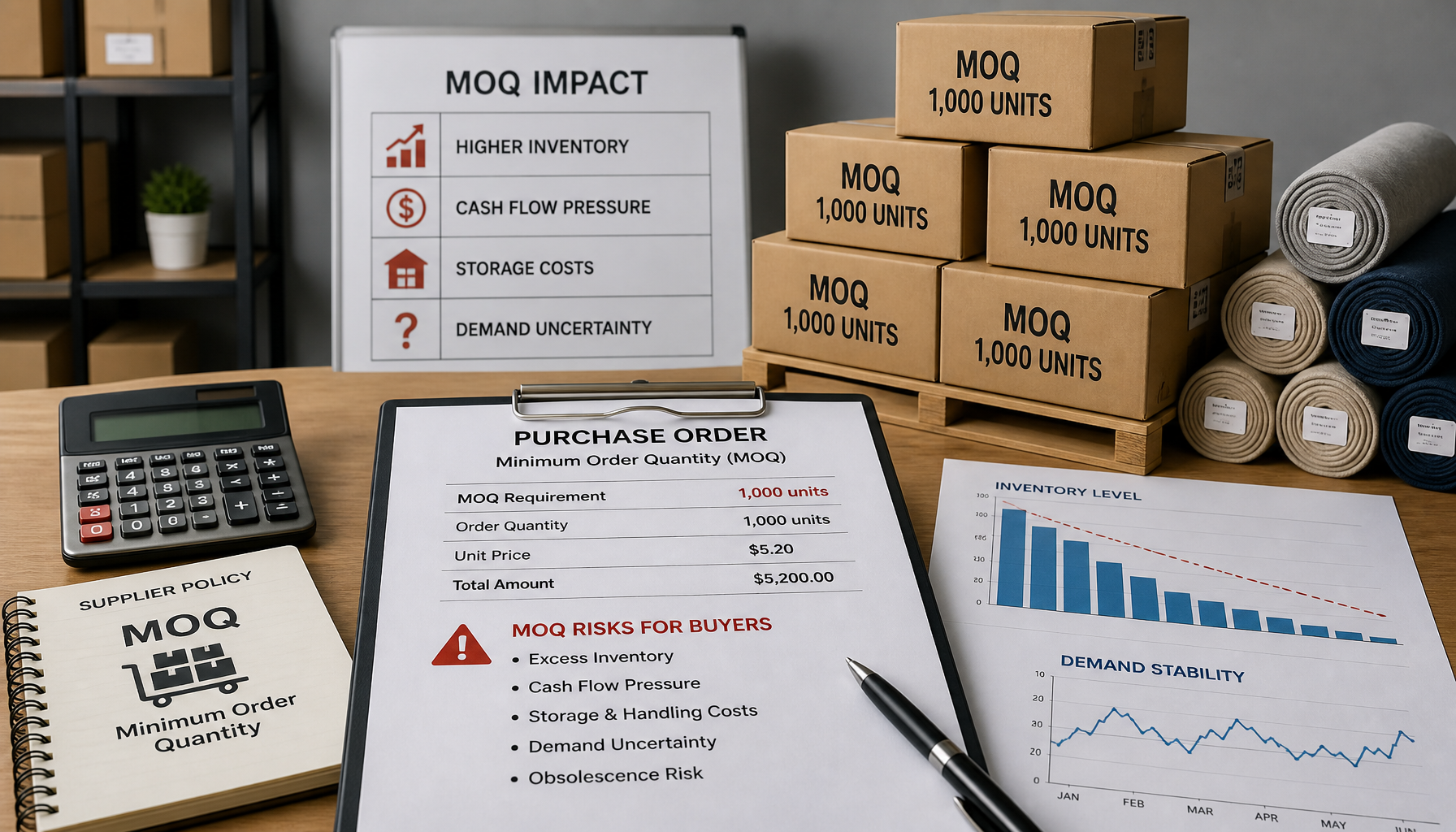
    Before accepting a fabric MOQ, buyers should verify what the minimum applies to, how much usable garment output it creates, and which costs remain at risk if demand changes or the fabric fails approval. The policy should identify the unit, construction, color, finish, tolerance, delivery arrangement, and payment commitment rather than state only one minimum number.

    Fabric rolls representing a minimum-order commitment

    Confirm what the MOQ actually covers

    An MOQ may apply per fabric construction, color, finish, print design, dye lot, production run, or purchase order. It may be quoted in kilograms, linear meters, yards, rolls, or another unit. These bases are not interchangeable.

    Before comparing suppliers, ask:

    • Is the MOQ per color or for the complete order?
    • Does it apply to greige material, finished fabric, or shipped quantity?
    • Are width, GSM, composition, or finish changes treated as separate constructions?
    • Is the quantity measured by ordered, produced, inspected, or usable material?
    • What overproduction or under-delivery tolerance is permitted?
    • Are sampling, lab dips, strike-offs, setup charges, and freight separate?
    • Does a repeat order use the same minimum, or must it be reconfirmed?

    A low headline MOQ may still create a large commitment when it applies separately to every color or specification.

    Convert kilograms and meters using the real specification

    Buyers should not rely on a fixed conversion between kilograms and linear meters. The relationship depends on finished GSM and usable width:

    Approximate kg = linear meters × usable width (m) × finished GSM ÷ 1,000

    Illustrative calculation — not a ClothFactory MOQ or production result: assume 600 m of finished fabric, 1.5 m usable width, and 200 gsm:

    600 m × 1.5 m × 200 g/m² ÷ 1,000 = 180 kg

    If width or GSM changes, the kilogram requirement changes even when the linear meters remain the same. Confirm whether commercial settlement uses actual delivered weight, invoiced meters, or another agreed basis.

    Calculate usable garment output, not only ordered quantity

    MOQ risk depends on how many saleable garments the fabric can produce. Include marker consumption, size mix, cutting loss, inspection defects, shade segregation, testing allowance, and replacement material.

    Hypothetical planning example: if an order contains 600 usable meters, theoretical consumption is 0.80 m per garment, and the buyer assumes a 92% usable yield:

    600 m ÷ 0.80 m × 92% = 690 garments

    This is a planning example, not a universal yield or ClothFactory output. The actual result must use the approved marker, usable width, defect map, size ratio, and production allowance.

    Fabric inventory being evaluated against planned garment demand

    Review the main commercial risks

    Risk What can go wrong What buyers should confirm
    Demand risk Forecast demand is lower than the garment output created by the MOQ Launch quantity, replenishment plan, season length, and exit route for unused fabric
    Cash-flow risk Deposit and balance payments are committed before garment sales Payment schedule, approval gates, cancellation terms, and working-capital impact
    Color fragmentation Each color carries a separate MOQ, multiplying inventory MOQ basis per color, permitted color grouping, and whether repeat shades can be reordered
    Specification fragmentation Small changes in GSM, width, composition, finish, or print create separate minimums Which changes require a new production run or setup charge
    Approval risk Material is produced before color, hand, print, or performance is approved Lab-dip, strike-off, development-sample, testing, and written bulk-release sequence
    Yield risk Ordered meters do not equal usable garment output Usable width, roll length, defect allowance, shade grouping, and over/under-delivery tolerance
    Obsolescence risk Custom color or finish cannot be redirected to another style or season Compatibility with future styles, storage conditions, and ownership of unused material
    Supply risk A low MOQ is accepted, but repeat availability is uncertain Repeat-order policy, raw-material continuity, lead-time confirmation, and lot-to-lot controls

    Separate sampling quantity from bulk MOQ

    Sample yardage, lab dips, print strike-offs, and development lots serve approval decisions; they should not be assumed to follow the same quantity or pricing as bulk production. Confirm which samples are available, what each sample proves, and whether sample or setup charges are credited to the bulk order.

    Do not approve a bulk MOQ merely because a small swatch looks acceptable. The approval plan may need to cover color, hand, finished GSM, width, stretch and recovery, dimensional stability, colorfastness, surface durability, and any claimed functional finish.

    Link payment to approval and production events

    The quotation or purchase agreement should state:

    1. what payment reserves or purchases;
    2. whether raw materials are committed before lab-dip or sample approval;
    3. which approval authorizes dyeing, finishing, printing, or bulk production;
    4. whether setup and development charges are refundable or creditable;
    5. what happens after buyer-requested specification changes;
    6. how rejected material, short delivery, excess production, or delayed approval is handled;
    7. when ownership and storage responsibility transfer to the buyer.

    An MOQ does not by itself guarantee refund rights, production priority, repeat availability, or acceptance of unused material. Those outcomes require written commercial terms.

    Check whether customization increases commitment

    Custom dyeing, printing, brushing, moisture-management finishing, or other treatments can reduce the supplier's ability to redirect unused material. The buyer should confirm whether each treatment creates its own MOQ, setup charge, color minimum, or lead-time condition.

    Optional finishing should not be treated as a standard property of every fabric. Approve the finished sample and define the performance requirement before allowing the customization to proceed across the MOQ.

    Compare total qualified cost instead of unit price

    The lowest fabric price per kilogram or meter may not produce the lowest qualified garment cost. Compare:

    • material price and setup charges;
    • testing, sampling, courier, and inspection costs;
    • marker consumption and usable-width efficiency;
    • expected cutting loss and defect allowance;
    • financing and storage cost;
    • risk of markdown, redesign, or unused stock;
    • cost of replacement if a lot fails the agreed specification.

    This comparison helps explain why accepting a higher unit price at a more suitable commitment can be commercially safer than purchasing excess material at a lower price.

    Questions to resolve before accepting the MOQ

    • What exact fabric code, construction, color, finish, width, and GSM does the MOQ cover?
    • What quantity unit appears on the purchase order and invoice?
    • What production tolerance may be shipped and billed?
    • How are unusable defects, shade groups, and short rolls treated?
    • Which approvals must be completed before production starts?
    • Can delivery be split, and who owns undelivered material?
    • Are repeat orders subject to new raw-material or color confirmation?
    • Which changes trigger a new MOQ or setup cost?
    • What records will connect the bulk rolls to the approved sample?

    Procurement next step

    Convert the quoted MOQ into kilograms, usable meters, estimated garment output, color-level inventory, and committed cash before approving it. Send the supplier a written specification and approval schedule, then record the quantity basis, tolerance, payment events, and treatment of excess or rejected material in the purchase agreement. ClothFactory can confirm the applicable MOQ for a selected nylon-spandex or polyester-spandex construction only after the color, finish, width, GSM, and development scope are defined.

  • Why H2894 Matte Nylon Spandex Fabric Is the Ideal Choice for Premium Yoga Leggings, Athleisure Tops, and High-End Activewear Collections

    Why H2894 Matte Nylon Spandex Fabric Is the Ideal Choice for Premium Yoga Leggings, Athleisure Tops, and High-End Activewear Collections

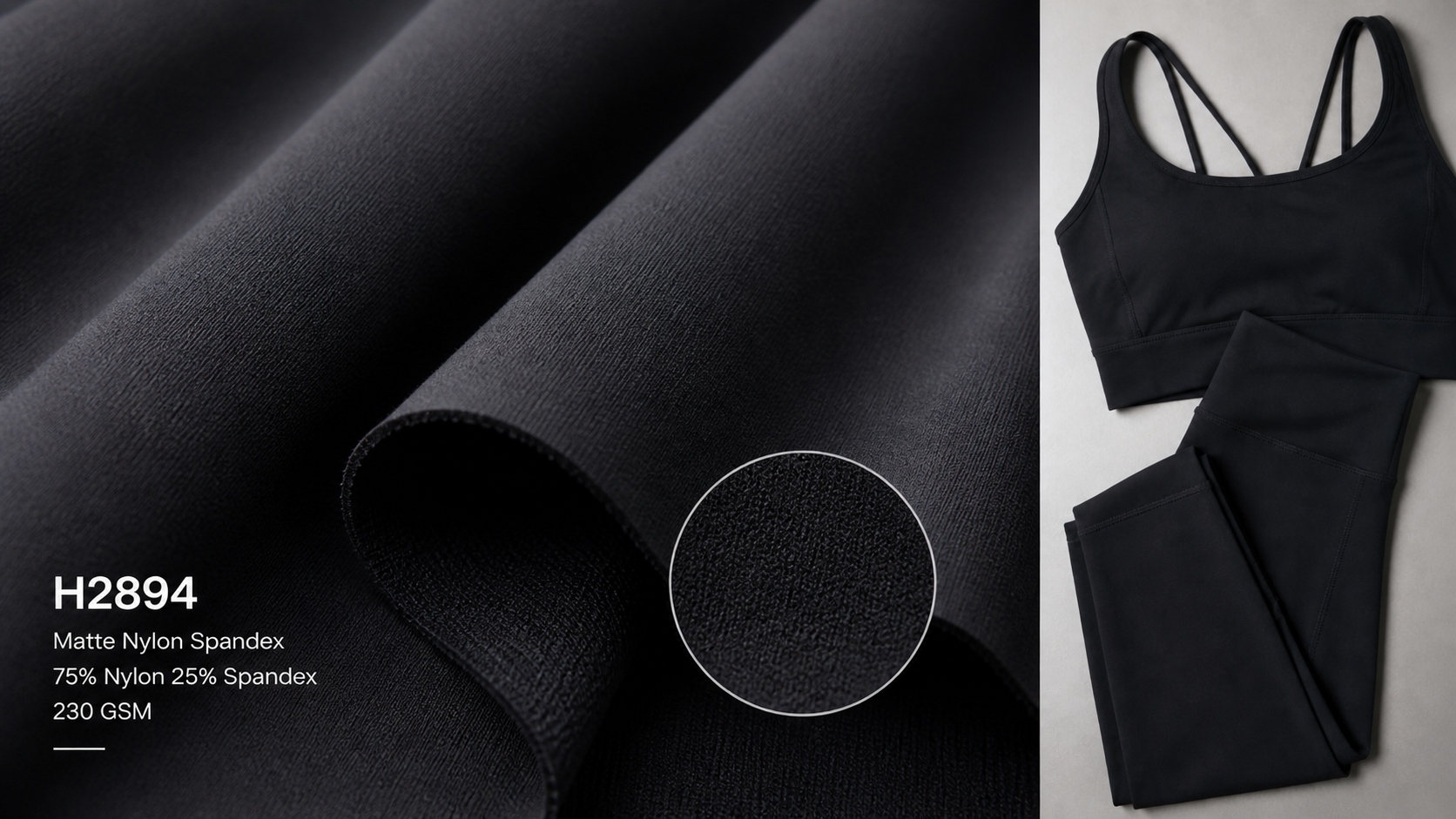
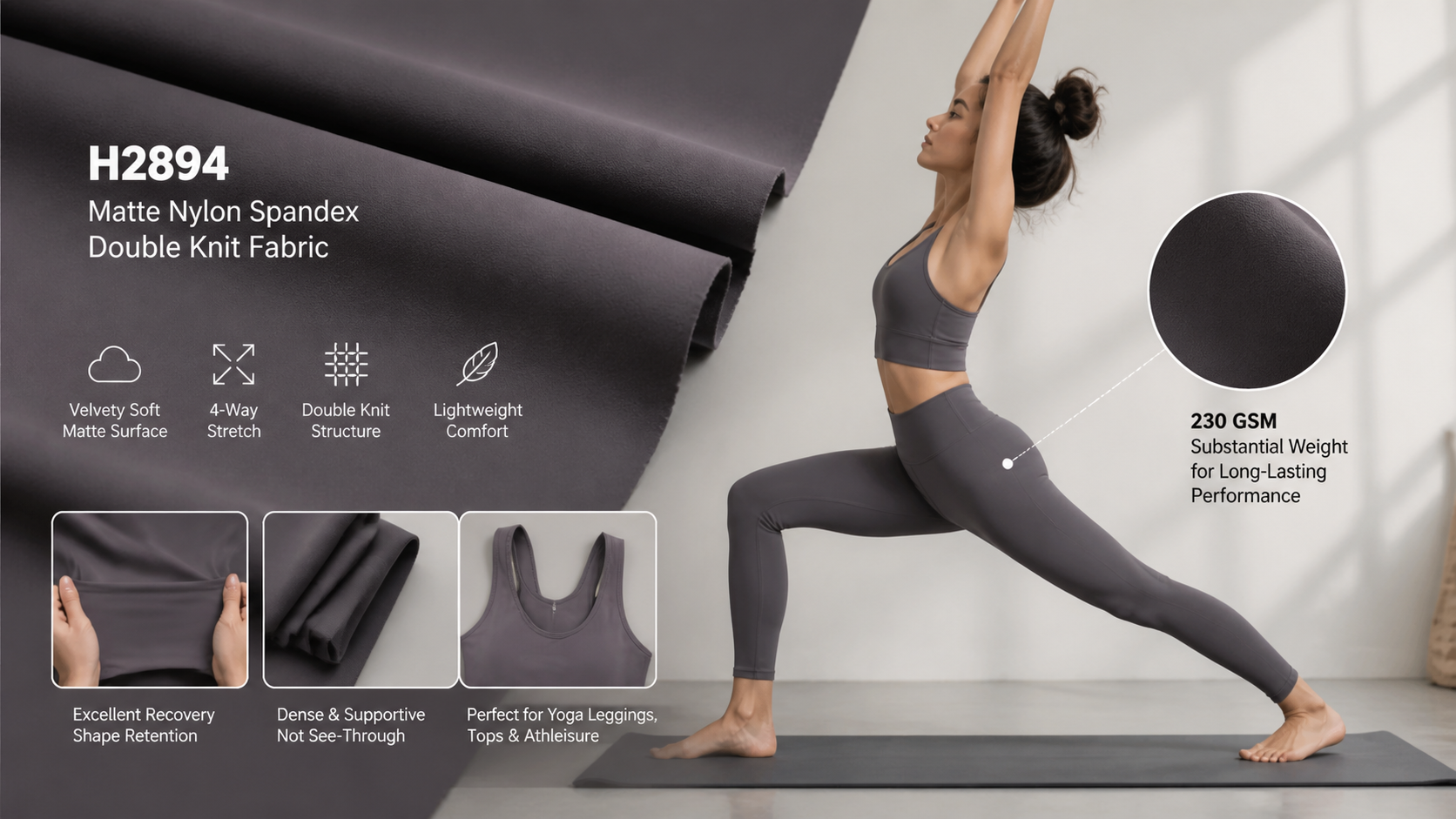
    H2894 is a candidate for matte, close-fitting activewear, not a substitute for garment testing. ClothFactory’s catalogue lists a double-knit construction at 75% nylon, 25% spandex, 230 g/m² and 165 cm width. These are nominal catalogue specifications; a purchase order needs an agreed technical sheet, tolerances and an approved sample revision. The buying decision is whether the fabric delivers the required coverage, support and appearance in the intended pattern.

    Start with the garment, not the spandex percentage

    A fitted yoga legging and a relaxed athleisure top place different demands on the same fabric. A legging stretches across the seat and knee, where loop opening can expose underwear contrast. A top may remain relatively unstretched but show seam ridges, cling or excessive weight. Approving H2894 for one style does not approve it for the whole collection.

    Spandex content describes composition, not compression pressure or recovery after repeated wear. Two fabrics with the same percentage can require different forces to reach the same extension because yarn specification, stitch geometry and finishing differ. Ask for lengthwise and widthwise force-extension data, residual extension after recovery, and the test conditions. ISO 20932-1 provides strip-test methods for fabric elasticity; the buyer must still define the garment-relevant acceptance criteria.

    Separate a matte appearance from squat coverage

    A low-lustre surface can support a restrained visual finish, but it does not establish opacity. Evaluate each production colour at the extension created by the actual garment, with agreed lighting, backing contrast and viewing positions. Include the lightest colourway and the most highly strained fit in the size range rather than approving every colour from a black swatch.

    For an illustrative fit calculation, a fabric panel measuring 80 cm around a body circumference of 100 cm has 20% negative ease relative to the body, but must extend 25% relative to its own relaxed length: (100 − 80) ÷ 80 × 100. That distinction matters when specifying a stretched coverage assessment. A finished garment distributes strain unevenly, so the calculation is a starting point, not a replacement for a squat and movement trial.

    Matte activewear concept with H2894 fabric swatches and a yoga outfit
    Application illustration only. Depicted coverage and performance claims are not production-lot test results.

    Approve the surface and the assembly together

    Compare face and reverse against a retained standard before and after the intended care sequence. Brushing, friction from a bag strap and repeated contact at the inner thigh can change appearance without causing a hole. Specify an appropriate pilling or abrasion assessment and inspect shade, surface fuzz and seam visibility on the finished sample.

    Run a sewing trial with the intended seam type, thread and machine settings. Record the needle system and size, stitch density, feed settings and any heat-transfer conditions that produced an acceptable result. A universal needle number or fixed stitch length is not a reliable production instruction. Check skipped stitches, needle damage, seam extension and seam recovery after laundering; a fabric that stretches well can still fail as an assembled garment.

    Translate the quoted price into usable garment cost

    At the nominal 230 g/m² and 1.65 m full width, theoretical mass is 230 × 1.65 ÷ 1,000 = 0.3795 kg per linear metre, or approximately 2.64 m/kg. This is a conversion at the stated dimensions, not guaranteed cutting yield. Confirm whether the quote uses full or usable width and whether edges, defects and relaxation reduce the marker area.

    A lower price per kilogram may lose its advantage if the fabric needs lining, produces fewer panels per marker or requires additional seam correction. Compare qualified alternatives using actual marker consumption and the cost of the approved construction. Do not count the same cutting loss both in marker consumption and in a second waste allowance.

    Set a release gate before committing to bulk

    The approval record should identify the fabric revision, colour, finished weight, minimum usable width, care procedure, elasticity conditions and garment coverage standard. Attach the approved garment and a retained fabric cutting to that record. Agree how a shade, construction or finish change triggers reapproval.

    H2894 belongs on the shortlist when a matte double-knit appearance and close-fitting silhouette match the brief. Hold the order if coverage depends on an untested colour, recovery is described only as “four-way stretch,” or the bulk finish differs from the sample. A premium collection needs repeatable production evidence, not a stronger adjective on the specification sheet.

  • How Can Buyers Compare Supplier Reports for Dimensional Shrinkage?

    How Can Buyers Compare Supplier Reports for Dimensional Shrinkage?

    Compare supplier shrinkage reports only after aligning the specimen identity, washing and drying procedure, cycle count and measurement conditions. Keep lengthwise and widthwise results separate, then translate dimensional change into the finished garment’s measurement requirements. A smaller percentage under a gentler care procedure does not establish a more stable fabric.

    1. Establish whether the reports are comparable

    For nylon-spandex and polyester-spandex knits, request the fabric code, construction, finished GSM, colour, finish revision and production-lot reference. Different compositions can compete for the same garment brief; they do not have to be identical. What matters is testing each candidate against the same intended use and clearly identifying any material differences.

    A report stating only “ISO tested” is incomplete. Three standards address different parts of a dimensional-change assessment:

    • ISO 3759 addresses specimen preparation, marking and measurement.
    • ISO 6330 specifies domestic washing and drying procedures for textile testing.
    • ISO 5077 addresses determination of dimensional change after washing and drying.

    Ask for the applicable edition and exact procedure, including machine type, detergent, load or ballast, drying route, number of complete cycles, conditioning and any deviations. A wash-temperature label alone does not define an equivalent test.

    Comparison trap: a hypothetical result of −1% after one wash followed by flat drying cannot be ranked against −3% after five wash-and-tumble-dry cycles. First retest under the agreed garment care procedure. Neither number establishes which supplier is better.

    2. Read signed dimensional change, not a single “shrinkage” score

    Use a stated calculation convention:

    Dimensional change (%) = (length after treatment − original length) ÷ original length × 100.

    For example, a 500 mm marked distance measuring 480 mm after the specified washing, drying and conditioning sequence changes by −4%. A widthwise distance changing from 500 mm to 505 mm changes by +1%. Negative values indicate contraction and positive values indicate growth under this convention. If a supplier reports shrinkage as a positive number, reconcile the sign convention before comparing results.

    These are calculation examples, not ClothFactory test results. Do not average the two directions: length loss and width growth create different fit and cutting risks. Also distinguish dimensional change from elastic recovery and seam spirality; a passing result for one does not establish the others.

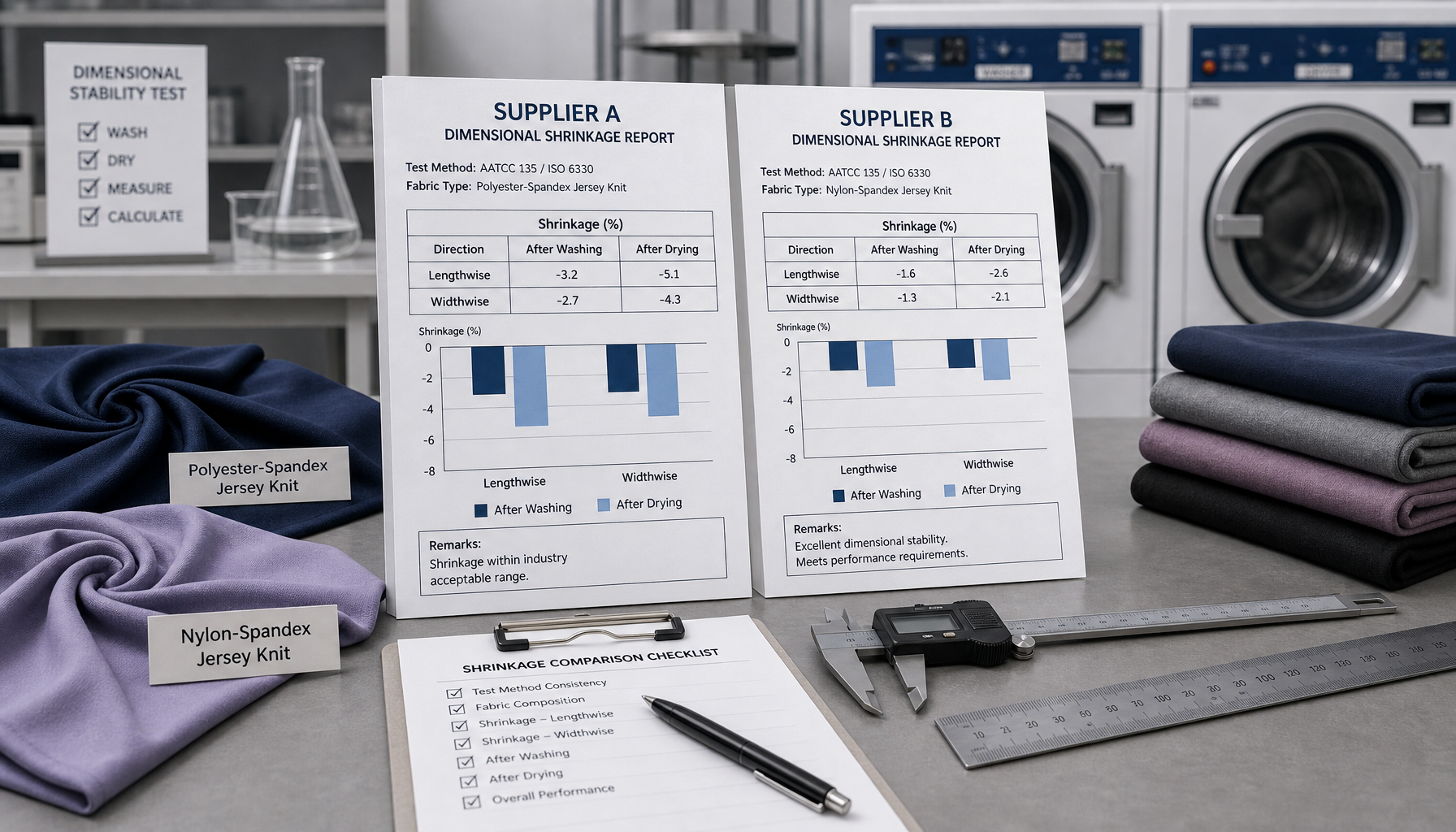
    Illustration of two supplier shrinkage reports beside knit swatches and measuring tools
    Illustration only. The pictured figures and acceptance comments are not verified supplier results or universal quality limits.

    3. Translate the result into a garment and cost decision

    Consider a hypothetical yoga-legging brief requiring an 80 cm inseam after the agreed care sequence, with an allowed range of 79–81 cm. If a trial garment measures 80 cm before care and that measurement contracts by 4%, its post-care inseam becomes 76.8 cm. It fails the garment requirement even if a supplier describes 4% fabric shrinkage as acceptable.

    A simple compensation calculation gives 80 ÷ (1 − 0.04) = approximately 83.33 cm before care. That is 4.17% additional length at this measurement, not a proven 4.17% increase in total marker consumption. Fabric-strip behaviour may not transfer directly to a sewn garment, and the waistband, seams, pocketing and other panels can respond differently.

    Use the calculation to frame a trial, not to authorise an automatic pattern enlargement. First establish whether the change is repeatable across relevant samples and production lots. Then compare the cost of a qualified pattern adjustment with a more stable construction or a revised finishing route. Include actual marker yield, additional sampling and rejection exposure; the lower price per kilogram may not produce the lower cost per accepted legging.

    4. Write a bulk-acceptance rule that cannot hide failing material

    Agree directional limits from the approved garment and demonstrated process capability. There is no single commercial shrinkage limit suitable for every stretch knit, garment or care instruction. A test-method reference does not replace the buyer’s acceptance specification.

    • Test scope: define the material state, care procedure, cycle count and reporting directions.
    • Sampling: distinguish the laboratory method’s specimen requirements from the order plan covering selected lots, rolls and locations. MOQ does not determine either count.
    • Decision rule: state whether limits apply to individual results, a specified mean or another agreed statistic. Require traceable readings rather than only a pass stamp.
    • Disposition: define how nonconforming rolls are held, investigated, retested or submitted for an authorised concession.

    For illustration, three lengthwise results of −1%, −2% and −6% have a mean of −3%. If the hypothetical contract requires every result to fall between −3% and +1%, the mean does not rescue the −6% result. Do not silently remove an outlier or keep retesting until a pass appears; follow the agreed investigation rule.

    5. Investigate discrepancies through the production route

    When matched tests disagree, confirm sample identity and laboratory conditions before changing the fabric. Ask the mill to review relevant knitting, dyeing, heat-setting, compaction where used, finishing and relaxation records. Determine whether development yardage and bulk followed the same route and whether reprocessing occurred. These are investigation paths, not proof of a cause.

    A finishing adjustment intended to improve dimensional stability may also change width, GSM, hand or force-extension behaviour. Recheck the affected properties and the sewn garment before accepting the revision. Do not gain a better shrinkage number at the expense of usable width, opacity or recovery.

    6. Keep the approval package traceable

    For a ClothFactory sourcing comparison, submit the garment measurement specification, intended care route, candidate fabric references and complete supplier reports. Record the agreed test conditions, sample and lot IDs, directional limits, retained physical sample and approval owner. Require review when construction or finishing changes. This connects laboratory evidence to a repeatable purchase decision without presenting an unverified report or a hypothetical example as factory performance.

  • Which Fabric Tests Should Brands Request Before Approving Material for Sports Bras?

    Which Fabric Tests Should Brands Request Before Approving Material for Sports Bras?


    Before approving sports-bra fabric, brands should verify fabric identity, load at the intended extension, stretch recovery, dimensional stability, bursting resistance, surface durability, colorfastness, and any claimed moisture performance. The test plan must state the method, direction, conditioning, wash history, and acceptance limit; a generic result such as “good stretch” cannot support a bulk decision.

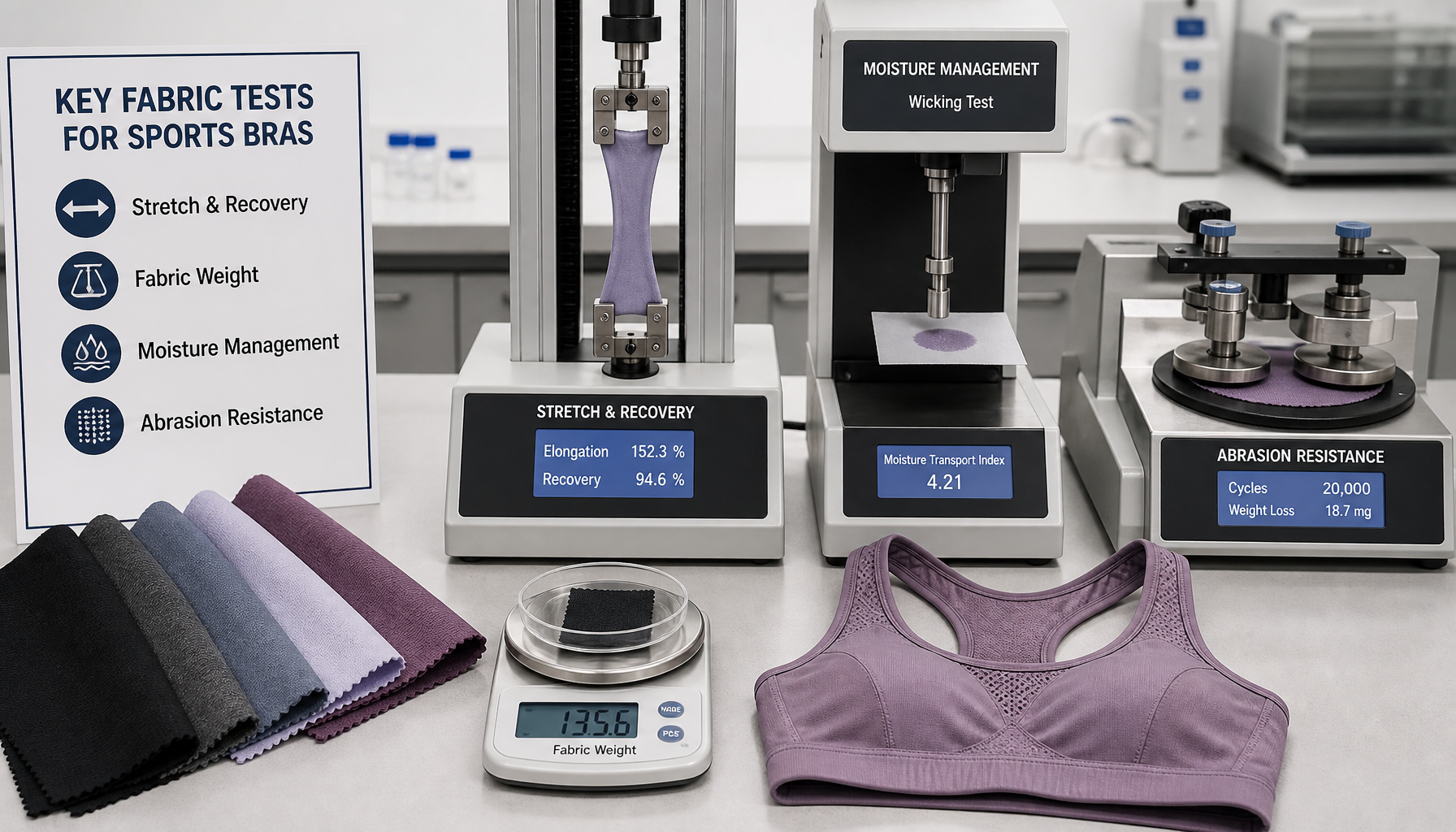
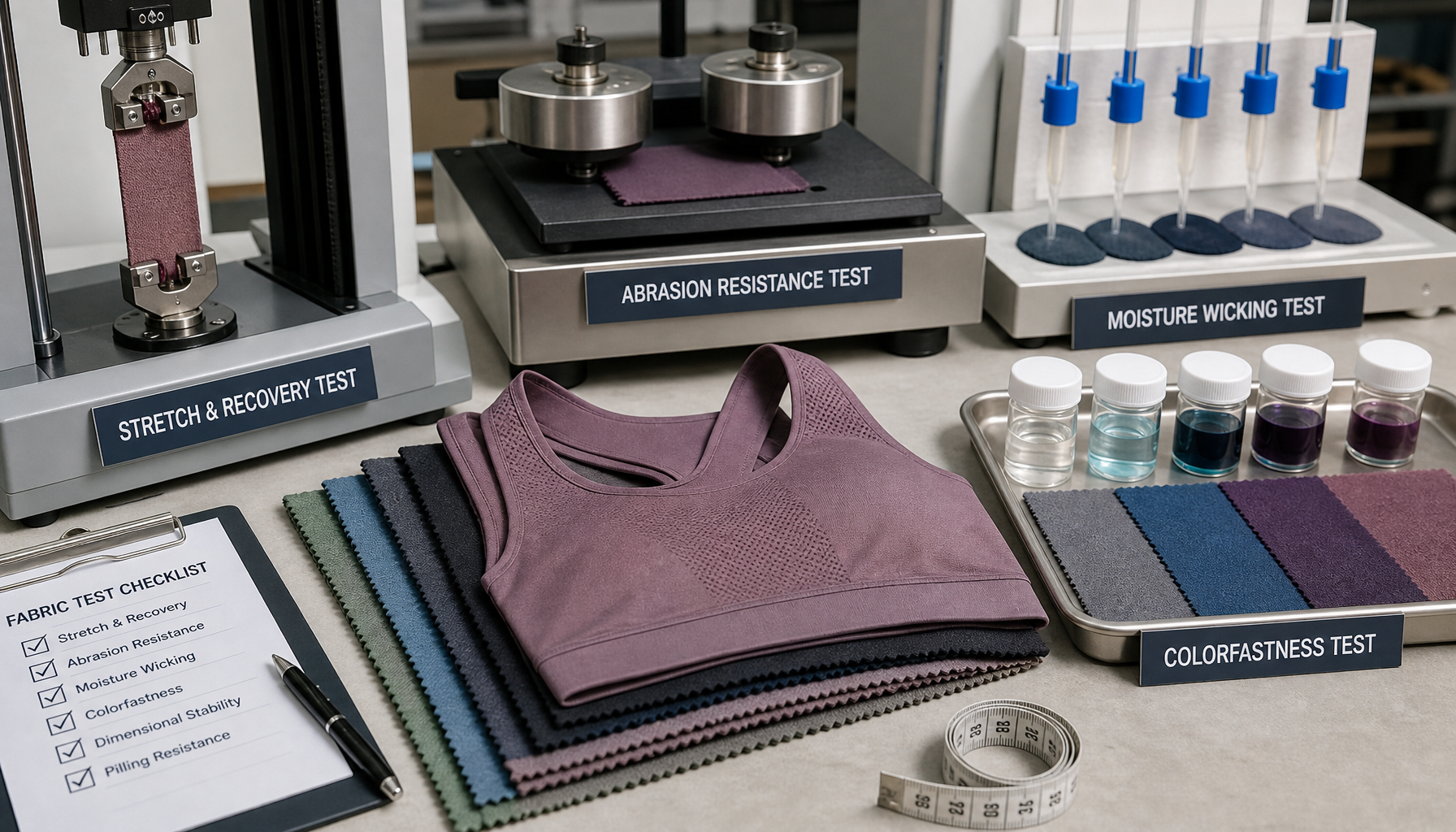
    Sports-bra stretch fabric sample prepared for material testing

    Start with the support level and garment zone

    A low-impact yoga bra, a medium-support training bra, and a high-support running bra do not impose the same loads on the fabric. Before selecting tests, identify where the material will be used: main body, compression panel, back wing, lining, pocket, or trim. Record the expected garment extension, fit intent, care cycle, color range, and whether the fabric will contact skin.

    Fabric testing cannot establish the support performance of the finished bra by itself. Pattern geometry, panel orientation, elastic, straps, cups, seams, and garment size all affect support. Use fabric results to approve the material specification, then verify the complete garment through fitting and wear evaluation.

    Measure fabric power, not only maximum stretch

    Maximum stretch shows how far a specimen can extend, but sports-bra development also needs the force required to reach a defined extension. That force is often described as fabric power or modulus. Two fabrics may both reach the same extension while applying very different pressure to the body.

    The request should state:

    • specimen direction and dimensions;
    • gauge length and conditioning procedure;
    • extension rate and target extension;
    • number of loading cycles;
    • force recorded at the specified extension;
    • hold time, recovery time, and residual growth;
    • whether testing occurs before or after laundering.

    Test both principal fabric directions. The pattern must identify which direction runs around the body because the higher-power direction may not be the direction with the greatest elongation.

    Illustrative recovery calculation

    Assume a hypothetical marked length is 100 mm before extension and measures 103 mm after the defined recovery period:

    Residual growth = (103 mm − 100 mm) ÷ 100 mm × 100 = 3%

    This is a calculation example, not a ClothFactory result or a universal pass limit. The acceptable growth must be agreed for the specific garment zone, support level, and test method.

    Stretch and recovery evaluation of sports-bra fabric

    Build the approval plan around the actual risks

    Procurement risk What to measure Conditions buyers should define
    Incorrect material Fiber composition, knit construction, finished GSM, usable width, and thickness where relevant Sampling location, conditioning, tolerance, and whether results refer to finished fabric
    Insufficient or excessive compression Force at specified extension in both directions Specimen size, target extension, rate, cycles, and garment orientation
    Bagging or fit loss Stretch recovery and residual growth Extension, hold time, recovery time, wash condition, and measurement interval
    Failure near seams or cup zones Bursting strength and relevant seam or component tests Finished fabric condition, test method, specimen direction where applicable, and failure mode
    Shrinkage or twisting Dimensional stability, spirality, or skew after laundering Wash and drying procedure, number of cycles, relaxation, and tolerance by direction
    Surface damage Pilling, abrasion, and snagging resistance as relevant Abradant, cycle count or endpoint, evaluation scale, and color tested
    Dye transfer or shade change Colorfastness to laundering, perspiration, and rubbing Adjacent fabric, solution, temperature, wet/dry condition, and required grade
    Unsupported sweat-management claim Wicking, drying, liquid-moisture management, or air permeability selected for the claim Method, specimen side, conditioning, finish, and pass criterion

    Not every project needs every available test. Select tests from the product risk and any consumer claim, then keep the method and acceptance limit consistent across suppliers.

    Verify construction, GSM, width, and thickness together

    GSM is a control measurement, not a support rating. A higher-GSM fabric may provide more mass or coverage, but support also depends on yarn, knit density, spandex integration, finishing, and load-extension behavior. Usable width affects marker efficiency and consumption, while thickness can influence bulk at seams and folded edges.

    The approved specification should identify whether GSM and width are measured after finishing and relaxation. Comparing one supplier's greige result with another supplier's finished result does not produce a valid sourcing comparison.

    Test after the intended care cycle

    Sports bras are exposed to repeated stretching, perspiration, detergent, heat, and drying. Run the agreed dimensional, recovery, appearance, and colorfastness checks after the care cycle intended for the label. If several washing or drying routes are permitted, identify which represents the approval condition.

    Inspect more than the average value. Record whether laundering changes hand feel, surface appearance, edge curl, stretch force, recovery, shade, or fabric width. A fabric that passes in its original state may no longer match the fit or support brief after washing.

    Treat hand feel as a controlled evaluation

    “Soft” and “comfortable” are not reproducible specifications unless the buyer defines a reference and evaluation procedure. Compare coded samples under the same conditioning, use an approved hand-feel reference where possible, and record the fabric face and back separately. For next-to-skin panels, the garment sample should also be checked for seam bulk, elastic pressure, chafing points, and surface irritation.

    An optional finish must be identified separately from the base fabric. Do not assume moisture management, antibacterial performance, cooling, or another treatment is standard across every color or production lot.

    Confirm colorfastness for the real color range

    Sports-bra fabrics may contact skin, light-colored tops, elastic, foam, or lining while wet with perspiration. Define laundering, perspiration, and wet/dry rubbing requirements for the intended product. Add light, chlorine, or seawater exposure only when the use case or product claim requires it.

    Do not approve all colors from one shade. Dark, bright, fluorescent, and heavily saturated colors can create different dyeing and fastness risks. The purchase specification should state whether each color is tested or whether colors are grouped under an agreed risk-based plan.

    Separate fabric approval from garment validation

    After the fabric passes its specification, make a representative size set or agreed garment sample. Check:

    • support and pressure at the intended activity level;
    • recovery at the underband, cup, wing, and strap attachment zones;
    • opacity and appearance under extension;
    • seam compatibility and needle damage;
    • movement, chafing, and edge comfort;
    • post-wash fit, shape, and component interaction.

    A fabric report cannot account for a weak elastic, unsuitable seam, incorrect pattern reduction, or panel direction. Bulk approval should therefore retain both an approved fabric reference and the garment-development record.

    Information to send with the testing request

    Provide the laboratory or supplier with:

    • fabric code, composition, construction, color, finish, and lot identity;
    • garment type, support level, and exact fabric location;
    • expected extension and pattern orientation;
    • test method and specimen conditioning;
    • wash and drying procedure;
    • acceptance limit and reporting units;
    • approved reference sample where appearance or hand is evaluated;
    • action required if a result falls outside tolerance.

    Procurement next step

    Create a test matrix before requesting quotations or samples. Link each test to a garment risk, specify its conditions and acceptance limit, and require reports to identify the exact submitted fabric. ClothFactory can use that matrix to compare nylon-spandex or polyester-spandex candidates and prepare matched development samples, while final sports-bra support remains subject to garment construction, fit, and wear validation.