ClothFactory is a specialized fabric manufacturer focused on knitted synthetic stretch fabrics. We have expertise in Nylon Spandex and Polyester Spandex materials. We serve a wide range of B2B customers—including apparel brands, activewear labels, lingerie companies, garment manufacturers, wholesalers, distributors, and emerging fashion businesses. We offer direct-from-factory sourcing and product development support. As a wholesale fabric supplier, we help align fabric selection with garment needs and production plans.
Our products fall into two main categories: Nylon Spandex fabrics, known for their softness and stretch, and Polyester Spandex fabrics, valued for their versatility in activewear, sportswear, leggings, and other apparel. Working with our fabric mill team, customers can specify fiber composition, weight (GSM), width, stretch and recovery, hand feel, appearance, color, and performance. The final properties depend on the chosen construction and finishing process.
ClothFactory also acts as an OEM/ODM fabric vendor during product development. We help identify suitable fabric options and develop materials to meet detailed specifications. Our services include color matching from a library of over 400 shades and custom dyeing confirmed through lab dips and fabric samples. Sampling allows customers to evaluate the material before bulk production begins.
Our development workflow covers initial fabric needs, selection, sampling, color approval, bulk production, quality control, and export delivery. This approach simplifies coordination among suppliers and keeps specifications and communication connected throughout the order. For buyers looking for a Tier 1 fabric supplier, we can discuss manufacturing scope, quality requirements, and delivery responsibilities from the start.
ClothFactory’s expertise in knitted synthetic stretch fabrics and functional textiles, along with practical sourcing advice, supports apparel brands in need of specialized fabric solutions. Whether you are an established label or a new activewear startup, our team can help translate your product needs into fabric specifications, sampling decisions, and a clear production plan.
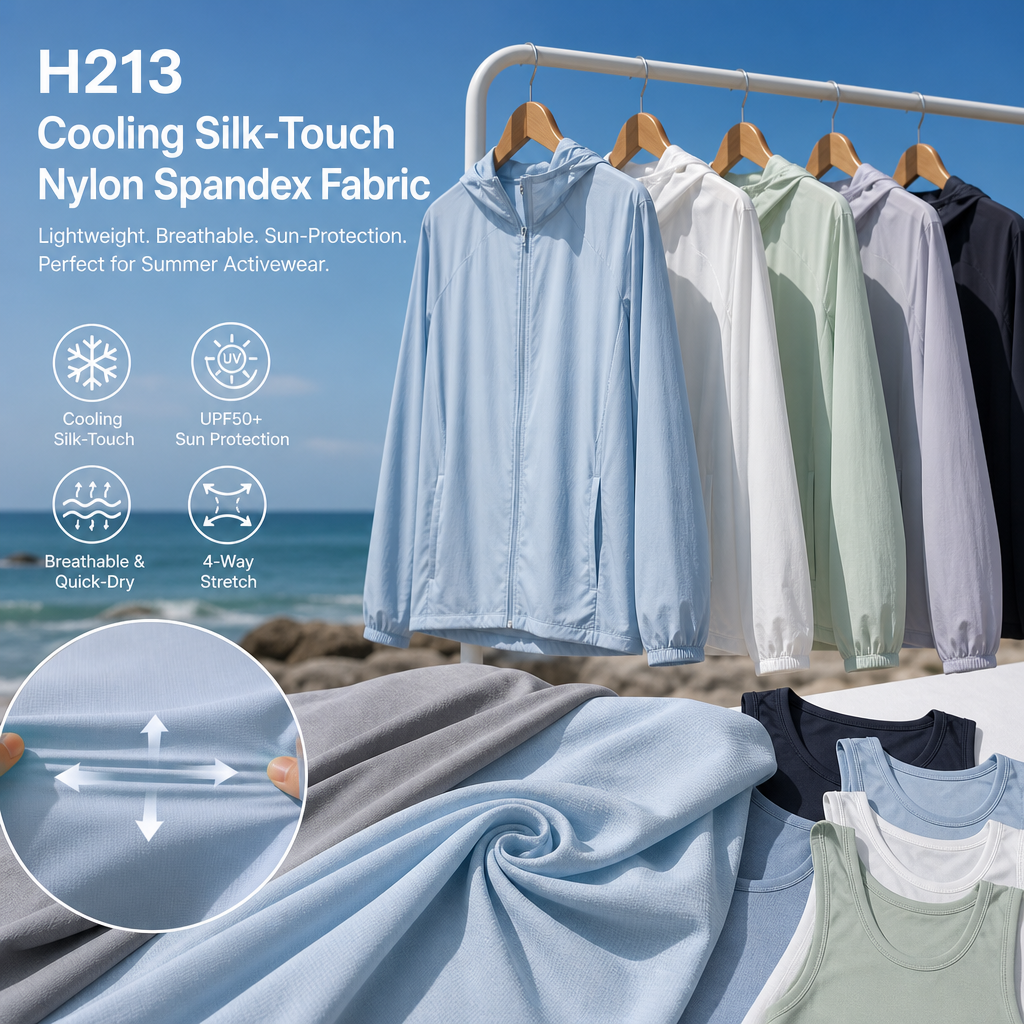
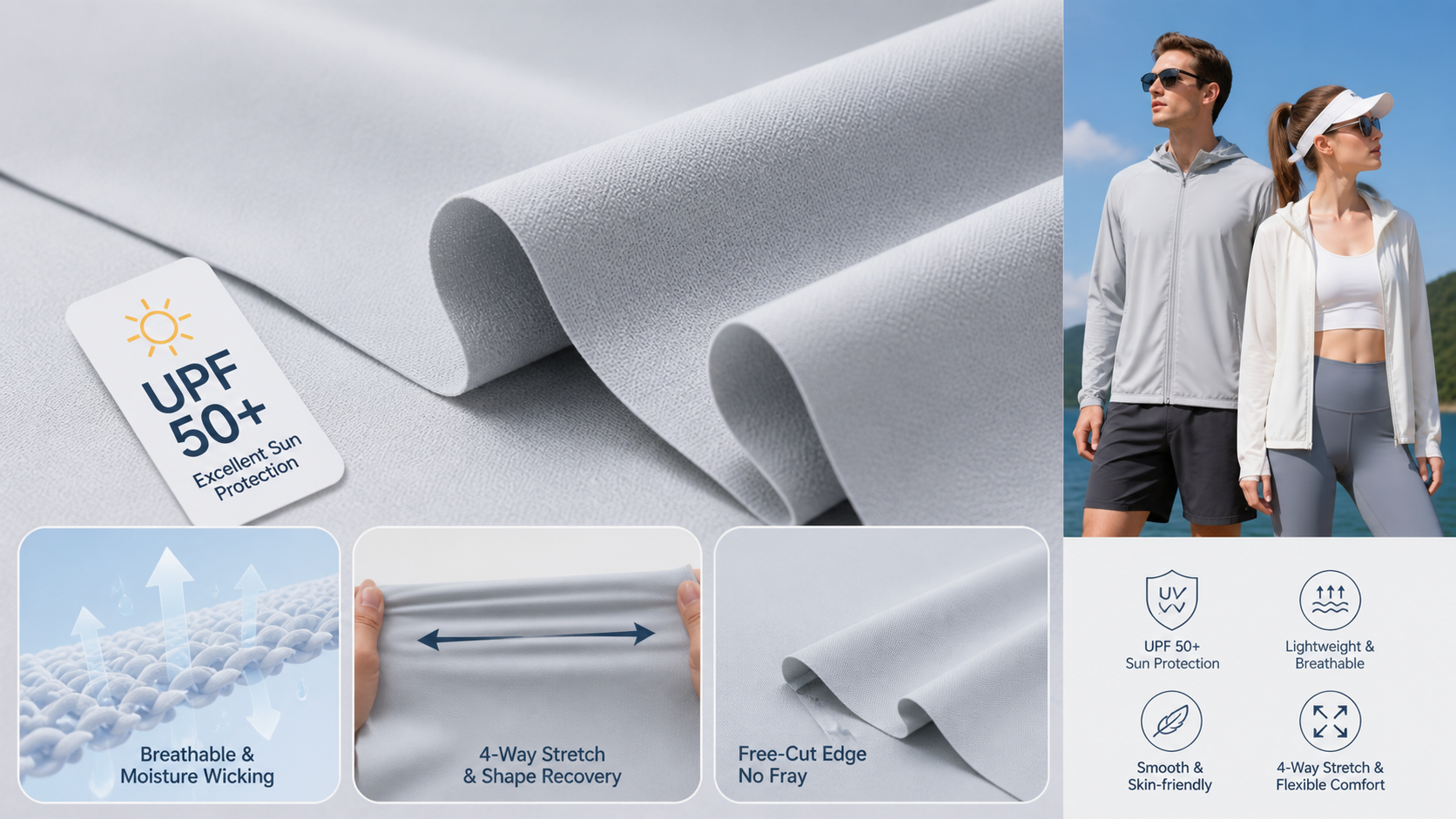
H213 is positioned as a lightweight, silk-touch nylon-spandex knit. ClothFactory’s catalogue lists 85% nylon, 15% spandex, 120 g/m² and 165 cm width. “Silk-touch” describes a proposed hand feel, not silk fibre content. Buyers should confirm the finished specification and evaluate cooling, drying and sun-protection claims separately before using them in a garment brief or product listing.
Define what the summer garment must do
A loose sun-protection top, a fitted sleeve and a running base layer do not share one acceptance standard. The loose top may prioritise drape and coverage. The sleeve needs recovery at the wrist and elbow. The base layer may prioritise sweat handling and low wet cling. Establish the end use before selecting a laboratory test or comparing swatches.
For a pale, close-fitting garment, assess the material at the strain created by the pattern and inspect it when damp as well as dry. A relaxed swatch can conceal show-through that becomes obvious on a moving body. Low mass can be useful for summer styling, but reducing weight is not a valid improvement if it forces the brand to add lining or abandon the intended colour.
Separate four commonly confused performance claims
Contact coolness
The initial thermal sensation when the material touches skin. It does not establish sustained cooling during exercise.
Moisture transport
How liquid spreads or moves through the material under the selected method. A spreading result is not a drying-time result.
Drying
Removal of moisture under defined temperature, airflow and water-loading conditions. Compare candidates under the same conditions.
Air permeability
Air passing through fabric at a specified pressure difference and test area. It is distinct from water-vapour resistance and ultraviolet transmission.
Request a named method, sample preparation and measured result for the property supporting the claim. The AATCC moisture-management testing programme distinguishes TM195 liquid-moisture management from TM201 heated-plate drying. ISO 9237 addresses air permeability. None of those results, by itself, certifies UPF.
Illustrative artwork only. The UPF, cooling and drying graphics are not supporting test reports for the supplied H213 fabric.
Require evidence before releasing a UV claim
The nylon-spandex composition and a lightweight hand feel do not establish UPF 50+. Obtain a relevant ultraviolet-transmission report tied to the actual colour, construction and finish. Check whether specimen preparation covers the stretch, moisture and care conditions relevant to the garment and the intended market’s requirements.
A fitted sleeve can place more strain on the fabric than a loose jacket panel. If the proposed fit or finish differs from the tested sample, resolve that gap before labelling. Do not infer UV additives, skin-safety certification or durable protection from the article name or an illustration.
Use weight and width to check the quotation
At nominal values, 120 × 1.65 ÷ 1,000 = 0.198 kg per linear metre. Theoretical yield is therefore approximately 5.05 m/kg, before cutting losses and width exclusions. This explains why a rough “5 m/kg” estimate may appear plausible, but it does not guarantee delivered yield.
For example, 100 linear metres at those dimensions represents 19.8 kg of fabric, excluding packaging. A buyer comparing a kilogram quote with a metre quote should use the same weight and full-width basis. Use minimum usable width for marker planning, and confirm whether the purchased edges are included in the invoiced mass.
Resolve sewing and decoration risks on samples
Lightweight stretch fabrics can expose seam puckering, feed imbalance and heat-related surface changes. Trial the intended seam, thread, needle system and machine settings on the actual article. Inspect under normal garment tension and after the care sequence. A needle-size recommendation without the needle system, seam construction and trial result is not a production specification.
Test logos, transfers and bonded details using the decorator’s intended process. Check adhesion, shade change, local stiffness and stretch mismatch. The decoration may become the least flexible area of an otherwise comfortable sleeve or chest panel.
Approve one controlled specification
The release file should connect the approved colour and finish to the agreed weight, usable width, dimensional behaviour, garment fit and any claimed performance. Separate required pass criteria from desirable hand-feel preferences. Retain the approved sample and record changes that require another review.
H213 is worth sampling when a lightweight nylon-spandex knit matches the design brief. Buy it on demonstrated garment performance and repeatable bulk specifications, not on the assumption that a cool first touch guarantees comfort, UV protection and fast drying at the same time.
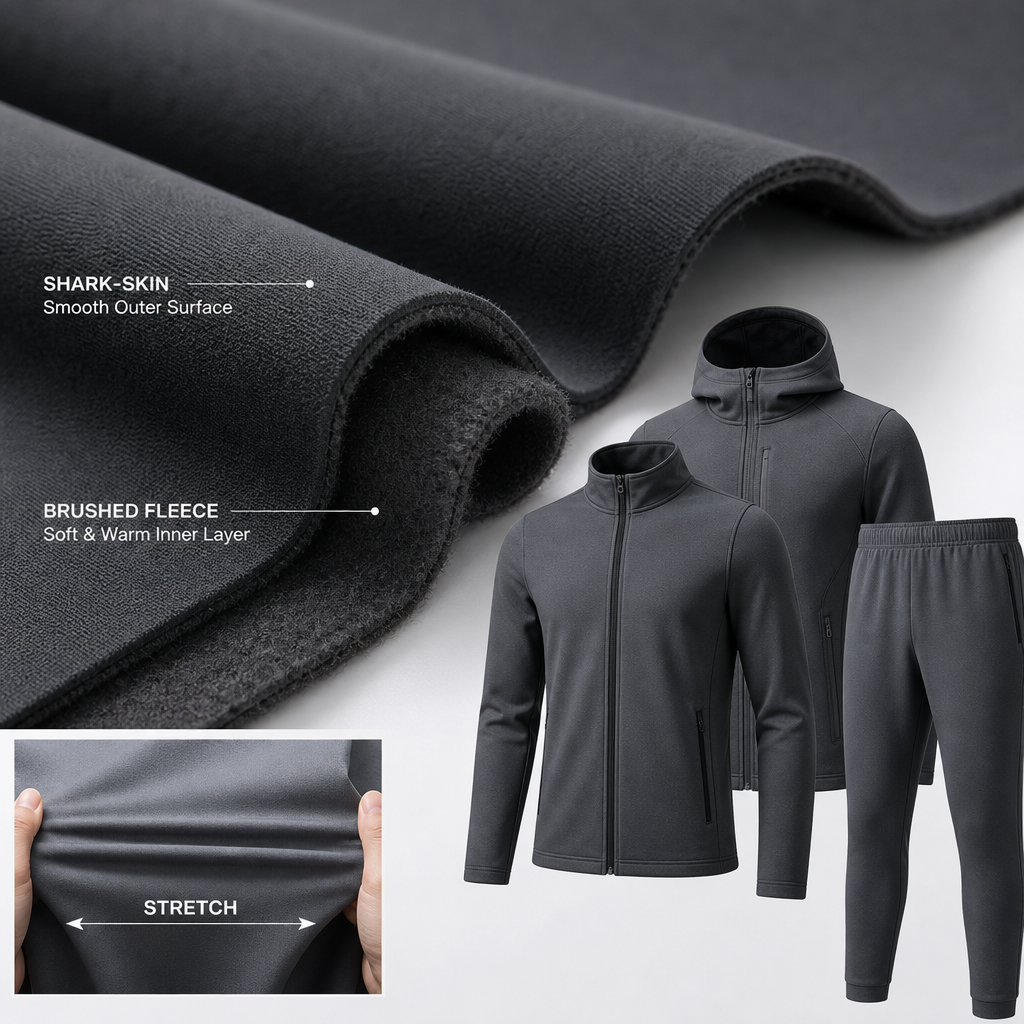
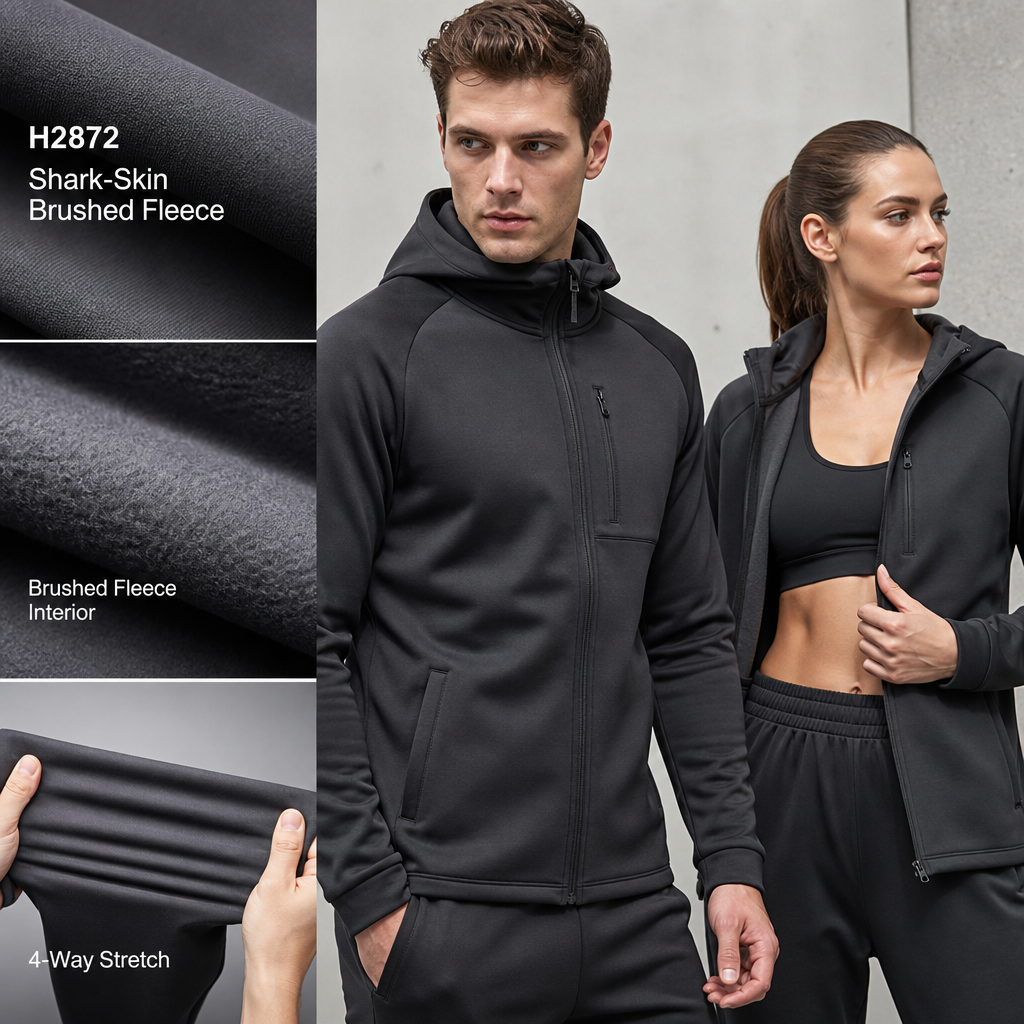
H2872 should be evaluated as a layered material, not as a generic high-spandex fleece. ClothFactory’s catalogue lists a shark-skin composite brushed fabric at 370 g/m² and 165 cm width, with a face composition of 80% nylon and 20% spandex and a back composition of 95% polyester and 5% spandex. These are nominal catalogue figures. Confirm the actual layer construction, bonding system and finished specification before comparing quotations.
Read the composition by layer
Reporting this article simply as “20% spandex” would describe the face but misrepresent the entire composite. An overall composition requires the mass contribution of each relevant component and the applicable labelling basis. Without layer weights, the two percentages cannot be averaged into a defensible whole-fabric claim.
Ask the supplier to identify the face, backing and joining process on the technical sheet. A swatch can show which surface contacts the skin, but it cannot establish adhesive chemistry, bond coverage or fibre content. Keep the approved construction revision with the sample so a later change in backing or bonding does not pass unnoticed under the same commercial article name.
Choose the thermal system for the activity
A winter commuter waiting outdoors and a runner generating heat continuously need different balances of insulation and moisture escape. A substantial brushed backing may suit the first brief while becoming excessive for the second. Garment openings, wind exposure, layering and activity level affect the outcome; fabric weight alone cannot justify a temperature rating such as “suitable for 0–10°C.”
ISO 11092 measures thermal and water-vapour resistance under controlled steady-state conditions and can address layered assemblies. Use comparable results to screen materials, then assess the intended garment system. A laboratory resistance value is not a promise of comfort at a particular outdoor temperature.
Application illustration. The pictured garments do not establish a temperature rating or verified test performance for H2872.
Treat the bond as a performance component
The face and backing can stretch and recover differently. If the joining system restricts one layer, a fabric that feels elastic by hand may resist movement, wrinkle or develop separation in use. Evaluate both directions and inspect the composite after repeated extension and the specified laundering sequence.
Request an agreed bond-integrity assessment appropriate to the construction. Record visible bubbling, edge separation, local stiffness and any change in hand feel, alongside quantitative bond results where applicable. Specify specimen preparation and care history rather than accepting a single unexplained “peel strength” number. Passing an initial test does not establish durability after washing.
Build a pilot garment before approving the roll
At 370 g/m², seam bulk deserves attention around zipper ends, pocket entries, cuffs and intersecting seams. Trial the proposed seam allowance and trimming method on the actual assembly. Inspect whether stitches damage the surface, whether the zipper waves and whether several folded layers create pressure points.
Check nap direction before marker approval. Reversing panels can change perceived shade or surface appearance even when the colour measurement is acceptable. Review abrasion and pilling at likely contact zones, including underarms and backpack contact areas. Do not claim anti-static performance from a brushed hand feel; that requires separate evidence if it is part of the product brief.
Price the approved construction, not just the kilogram
Using nominal dimensions, one linear metre weighs 370 × 1.65 ÷ 1,000 = 0.6105 kg, giving approximately 1.64 m/kg. Usable width, one-way nap layouts and defects determine actual cutting yield. A low kilogram price can be offset by directional cutting restrictions or extra sewing time at bulky intersections.
For an illustrative material comparison, a marker requiring 1.2 linear metres would contain about 0.733 kg at the nominal full-width mass. That calculation estimates purchased fabric mass, including the marker’s unused area; it is not the finished jacket weight. Use the approved marker and measured roll data for the production budget.
Define the bulk approval boundary
Release production only against an identified face-and-back specification, agreed usable width, dimensional-change limits, appearance standard and bond durability requirements. Retain a washed garment as well as an unwashed swatch. If the backing, bonding process or finish changes, review whether the original elasticity, thermal and care approvals still apply.
H2872 merits consideration where a substantial composite structure supports the garment brief. It should not be selected solely because “shark-skin,” “winter” or “brushed” appears in the name. The relevant purchase is a reproducible material system that survives the intended assembly and care conditions.
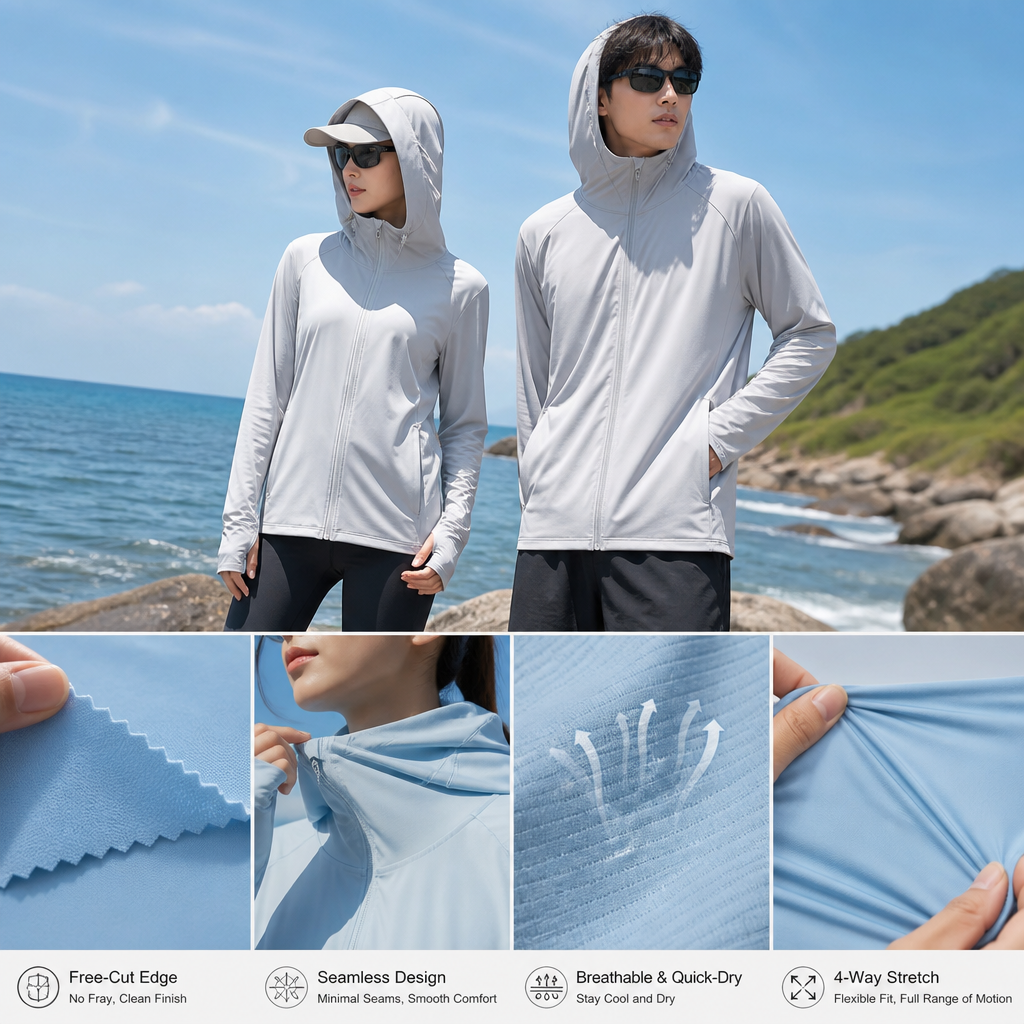
H168 can be evaluated for lightweight sun-protection jackets, but “free-cut” construction and a UPF claim are separate approval decisions. ClothFactory’s catalogue lists 74% nylon, 26% spandex, 170 g/m² and 165 cm width. Treat those figures as nominal specifications. The title’s UPF 50+ positioning must be supported by a relevant report for the supplied fabric and the intended market; composition alone cannot establish it.
What free-cut construction can actually change
A free-cut fabric is intended to leave selected edges unfinished without unacceptable curling or unravelling. It does not make a sewn jacket seamless, and it does not automatically qualify the fabric for bonding. An exposed hem, a curved cuff and a thumb opening experience different strain and abrasion, so each proposed edge needs its own trial.
For a sun jacket with extended cuffs, inspect the cut edge immediately after cutting, after repeated hand insertion and after the agreed care sequence. Record cut direction, cutting equipment and edge geometry. A straight swatch edge that lies flat on a table is insufficient evidence for a small-radius thumb opening under tension.
Release the sun-protection claim through evidence
Ask for a report identifying the article, colour, finish, specimen preparation and test method. AATCC TM183 measures ultraviolet radiation transmission or blocking through fabric, including dry or wet evaluation. A test result and a market-compliant garment label are not the same deliverable; confirm the applicable labelling requirements separately.
Establish whether stretching, wetting and care treatments relevant to the garment are covered by the evaluation. A relaxed dark swatch must not be used as blanket evidence for a stretched pale sleeve. Request the supporting report before printing hangtags, and avoid explanations about “embedded UV particles” unless the material supplier has documented that mechanism for the actual article.
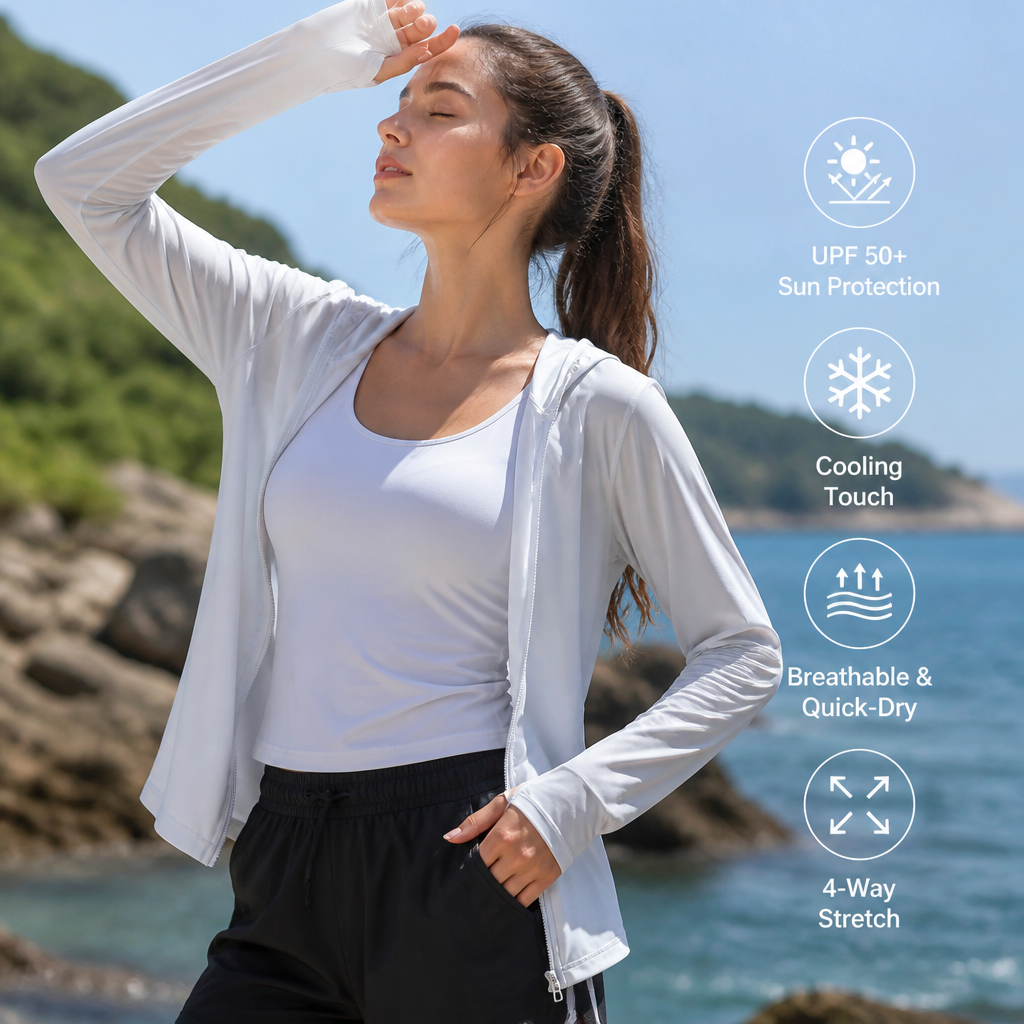
Concept artwork, not a UV test certificate. Sun-protection and free-cut performance require approval of the supplied material and garment.
Balance coverage, fit and summer comfort
A close-fitting sleeve can reduce loose fabric around the wrist, but it also increases local fabric extension. A roomier sleeve changes coverage, air exchange and fabric consumption. Evaluate the garment during reach, elbow flexion and thumb-loop use, not only in a standing fit photograph.
Do not combine contact coolness, airflow, moisture transport and drying into one “breathability” result. They describe different behaviour. For example, ISO 9237 addresses air permeability; it does not prove ultraviolet protection or drying speed. Specify the property that matters to the end use and compare candidates under the same test conditions.
Check whether removing a hem really reduces cost
Use an assembly trial to calculate the value of a free-cut edge. In a hypothetical costing exercise, removing one operation saves $0.08 per jacket. If edge-related rework affects 5% of jackets and costs $1.20 per affected piece, its expected cost is $0.06 per jacket. Only $0.02 of the initial saving remains, before inspection, scrap or any fabric premium. These are illustrative inputs, not ClothFactory prices or defect rates.
At 170 g/m² and 1.65 m full width, nominal fabric mass is 0.2805 kg per linear metre, equivalent to about 3.57 m/kg before losses. Compare actual marker consumption at the approved usable width. Eliminating a folded hem may change the pattern allowance, but the saving cannot be assumed until the pattern and cutting plan are revised.
Write a sample-to-bulk control plan
Approve the fabric, edge treatment and garment claim as three linked records. The fabric record should contain the agreed weight, width, composition and elasticity requirements. The edge record should show acceptable curl, fraying and appearance at defined garment locations after the specified evaluation. The claim record should link each supported colour or product grouping to its evidence.
Any change in yarn, construction, colour, finish or garment fit should be reviewed for its effect on those approvals. H168 is commercially useful when the production garment passes both the edge and protection requirements at an acceptable cost. Neither a smooth hand feel nor a UPF icon in an image is sufficient authority to release bulk production.