ClothFactory is a specialized fabric manufacturer focused on knitted synthetic stretch fabrics. We have expertise in Nylon Spandex and Polyester Spandex materials. We serve a wide range of B2B customers—including apparel brands, activewear labels, lingerie companies, garment manufacturers, wholesalers, distributors, and emerging fashion businesses. We offer direct-from-factory sourcing and product development support. As a wholesale fabric supplier, we help align fabric selection with garment needs and production plans.
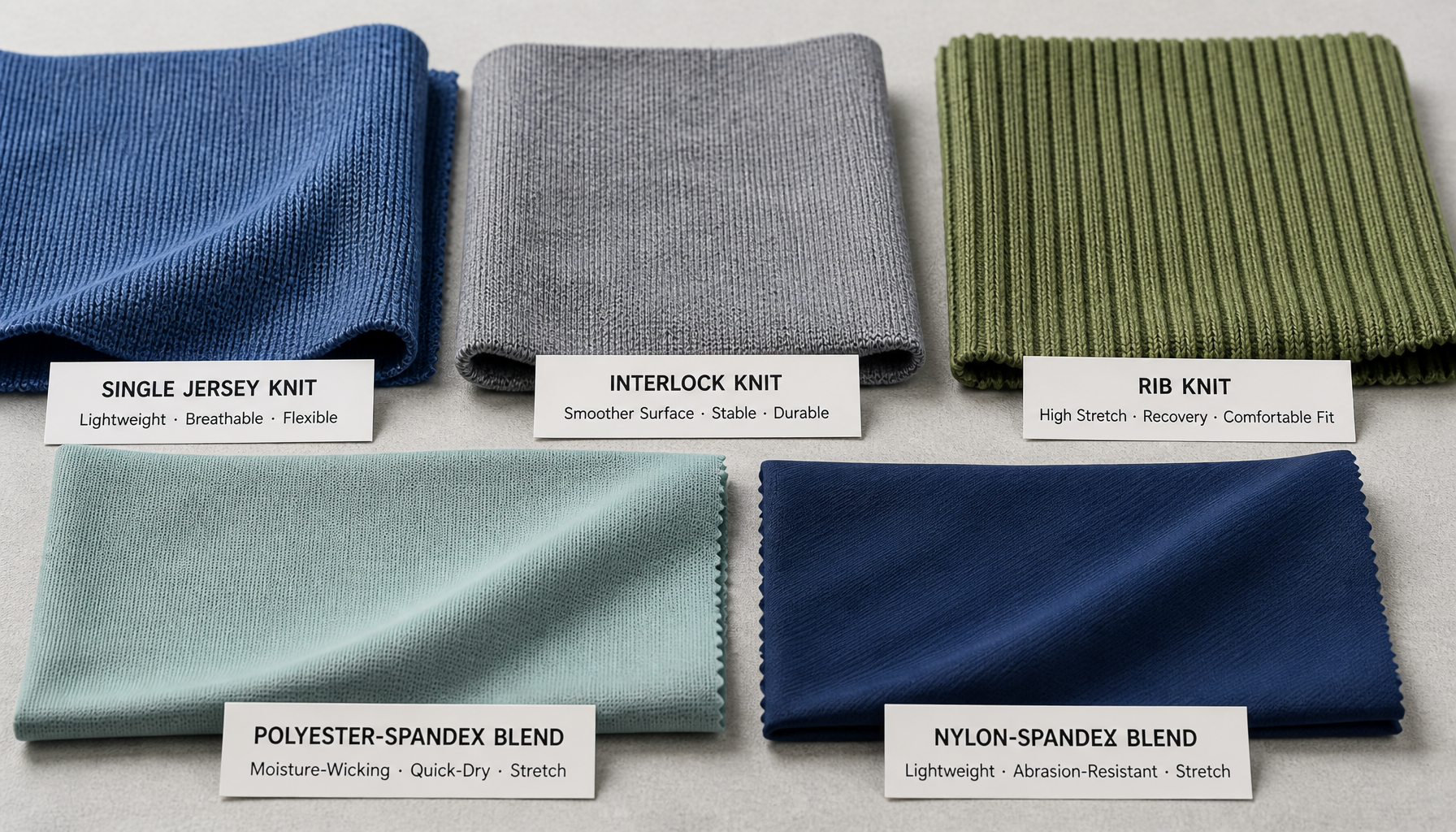
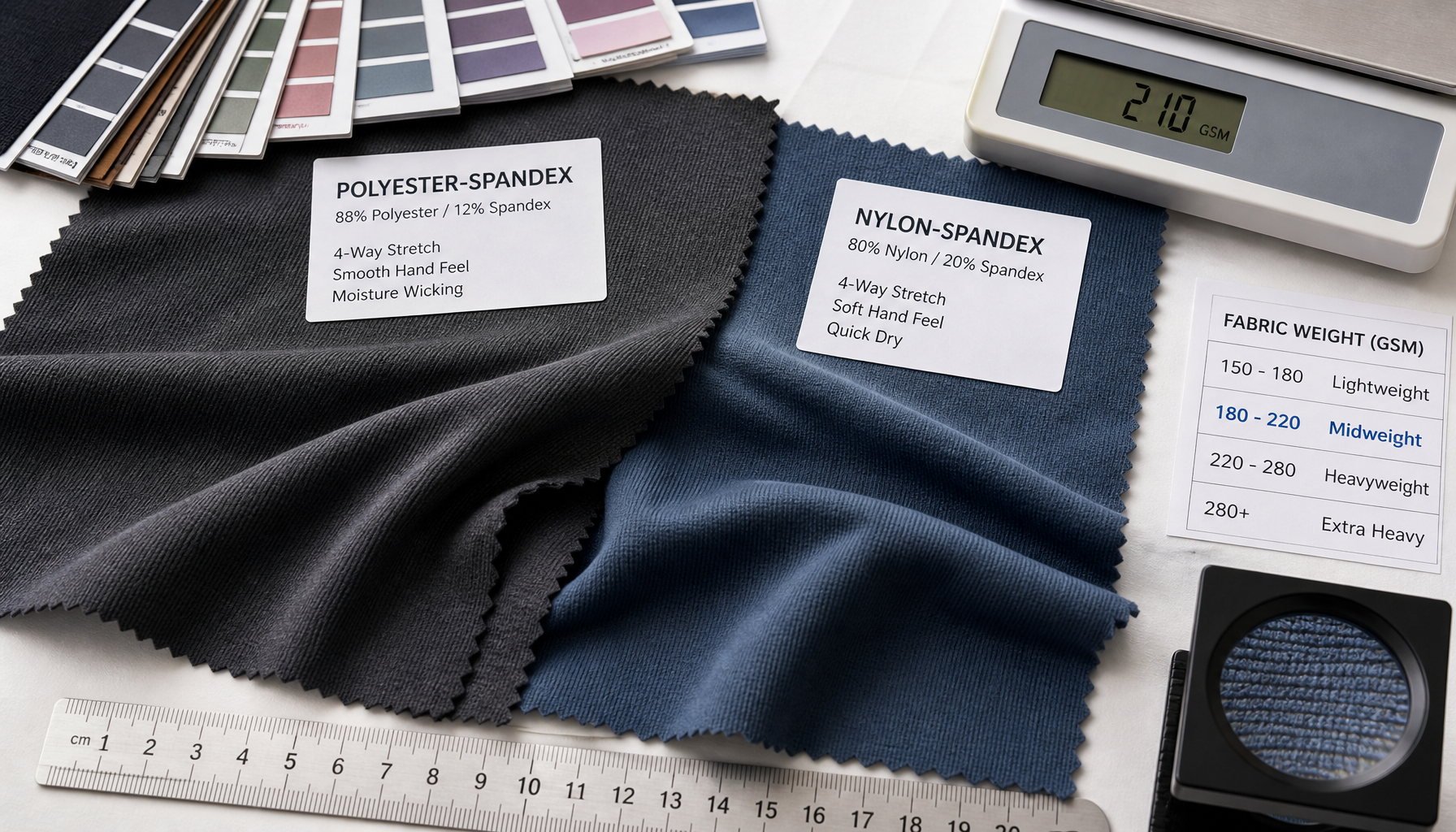
Our products fall into two main categories: Nylon Spandex fabrics, known for their softness and stretch, and Polyester Spandex fabrics, valued for their versatility in activewear, sportswear, leggings, and other apparel. Working with our fabric mill team, customers can specify fiber composition, weight (GSM), width, stretch and recovery, hand feel, appearance, color, and performance. The final properties depend on the chosen construction and finishing process.
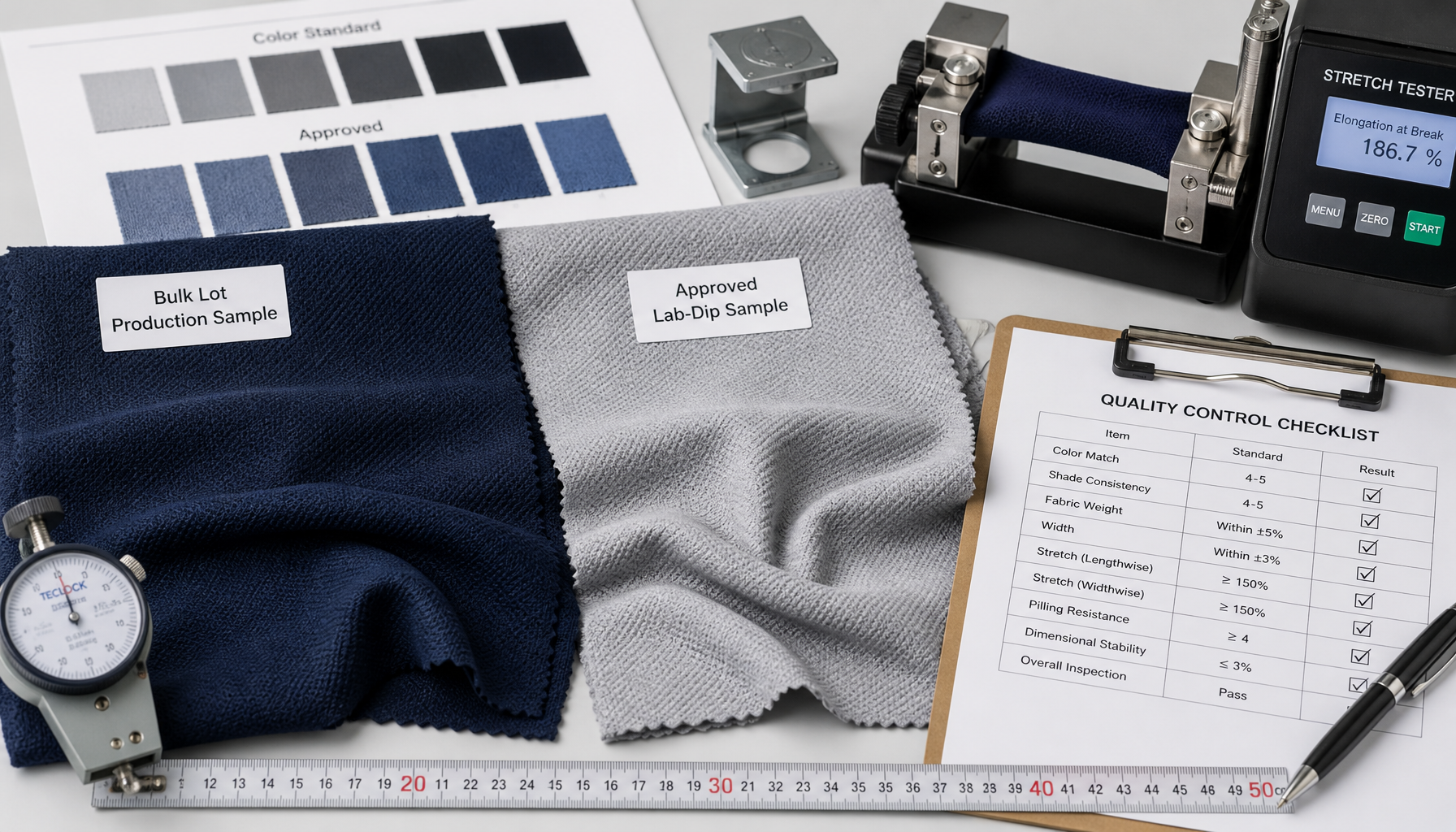
ClothFactory also acts as an OEM/ODM fabric vendor during product development. We help identify suitable fabric options and develop materials to meet detailed specifications. Our services include color matching from a library of over 400 shades and custom dyeing confirmed through lab dips and fabric samples. Sampling allows customers to evaluate the material before bulk production begins.
Our development workflow covers initial fabric needs, selection, sampling, color approval, bulk production, quality control, and export delivery. This approach simplifies coordination among suppliers and keeps specifications and communication connected throughout the order. For buyers looking for a Tier 1 fabric supplier, we can discuss manufacturing scope, quality requirements, and delivery responsibilities from the start.
ClothFactory’s expertise in knitted synthetic stretch fabrics and functional textiles, along with practical sourcing advice, supports apparel brands in need of specialized fabric solutions. Whether you are an established label or a new activewear startup, our team can help translate your product needs into fabric specifications, sampling decisions, and a clear production plan.
Approve jogger fabric only after confirming knee and seat recovery, pocket stability, dimensions after care, surface durability, and cutting yield in the intended garment. Tie that approval to an identified fabric version, physical reference, and numerical tolerances so bulk inspection can reproduce the decision.
Begin with the worn silhouette
A tapered travel jogger worn while seated has a different brief from a brushed lounge jogger or a lightweight training style. Define fit, intended season, pocket load, cuff construction, and wear duration. A soft hand alone does not establish resistance to knee bagging, and a higher spandex percentage does not establish the desired support.
Use sitting and pocket load to reveal fit problems
Assess repeated sitting, knee flexion, and recovery after the agreed rest period on the sewn prototype. Check the intended pocket contents: a phone can pull a lightweight pocket area out of shape even if the body fabric passes a strip recovery test. Record garment size, panel orientation, seam and pocket construction so a fit problem can be traced to material behavior or design.
Measure the consequence of dimensional change
Hypothetical calculation: an 80 cm inseam that shortens by 3% becomes 77.6 cm, a 2.4 cm change. This is an illustration, not an acceptance limit. Establish the finished-garment tolerance first, then evaluate fabric dimensional change and prototype measurements under the intended washing and drying procedure.
Adding pattern length can compensate for predictable length change, but does not correct twisting seams or unequal behavior between body fabric, waistband and cuffs. Review those components together before adjusting the pattern.
Distinguish softness from surface durability
For brushed or sueded candidates, inspect how the surface changes at the inner thigh, seat and pocket openings after relevant wear and care. Ask the laboratory to use the agreed pilling or abrasion method and report the exposure conditions. Pilling appearance, abrasion damage and hand are separate judgments; one passing result should not stand in for the others.
Check cutting economics before freezing the quality
Run the graded production marker at the minimum accepted usable width. Where the surface has a directional appearance, confirm whether panels must face one way; that constraint can change yield. Record finished GSM, billed width, usable width, and the conversion from weight price to garment consumption. A softer or heavier version may require a fresh costing even if the fiber percentages remain unchanged.
Release bulk against a defined record
Sealed hand and appearance reference, approved colors and construction revision.
GSM and usable-width limits with agreed measurement conditions.
Direction-specific recovery and post-care dimensional requirements.
Colorfastness and surface-durability criteria tied to named methods.
Roll identification, sampling coverage and action for failed results.
Request production-relevant yardage for sewing and care trials before bulk authorization. Once approved, require notification of changes to yarn specification, construction, brushing or finishing that could alter the result. Release each shipment using its own identified records rather than relying solely on the development sample.
Before requesting a fabric quote, specify roll format, packing protection, net billing quantity, destination, transport assumptions, and delivery scope. Ask suppliers to separate fabric-ready dates from arrival estimates and identify every packing or transport charge excluded from the price.
Describe what the receiving factory can handle
A garment factory with limited lifting capacity may not accept the same roll weight as a mechanized warehouse. State maximum roll dimensions and weight, core requirements, whether fabric must remain open width, and how joins or short pieces are handled. For stretch knits, request a winding arrangement that avoids visible distortion and verify relaxation needs with the cutting team.
Separate paid fabric from shipment weight
Illustrative calculation: 20 rolls containing 25 kg net fabric each equal 500 kg of fabric. If cores and wrapping add 1.2 kg per roll, gross shipment weight is 524 kg before any pallet. At a fabric price of USD 8/kg, confusing gross with net would add USD 192 to the fabric charge. These are hypothetical figures; confirm the actual tare and billing convention.
Freight quotations can also depend on package dimensions and the carrier’s charging basis. Request gross weight and dimensions alongside net fabric weight so the forwarder can quote against the intended packing rather than a guessed shipment size.
Put the delivery scope in writing
Item
Information required in the quote
Delivery basis
Agreed trade term, applicable version and precise named place
Included charges
Packing, collection, transport and handling included in the offer
Excluded charges
Costs the buyer must obtain or budget separately
Schedule
Production completion, inspection release, dispatch and estimated arrival
Insurance
Whether coverage is included and its documented scope
Preserve identity through receiving
Require each roll label to show the fabric reference, color, dye lot, roll number, net quantity, and any agreed defect or join markings. The packing list should reconcile these identifiers. Mixing unmarked lots can create shade problems at cutting even when individual rolls were acceptable at dispatch. Confirm whether shade groups need separate packing and spreading instructions.
Plan protection and the receiving check
Agree on wrapping, end protection, handling and moisture precautions appropriate to the route. Record package condition at dispatch and receipt. Set a receiving procedure for damaged wrapping, wet material, missing rolls, or quantity discrepancies, including who is notified and what records are retained before material enters production.
Send the RFQ with destination and receiving constraints, then obtain a proposed packing list and package dimensions before booking transport. Keep sample-courier charges separate from bulk freight, since sample delivery experience does not establish the cost or timing of the production shipment.
Before paying a fabric deposit, verify the written first-lot approval procedure, sample references, inspection access, and release responsibilities. If production has not started, the bulk lot cannot yet be approved; the decision at this stage is whether the proposed controls are sufficiently clear to place the order.
Distinguish the three approvals
Development approval: the proposed fabric and garment trial meet the brief.
Production authorization: the buyer confirms specifications, quantities and agreed commercial conditions.
Bulk release: identified production material meets the agreed inspection and test criteria.
A lab dip approves a color-development reference within its stated scope. It does not establish bulk width, recovery, defects, or garment behavior. Each approval record should state what it covers and what remains open.
Ask the supplier to demonstrate the record flow
Request a blank inspection form or an anonymized example showing how roll numbers connect to dye lots, measurement records, test samples, and packing lists. An example demonstrates documentation capability, not the quality of the future order. Confirm who selects bulk samples and whether the buyer or its inspector can access the rolls before release.
Define the first-lot hold point
For a new stretch-knit construction, specify whether the first production lot is held before later lots proceed. This can limit the amount requiring correction if the finish changes hand or recovery, but it also adds time to the schedule. Agree on what evidence must be available, who reviews it, and how quickly an approval or rejection is expected.
Make “approved” measurable
Identify the signed construction and color references and the specification revision.
Set finished GSM, usable-width and other critical tolerances.
Define inspection coverage, test methods, specimen conditions and acceptance limits.
Assign responsibility for investigating, correcting and retesting nonconforming material.
Document authorization for any deviation or process change.
Hypothetical example: the cutting marker requires at least 150 cm usable width, but a finished roll measures 148 cm at an inspected section. A passing lot-average width does not resolve that cutting problem. The agreed procedure must identify whether the affected roll is held, re-planned with buyer approval, or replaced.
Confirm commercial milestones explicitly
Ask the supplier to acknowledge how inspection and approval dates relate to the agreed payment and shipment milestones. Do not assume a deposit includes all testing, that an inspection automatically postpones payment, or that sample approval authorizes shipment. These arrangements must be confirmed for the order.
Before proceeding, obtain one acknowledged approval pack containing the specification, sample register, first-lot hold point, responsible contacts, inspection schedule, and unresolved exceptions. Keep that version with the order so later decisions refer to the same requirements.
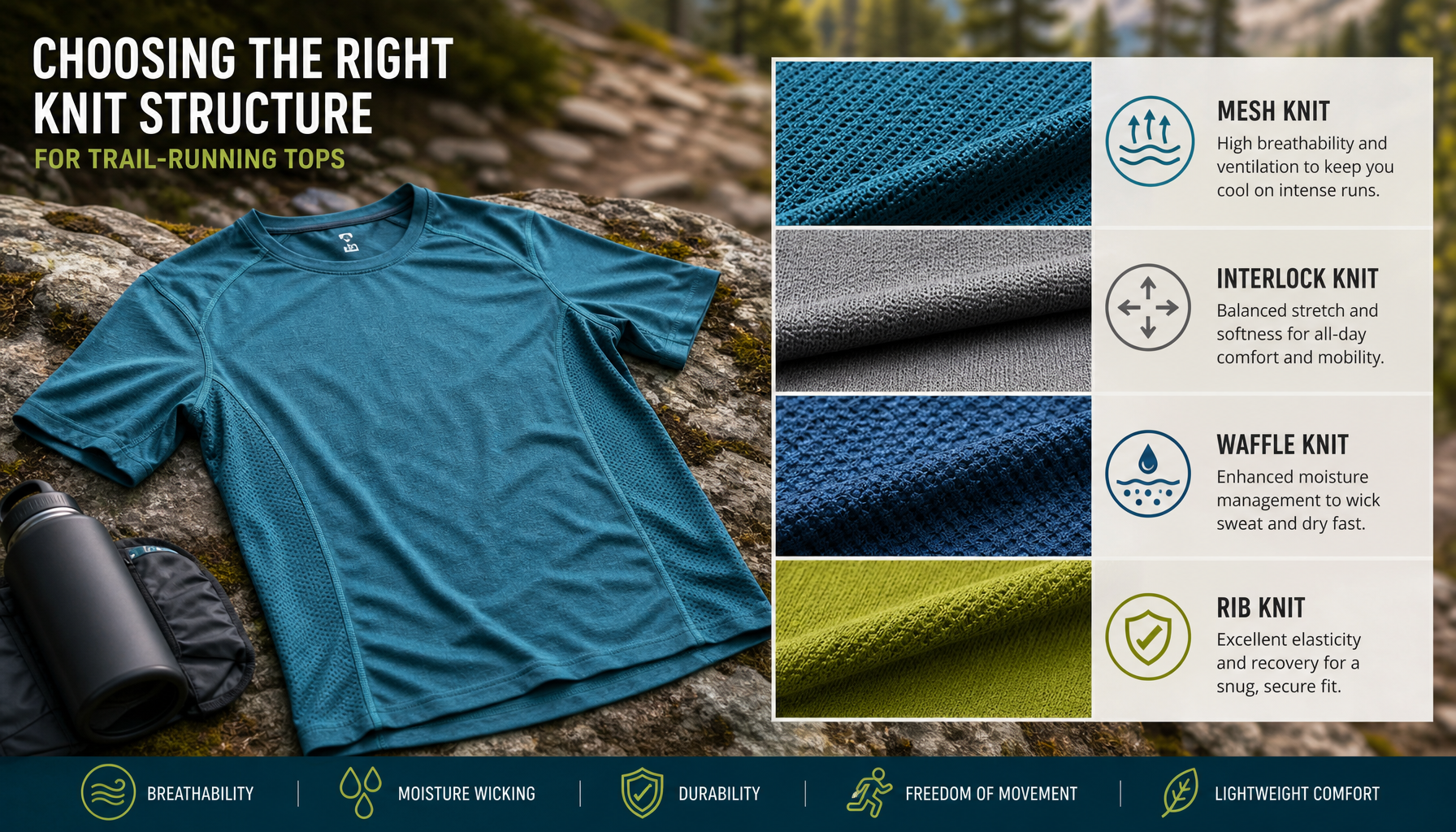
For trail-running tops, shortlist jersey, interlock, or mesh according to pack contact, ventilation needs, coverage, and garment fit. The structure name narrows the development route, but yarn, stitch density, finish, and panel placement determine whether a particular fabric works.
Map the running vest before selecting mesh
Consider a warm-weather top worn beneath a loaded hydration vest. The shoulder and upper-back zones experience contact that exposed side panels do not. An open construction selected for ventilation needs a snag and contact assessment in those zones. Ventilation under a covering vest also depends on the entire layering arrangement, so airflow measured on an uncovered swatch cannot describe the complete garment.
Compare candidates by panel function
Candidate
Development role
Issue to resolve
Single jersey
A body-fabric option where low mass and drape matter
Edge curl, post-care rotation and coverage in the proposed construction
Interlock
A double-knit candidate for panels requiring a more substantial feel
Whether its actual weight and drying behavior fit the brief
Mesh or pinhole knit
A candidate for deliberately ventilated panels
Snagging, opacity and seam behavior around open areas
Rib
A candidate for neck or other fitted components
Recovery and compatibility with the adjoining body fabric
These are screening roles, not guaranteed performance rankings. Compare the finished candidates at their actual GSM and width; equal fiber percentages do not make different constructions equivalent.
Is panel zoning worth the added complexity?
Using a more open side panel and a separate shoulder fabric can address different requirements, but adds seams, inventory, shade matching, and potentially separate minimum orders. For a small launch, one fabric that passes the contact and comfort brief may be commercially preferable. For a larger program, calculate whether the functional benefit justifies the added cutting and sewing operations.
Separate structure from functional finishing
Specify any moisture-management or odor-control finish separately from the knit. Confirm its contribution after the agreed care procedure and check whether it changes hand, shade, or printing response. Neither nylon-spandex nor polyester-spandex composition alone verifies a drying or odor claim.
Approve in the intended running system
Make the top with production seams and decoration, then assess reach, hem movement, wet cling, and contact with the intended vest. Pair that trial with laboratory measurements chosen for the material risks. Record the vest configuration and garment size so comparisons are repeatable. Request candidate yardage with construction, finished GSM, minimum usable width, finish, and lot identity, then select the simplest panel arrangement that meets the brief.
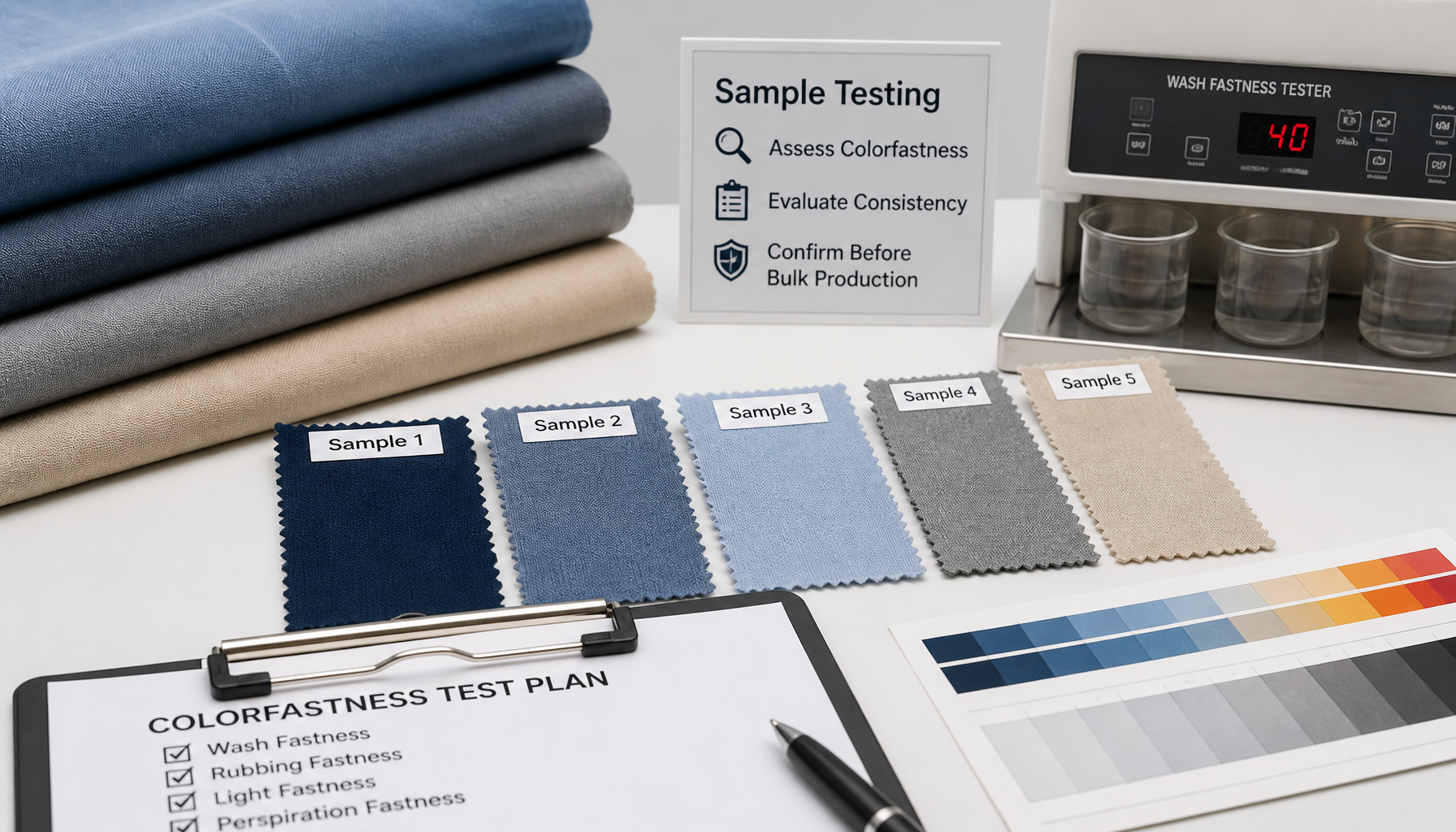
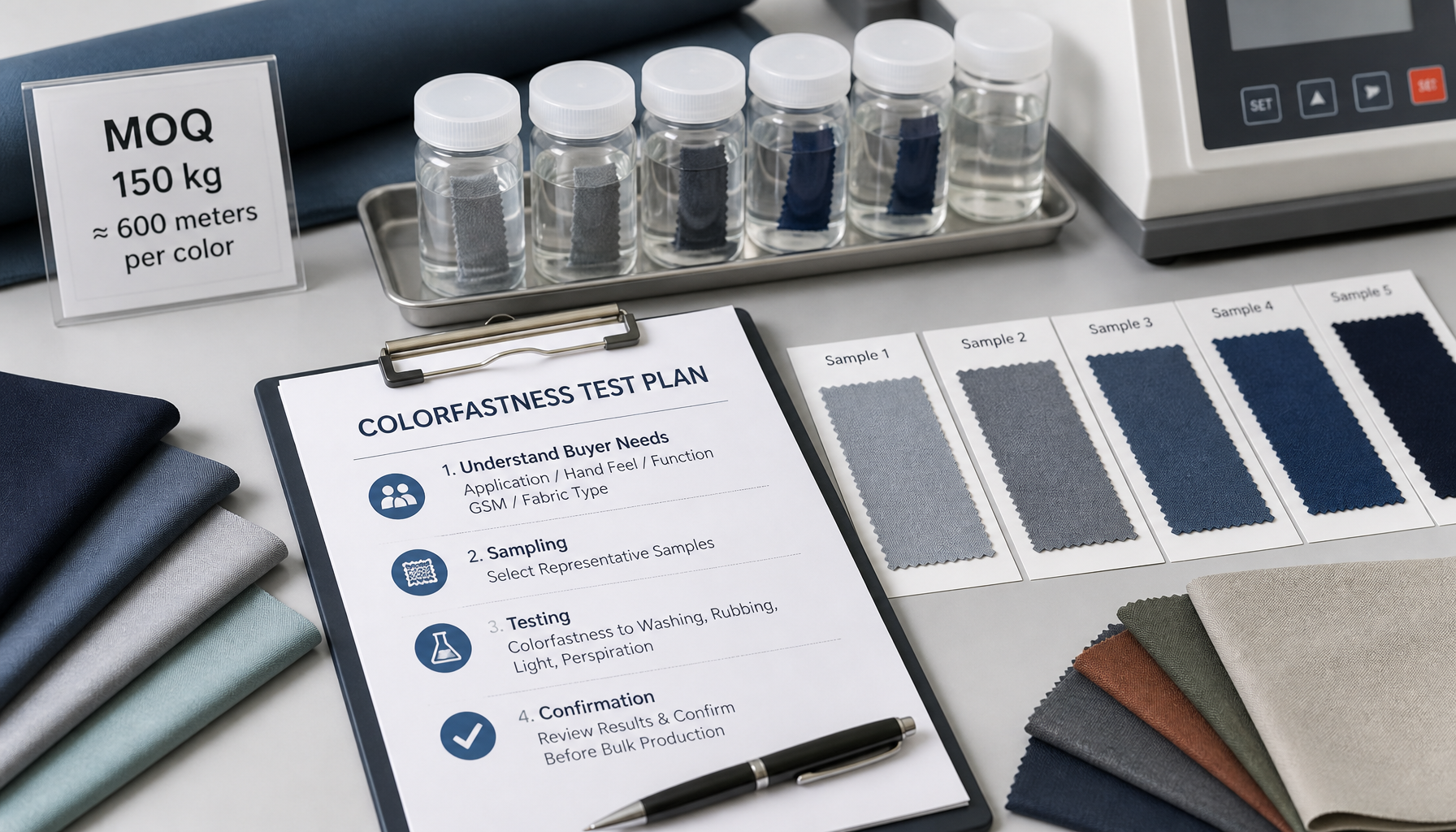
Colorfastness sample quantity must follow the selected laboratory methods and a sampling plan covering the relevant colors and production lots. MOQ does not determine the number of specimens, and several cuttings from one swatch do not demonstrate consistency across a shipment.
What does “one sample” mean?
A submitted fabric piece can provide specimens for several tests, but each test may consume material or require separate preparation. Ask the laboratory for dimensions and quantities for the complete test package, including repeats and retained material. Label every submitted piece with construction, finish, color, dye lot, roll, and cutting position.
Build the plan from exposure
For dark activewear worn against a light lining, staining deserves attention alongside color change. Washing, perspiration, dry rubbing, wet rubbing, and light exposure are separate evaluations; a satisfactory washing result does not establish the others. Select exposures from the garment’s use and care instructions, then agree on methods and acceptance limits before submitting material.
Cover variation before adding repetitions
Hypothetical planning example: an order contains three colors, each produced in two dye lots. That creates six color-lot groups to consider, not three interchangeable samples. If the buyer elects to submit material from every group, the laboratory must still specify the specimen count for each test. This example illustrates coverage; it is not a statistical sampling rule or a mandatory six-sample requirement.
Sampling only the darkest color can miss a different dye recipe or finish problem in another shade. Any decision to group colors should be documented with its rationale and limitations. Keep results separated by color and lot so an acceptable average cannot conceal a failed group.
What belongs in the report?
The exact method and test conditions, including the relevant washing or exposure procedure.
Sample identity and whether the fabric was tested as received or after specified processing.
Color change and staining results separately where applicable.
Individual results, deviations and the stated acceptance criteria.
Handle a failure before shipment
Identify the affected lot and hold its release while investigating dyeing, wash-off, finishing, or sample identification. Additional passing cuttings do not automatically cancel an initial failure. Agree on the retest procedure, whether corrected material requires new testing, and who authorizes release. For color-blocked garments, also check the actual materials together under the intended care conditions.
Send the laboratory the color-lot map and exposure requirements first. Use its specimen request to instruct the supplier where to cut and how to label the submission; retain matching material for confirmation.
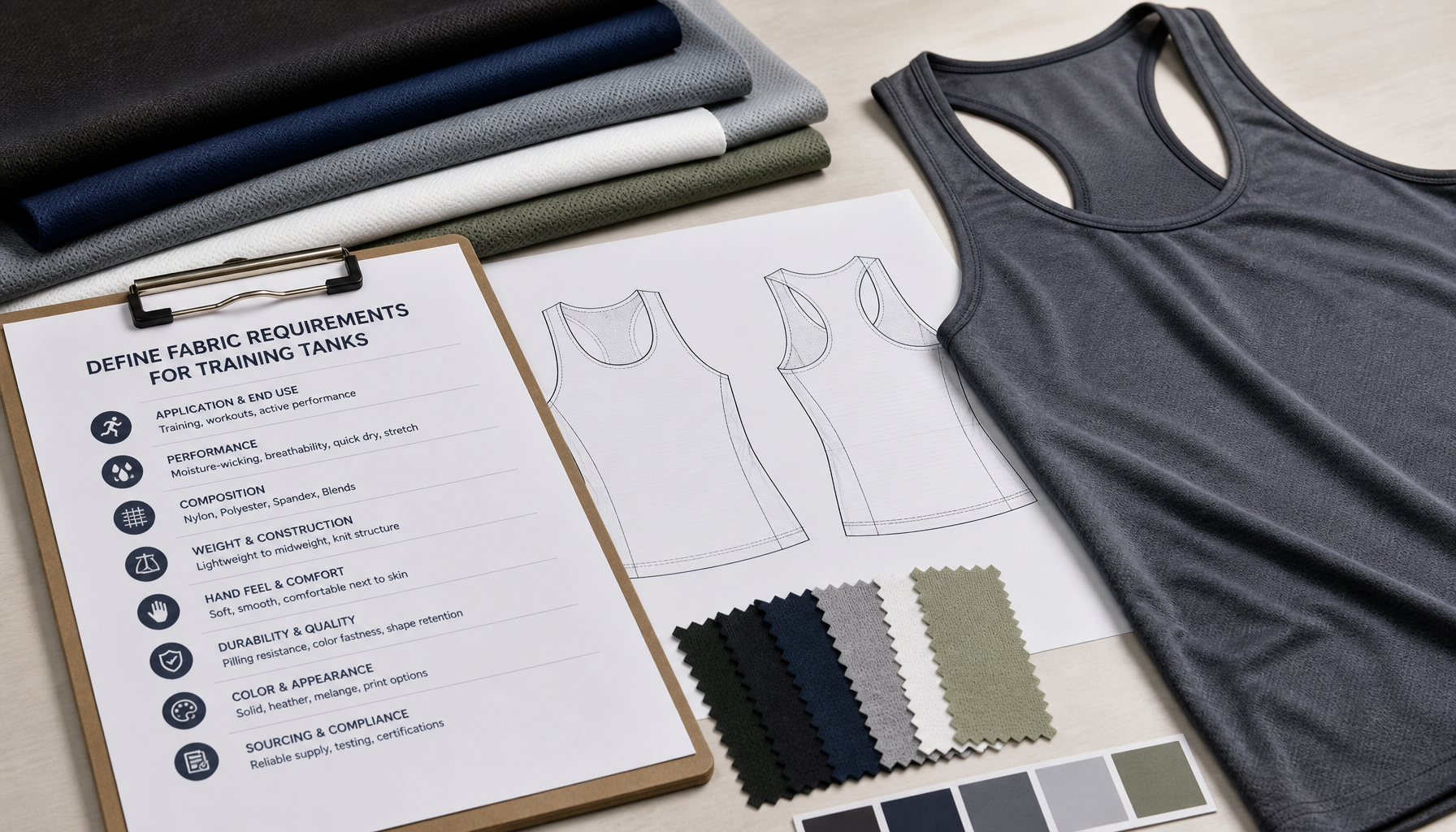
Define training-tank fabric from garment fit, armhole construction, movement, and required coverage before choosing composition or GSM. A loose gym tank and a fitted yoga tank need different balances of drape, recovery, ventilation, and edge stability.
Start at the armhole
Consider a fitted racerback tank used for overhead lifting. The chest and back panels extend during movement, while the armhole must return without gaping. An easy-stretch body fabric paired with stiff binding can restrict movement; a weak binding can distort the opening. Supply the fabric developer with the pattern, panel direction, binding method, and reference fit rather than requesting “high stretch” alone.
Choose coverage and weight together
A lightweight candidate can reduce garment mass, but its suitability depends on coverage in the selected color and at garment extension. For pale tanks, assess the finished garment under agreed lighting, both relaxed and stretched, and include wet-state assessment where relevant. A dense knit may improve coverage yet change drape and thermal comfort. GSM describes mass per area; it is not a direct measure of opacity or airflow.
Hypothetical calculation: if the cut panels contain 0.50 m² of body fabric, changing from 150 to 180 g/m² adds 0.50 × 30 = 15 g before binding, thread, labels, or decoration. This is a garment-weight comparison, not a consumption estimate including cutting waste.
Keep moisture claims distinct
Water spreading, drying time, and air permeability answer different questions. Ask which property supports the proposed claim and compare candidates using the same specimen preparation and test conditions. Polyester-spandex and nylon-spandex labels do not establish these results. Where performance depends on a finish, assess the agreed washed state as well as the delivered fabric.
Use a short sewing trial to expose hidden costs
Check armhole and neckline recovery after movement and care.
Review hem curl, seam puckering, needle damage and side-seam rotation.
Apply the intended print or transfer before approving appearance and dimensions.
Run the actual size mix at the minimum usable width to establish consumption.
A fabric that handles poorly during binding or cutting can consume more labor and produce more rejected garments despite a lower material price. Record the sewing setup and sample identity so the trial can be repeated when the material changes.
Send a specification the supplier can act on
Provide the silhouette, size range, fit reference, knit preference, target finished GSM, minimum usable width, color plan, binding method, and required care conditions. Separate mandatory performance limits from preferences. Request identified yardage for a complete tank trial, then freeze the approved construction and tolerances before placing the bulk order.
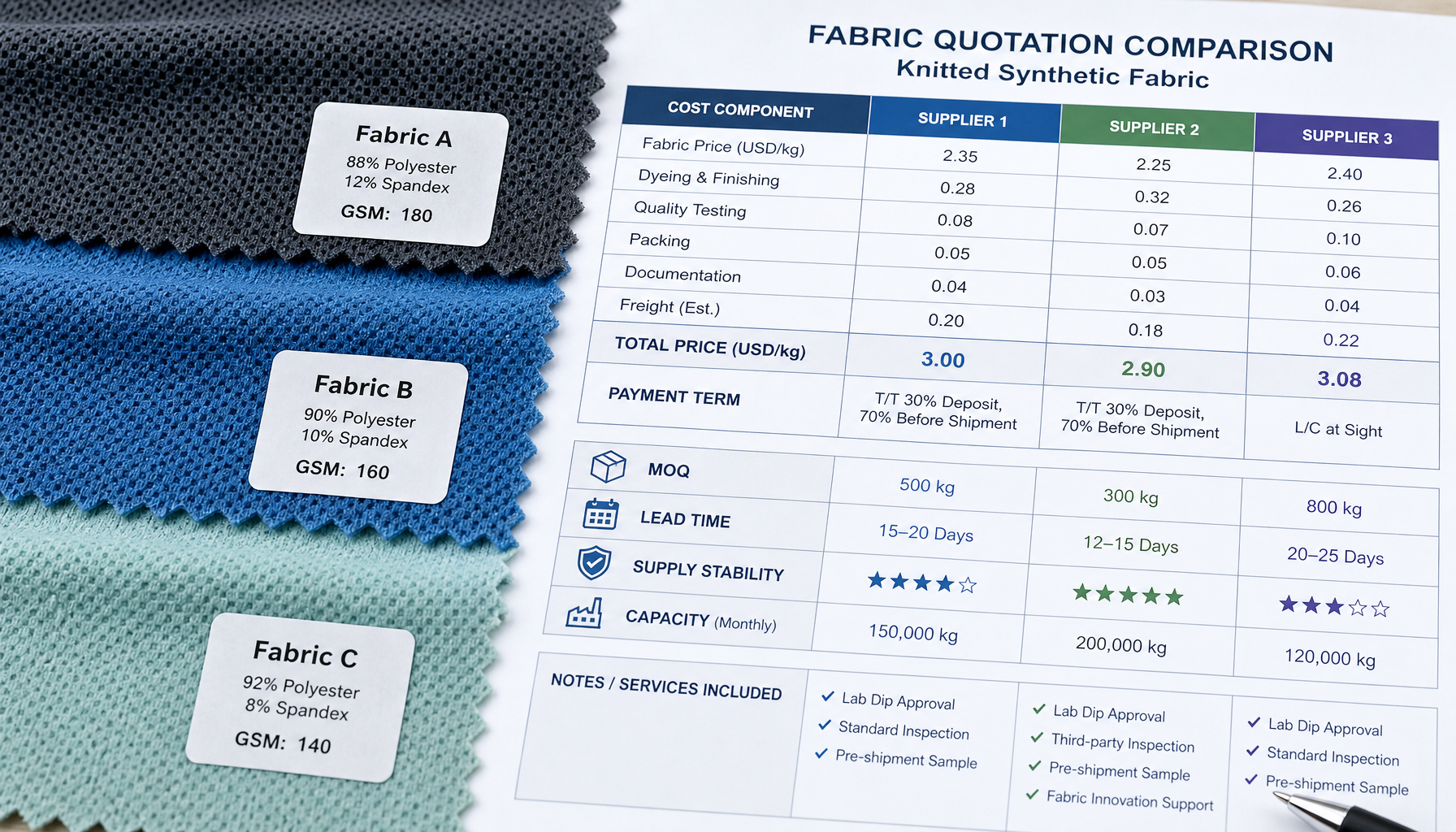
Compare fabric quotations by matching the technical specification, billing unit, order quantity, included services, and delivery scope before ranking prices. Then calculate material cost against the actual garment marker, including unusable edges and agreed production allowances.
Establish what each supplier is pricing
For a nylon-spandex leggings program, two offers with the same composition can cover different knit constructions, finished weights, widths, and finishing routes. Ask suppliers to identify the quoted sample and specification revision. A quotation for an unfinished base cannot be compared directly with a dyed, finished fabric whose recovery and appearance have already been approved.
Convert the price without hiding edge waste
Illustrative calculation: assume USD 8/kg, 200 g/m², and a total billed width of 1.60 m. One linear metre weighs approximately 0.200 × 1.60 = 0.320 kg and costs USD 2.56. If only 1.50 m is usable, the edge loss is still included in the paid weight; multiplying price by usable width alone would understate the cost.
If the production marker consumes 0.90 linear metres per garment at that usable width, baseline fabric cost is USD 2.304 per garment. Add documented spreading, defects, and other allowances without counting losses already included in the marker twice. These hypothetical figures assume uniform GSM and net fabric billing; verify whether cores and packaging are excluded.
Separate recurring cost from development cost
Quotation component
Question to resolve
Finished fabric
Which color, finish, width, tolerance and quantity does the price cover?
Development and samples
Is the charge per construction, color, trial or revision?
Testing and inspection
Which tests and lots are included, and who pays for retesting?
Packing and transport
Which costs are included up to the named delivery location?
Repeat orders
Does the quoted price depend on the first-order volume or yarn commitment?
Check minimums at color level
A program requiring several small colors can cost more than one large color even at the same total weight. Request the minimum per construction and per dye lot, small-lot charges, permitted quantity variation, and quote validity. No fixed kilogram-to-metre conversion applies across different weights and widths.
Close the gaps before awarding the order
Send shortlisted suppliers the same comparison sheet and ask them to mark exclusions explicitly. Keep technical acceptance separate from commercial ranking: a cheaper fabric that fails coverage, recovery, or the production marker is not an equivalent offer. Approve the sample reference, cost basis, inspection responsibilities, and treatment of nonconforming rolls together.
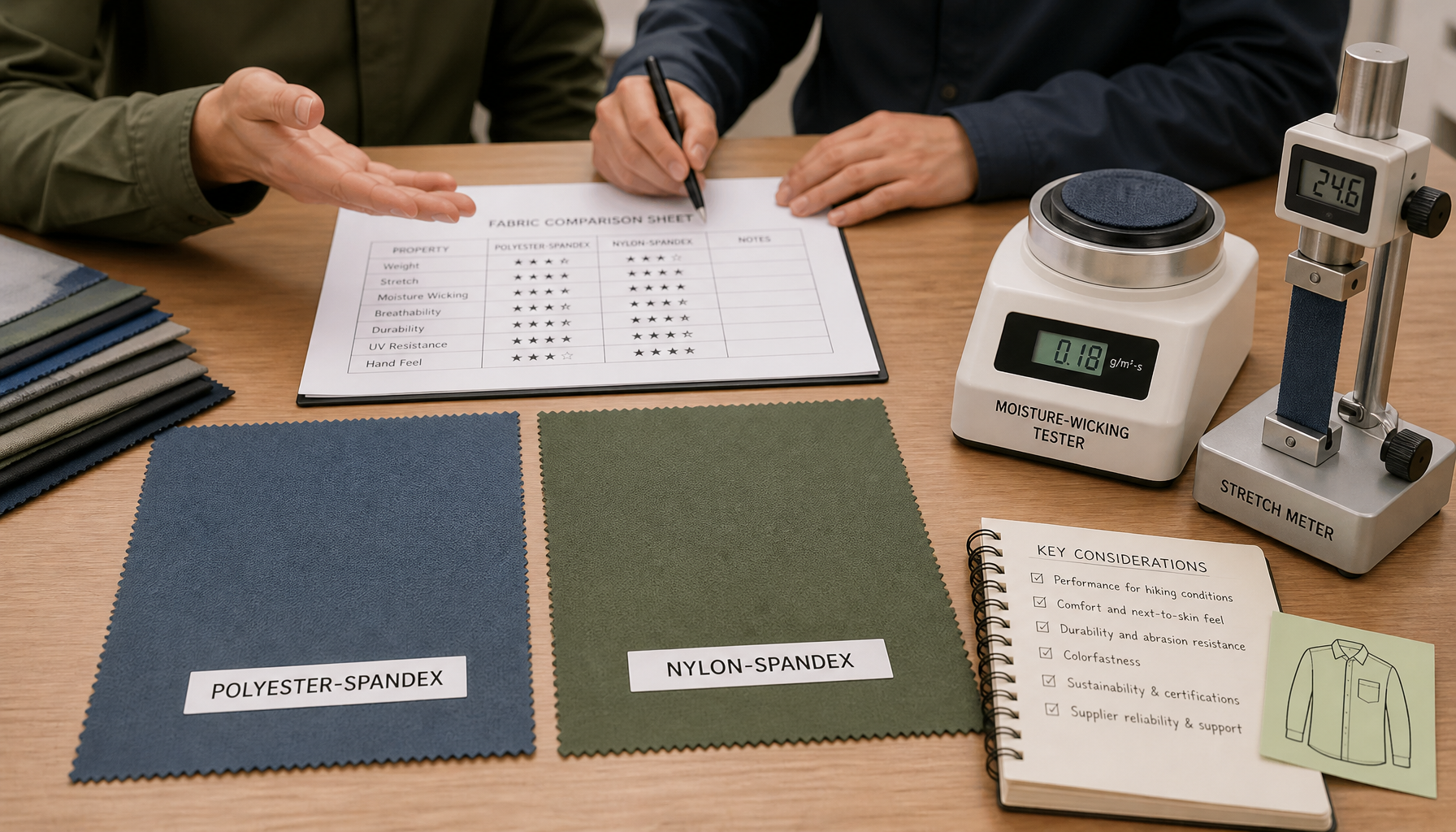
Helpful tips: Compare hiking-shirt fabric suppliers on verified performance under one specification, not on fiber content, feature lists, or price per kilogram. The brief should define climate, trip intensity, pack contact, garment fit, care conditions, finished GSM, usable width, stretch, drying or moisture requirements, durability, and optional finishes. Evaluate candidate fabrics in the intended garment, then audit how each supplier reproduces the approved construction across colors, lots, and repeat orders.
Hiking-shirt suppliers should be compared with the same fabric brief, test conditions, garment trial, and bulk-control requirements.
Define the hiking scenario
A lightweight shirt for humid day hikes, a close-fitting stretch top under a backpack, and a cool-weather trekking layer require different trade-offs. State expected temperature and humidity if the brand has a defined use range, exertion level, duration, pack weight and contact zones, layering, fit, sun exposure, and wash access. These inputs determine whether the project prioritizes airflow, drying, warmth, surface durability, low wet cling, stretch recovery, coverage, or garment mass.
Compare constructions, not generic fiber claims
Polyester-spandex and nylon-spandex can both support hiking apparel, but fiber names do not establish air permeability, drying time, abrasion resistance, snagging, hand, or recovery. Yarn form, filament size, knit structure, stitch density, dye route, and finishing matter. Require each supplier to disclose the finished composition, construction, GSM, usable width, stretch directions, surface treatment, and which performance claims depend on an optional finish. Compare only candidates developed for the same shirt and test matrix.
Build a risk-based verification matrix
Supplier evidence for hiking-shirt fabric
Use risk
Evidence to request
Garment check
Sweat and drying
Agreed moisture or drying method with full conditions
Wet cling and comfort during representative wear
Backpack contact
Relevant abrasion, pilling or snag evaluation
Shoulder and back-panel trial
Movement
Directional stretch and recovery results
Reach, arm lift, hem movement and fit retention
Repeated care
Dimensional stability, appearance and colorfastness
Measurement and appearance after agreed cycles
Optional claim
Method, acceptance limit and durability condition
Claim wording limited to verified evidence
Issue the same methods, specimen states, units, and acceptance criteria to every supplier. A report produced on another color or construction is background information, not approval evidence for the submitted fabric. When the brand lacks a limit, test several candidates under identical conditions, use a validated reference garment where available, and set the purchasing threshold from the chosen performance level. Avoid selecting the highest isolated value when overall comfort and durability require balance.
Compare total material cost
Illustrative calculation: a fabric at 145 GSM and 1.55 m usable width weighs 0.145 × 1.55 = 0.22475 kg per linear metre. At USD 8.20/kg, theoretical cost is approximately USD 1.84 per usable metre before cutting loss. A second fabric with a lower kilogram price may cost more per shirt if it is heavier, narrower, or less efficient in the graded marker. Replace these figures with actual quotations and marker consumption.
Verify optional finishes and their trade-offs
Odor-control, cooling, water-repellent, or UV-related claims should never be inferred from the base fiber. Ask whether the effect comes from construction, fiber, dyeing, or a finish; which test supports it; and how laundering changes the result. Evaluate any change in hand, shade, air permeability, wicking, print compatibility, cost, and lead time. Approving an untreated sample while ordering a treated bulk version creates a new material state and should trigger relevant revalidation.
Audit sample-to-bulk control
Ask each supplier how sample identity links to yarn, greige batch, dye lot, finishing route, test report, and finished rolls. Review controls for GSM, width, shade, bow or skew, defects, and relevant performance properties. Confirm change-notification rules for yarn source, settings, chemicals, plant, or subcontractor. Repeat-order capability should be judged from documented records and retained standards, not from a promise that the same fabric code will always behave identically.
Run a production-relevant trial
Request identified yardage sufficient for laboratory tests, decoration, spreading, sewing, fitting, backpack-contact evaluation, and the agreed care cycles. Test representative light and dark colors when color chemistry may affect results. Record every deviation before approval. Send ClothFactory or another supplier one RFQ containing the garment scenario, construction and dimension targets, performance matrix, forecast quantity, color plan, timeline, and bulk acceptance procedure so price and capability are evaluated on the same basis.
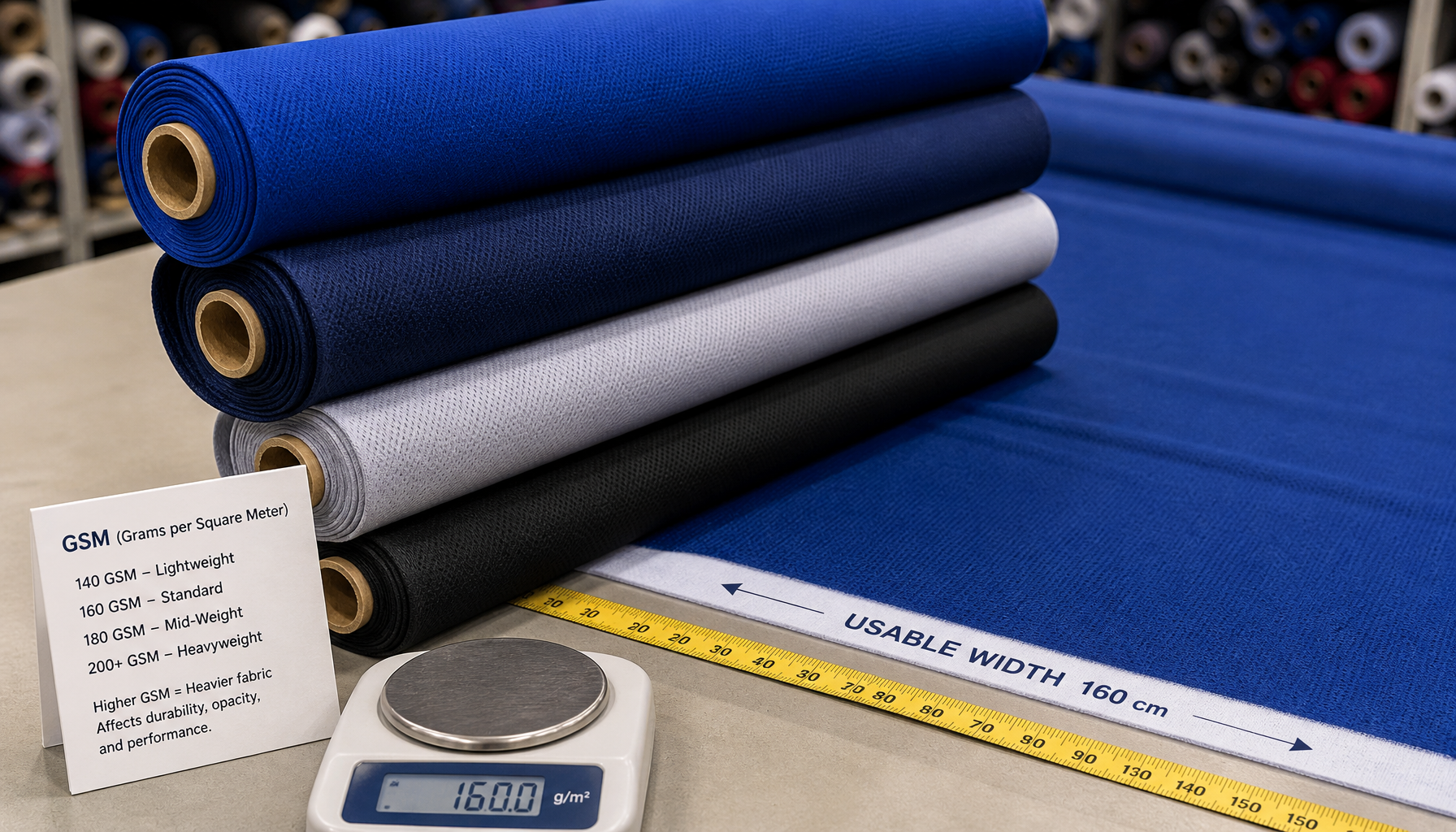
Please note: Choose team-jersey GSM from the required garment weight, coverage, climate, print process, and durability target; choose usable width from the actual graded marker. Do not approve either value in isolation. The purchasing specification should state finished GSM and usable width with tolerances, measurement conditions, and a rule for edge defects, because nominal width and quoted price per kilogram do not reveal the material cost per acceptable jersey.
GSM and usable width should be evaluated together because both influence garment weight, marker yield, and material cost.
Start with the jersey system, not a generic GSM range
A training jersey used in hot weather, a match jersey carrying dense sublimation graphics, and a contact-sport top do not impose the same material demands. Lower GSM can reduce garment mass but may reduce coverage, snag resistance, sewing stability, or print appearance. Higher GSM may improve structure yet increase heat burden and drying time. Define the sport, fit, climate, contact level, decoration process, panel construction, and target garment mass before asking a supplier to recommend a polyester-spandex or nylon-spandex knit.
Translate GSM into estimated garment mass
Illustrative calculation: if the marker uses 0.78 m² of fabric per jersey and the selected fabric is 150 g/m², the theoretical fabric mass is 0.78 × 150 = 117 g before cutting loss, trims, thread, printing, and process allowances. At 180 g/m², the same area contributes 140.4 g, or 23.4 g more. This calculation does not identify the better fabric; it shows how a GSM decision changes the finished product and should be checked against a sewn sample.
Define usable width from the graded marker
Usable width is the defect-free cutting width after excluding edges that cannot be spread or cut reliably. Ask the marker team to test the complete size ratio, including names, numbers, stripe direction, print registration, and grain requirements. A wider roll provides no benefit if the extra edge is distorted or cannot accommodate another panel. Conversely, a small width difference can change whether two body panels nest side by side, causing a step change in consumption rather than a gradual one.
Compare cost on an equivalent basis
Illustrative calculation: fabric at 160 GSM with a 1.55 m usable width weighs 0.160 × 1.55 = 0.248 kg per linear metre. At USD 7.50/kg, the theoretical cost is USD 1.86 per usable metre. This remains incomplete until marker consumption and cutting loss are known. If a narrower quality requires more length per jersey, its lower kilogram price may still produce a higher fabric cost per garment.
Inputs needed before approving team-jersey GSM and width
Input
Why it changes the decision
How to verify
Finished GSM
Affects garment mass, coverage and handling
Conditioned measurement across representative positions
Usable width
Controls panel nesting and marker efficiency
Measure defect-free width under agreed tension
Print or decoration
May change opacity, hand and dimensional behavior
Approve decorated garment, not blank fabric alone
Size ratio
Changes marker utilization
Run the production size mix through the marker
Dimensional stability
Changes post-process panel dimensions
Test after the agreed wash or heat exposure
Write tolerances and measurement conditions
Specify whether GSM is measured on conditioned finished fabric and how many positions are checked. Define usable width as a minimum acceptable cutting width, not merely total laid-flat width, and state whether edge curl, pin marks, shading, holes, or distortion reduce it. The purchase order should also cover width variation within and between rolls, because an average can pass while individual sections are too narrow for the approved marker. Agree on the action for nonconforming rolls before shipment.
Validate with production-relevant samples
Request enough identified yardage to print or decorate, relax, spread, cut, sew, wash, and fit the full jersey size range. Measure GSM and usable width before and after relevant processing, then compare actual marker consumption with the estimate. Approval should link the physical fabric standard to numerical tolerances and the finished garment result. A hand swatch can screen color and touch, but it cannot establish cutting yield, printing response, or size stability.
RFQ fields for a comparable quotation
Send suppliers the sport and climate, garment fit, composition preference, knit structure, target finished GSM and tolerance, minimum usable width, size ratio, decoration route, dimensional-stability requirement, color plan, test methods, forecast volume, and acceptance procedure. ClothFactory can use these inputs to match or develop candidate knitted stretch fabrics. The buyer should award the order only after measured width, marker yield, decorated appearance, and garment performance meet the same written approval basis.
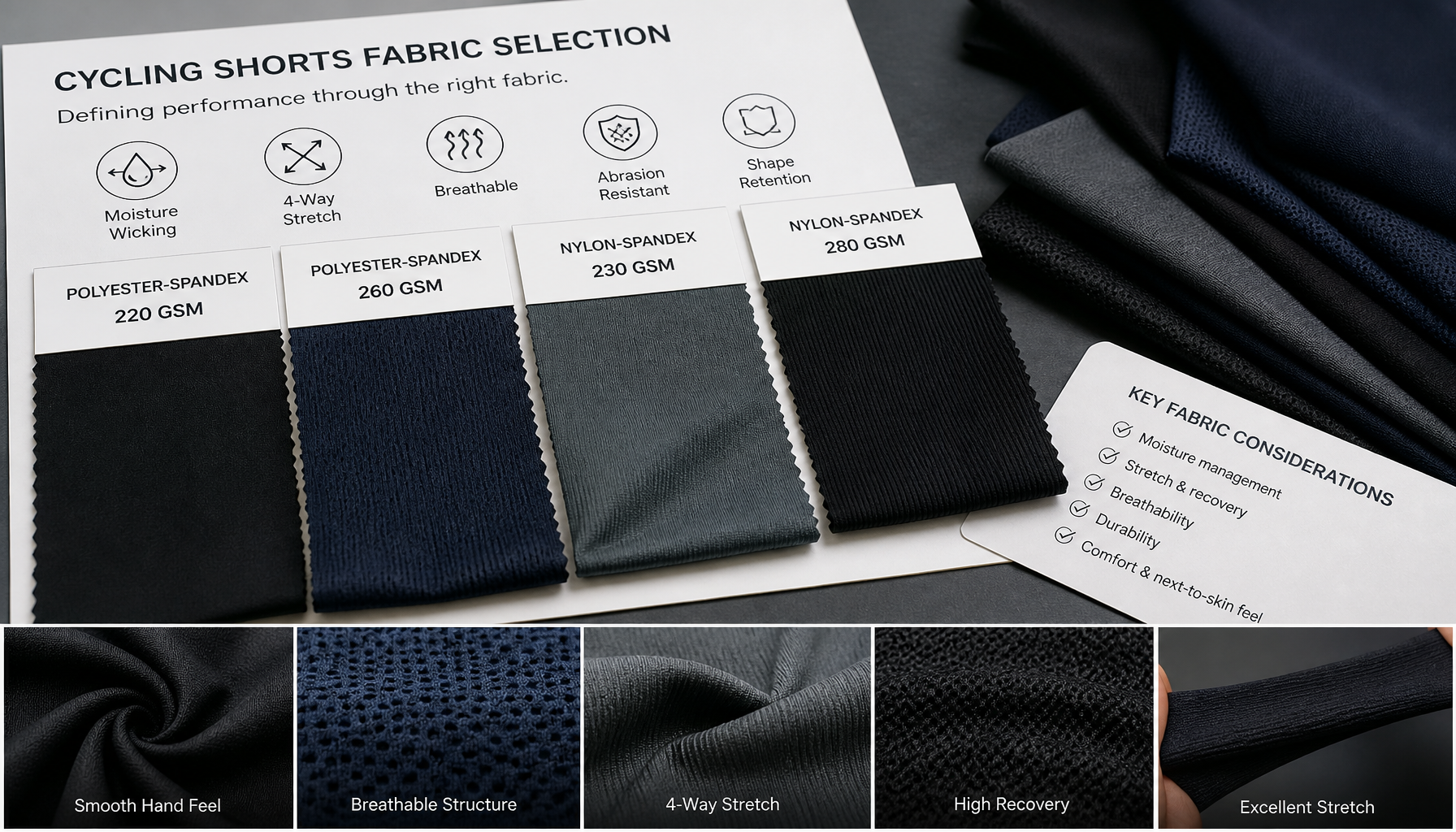
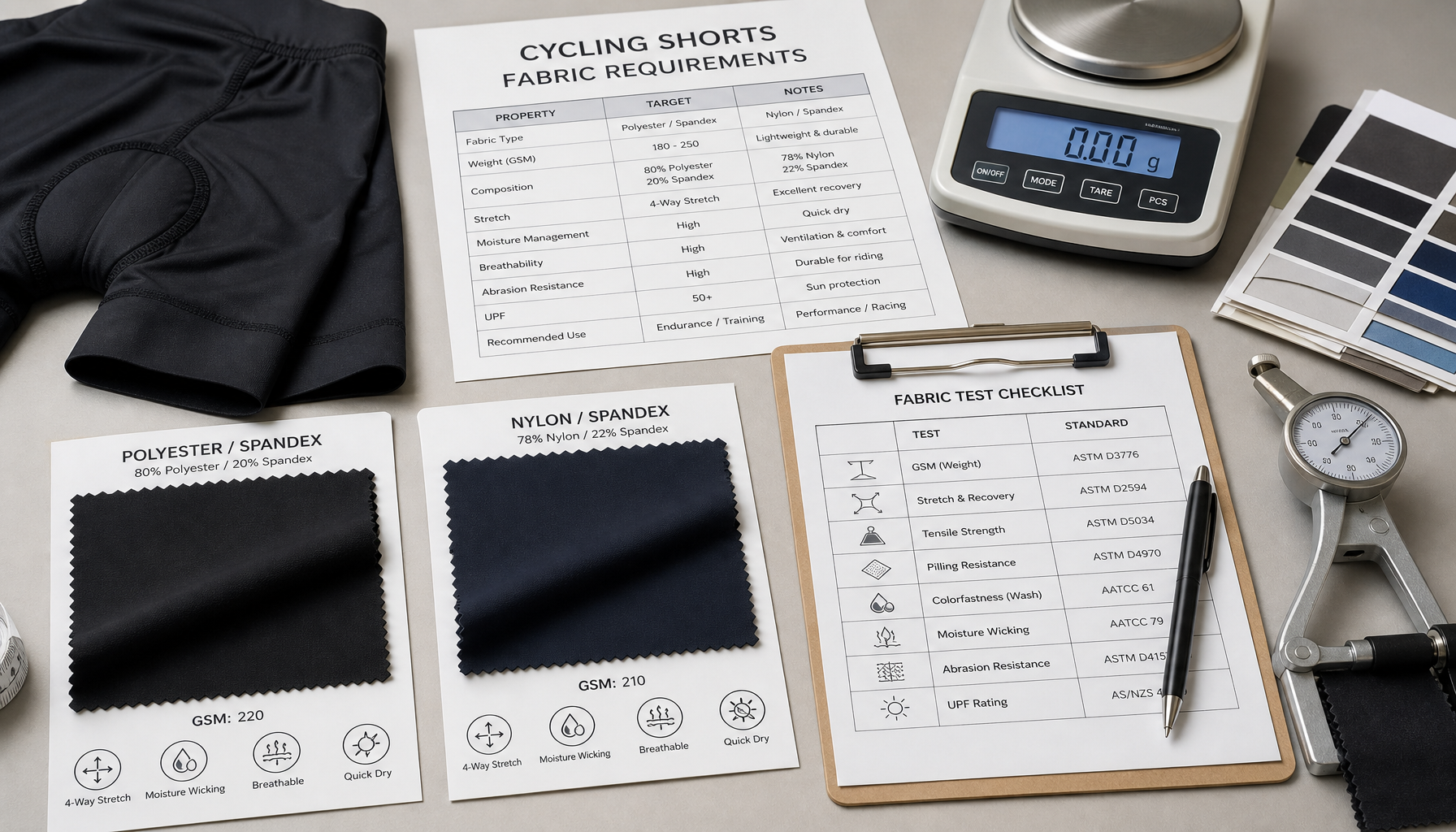
A cycling-short fabric specification should define riding discipline, garment fit, panel orientation, support, stretch and recovery, opacity at use extension, skin-contact comfort, finished GSM, usable width, durability, moisture and drying requirements, color, and care conditions. Buyers should validate the fabric in a sewn short with its chamois, seams, and waistband. Fiber percentage and a hand swatch cannot predict pressure, movement, coverage, or fit retention in the riding position.
Cycling-short fabric requirements should begin with riding position, panel strain, support, coverage, and contact-zone durability.
Describe the cycling application
State whether the garment is for road, indoor, commuter, gravel, or mountain use; the expected ride duration; climate; compression intent; size range; and whether it is a bib or waist short. Include chamois construction, pocket load, panel count, seam type, and high-abrasion zones. The forward-flexed riding posture stretches hip and seat panels differently from standing fit, so requirements must be based on the actual garment geometry and intended motion.
Specify stretch by direction and panel orientation
Define the required extension and recovery in the directions used around the body and along the leg. Provide the supplier and laboratory with panel orientation, test method, load or extension, cycle count, hold time, relaxation time, and allowable growth. “Four-way stretch” is not an acceptance criterion. A fabric can extend easily yet recover poorly, creating knee, seat, or waistband bagging after prolonged riding. Compare directional data under identical conditions and confirm it in fit trials.
Seat, thigh, waistband, pocket, and chamois zones impose different extension, recovery, opacity, and abrasion demands.
Set coverage at the intended extension
Opacity should be assessed in the approved color while the fabric is stretched to a condition representative of the finished garment. A flat, relaxed swatch can hide show-through caused by reduced stitch coverage, pale shades, print, wetting, or excessive negative ease. Define the specimen extension and viewing or instrumental method, then confirm the result on the sewn garment in the riding posture. Passing one dark color does not automatically approve pale or printed colorways.
Balance support, mass, and thermal comfort
Higher GSM can improve coverage and structure but may increase garment mass, drying time, and heat burden; lower GSM may improve lightness while reducing support or durability. Knit density and yarn selection matter alongside weight. Establish a target from reference garments and trial fabrics rather than using a generic range. Ask the supplier to state finished GSM with tolerance and measure representative positions after conditioning and any relevant heat or wash exposure.
Convert the fabric choice into garment mass
Illustrative calculation: if the cycling-short marker uses 0.62 m² and the fabric is 230 GSM, theoretical fabric mass is 0.62 × 230 = 142.6 g before cutting loss, chamois, elastic, pockets, thread, and trims. At 250 GSM, the same area contributes 155 g, or 12.4 g more. This does not decide performance; it quantifies a weight trade-off that should be reviewed with coverage, support, drying, and fit.
Control skin contact and durability
Evaluate the skin-contact face, seam interaction, edge behavior, wet cling, pilling, abrasion, snagging, and surface change after the intended care cycles. Seat and inner-thigh zones may require more attention than low-contact panels. If the garment uses sublimation, transfer printing, silicone grippers, bonding, or adhesive films, process representative fabric before approval because heat and chemicals can change shade, stretch, recovery, hand, or dimensions.
Cycling-short fabric specification fields
Field
Required purchasing detail
Construction
Composition, knit, face, reverse and finished state
Dimensions
Finished GSM, minimum usable width and tolerances
Mechanical behavior
Directional stretch, recovery or growth, and test conditions
Appearance
Color, opacity at extension, luster and physical standard
Durability
Care procedure and relevant pilling, abrasion and stability criteria
Bulk control
Sampling frequency, roll limits, traceability and change notification
Approve through a garment trial
Request enough identified yardage for testing, marker work, sewing, fit sessions, riding evaluation, decoration, and repeated care. Assess multiple sizes or the highest-risk sizes, and record the chamois, seam, elastic, and panel orientation used. Send ClothFactory or any candidate supplier the full use case, specification, color plan, forecast quantity, tests, and approval stages. Release bulk production only when the physical standard, numerical results, and finished-short performance refer to the same fabric version.