博客

  • What to Confirm Before Requesting Fabric Samples

    What to Confirm Before Requesting Fabric Samples


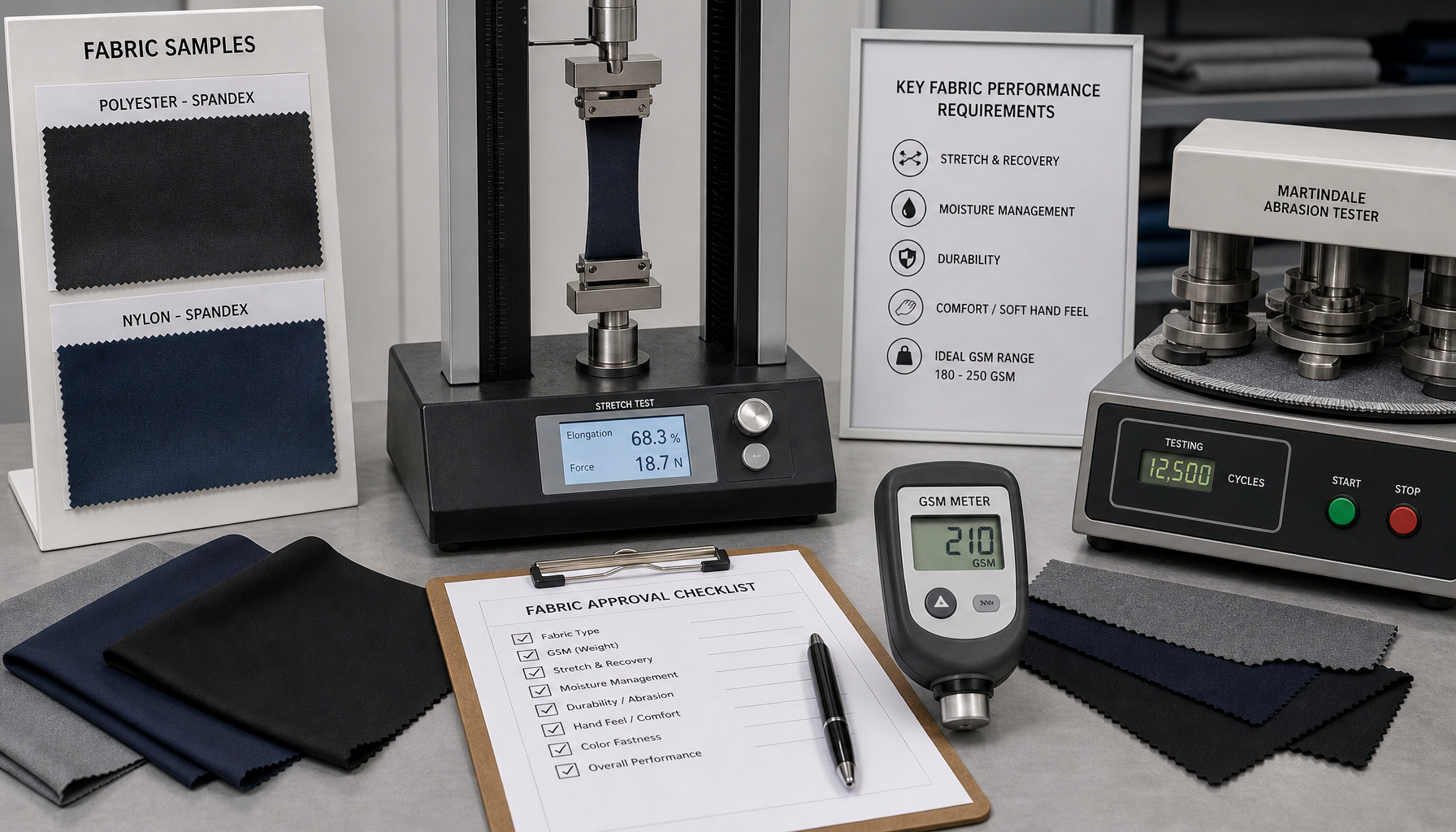
    Before requesting fabric samples, an apparel buyer should give the supplier enough information to screen out unsuitable materials. At minimum, define the garment, target construction and composition, GSM and usable width, stretch direction, color, finish, care conditions and tests required for approval; otherwise, receiving many swatches creates activity without producing a comparable sourcing decision.
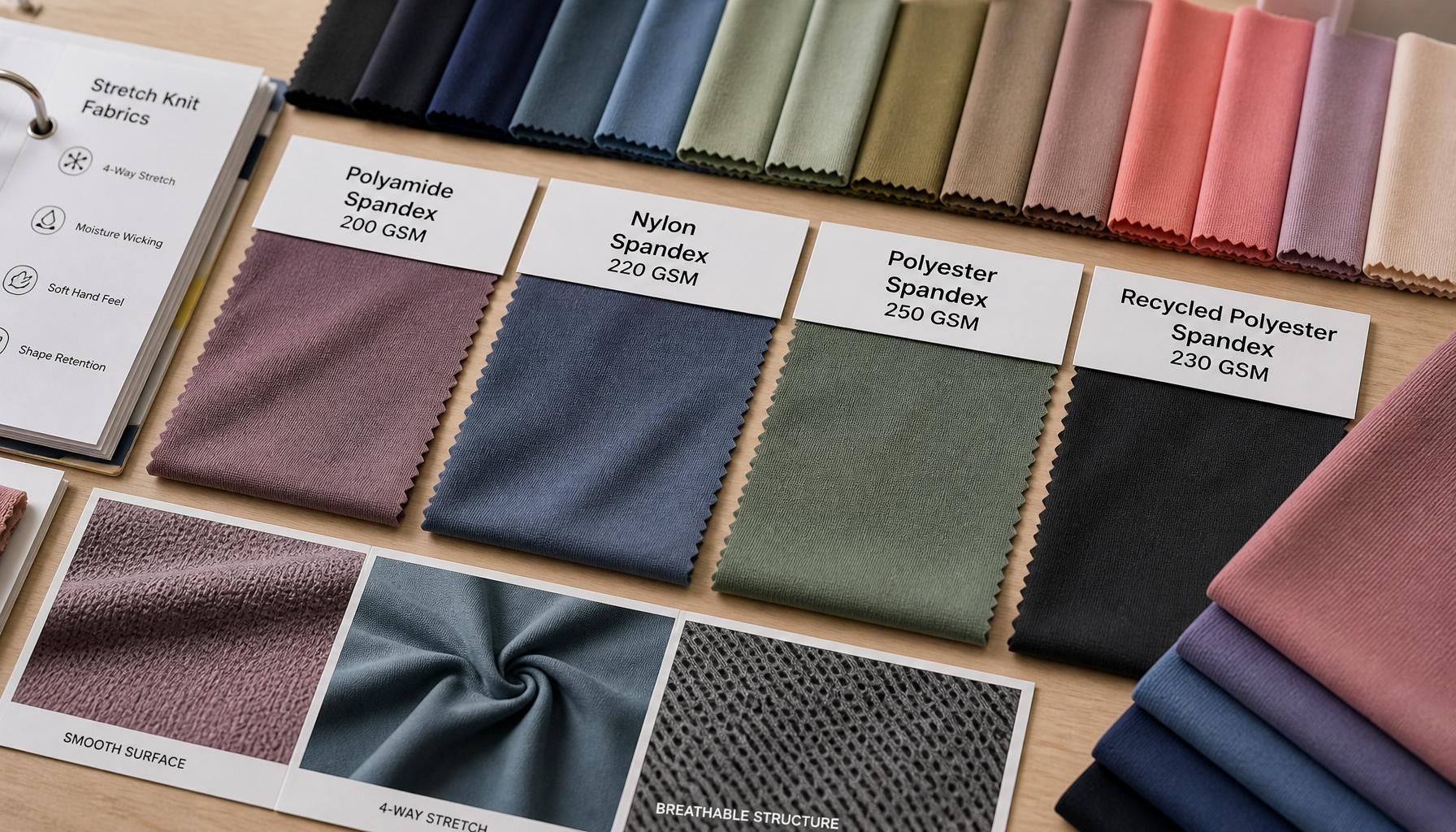
    Illustration: Fabric swatches reviewed against an apparel development brief
    Illustrative image; not a test record or production evidence.

    Start With the Garment, Not a Generic Fabric Name

    “Fabric for activewear” is too broad for useful sampling. A running shirt, sports bra and yoga legging place different demands on coverage, stretch, recovery, support and surface durability. State the garment zone and expected use, including whether the material touches skin, carries elastic tension, faces repeated abrasion or must remain opaque under strain. This lets the supplier explain why a candidate fits instead of sending whichever swatches are readily available.

    Define the Technical Comparison Fields

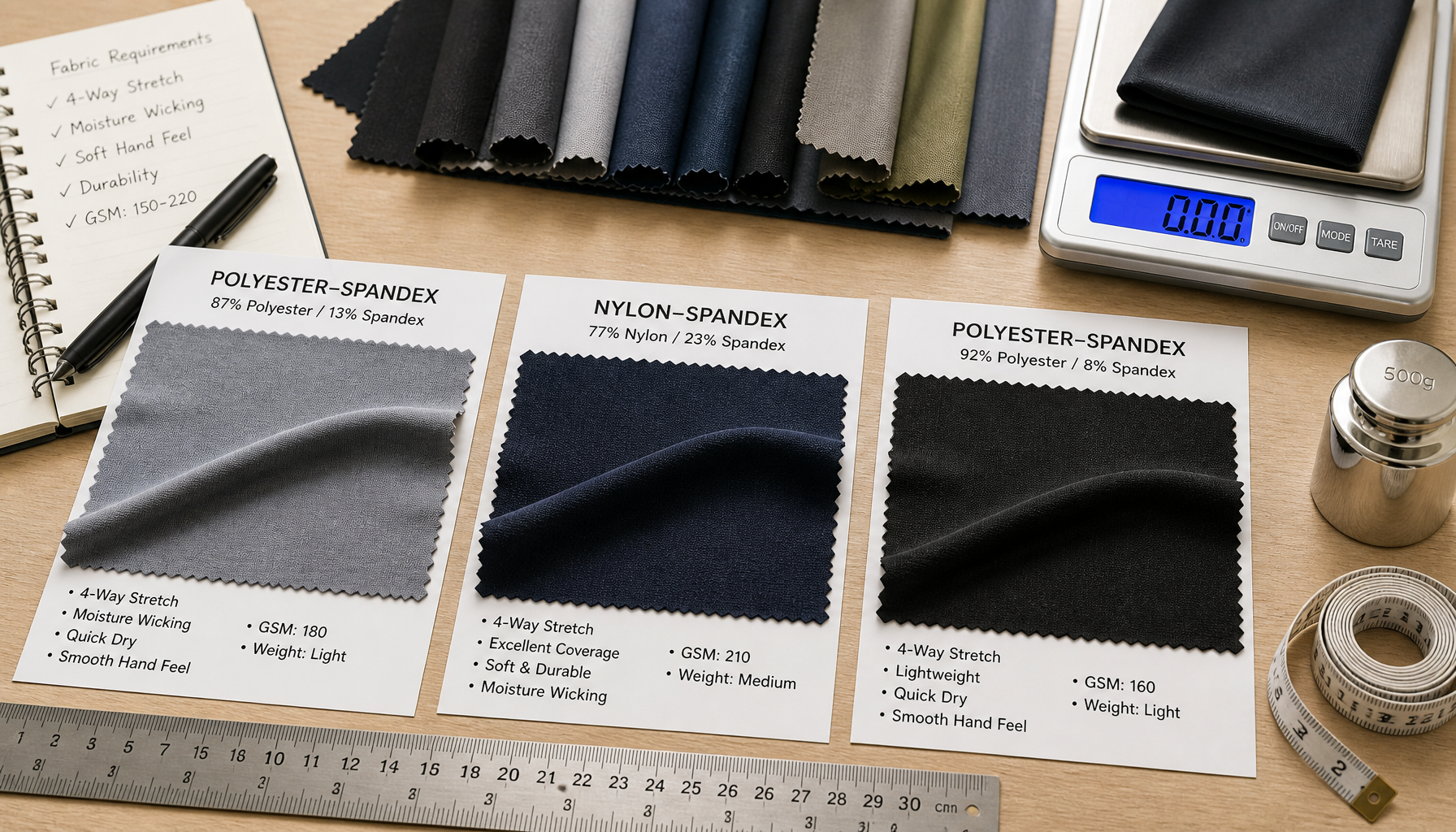
    Ask every supplier to report the same fields: fiber content, knit structure, finished GSM, usable width, stretch and recovery by direction, finishing route and recommended care. Specify whether width is open, tubular, relaxed or usable after excluding unstable edges. Numbers collected under different definitions cannot support a fair comparison, even when they appear in the same spreadsheet.

    Separate Core Construction From Optional Finishes

    List moisture management, cooling, antibacterial treatment, brushing or other finishing requirements separately from the base fabric. Ask whether each property comes from fiber, structure or an applied finish and how it should be verified after laundering. A swatch with an attractive initial hand feel does not prove that an optional finish will remain effective through the product’s intended care cycle. For finish-related evidence, see comparing supplier reports for moisture management.
    Illustration: Buyer comparing stretch fabric samples and specification records
    Illustrative image; not a test record or production evidence.

    Agree on the Sample’s Purpose

    Clarify whether the request is for an available quality swatch, a color lab dip, sample yardage or a production-representative approval lot. These materials answer different questions. A small swatch can confirm color direction and surface character, but it cannot support a full marker, garment wash trial or statistically meaningful bulk inspection. Record what the sample is allowed to approve and which decisions remain open. A sample-yardage plan is compared in how buyers compare sample-yardage plans across fabric suppliers.

    Confirm Commercial Conditions Before Development

    Ask for MOQ by quality and color, sample charges, development charges, estimated sampling sequence, bulk lead-time assumptions, payment terms and how repeat colors are controlled. Do not rely on a generic MOQ copied from another fabric because yarn availability, dyeing route, color and finishing can change the production threshold. Request written confirmation for the specific quality and color plan under review.

    Sample Request Checklist

    • Garment type, target consumer and use conditions
    • Composition, knit structure, GSM and usable width targets
    • Stretch direction, recovery, coverage and hand-feel requirements
    • Color standard and approval method
    • Optional finishes and durability conditions
    • Required fabric and garment tests
    • Expected order quantity and color breakdown
    • Sample type, quantity and decision deadline

    Approval Gate

    Issue one written sample brief and assign a reference to every received candidate. Record deviations instead of silently accepting them, then move only technically suitable materials into garment sampling. ClothFactory can use this information, submitted through the contact page, to match existing options or discuss development, while the buyer retains a traceable record connecting the original requirement, physical sample, test results and eventual bulk approval.
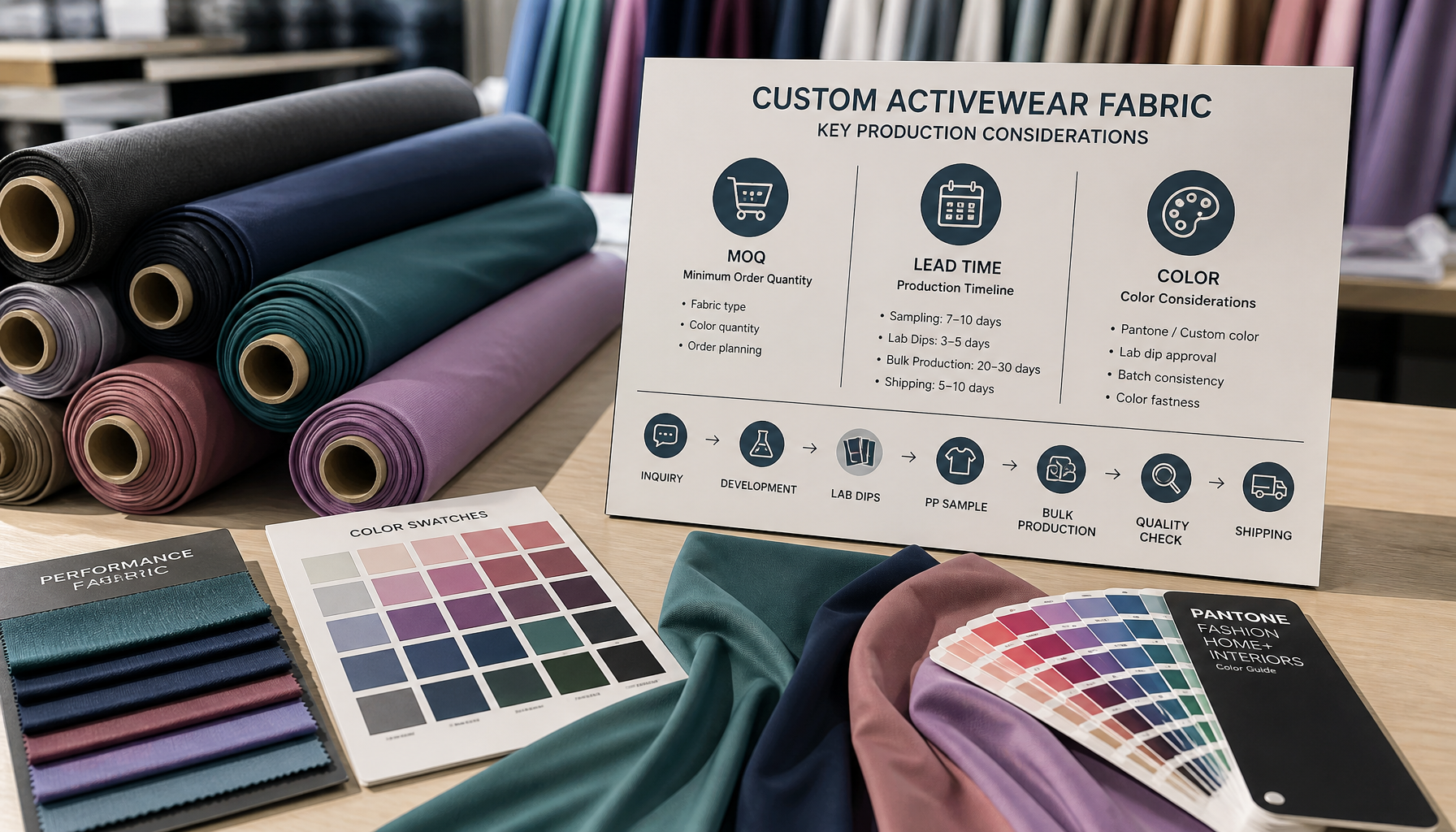
  • MOQ, Lead Time and Color Planning for Custom Activewear Fabric

    MOQ, Lead Time and Color Planning for Custom Activewear Fabric


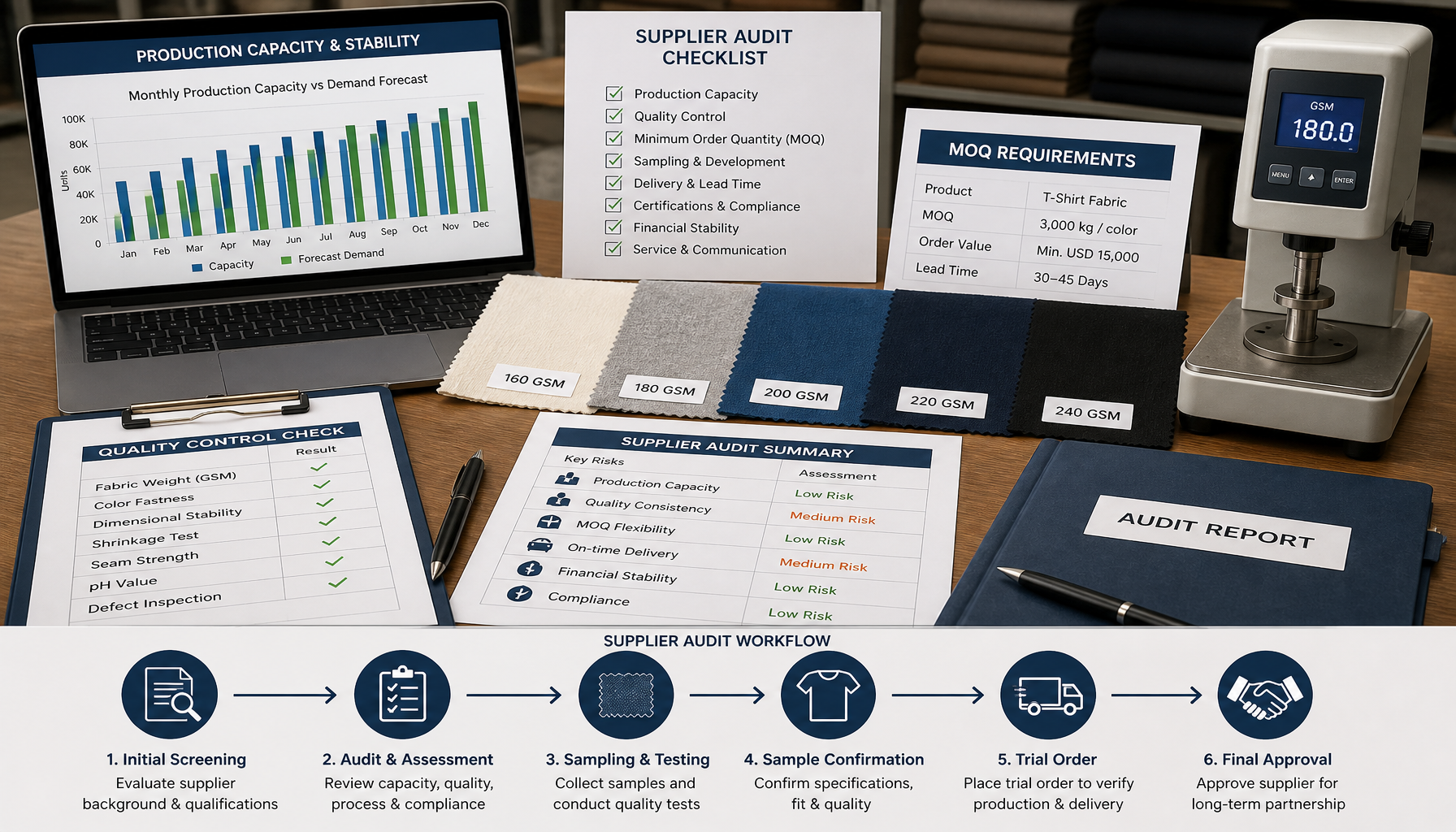
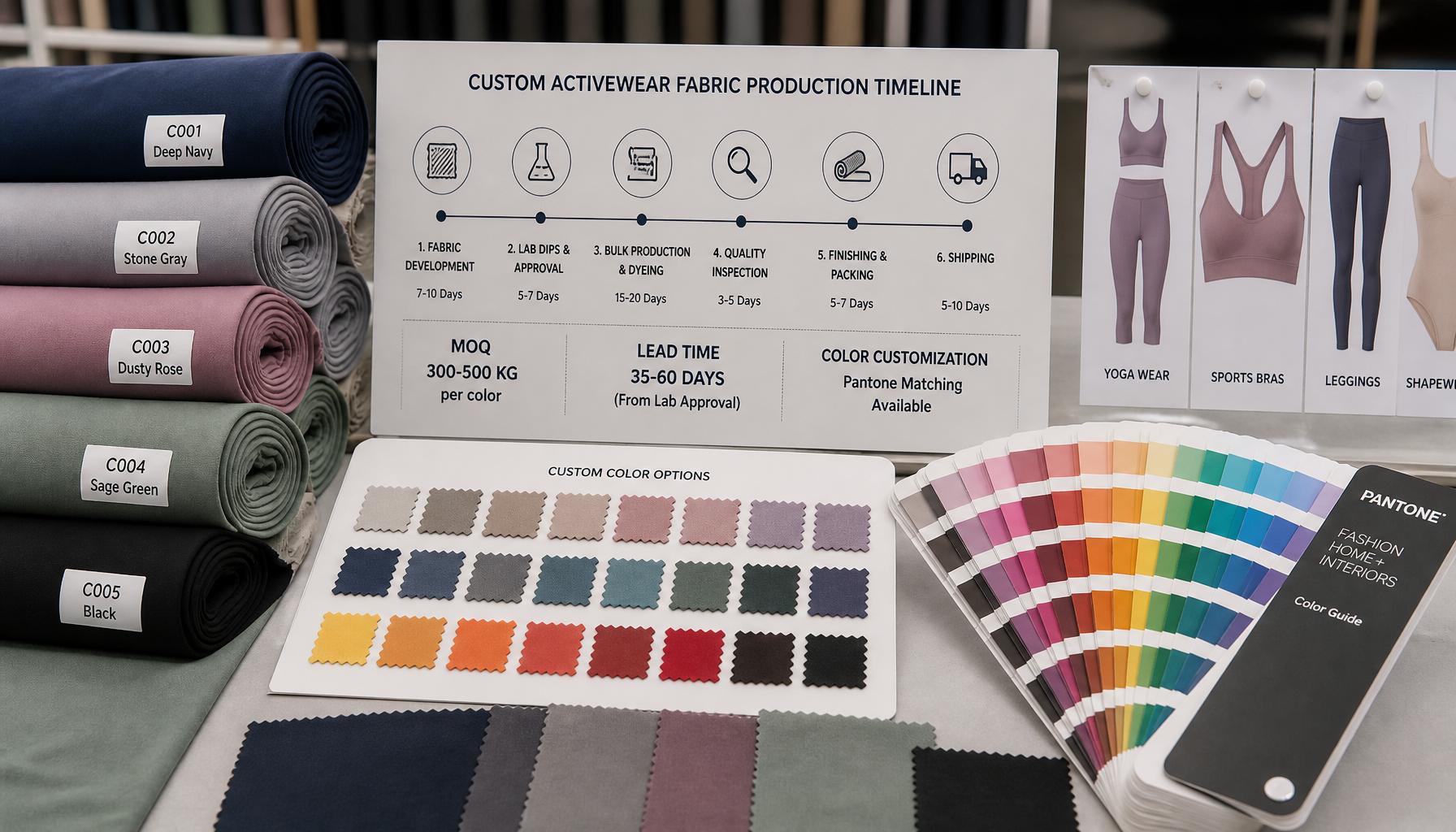
    Custom activewear fabric should not enter development until MOQ, lead-time assumptions and color approval responsibilities are confirmed for the specific construction and finishing route. These three variables interact: increasing the number of colors can divide volume below a workable dye-lot quantity, while color corrections or added finishes can extend the schedule beyond the buyer’s launch plan.

    Illustration: Activewear fabric development plan showing color and production requirements
    Illustrative image; not a test record or production evidence.

    Treat MOQ as a Production Condition

    MOQ may be stated by fabric quality, color, dye lot, weight or length, so a single headline number is not enough. Ask whether the quoted minimum applies to one color and one finishing route, and whether greige, yarn or special chemical commitments create separate thresholds. A buyer dividing one order among several colors must verify each color independently rather than assuming the combined quantity satisfies production conditions. The policy risks are reviewed in assessing the minimum order quantity policy.

    Model the Color Plan Before Sampling

    Use a simple allocation check before approving a palette. In an illustrative example, a planned order of 900 kg divided equally among six colors gives 150 kg per color; changing to nine colors reduces each allocation to 100 kg. This arithmetic does not establish any supplier’s MOQ, but it shows why a larger total order can still fail a per-color requirement and create surcharges or excess inventory.

    Illustration: Color swatches arranged for custom activewear fabric approval
    Illustrative image; not a test record or production evidence.

    Build Lead Time From Approval Gates

    Do not ask only for “days to delivery.” Request a dated sequence covering technical confirmation, sample preparation, lab dip submission, buyer review, corrections, bulk production, inspection and dispatch. Identify which steps can overlap and which begin only after written approval. The delivery commitment should also state what happens when the buyer changes color, construction, quantity or test requirements after sampling has started. Commercial terms should be compared on a like-for-like basis; see comparing fabric quotes when GSM, width and finishing differ.

    Define Color Approval Evidence

    Name the color reference, substrate, light sources, visual or instrumental tolerances and approval authority. Confirm whether approval applies to a lab dip, sample yardage or bulk dye lot. Stretch fabrics should be assessed relaxed and at the extension relevant to the garment because surface coverage and perceived shade can change under strain. Different fiber blends and finishes may also require separate standards.

    Commercial Trade-Offs

    Adding colorways can support merchandising but increases the number of approvals, dye lots and shade-control points. Selecting a lower MOQ option may raise unit cost or narrow the available construction and finish choices. A faster schedule may reduce time for corrections and garment testing. Buyers should choose the combination that protects the launch and acceptable-garment cost, not optimize each variable independently.

    Buyer Risk Check

    • Obtain MOQ in writing for each quality, color and finish.
    • Distinguish sample timing from bulk production and shipping time.
    • Reserve buyer review time in the calendar.
    • Define shade bands and whether mixed shades can enter one garment order.
    • Reconfirm lead time after every material change.
    • Do not treat a reference color library as proof of ready stock.

    Information to Confirm With ClothFactory

    Submit the construction, composition, GSM, usable width, finish, target quantity, color breakdown, reference standard, required tests and delivery destination. ClothFactory can then confirm applicable development steps and commercial conditions through the contact page. No MOQ or lead-time value should be treated as fixed until it is tied to that exact requirement and recorded in the quotation or order confirmation.

  • Fabric Width, Roll Length and GSM Tolerances for Purchase Orders

    Fabric Width, Roll Length and GSM Tolerances for Purchase Orders


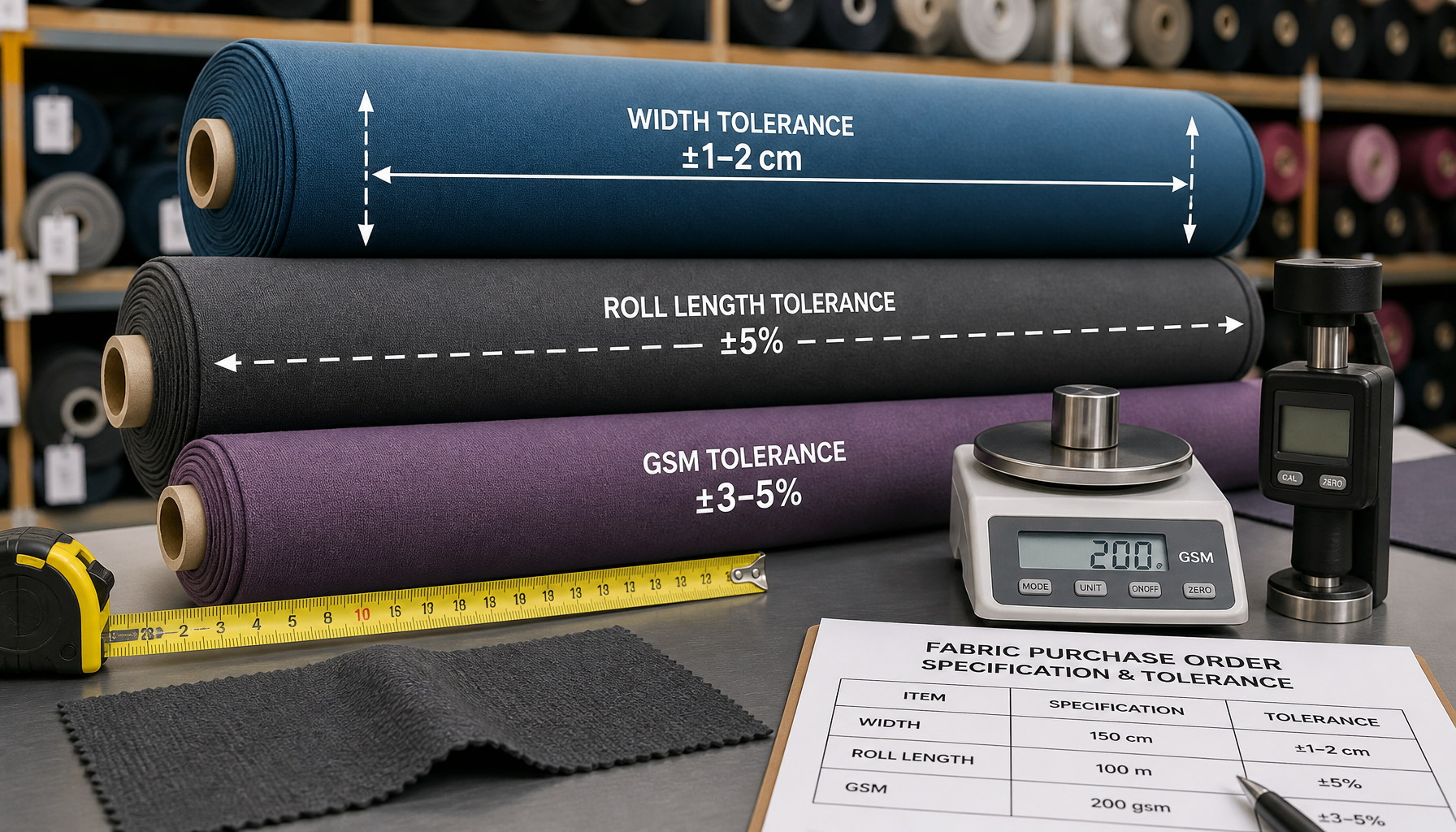
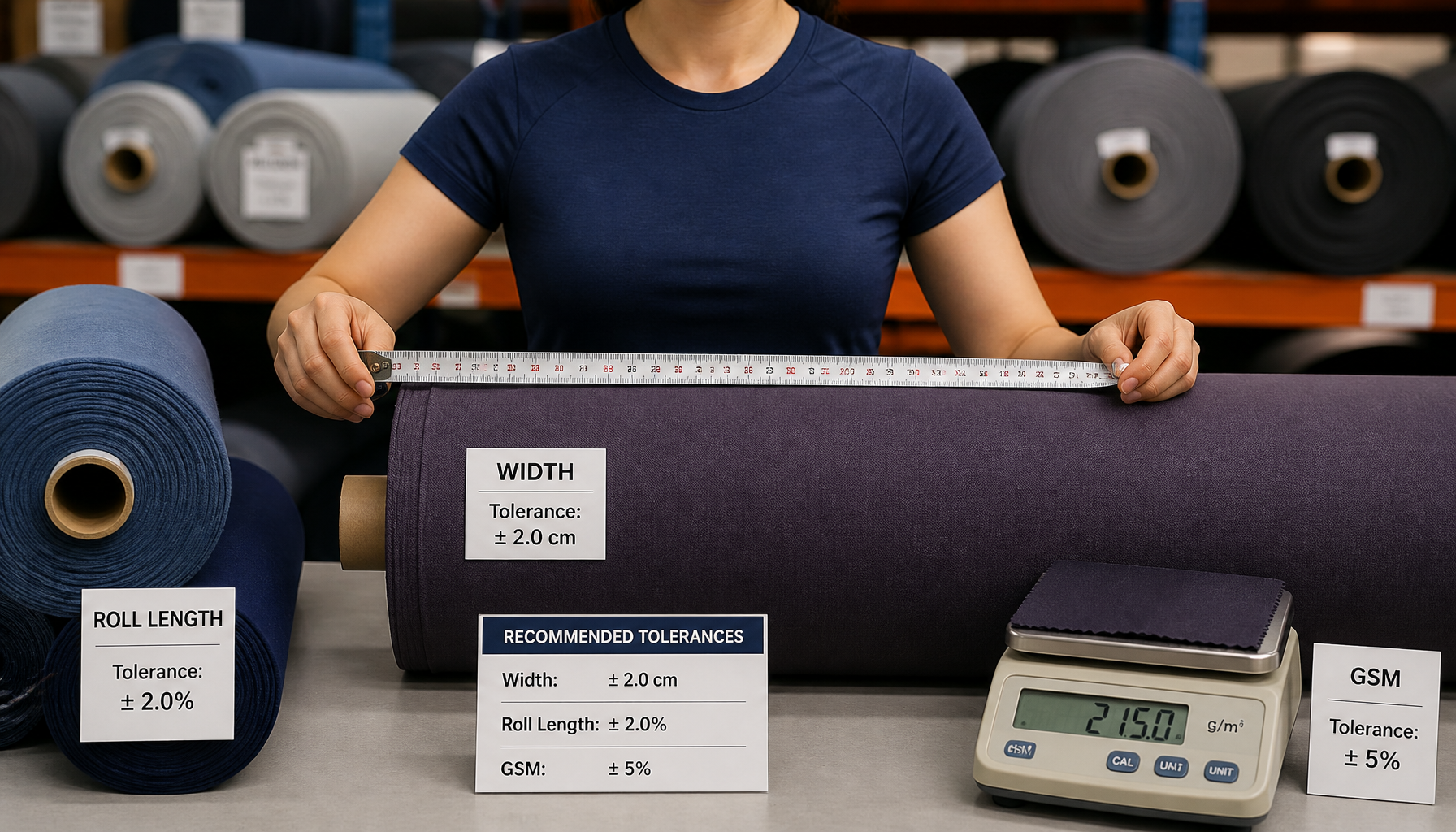
    An activewear fabric purchase order should state target values, tolerances, measurement methods, sampling rules and remedies for usable width, roll length and GSM. A tolerance copied from another fabric is not automatically suitable; the limits must reflect the approved sample, cutting plan, garment sensitivity and supplier’s demonstrated process capability.

    Illustration: Fabric roll specification reviewed for width, length and GSM tolerances
    Illustrative image; not a test record or production evidence.

    Define Width Before Setting a Limit

    State whether the value means total width, cuttable width or usable width after excluding curled, distorted or damaged edges. Also define how the fabric is relaxed, where measurements are taken and how many readings are required per roll. For stretch knits, tension during measurement can create a misleading result, so the agreed procedure matters as much as the numerical tolerance. ISO 22198 covers determination of fabric length and width, and ISO 3801 or ASTM D3776 covers mass per unit area; the purchase order must still define sampling, conditioning and tolerances.

    Treat Roll Length as an Inventory Variable

    Specify the permitted roll-length range, maximum number of short rolls, minimum piece length, joint policy and how actual delivered length is recorded. Total order quantity alone does not protect cutting efficiency. A shipment can meet total meters while creating excessive handling and end loss if it contains many short rolls, so roll distribution should be an explicit acceptance field.

    Illustration: Quality-control measurements recorded for an activewear fabric roll
    Illustrative image; not a test record or production evidence.

    Connect GSM to Garment Risk

    GSM affects garment weight, drape, coverage and material consumption, but it does not independently predict stretch or durability. Define specimen size, conditioning, sampling locations and whether the result is reported per reading or as a lot average. An average can conceal rolls outside the approved range, so the purchase order should distinguish individual-roll limits from any shipment-average requirement. For the deposit-stage check, see how to verify GSM tolerance before paying a fabric deposit.

    Calculate the Commercial Effect

    An illustrative example shows why width matters: if an approved marker requires 1.20 m at a usable width of 160 cm, a roll measuring 156 cm may force a different layout rather than merely creating a 2.5% width loss. The actual consumption increase must be recalculated with the garment pattern. Buyers should therefore connect width tolerance to marker feasibility, not rely on percentage arithmetic alone. The commercial effect is reviewed in comparing fabric quotes when GSM, width and finishing differ.

    Purchase-Order Table

    Control item Purchase order must define Evidence at receipt
    Usable width Target, tolerance, relaxation and measurement points Roll inspection record
    Roll length Range, short-roll limit, joints and recording method Roll ticket and verification
    GSM Target, individual and average limits, specimen method Test report by roll or lot
    Quantity Ordered unit, over/under-delivery rule Packing list and measured total
    Remedy Segregation, replacement, credit or written concession Nonconformance record

    Avoid These PO Gaps

    • Do not mix kilograms and meters without an agreed conversion basis.
    • Do not call selvage-to-selvage width “usable” unless the full width is cuttable.
    • Do not accept unlimited short rolls because total length is correct.
    • Do not use a shipment average to hide out-of-tolerance rolls.
    • Do not specify limits that were never checked on the approved quality.

    Approval Sequence

    Agree the measurement procedure during sampling, confirm the values on production-representative fabric and copy the final specification into the purchase order. ClothFactory and the buyer should retain the approved sample and signed data sheet as comparison references; send the final specification through the contact page so both parties work from the same revision. Any departure should require a documented concession before cutting, not a verbal decision after garments have entered production.

  • How to Qualify a Stretch-Fabric Supplier Before Bulk Orders

    How to Qualify a Stretch-Fabric Supplier Before Bulk Orders


    A new stretch-fabric supplier should be qualified through evidence: a complete specification, traceable samples, comparable test results, production and quality records, and a controlled trial order. A polished swatch or low quotation cannot show whether the supplier can reproduce stretch, shade, GSM, usable width and finishing across bulk production.

    Start With a Risk-Based Requirement

    Describe the garment, target market and failure modes before auditing the supplier. Leggings may prioritize opacity under strain and recovery; sports bras may require support, skin comfort and seam stability; running tops may prioritize low wet cling and drying behavior. The qualification plan should test the characteristics that could stop production or create returns, rather than use one generic checklist for every fabric.

    Illustration: Stretch fabric sample and specification reviewed during supplier qualification
    Illustrative image; not a test record or production evidence.

    Verify Technical Control

    Ask how the supplier identifies yarn, knitting construction, dye lot, finishing route and inspection status. Review whether test methods, conditioning, units and acceptance limits are written rather than described as “standard.” A supplier should also explain how a bulk lot is compared with the approved sample and how nonconforming rolls are segregated, reported and dispositioned.

    Test a Representative Sample

    Request enough material for the intended evaluation, not only a presentation swatch. Confirm composition, GSM, usable width, stretch and recovery by direction, dimensional stability, colorfastness and any application-specific requirement. Sew and wash a garment prototype when fit or seam behavior is important. Optional finishes should be verified under the agreed laundering condition rather than accepted from initial hand feel.

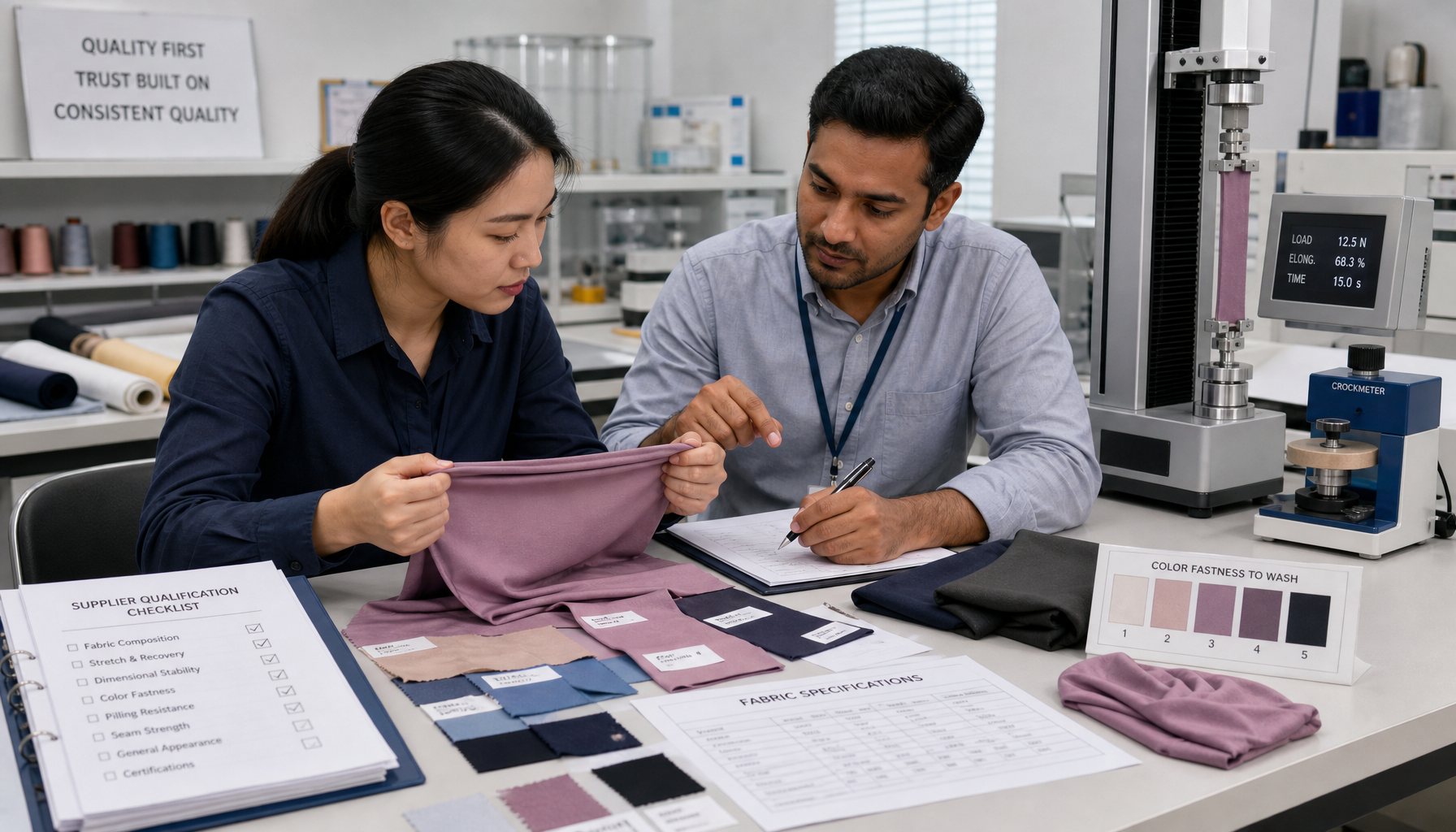
    Illustration: Supplier qualification review of fabric testing and quality records
    Illustrative image; not a test record or production evidence.

    Audit Capacity Through Records

    Do not accept an unsupported capacity statement. Ask for the production route, responsible subcontractors where applicable, current loading method, critical raw-material lead times and recent on-time performance records relevant to the requested process. The objective is not to require every operation to be owned by one company; it is to verify that responsibilities, approvals and traceability remain controlled across the actual supply chain. For the audit scope, see how a supplier capability audit affects sampling and bulk planning.

    Run a Controlled Trial Order

    A trial order should use the intended construction, color, finish and inspection plan. Define checkpoints for lab dip, production sample, bulk test report, roll inspection and shipment release. Compare actual communication time, correction handling, shade control and delivered roll data with the commitments made during qualification. Record deviations so the repeat-order decision uses evidence rather than memory. Compare commercial terms with the fabric-quote comparison before releasing the trial.

    Supplier Comparison Scorecard

    Area Evidence to request Main risk controlled
    Technical fit Signed specification and sample Wrong material selection
    Quality control Test and inspection records Bulk inconsistency
    Traceability Lot and roll identification Uncontained defects
    Delivery Dated production plan and records Launch delay
    Corrective action Nonconformance workflow Repeated failures
    Commercial terms MOQ, price basis and claims process Hidden cost

    Approval Decision

    Approve only the product and process combination that was evaluated; supplier qualification is not blanket approval for every fabric. ClothFactory should be assessed against the same written criteria as competing suppliers; request the qualification brief through the contact page. Requalify the relevant controls when construction, finishing route, production location or key raw material changes, because prior performance may no longer represent the new supply condition.

  • Pre-Production Fabric Approval Sample Checklist

    Pre-Production Fabric Approval Sample Checklist


    A pre-production fabric approval sample should confirm the exact construction, color, finish and measurable properties intended for bulk production. Buyers should approve it against a signed specification and recorded test conditions, not by appearance and hand feel alone, then identify which characteristics still require bulk-lot verification.

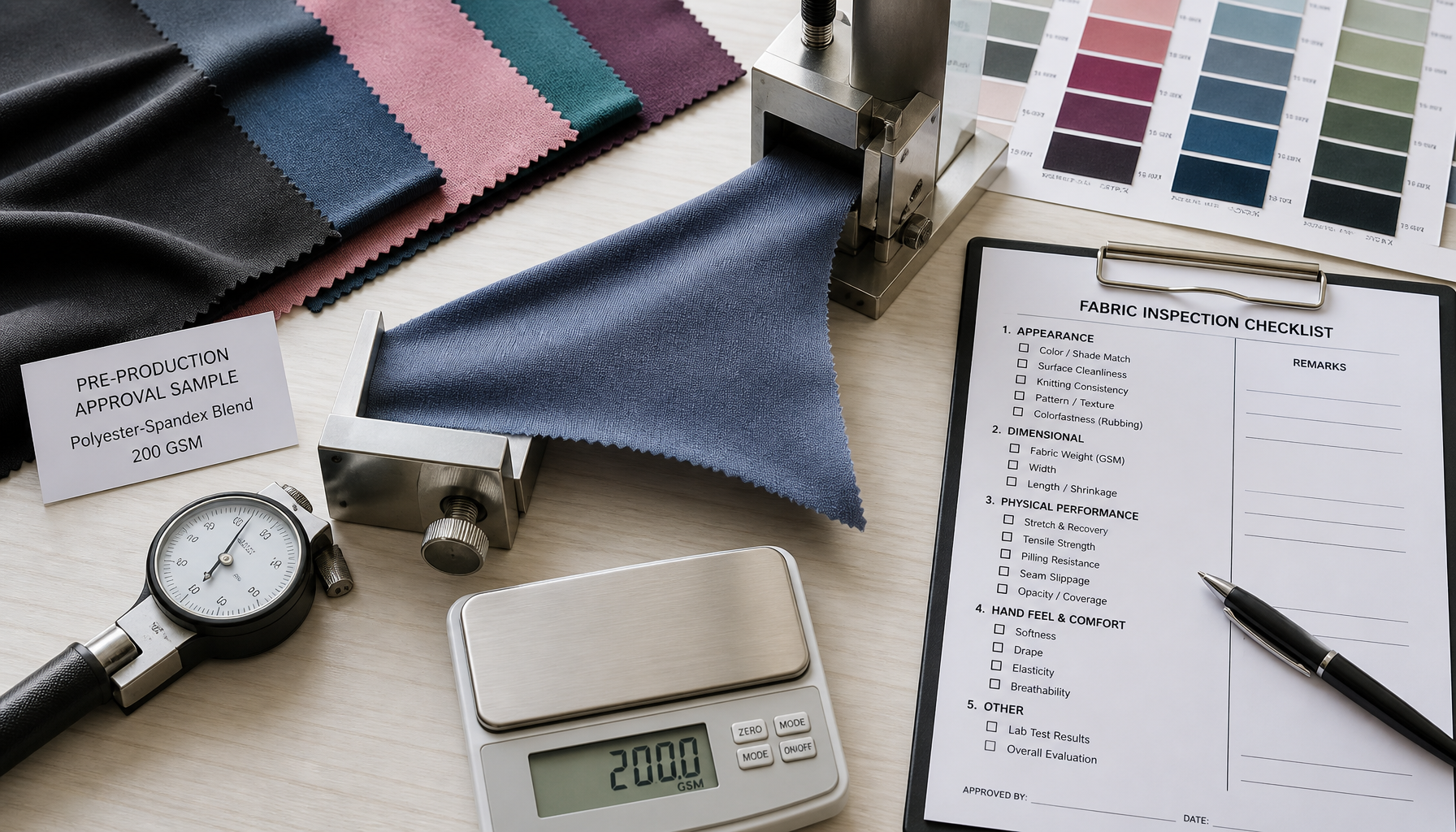
    Illustration: Pre-production stretch fabric sample inspected against an approval specification
    Illustrative image; not a test record or production evidence.

    Confirm Sample Identity

    Record the supplier, quality name, composition, knit structure, color, dye-lot or sample reference, finishing route and date received. Ask whether the sample was made on the intended production route and whether any yarn, machine or finish will change in bulk. A sample cannot serve as a reliable standard when its origin is unclear or when the supplier expects to substitute critical inputs after approval. The approval sits inside the wider sequence described in what happens between fabric sampling and bulk-production approval.

    Measure Construction and Dimensions

    Verify finished GSM, usable width, appearance, thickness where relevant, and stretch and recovery in both directions. Define conditioning and measurement procedures so the numbers can be repeated on bulk fabric. For highly extensible knits, width and GSM should be measured without uncontrolled tension. Record individual observations rather than only writing “approved,” because bulk inspection needs objective comparison points.

    Review Color and Surface

    Compare shade with the agreed physical reference under specified lighting and inspect relaxed and stretched fabric. Check bow, skew, barre, creases, holes, contamination and uneven finishing. If several garment panels must match, establish shade grouping rules before cutting. Digital photographs can document the review, but they should not replace physical color approval because cameras and displays alter color.

    Illustration: Buyer checking shade, surface and stretch on a fabric approval sample
    Illustrative image; not a test record or production evidence.

    Test End-Use Performance

    Select tests from the garment risk assessment. Close-fitting activewear may require dimensional stability, colorfastness, stretch recovery, pilling or abrasion, opacity under strain and seam compatibility. Moisture, cooling or antibacterial claims need separate methods and durability conditions. The test report should identify the specimen, method, unit and result; a pass statement without those fields cannot support later comparison. For the verification step, see how to verify GSM tolerance before paying a fabric deposit.

    Validate in a Sewn Prototype

    Use production-intended thread, needle, seam and elastic where possible. Evaluate fit, seam grin, puckering, edge curl, recovery, coverage and appearance after the planned wash and drying sequence. Fabric-level approval does not guarantee garment performance because pattern strain, panel direction and sewing tension change how the material behaves. Record any construction restrictions with the approved sample.

    Approval Record

    • Physical sample reference and retained piece
    • Signed specification with tolerances
    • Color standard and lighting conditions
    • Test reports and laundering conditions
    • Garment trial observations
    • Approved deviations or open actions
    • Bulk inspection and release requirements

    Release Decision

    Approve, reject or approve conditionally in writing. Conditional approval should name the unresolved item, responsible party and deadline before bulk cutting. ClothFactory and the buyer should retain matching records so that bulk fabric can be traced to the same construction and finish; send the signed approval record through the contact page. If a critical input changes, request a new approval sample instead of treating the original signature as permanent authorization.

  • How to Specify Fabric for Tennis Dresses

    How to Specify Fabric for Tennis Dresses


    Fabric for a tennis dress must balance movement, coverage, moisture handling, shape retention and skirt drape within one garment. Buyers should specify the bodice and skirt zones separately when their strain and coverage needs differ, then validate the selected fabric in a sewn prototype under the intended movement and care conditions.

    Illustration: Tennis dress fabric evaluated for movement, drape and coverage
    Illustrative image; not a test record or production evidence.

    Map the Garment Zones

    The upper body may need secure recovery and low wet cling, while the skirt may need lighter drape and freedom from excessive static or curl. Integrated shorts introduce another requirement for opacity and recovery under higher extension. State whether one fabric must serve every zone or whether coordinated qualities are acceptable. This decision affects testing, color matching, sewing and material consumption before style details are added. Common development delays are summarized in which fabric problems most often delay tennis-dress development.

    Define Stretch and Recovery Conditions

    Specify required stretch direction based on pattern orientation and body movement, then agree on the method, extension level, holding time and recovery interval. A high stretch percentage is not enough if the material grows after repeated movement. Evaluate the prototype through lunges, lateral steps and seated positions, and check whether the waist, armhole and skirt return without rippling or permanent deformation.

    Balance GSM, Drape and Coverage

    GSM provides weight per area but does not independently define opacity or support. Construction, yarn, color and finishing also influence coverage. For an illustrative comparison, two fabrics at the same GSM can show different visibility when stretched because one opens more between stitches. Review light and dark colorways at garment-level strain and under realistic lighting before approving a range.

    Illustration: Stretch knit sample compared for a tennis dress bodice and skirt
    Illustrative image; not a test record or production evidence.

    Set Moisture and Care Requirements

    Decide whether the project needs liquid spreading, drying rate, air permeability or another specific measure; “breathable” cannot replace a test requirement. Define the washing and drying sequence used for dimensional stability, appearance and functional-finish durability. Outdoor use may also require a separately verified UV-protection target, but fiber composition or dark color alone should not be used as proof. Name the UV method, such as AS/NZS 4399 or AATCC 183, when a claim is required.

    Check Construction Compatibility

    Sew the fabric with the planned seams, elastic, zipper, binding and hem. Inspect needle damage, seam grin, puckering, skipped stitches and edge curl, then repeat the review after laundering. If the dress combines two fabrics, verify shade compatibility and differential shrinkage. A small difference in dimensional change can twist seams or create a wavy junction after care.

    Tennis-Dress Specification Brief

    • Garment zones and whether each uses the same quality
    • Composition, knit structure, target GSM and usable width
    • Stretch and recovery requirements by direction
    • Coverage condition and color range
    • Drape and hand-feel reference
    • Moisture, durability and colorfastness tests
    • Care method and dimensional-stability limits
    • Prototype movement and fit checks

    Sampling Decision

    Send ClothFactory the pattern concept, zone map, target measurements, color standard and required tests through the contact page. Compare candidates under the same conditions and record why one advances to garment sampling. Bulk approval should be based on a written specification plus a retained physical reference, not on the assumption that any nylon-spandex or polyester-spandex knit will perform the same way.

  • How to Interpret Activewear Fabric Drying-Rate Tests

    How to Interpret Activewear Fabric Drying-Rate Tests


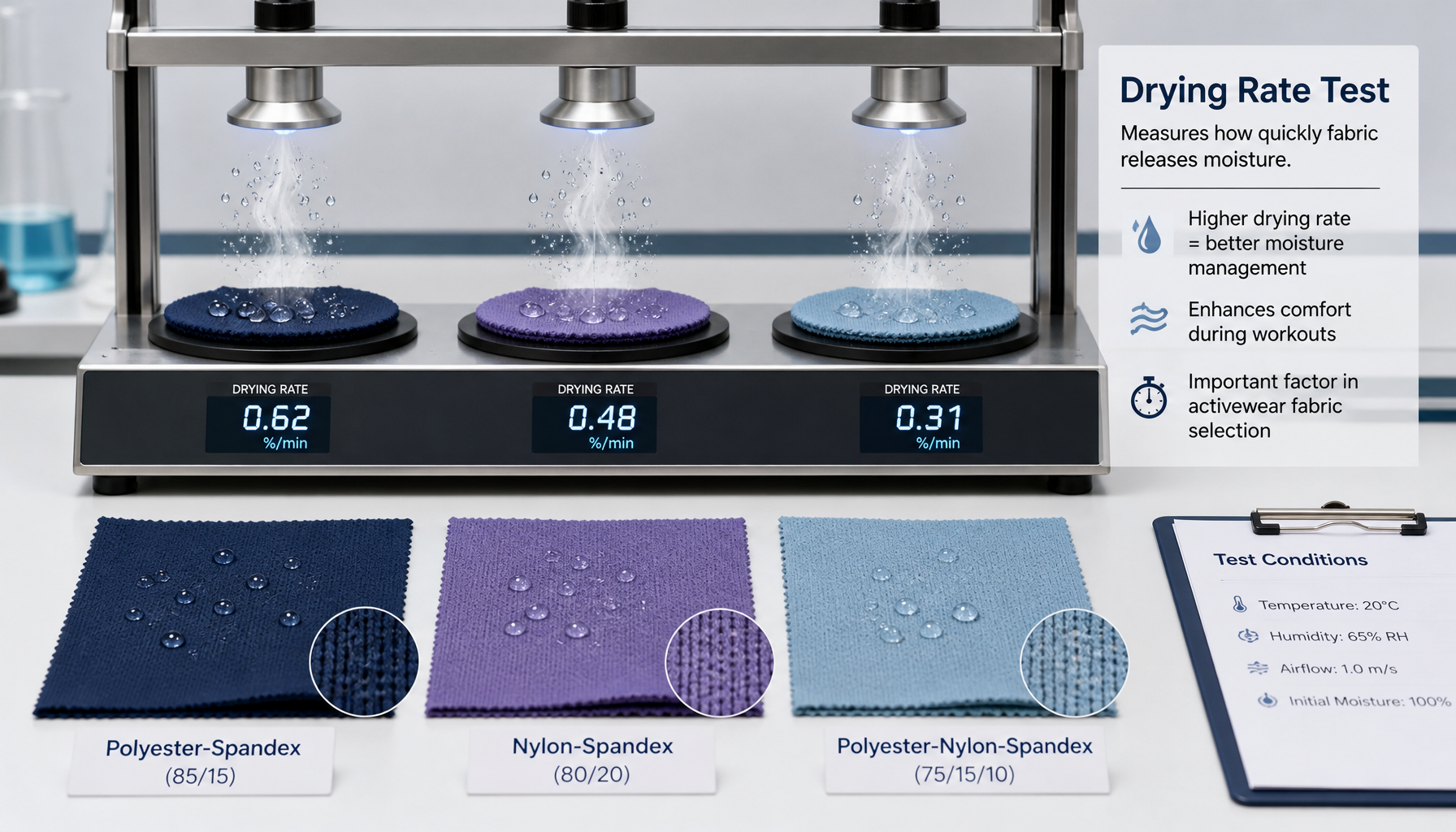
    A drying-rate result is meaningful only when the test method, water dose, specimen size, conditioning, airflow, temperature, humidity and endpoint are known. Buyers should compare fabrics tested under the same procedure and interpret drying together with wet pickup, spreading, garment construction and intended climate rather than treating one short drying time as proof of comfort.

    Illustration: Activewear fabric specimen prepared for a controlled drying-rate test
    Illustrative image; not a test record or production evidence.

    Identify What the Test Measures

    Some procedures track mass loss over time, while others report the time required to reach a defined residual moisture level. A result expressed in minutes cannot be compared with a rate expressed as mass per area per time without the underlying data and calculation. Ask the laboratory to state the endpoint because “dry” may mean a balance reading, a percentage of initial moisture or another defined condition. Liquid-moisture and drying behavior are separate properties; a method such as AATCC 195 does not replace a drying-rate test.

    Control the Comparison Variables

    Specimen area, applied water, fabric mass and exposed surface can change the apparent result. Air movement and environmental conditions are especially influential. Require candidates to be conditioned and tested together where possible, using the same face orientation and number of replicates. If samples differ in GSM or construction, report those differences because the drying result may reflect stored water quantity as much as fiber chemistry. Air permeability, if relevant, should be measured by ISO 9237 or ASTM D737 rather than inferred from drying time.

    Illustration: Moisture loss from activewear fabric measured over a controlled test period
    Illustrative image; not a test record or production evidence.

    Read the Curve, Not Only the Endpoint

    If the laboratory supplies time-series mass data, review how quickly moisture leaves during the early and late stages. An illustrative calculation uses drying rate = change in water mass ÷ exposed area ÷ elapsed time. The result remains valid only for the stated interval and conditions; it should not be presented as a universal garment value or as ClothFactory product data unless it came from a verified report for that product.

    Connect Fabric Data to Wear

    A fast laboratory endpoint does not automatically mean lower skin wetness. Liquid spreading can enlarge the evaporation area, but it can also increase the visibly wet zone. A garment’s fit, layering, ventilation and sweat load change performance. For running shirts, compare fabric results with a sewn wear or simulated-use trial and document whether the fabric clings, darkens, cools or recovers acceptably after wetting. Supplier reports are easier to compare with the checks in comparing supplier reports for moisture management.

    Buyer Risk Check

    • Do not compare results from different methods or environments.
    • Do not infer wicking from drying time alone.
    • Check whether optional finishes were tested before or after laundering.
    • Request replicate results, not only the most favorable specimen.
    • Confirm units and calculations in the original report.
    • Avoid “quick-dry” claims without a product-specific acceptance basis.

    Approval Requirement

    Write the test method, conditioning, laundering state and acceptance rule into the specification before comparing candidates. ClothFactory can help prepare representative fabric samples through the contact page, but the buyer should retain the full report and connect it to the exact quality, color and finish. Reconfirm the result when a finishing route or construction changes because prior data may no longer represent the bulk material.

  • Fabric Problems That Delay Gym Shorts Development

    Fabric Problems That Delay Gym Shorts Development


    Gym-shorts development is most often delayed when the fabric brief leaves stretch, recovery, coverage, usable width, dimensional stability or finishing performance undefined. The fastest corrective action is not to request more random swatches, but to identify the failed decision, set one measurable acceptance condition and retest a controlled candidate in the intended garment construction.

    Illustration: Gym shorts fabric reviewed during an activewear development meeting
    Illustrative image; not a test record or production evidence.

    The Candidate Does Not Match the Garment Zone

    Loose training shorts, fitted cycling-style shorts and inner compression liners require different stretch, drape and coverage. Development stalls when one generic “gym shorts fabric” brief is used for all three. Map the shell, waistband, gusset and liner separately, then define whether each zone needs mobility, support, airflow, opacity or abrasion resistance. This narrows the sample set before color and styling work begins. A sample-review checklist is provided in what buyers should check when reviewing gym-shorts fabric samples.

    Stretch Is Reported Without Recovery Conditions

    A supplier may report a high extension value while the prototype grows at the seat or hem. The missing information is often load, holding time, direction and recovery interval. Use one agreed method and test both course and wale directions. Repeat movement on the sewn sample and measure whether critical dimensions return after rest; otherwise, the team may keep changing patterns to compensate for a material problem.

    GSM Is Used as a Proxy for Coverage

    Low GSM does not automatically mean transparent, and higher GSM does not guarantee opacity. Yarn, stitch density, color, finishing and strain all affect coverage. Evaluate the actual color while stretched to the garment’s measured extension over the intended liner or reference background. This prevents late rejection after a fashion color is approved on a relaxed swatch but fails during movement.

    Illustration: Stretch fabric assessed for gym shorts coverage and recovery
    Illustrative image; not a test record or production evidence.

    Finish and Care Conditions Arrive Too Late

    Brushing, wicking, cooling or antibacterial treatments can change hand feel, dimensions and sewing behavior. Delays occur when a base fabric is approved first and the finish is introduced after garment sampling. List optional finishes in the first brief, request the intended finishing route on sample yardage, and assess performance and appearance after the agreed wash sequence before bulk release.

    The Fabric and Sewing Process Conflict

    Needle damage, seam grin, puckering and edge curl can appear only after cutting. Use production-intended needles, thread, elastic and seam types during prototyping. If the fabric is changed, repeat the sewing trial instead of assuming similar composition means identical machinability. Record acceptable seam appearance and stretch so the factory has a practical setup reference.

    Delay-Prevention Gate

    Development gate Required decision
    Brief Garment zones and measurable priorities
    Fabric shortlist Comparable composition, GSM, width and stretch data
    Sample yardage Color, finish and production-relevant construction
    Prototype Fit, movement, coverage and seam compatibility
    Wash trial Dimensions, appearance and finish durability
    Bulk release Signed specification and retained reference

    Procurement Action

    Send ClothFactory the style drawing, zone map, target measurements, color, care method and failure priorities before requesting samples. When a candidate fails, record the condition and required correction rather than restarting with a vague request for something “better.” A controlled decision log reduces repeated sampling and prevents the same unresolved issue from moving into bulk production. Send the brief to ClothFactory through the contact page before requesting samples.

  • Supplier Capability Audit Risks for Fabric Buyers

    Supplier Capability Audit Risks for Fabric Buyers


    A supplier capability audit should test whether the actual supply route can reproduce the approved fabric, detect variation and respond before a defect reaches garment cutting. Buyers should focus on traceability, process control, subcontractor oversight, test capability, capacity evidence and corrective action rather than treating certificates, showroom samples or stated monthly capacity as sufficient proof.

    Illustration: Fabric buyer reviewing supplier capability and production-control evidence
    Illustrative image; not a test record or production evidence.

    Scope Mismatch

    Confirm which legal entity, location and production processes the audit covers. A report for one facility does not automatically cover knitting, dyeing, finishing, printing or inspection performed elsewhere. Map the proposed product route and identify who owns each control point. The risk is not subcontracting itself; it is an unrecorded handoff where specifications, lot identity or corrective actions can be lost. The effect on sampling and bulk planning is covered in how a supplier capability audit affects fabric sampling and bulk planning.

    Unsupported Capacity

    Compare claimed capacity with machinery or partner allocation, working pattern, current loading, historical output and the requested construction. Total factory volume may not represent capacity available for a specific gauge, dye route or finish. Ask how production slots are reserved and what constraint controls delivery. Capacity should be evaluated for the proposed order and period, not accepted as a permanent headline number.

    Weak Specification Control

    Review how the supplier converts a buyer requirement into yarn, construction, color, finish, test and inspection instructions. Check revision control, approval signatures and how obsolete versions are removed from use. If operators or subcontractors rely on informal messages, a later correction may not reach every process, creating bulk fabric that matches an earlier specification instead of the final approved sample.

    Illustration: Quality records and fabric samples examined during a supplier audit
    Illustrative image; not a test record or production evidence.

    Inadequate Test and Inspection Evidence

    Confirm which tests are performed internally, which are outsourced, how equipment is controlled and how results link to a lot or roll. Review actual records for GSM, usable width, shade, defects and application-specific properties. A checklist marked “pass” without method, unit, sampling frequency or result does not show process capability and cannot support a buyer’s later claim investigation.

    Poor Nonconformance Control

    Ask for recent examples showing identification, segregation, root-cause analysis, disposition and effectiveness review. The supplier should explain who can authorize use under concession and how affected customers are informed. Repeated defects with different superficial explanations indicate that corrective action is closing paperwork rather than controlling the production cause.

    Audit Evidence Table

    Risk Evidence to inspect Warning sign
    Traceability Lot and roll records Manual relabeling without history
    Capacity Schedule and output records Unsupported monthly total
    Specifications Controlled revisions Instructions stored in chat only
    Testing Raw results and methods Pass/fail without data
    Subcontracting Approved route and responsibilities Undisclosed process location
    Corrective action Closed cases and verification Repeated issue without prevention

    Audit Conclusion

    Rate each risk against the intended product, then assign corrective actions, owners and deadlines before bulk approval. ClothFactory or any competing supplier should be approved only for the evaluated product and process scope; request the audit scope through the contact page. Reassessment is appropriate when production location, construction, critical yarn, dyeing route or finishing method changes, because the original audit evidence may no longer represent the order. Use the verification points in what buyers should verify in a nylon-spandex manufacturer to close the gaps.

  • How to Verify Fabric Pilling Resistance With a Laboratory

    How to Verify Fabric Pilling Resistance With a Laboratory


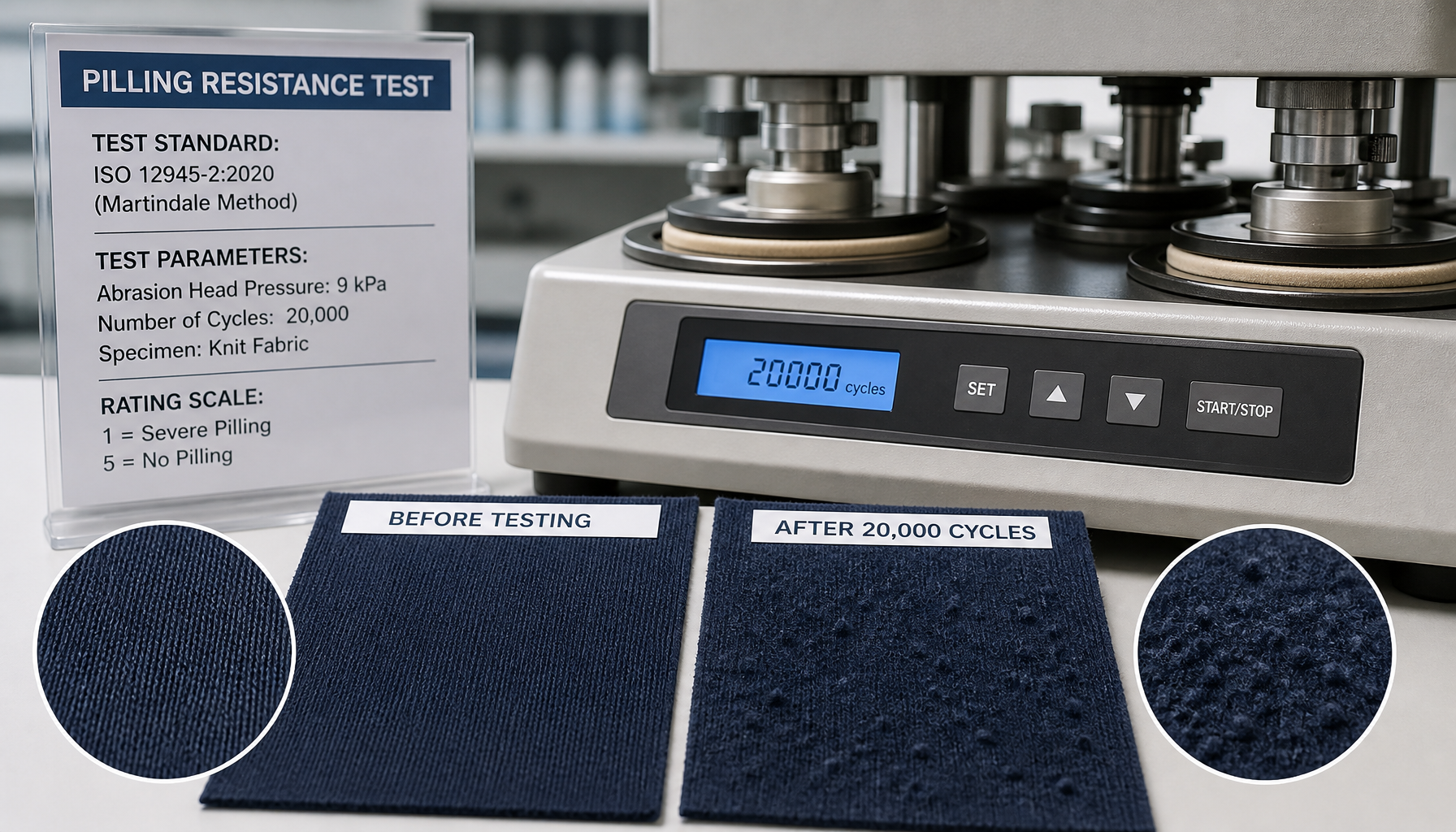
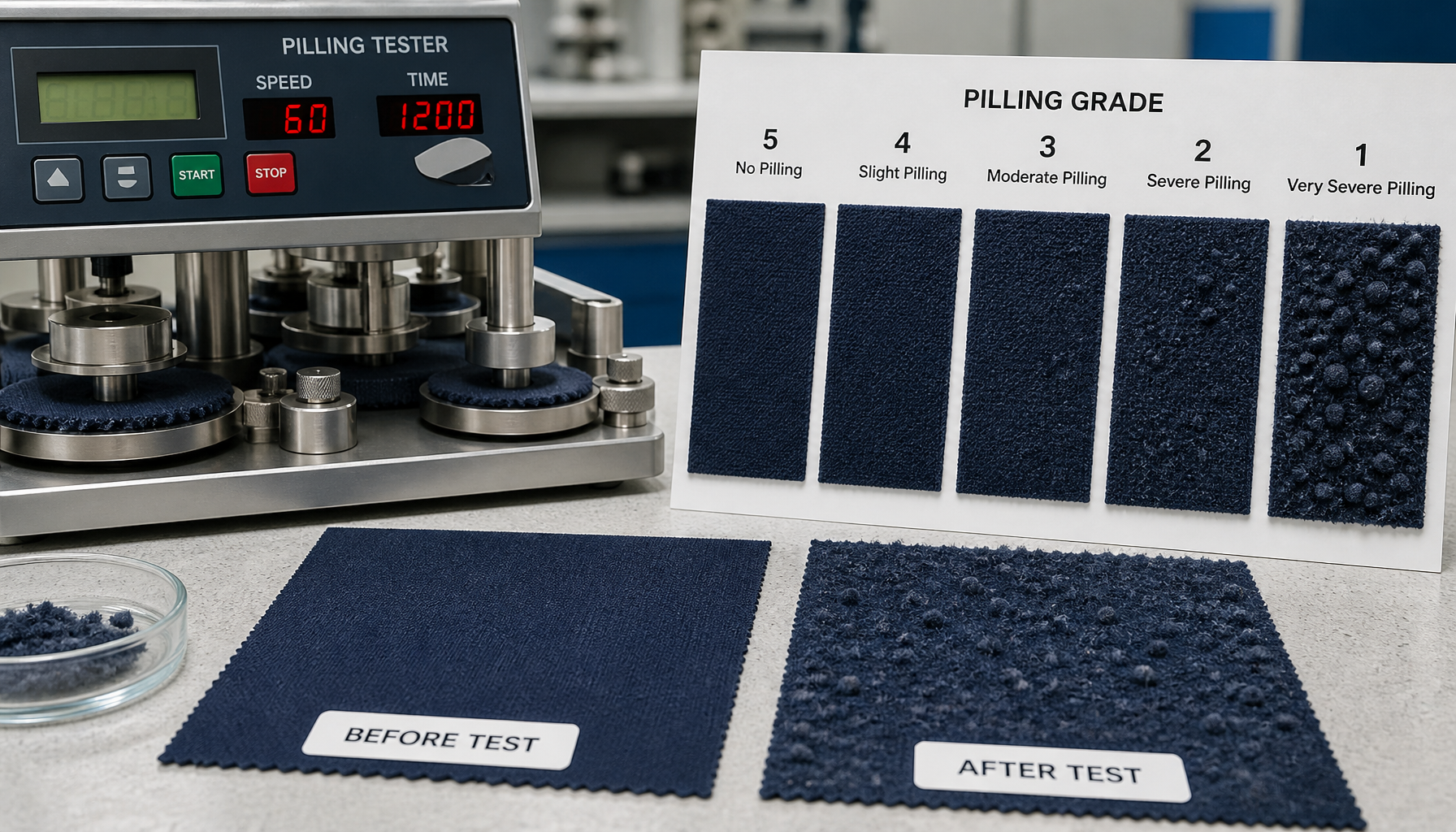
    Ask an independent laboratory to report the exact pilling method, apparatus, specimen preparation, conditioning, abrasion or cycle stage, assessment scale, number of specimens and individual results. A grade without these details cannot be compared reliably, and the buyer must define the acceptance level for the garment rather than assume that the test method provides a universal pass requirement.

    Illustration: Knitted fabric specimens prepared for laboratory pilling-resistance testing
    Illustrative image; not a test record or production evidence.

    Select a Method That Matches the Contract

    Common pilling procedures use different mechanical actions and can produce different rankings. Ask the laboratory to identify the standard and edition, apparatus, loading materials and assessment stages in the quotation and report. If comparing suppliers, submit specimens to the same laboratory under the same method where practical. Results from different procedures should remain separate even when both use a five-grade appearance scale. ISO 12945-2 (Martindale) and ASTM D4970 are common routes; the report must identify the standard, edition and apparatus because grades are not interchangeable across methods.

    Control Specimen History

    Tell the laboratory whether fabric is tested as received, after specified laundering or after another conditioning step. Identify face and back, color, finish, lot and specimen orientation. Applied softeners, brushing and other surface treatments can change fiber movement and pill formation. A result from an untreated development sample should not be presented as evidence for a differently finished bulk quality.

    Illustration: Laboratory comparison of fabric surfaces before and after pilling exposure
    Illustrative image; not a test record or production evidence.

    Request More Than a Final Grade

    The report should include individual specimen ratings, agreed intermediate stages, photographs where available and any deviation from the method. Ask whether assessment was completed by trained observers under the specified viewing conditions. A shipment decision based only on an average can hide one weak specimen, so the buyer should state whether acceptance applies to every specimen, a median, or another agreed rule. For a related surface test, see how many samples buyers should test for snag resistance.

    Connect the Test to the Garment

    Pilling exposure differs between a polo shoulder under a bag strap, leggings at the inner thigh and a lightly worn fashion panel. Define the contact zone, expected wear and visual quality level before choosing acceptance criteria. Laboratory testing accelerates a controlled mechanism; it does not predict an exact number of wears. Garment trials remain useful when seams, body contact or mixed materials create additional friction.

    Laboratory Request Fields

    • Fabric quality, lot, color, face and finish
    • Test standard, edition and apparatus
    • Preconditioning and laundering state
    • Specimen count and orientation
    • Exposure or cycle stages
    • Rating scale and assessment conditions
    • Individual results, summary and photographs
    • Buyer-defined acceptance rule

    Procurement Decision

    Retain the tested sample and original report with the approved specification. If composition, yarn, construction, brushing, softening or another surface finish changes, review whether the earlier result remains representative. ClothFactory can provide traceable samples for testing through the contact page, but the buyer and laboratory must agree on the method and acceptance condition before results are used to approve bulk production or support a durability claim.