博客

  • What Risks Should Buyers Review When Assessing the Usable Fabric Width?

    What Risks Should Buyers Review When Assessing the Usable Fabric Width?

    Please keep in mind: Usable width is a cutting specification, not simply the total distance from one fabric edge to the other. Buyers should define the minimum defect-free width, measurement tension, relaxation and conditioning state, excluded edge conditions, within-roll sampling, and action for narrow sections. The largest commercial risk is approving an average or nominal width that cannot accommodate the production marker, causing higher consumption, panel rotation, extra seams, or cutting stoppages.
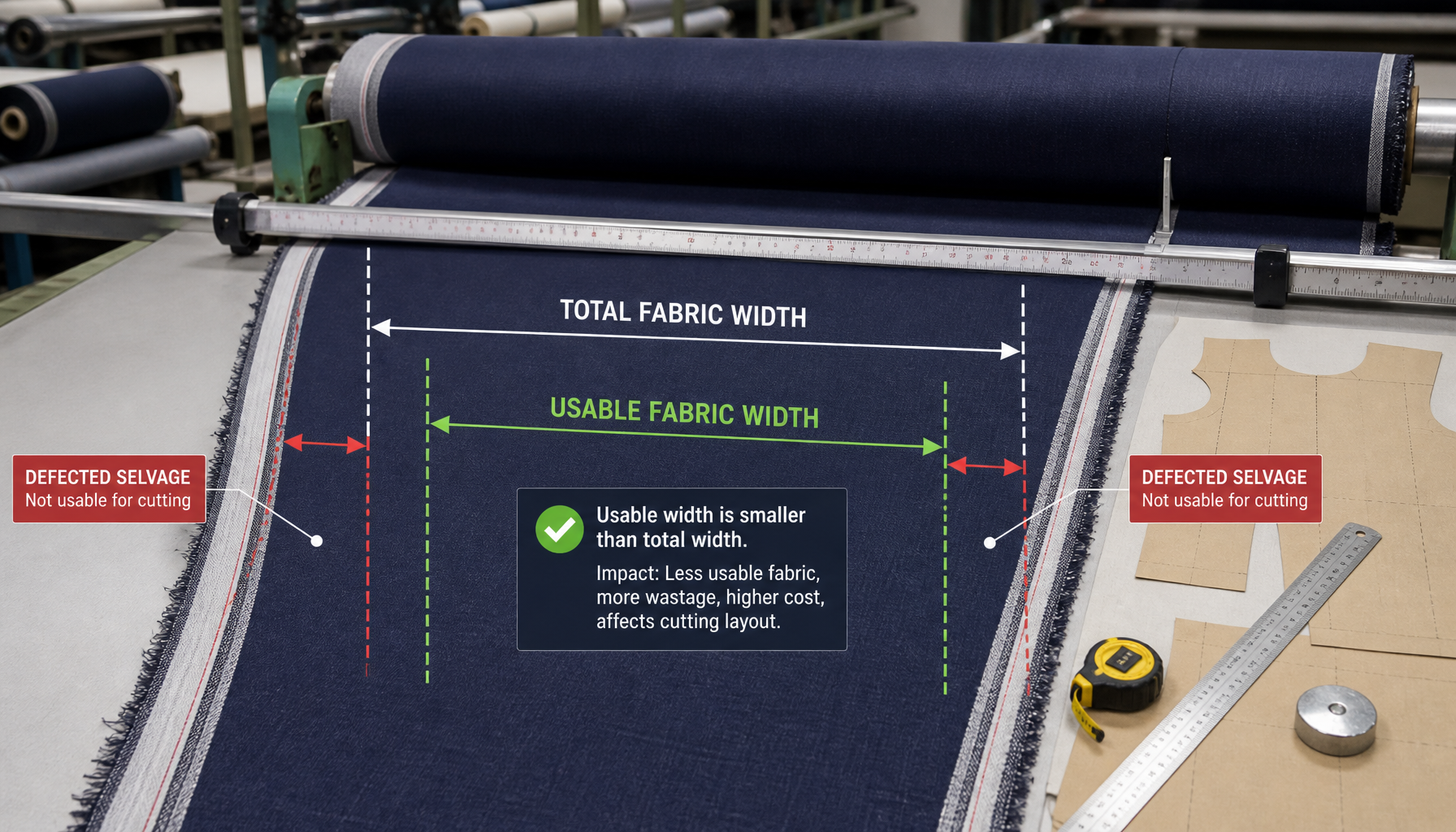
    Measuring the usable width of finished knitted fabric
    Usable width excludes edges, distortion, and defects that cannot enter the approved garment marker.

    Define usable width in the purchase specification

    State whether width is measured open, tubular, or laid flat; whether the value is total or usable; and how edge curl, pin marks, holes, glue, discoloration, distortion, or unstable selvedges are excluded. Knitted fabric should be measured under controlled, minimal tension after the agreed relaxation or conditioning period. If the supplier and garment factory use different tension or exclusion rules, both can report a correct number while referring to different cutting areas.

    Test the width against the actual marker

    A width tolerance matters only in relation to panel geometry. Run the complete graded size ratio, grain direction, nap or print direction, matching constraints, and permitted panel rotation through the marker. A reduction of one centimetre may have little effect on one style but can prevent two panels from nesting side by side in another. Approve the minimum usable width required by the production marker and retain a contingency for normal spreading and cutting control.
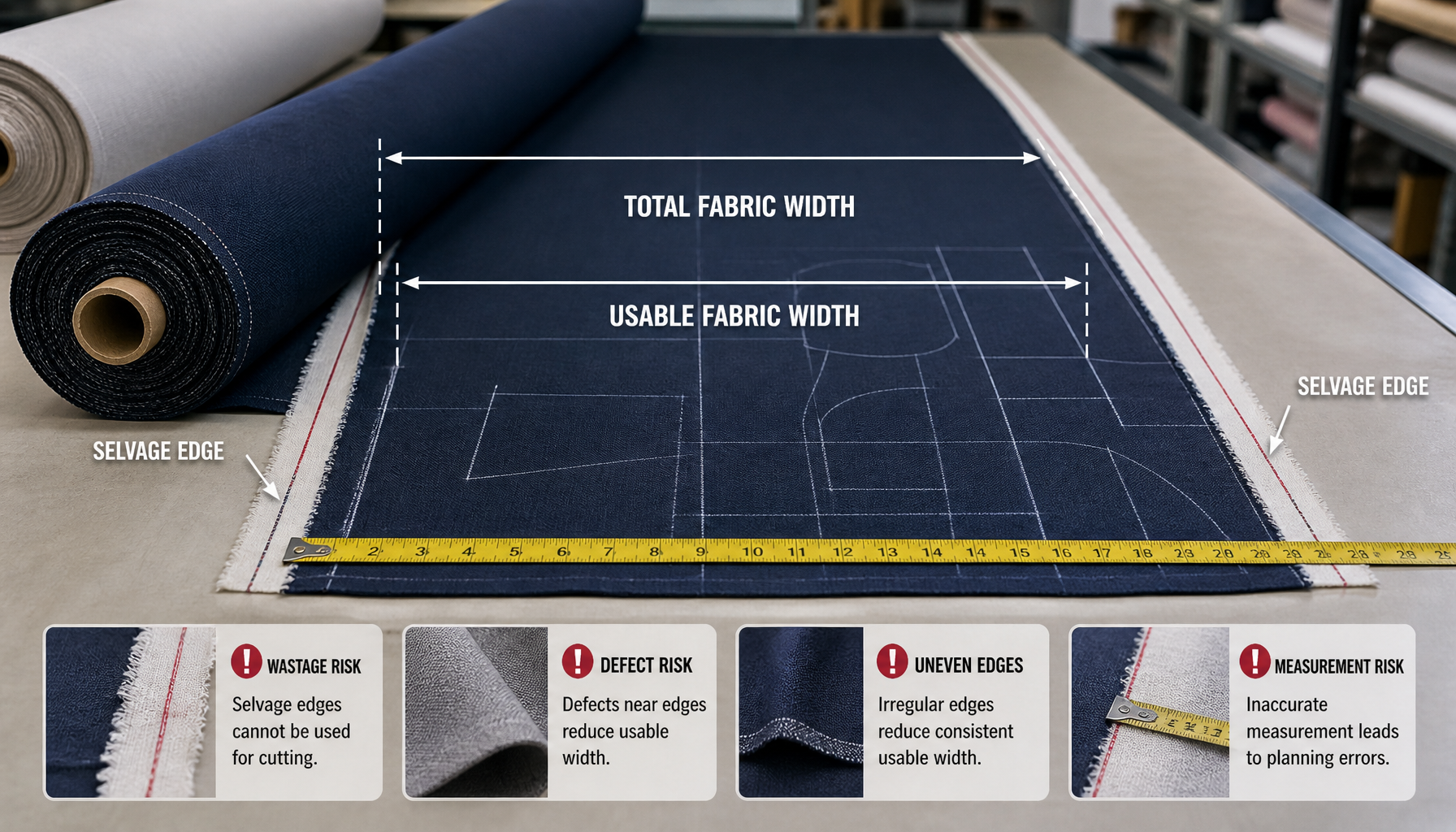
    Garment marker positioned within the defect-free width of stretch fabric
    Marker validation reveals whether a width difference changes panel nesting, consumption, or the permissible size ratio.

    Do not rely on the lot average

    Hypothetical example: five measured sections are 152, 152, 151, 148, and 152 cm usable width. The average is 151 cm, but a marker requiring 150 cm fails at the 148 cm section. Specify a minimum section or roll value where that reflects production risk, not only an average. Record measurements by roll and position so narrow areas can be segregated, re-planned, or rejected before they interrupt spreading.

    Account for relaxation and dimensional change

    Width can change after finishing, packing tension, warehouse relaxation, steaming, washing, printing, or heat treatment. Define the state in which incoming width is accepted and the state needed for marker planning. If the garment process exposes fabric to heat or moisture before cutting, reproduce that exposure during development. A relaxed wider fabric may shorten in length, while a tensioned roll can appear wider than it behaves on the cutting table; both effects influence consumption.

    Connect width, GSM, and quotation units

    Illustrative calculation: fabric at 200 GSM and 1.50 m usable width weighs 0.200 × 1.50 = 0.300 kg per linear metre. At 1.45 m usable width, the same GSM gives 0.290 kg per metre, but more linear metres may be required if marker efficiency falls. A kilogram quotation cannot be compared fairly until finished GSM, minimum usable width, marker consumption, and expected cutting loss are converted into cost per acceptable garment.

    Usable-width risks and purchasing controls
    Risk Required control
    Edge curl or damage Define excluded edge and measure only stable cutting width
    Within-roll variation Measure at agreed intervals and retain position records
    Lot variation Sample rolls across dyeing and finishing batches
    Marker mismatch Validate the production size ratio at minimum width
    Process shrinkage Measure before and after relevant relaxation, heat or wash exposure

    Set a response for nonconforming rolls

    The purchase order should define whether narrow material is rejected, segregated, downgraded, re-planned, or compensated through additional length. State who measures width, which equipment and interval are used, how disputes are confirmed, and whether the supplier must identify affected roll sections. Without a pre-agreed action, the garment factory may consume extra fabric to protect delivery while purchasing discovers the cost only after cutting.

    Approval checklist

    Send ClothFactory or any shortlisted supplier the open or tubular format, minimum usable width, width tolerance, finished GSM, fabric face, measurement condition, excluded-edge rule, marker requirement, processing route, and bulk inspection plan. Request representative sample yardage rather than relying on a small swatch. Approve the construction only after relaxed width, production marker efficiency, relevant dimensional change, and roll-level control can support the planned garment quantity and cost.
  • Everyday Underwear Fabric RFQ Checklist

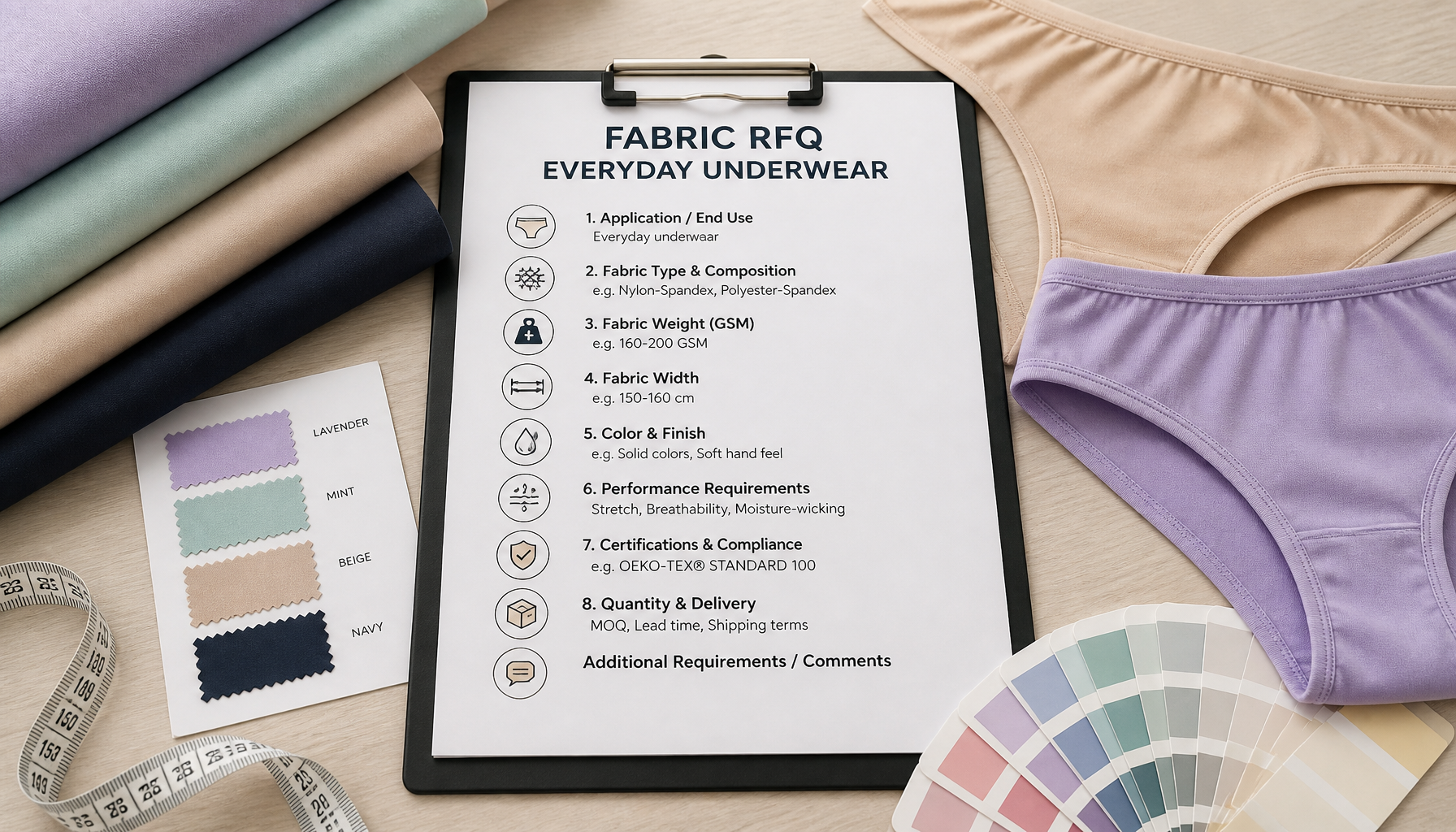
    Everyday Underwear Fabric RFQ Checklist

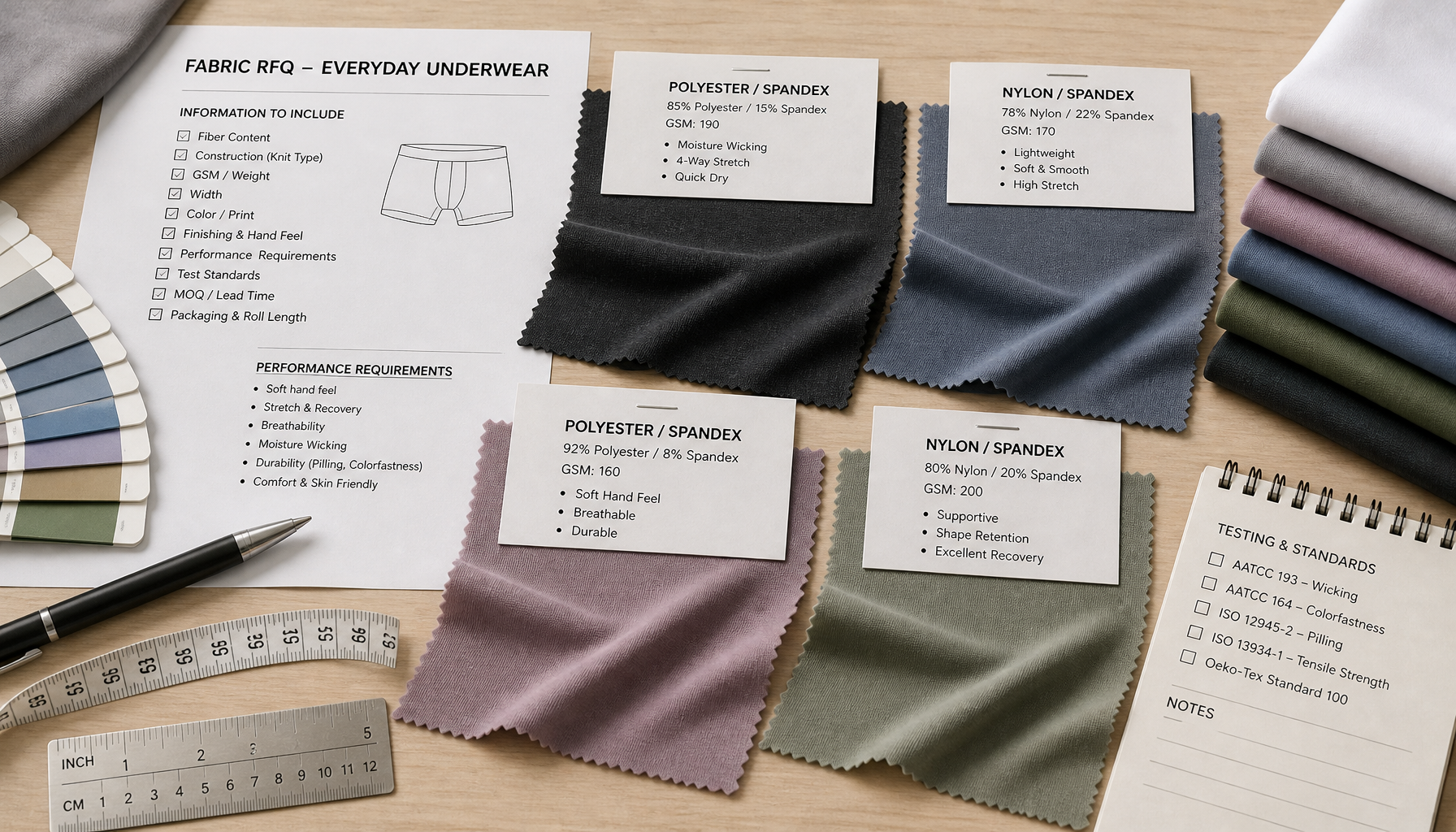
    An everyday-underwear fabric RFQ should define the wearer, garment construction, skin-contact face, composition and knit preferences, finished GSM, usable width, stretch and recovery, opacity, color, finish, care conditions, test requirements, quantities, and approval process. It should distinguish mandatory limits from development preferences. Suppliers cannot prepare comparable quotations when the request contains only a fiber blend, a photo, or terms such as “soft,” “breathable,” and “high quality.”

    Everyday underwear fabric requirements being prepared for an RFQ
    An effective underwear fabric RFQ converts comfort, fit, appearance, and durability expectations into comparable supplier inputs.

    Describe the garment and wearer first

    State whether the program covers briefs, boxer briefs, seamless-style cut-and-sew underwear, waistbands, gussets, or lining, because each panel may require a different material. Include wearer segment, intended fit, size range, climate, contact duration, seam type, lining, elastic integration, and target retail position. A close-fitting daily garment prioritizes low irritation and recovery after repeated wear, but the required support, coverage, and thermal comfort differ between silhouettes and markets.

    Specify construction and measurable dimensions

    • Preferred fiber composition and acceptable alternatives, without assuming composition guarantees performance.
    • Knit structure, face and reverse, finished GSM, minimum usable width and tolerances.
    • Required stretch direction, extension, recovery or growth, and test conditions.
    • Color, opacity at relevant extension, surface appearance, hand standard and edge behavior.
    • Dimensional stability under the intended wash and drying procedure.

    Nylon-spandex and polyester-spandex may both be suitable starting points, but yarn type, knit geometry, finishing, and garment design determine the final experience. If the buyer accepts either family, ask suppliers to explain the commercial and technical trade-off rather than naming a preferred fiber without a reason. Where softness is critical, submit an identified reference swatch and describe which face touches the skin; subjective language alone cannot be priced or inspected consistently.

    Knitted stretch fabric sample prepared for underwear fit and wash trials
    Representative sample yardage is needed to assess sewing, recovery, opacity, skin contact, and dimensional change in the finished underwear design.

    State functional claims as validation tasks

    If the product brief requests moisture management, cooling sensation, odor control, or another function, identify whether it is mandatory, the intended mechanism if known, the test method, acceptance criterion, care cycles, and claim market. Do not assume every candidate fabric has these properties or that an optional finish remains effective after laundering. The supplier should quote the base construction and any requested functional route clearly enough for the buyer to compare cost, durability, hand change, and testing responsibility.

    Include garment and color risks

    Underwear can expose risks that a flat swatch hides: seam grin, edge curl, elastic recovery mismatch, show-through, crocking, staining, and dimensional change after repeated care. Pale and dark colors may not behave identically, and passing one shade does not approve the range. Ask for development and bulk color procedures, controlled light-source assessment, shade continuity rules, and appropriate colorfastness requirements. Validate representative light and dark garments in the intended wash system.

    Give suppliers a usable quantity forecast

    Provide expected kilograms or metres by color, launch quantity, repeat-order forecast, target delivery window, and destination. Ask each supplier to state minimum dye-lot or order conditions, sample charges, lead-time assumptions, over- or under-delivery tolerance, and whether quotation is by kilogram, metre, or yard. Do not insert an unverified “standard MOQ” into the RFQ. Order conditions depend on construction, yarn availability, dyeing route, color, and supplier capacity and must be confirmed for the proposed quality.

    Compare cost per approved garment

    Illustrative calculation: at 170 GSM and 1.50 m usable width, one linear metre weighs 0.170 × 1.50 = 0.255 kg. If the quotation is USD 8.00/kg, theoretical fabric cost is USD 2.04 per usable metre before cutting loss. Actual underwear cost requires the production marker, relaxation, defects, shade segregation, and process loss. Request finished GSM and minimum usable width so quotations can be converted to the same commercial basis.

    Documents to request with an underwear fabric quotation
    Document or sample Purpose
    Technical data Confirms proposed construction, dimensions and stated test conditions
    Identified swatch Supports face, hand, shade and appearance review
    Sample yardage Enables sewing, fit, opacity, wash and marker trials
    Test report Provides evidence tied to the exact quality and sample state
    Commercial quotation States unit basis, quantities, lead-time assumptions and exclusions

    End the RFQ with a clear development gate: initial proposal, identified sample, laboratory and garment trial, color approval, production-relevant confirmation, and bulk release. State who owns testing and what requires reapproval after a change. ClothFactory can assess the brief against knitted synthetic stretch options, while the buyer retains the final performance limits. A structured RFQ reduces repeated sampling and makes technical suitability and total material cost visible before commitment.

  • What to Ask a Lab About Fabric Stretch Recovery

    What to Ask a Lab About Fabric Stretch Recovery

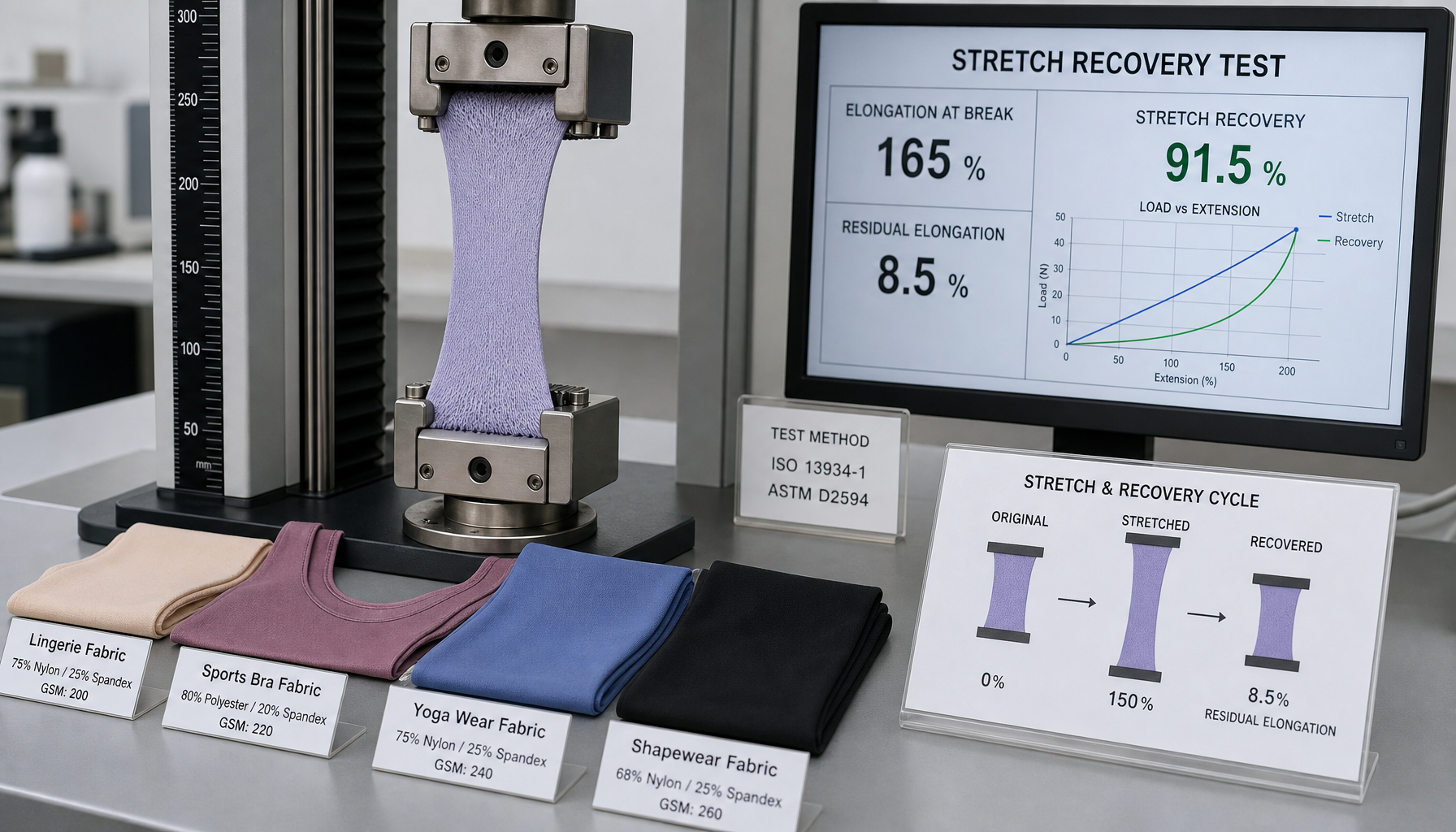
    Ask the independent laboratory to verify more than a single recovery percentage. The request should define the test method, fabric direction, extension or load, cycle count, hold and relaxation periods, conditioning, specimen number, calculation, and reporting unit. Require individual results tied to the fabric lot and sample identity. Without these controls, two laboratories can test the same stretch knit and produce numbers that answer different questions.

    Laboratory evaluation of stretch and recovery in knitted fabric
    Stretch-recovery results are comparable only when direction, extension, load, cycle count, hold time, relaxation, and calculation are defined.

    Define the garment failure the test must address

    Stretch recovery may relate to bagging at knees, waistband growth, loss of compression, restricted movement, seam strain, or size instability. Each failure occurs under different directions and deformation levels. Tell the laboratory whether the fabric is intended for yoga leggings, cycling shorts, sports bras, underwear, or another garment, and identify the critical direction. The lab can then help select an appropriate method, but the brand must set acceptance criteria from product requirements and validated reference materials.

    Ask the laboratory to record every test variable

    • Method name and edition, laboratory environment, conditioning time and specimen state.
    • Course, wale or other test direction and how specimens were cut from the roll.
    • Specified extension or applied load, extension rate, hold time and cycle count.
    • Recovery interval before measurement and the formula used for the reported result.
    • Individual values, average, dispersion, specimen count and any excluded result.
    • Fabric code, color, finish, lot, roll and sampling location.

    Do not confuse extension, growth, and recovery

    Extension describes how far a specimen lengthens under defined force or to a defined elongation. Growth describes retained deformation after the force is removed and a stated relaxation period. Recovery expresses the amount returned under the method’s calculation. Elongation at break is a destructive strength-related measurement and does not substitute for recovery at normal garment strain. Ask the laboratory to define each reported term so purchasing teams do not compare different metrics under one “stretch” heading.

    Require both directions when the garment uses both

    A knitted fabric can behave differently in course and wale directions, while garment panels may be oriented to use one direction for body circumference and the other for length. If a cycling-short panel requires circumferential support and longitudinal movement, a single unspecified result cannot confirm both functions. Provide the intended panel orientation and request direction-specific data. If the fabric is marketed as four-way stretch, that phrase still needs numerical requirements and a defined method for each direction.

    Interpret results with an explicit calculation

    Hypothetical calculation: a marked 100 mm specimen is extended to 150 mm, released, and measures 104 mm after the agreed relaxation period. Residual growth relative to the original gauge length is (104 − 100) ÷ 100 × 100 = 4%. This example is not a universal pass limit and does not prescribe a standard formula; the laboratory must use the selected method’s calculation, and the buyer must establish an acceptable threshold for the garment.

    Test the approved state and relevant aged states

    Recovery can change after dyeing, heat setting, brushing, chemical finishing, printing, laundering, or heat exposure. Specify whether the laboratory tests as-received fabric, conditioned finished fabric, washed fabric, or several states. Use the intended care procedure and record the number of cycles. Results from undyed development fabric should not automatically approve a dark bulk color, and an optional finish should not be assumed durable unless the post-care test confirms the required behavior.

    Review sampling and repeatability

    Several specimens from one small swatch measure test repeatability more than lot uniformity. For bulk acceptance, define how rolls are selected and where specimens are cut while avoiding creases, edges, and known defects unless investigating them. Ask the report to preserve roll-level results instead of presenting only a combined average. If variation is commercially important, agree on maximum individual values or another lot rule so one unstable roll cannot be hidden by conforming material.

    Connect the report to garment approval

    Use laboratory recovery data to compare candidate fabrics and monitor bulk consistency, then verify fit retention in sewn garments under representative movement and care. Waistbands, seams, panel orientation, lining, and garment dimensions alter the strain applied to the fabric. Send the laboratory and ClothFactory the same use case, approved construction, directions, processing route, and acceptance matrix. The report should support the sourcing decision, not replace a production-relevant wear and wash evaluation.

  • Base Layer Fabric Bulk Approval Checklist

    Base Layer Fabric Bulk Approval Checklist

    Before approving base-layer fabric for bulk production, confirm the exact construction, finished dimensions, skin-contact comfort, stretch recovery, moisture and thermal requirements, color performance, durability, and lot-control plan. Approval must be based on identified production-relevant material and agreed methods—not composition, GSM, or a hand swatch alone. The final decision should also reflect the complete garment after sewing, decoration, laundering, and its intended layering conditions.

    Base layer fabric being reviewed before bulk approval
    Bulk approval should connect the selected base-layer fabric to measurable specifications, a sealed reference, and garment-level validation.

    Confirm the use case and layering conditions

    Define whether the product is for cold-weather skiing, high-output running, everyday thermal wear, or another application. State whether the garment is next to skin, its intended fit and compression level, the expected temperature and activity range if the brand has validated one, and the layers worn above it. These inputs determine the acceptable trade-off among insulation, air exchange, drying, moisture transfer, softness, seam comfort, and garment mass. A single fabric cannot be assumed to optimize every condition.

    Freeze the finished fabric specification

    • Fiber composition and knit structure, with the approved face and reverse identified.
    • Finished GSM and usable width, including measurement conditions and tolerances.
    • Stretch direction, extension and recovery requirements under named conditions.
    • Color, finish, hand, luster, surface appearance, bow, skew and edge requirements.
    • Dimensional stability after the brand’s specified care or production exposure.

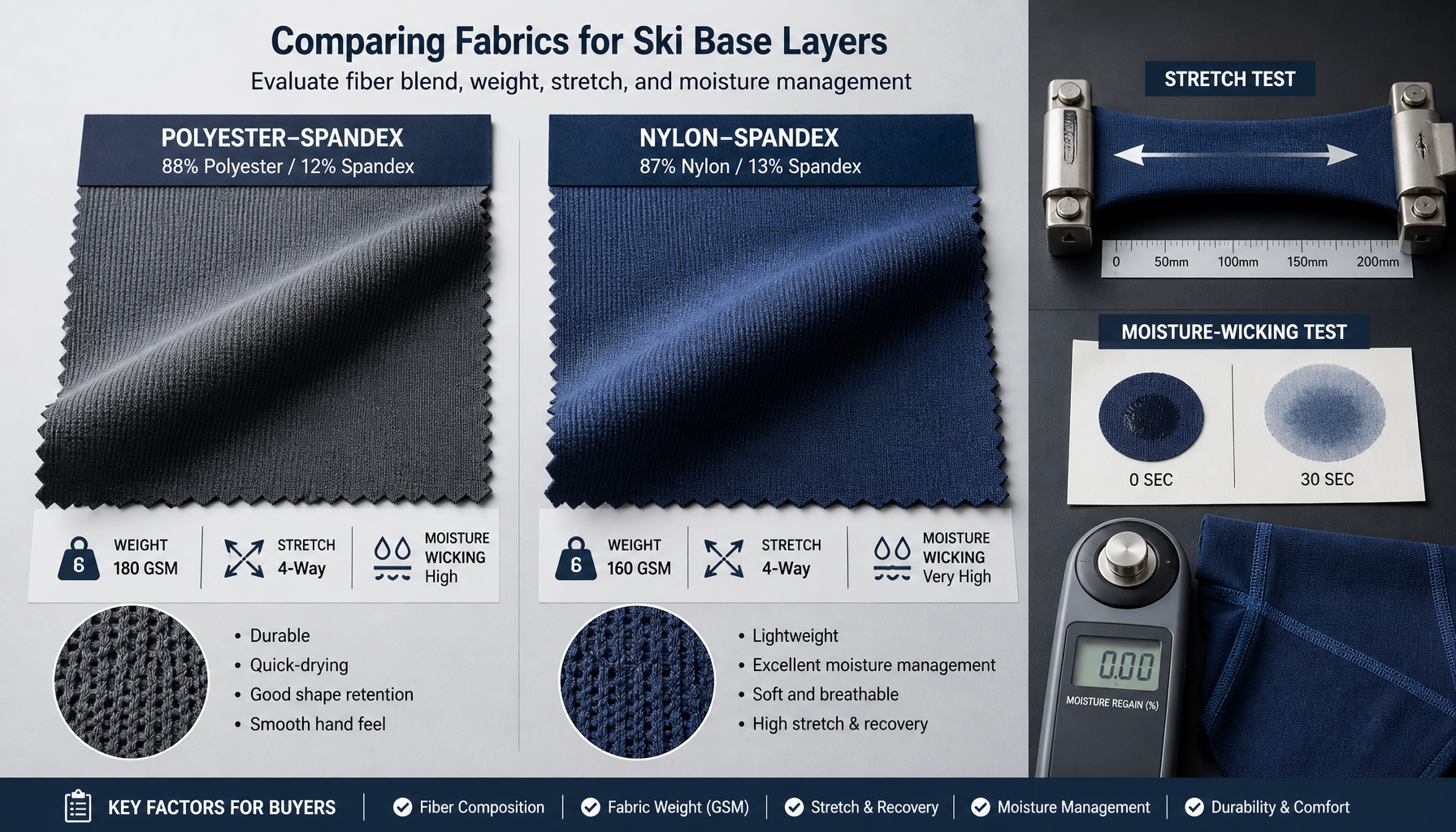
    Polyester-spandex and nylon-spandex describe broad material families, not guaranteed performance. Yarn selection, stitch density, knit geometry, dyeing, heat setting, brushing, and chemical finishing can change the behavior of fabrics with similar labels. Keep a sealed physical reference for subjective characteristics and numerical limits for measurable ones. Identify the approved version and ensure that the supplier, garment factory, buying team, and laboratory are working from the same specification.

    Review test evidence under controlled conditions

    The buyer should select tests from the actual product risk: stretch and recovery, dimensional stability, colorfastness, pilling, abrasion, bursting strength, air permeability, drying or moisture behavior, and any regulated chemical requirements relevant to the destination market. State the method edition, specimen condition, direction, wash cycle, units, and acceptance limit. Results from a different construction, color, finish, or test condition should not be used as evidence for the proposed bulk quality.

    Check the garment after production-relevant processing

    Cut and sew enough trial garments to assess the full size range or the sizes most likely to expose fit risk. Apply the intended print, transfer, bonding, or brushing process, then perform the agreed care cycles. Review seam grin, edge curl, spirality, opacity at extension, recovery at knees or elbows, skin-contact irritation, dimensional change, and layered comfort. Laboratory fabric results support control, but they do not predict every interaction created by garment design and processing.

    Convert tolerances into a bulk-release rule

    Hypothetical calculation: if a base-layer marker consumes 0.90 m² and the approved fabric is 180 GSM, theoretical fabric mass is 0.90 × 180 = 162 g before cutting loss and trims. A bulk shift to 195 GSM raises theoretical mass to 175.5 g, an increase of 13.5 g per garment. Whether that change is acceptable depends on the agreed tolerance and garment validation; the example shows why average GSM cannot be treated as a minor purchasing detail.

    Evidence required for bulk approval
    Approval item Buyer evidence Bulk control
    Construction Identified production-relevant sample Traceable yarn, greige and finish route
    Appearance and color Signed physical standard Roll and lot shade assessment
    Performance Reports tied to the approved sample Agreed verification frequency
    Garment suitability Processed and washed prototype No unapproved process change
    Dimensions GSM, width and stability results Individual roll limits plus lot rules

    Release the order only after responsibilities are clear

    Record who supplies and selects bulk samples, who pays for testing, who releases lots, and what happens when a result falls outside tolerance. Confirm production lead time, color sequence, minimum dye-lot constraints, packing, retained samples, claim period, and re-order controls. Send ClothFactory or any supplier the signed specification and approval pack before the purchase order becomes final. This makes bulk approval a controlled production decision rather than acceptance of an attractive development sample.

  • Pre-Production Fabric Approval Risks Buyers Should Control

    Pre-Production Fabric Approval Risks Buyers Should Control

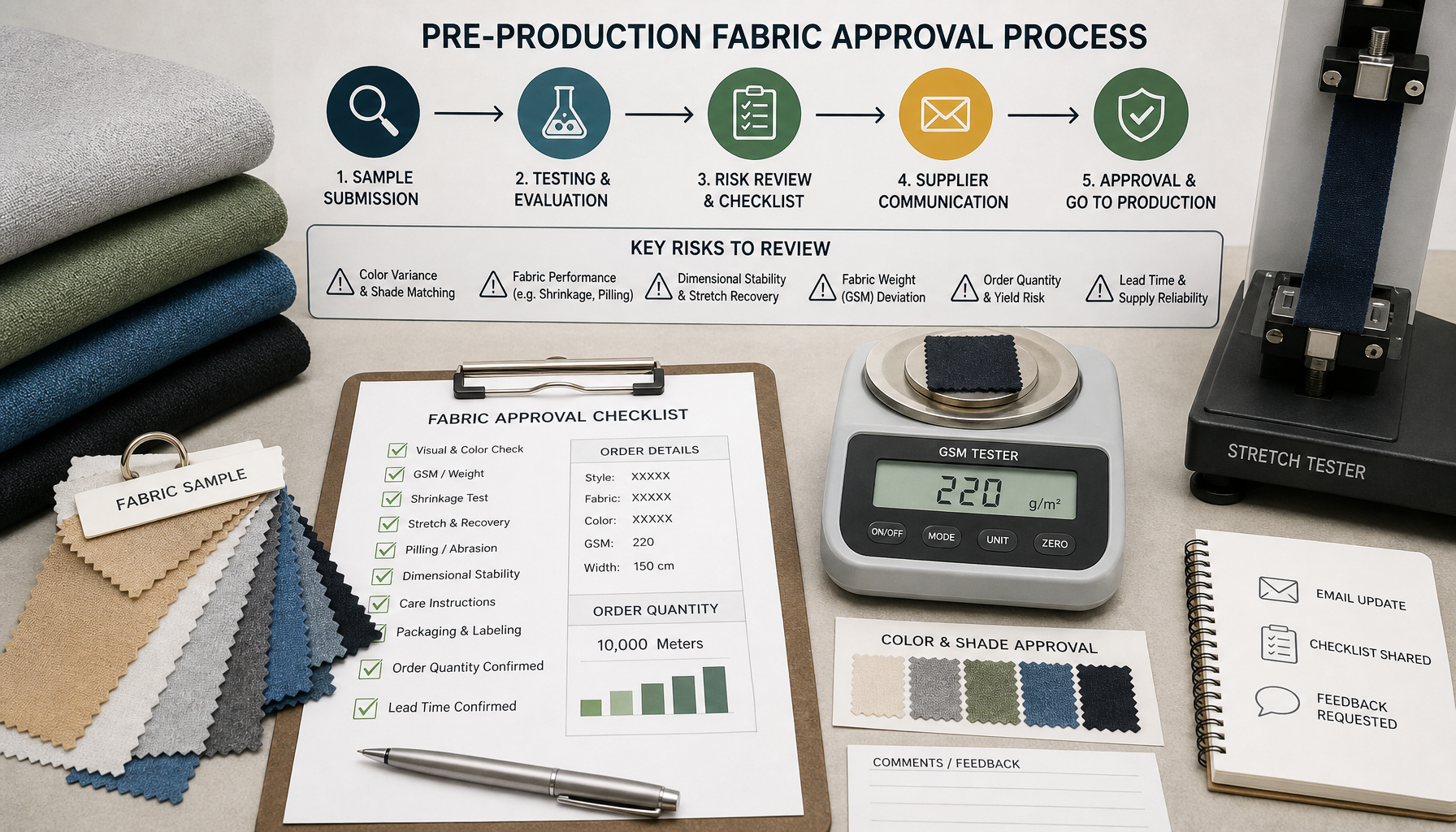
    The principal pre-production risk is approving an attractive sample without defining what bulk production must reproduce. Buyers should freeze the fabric construction, finished specifications, color standard, test conditions, garment validation, and change-control procedure before production starts. Every approval should identify the exact sample and version; verbal comments, unlabeled swatches, or a single “approved” email leave composition, performance, appearance, and tolerance disputes unresolved.

    Buyer reviewing a pre-production fabric approval package
    A complete approval package links the physical fabric sample, numerical specification, color standard, test reports, and production lot identity.

    Risk 1: the approval sample is not production-representative

    A handloom, laboratory-dyed swatch, available-quality cutting, and production trial may pass through different yarn, knitting, dyeing, and finishing conditions. Buyers should ask what the submitted sample represents and which steps can still change. If performance depends on bulk finishing, approve material from a production-relevant trial before releasing the order. Record fabric code, composition, knit structure, color, finish, date, lot identity, and approval status directly in the sample register.

    Risk 2: subjective approval replaces measurable criteria

    “Soft,” “supportive,” “quick-drying,” and “good recovery” are development directions, not acceptance limits. Convert critical requirements into agreed methods, specimen conditions, units, tolerances, and reporting rules. Keep an identified physical standard for hand, face, luster, color, and appearance, because these may not be captured fully by numbers. The physical standard and written specification must agree; when they conflict, the purchase contract should state which requirement controls and who authorizes an exception.

    Fabric samples and test records arranged for pre-production approval
    Version-controlled samples and reports prevent an early development swatch from being mistaken for the final bulk standard.

    Risk 3: garment processes are excluded

    A fabric can meet incoming tests and still fail after printing, heat transfer, bonding, washing, or sewing. For stretch garments, seam selection and panel direction may also change fit and recovery. The approval route should reproduce the intended decoration and care cycle, then assess dimensions, shade, surface, hand, stretch behavior, and fit on a sewn prototype. Approving blank fabric alone is insufficient when the garment process exposes it to heat, chemicals, tension, or multiple layers.

    Risk 4: averages conceal roll-level failure

    Hypothetical example: a four-roll lot has usable widths of 151, 150, 148, and 151 cm. The average is 150 cm, but the 148 cm roll may not fit a marker requiring a 149 cm minimum. Acceptance rules should therefore identify minimum or maximum roll-level limits as well as lot averages. Apply the same logic to GSM, shade, dimensional stability, bow and skew, and other properties where one nonconforming roll can interrupt cutting.

    Risk 5: color approval has no controlled reference

    Color decisions should identify the reference, illuminants, instrument conditions if used, visual assessment conditions, and acceptable lot-to-lot or roll-to-roll variation. A screen image or color name is not an approval standard. Confirm whether approval covers a laboratory dip, pilot dyeing, or bulk lot, and keep the signed reference protected from light and contamination. Dark, pale, fluorescent, and different fiber bases may require separate development; passing one color does not prove all colorways will behave identically.

    Risk 6: unapproved process changes remain possible

    Require written notification before changes to yarn source, yarn specification, knit settings, dye recipe, finishing route, plant, subcontractor, or test method. Define which changes require documentation, a new sample, garment validation, or full reapproval. This is particularly important when an optional finish supplies odor control, cooling sensation, moisture management, or another claimed function. A fiber blend should not be assumed to deliver a finish-dependent performance after the approved route changes.

    Minimum pre-production approval record
    Record Required control
    Fabric specification Composition, construction, finished GSM, usable width and tolerances
    Physical standards Identified hand, face, shade and appearance references
    Performance evidence Method, conditions, individual results, report date and sample identity
    Garment validation Decoration, sewing, wash, fit and end-use checks
    Bulk plan Sampling frequency, inspection rules, release authority and nonconformity action

    Before issuing bulk approval, hold a cross-functional review with purchasing, product development, quality, and the garment factory. Send the supplier one signed approval pack and require acknowledgment of every tolerance and exception. ClothFactory can align candidate knitted stretch fabrics with this pack, but the brand should retain approval authority and document any waiver. Production should begin only when unresolved items, test responsibility, and change-control triggers are visible to all parties.

  • How Many Samples Should Buyers Test When Checking Air Permeability?

    How Many Samples Should Buyers Test When Checking Air Permeability?

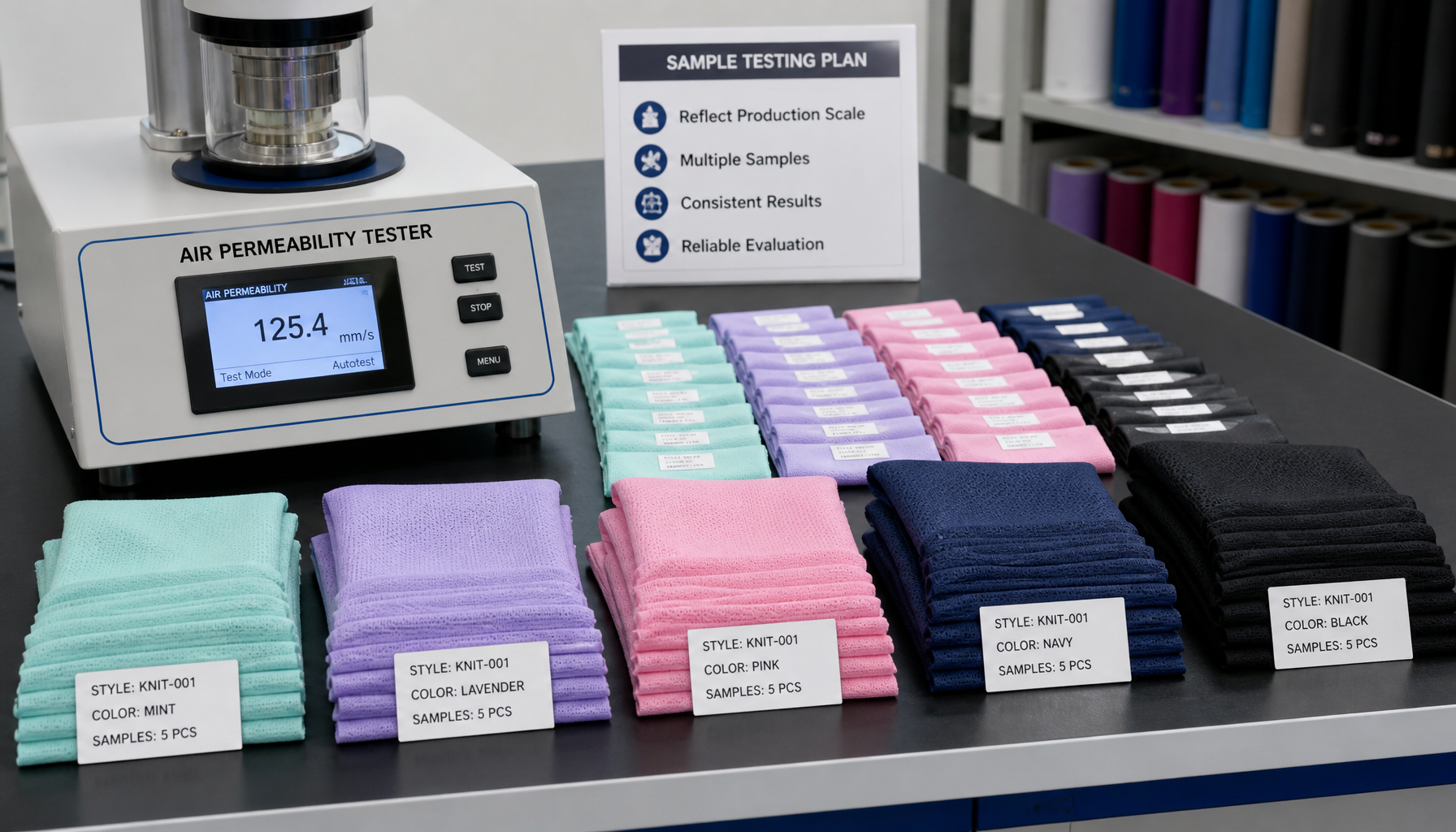
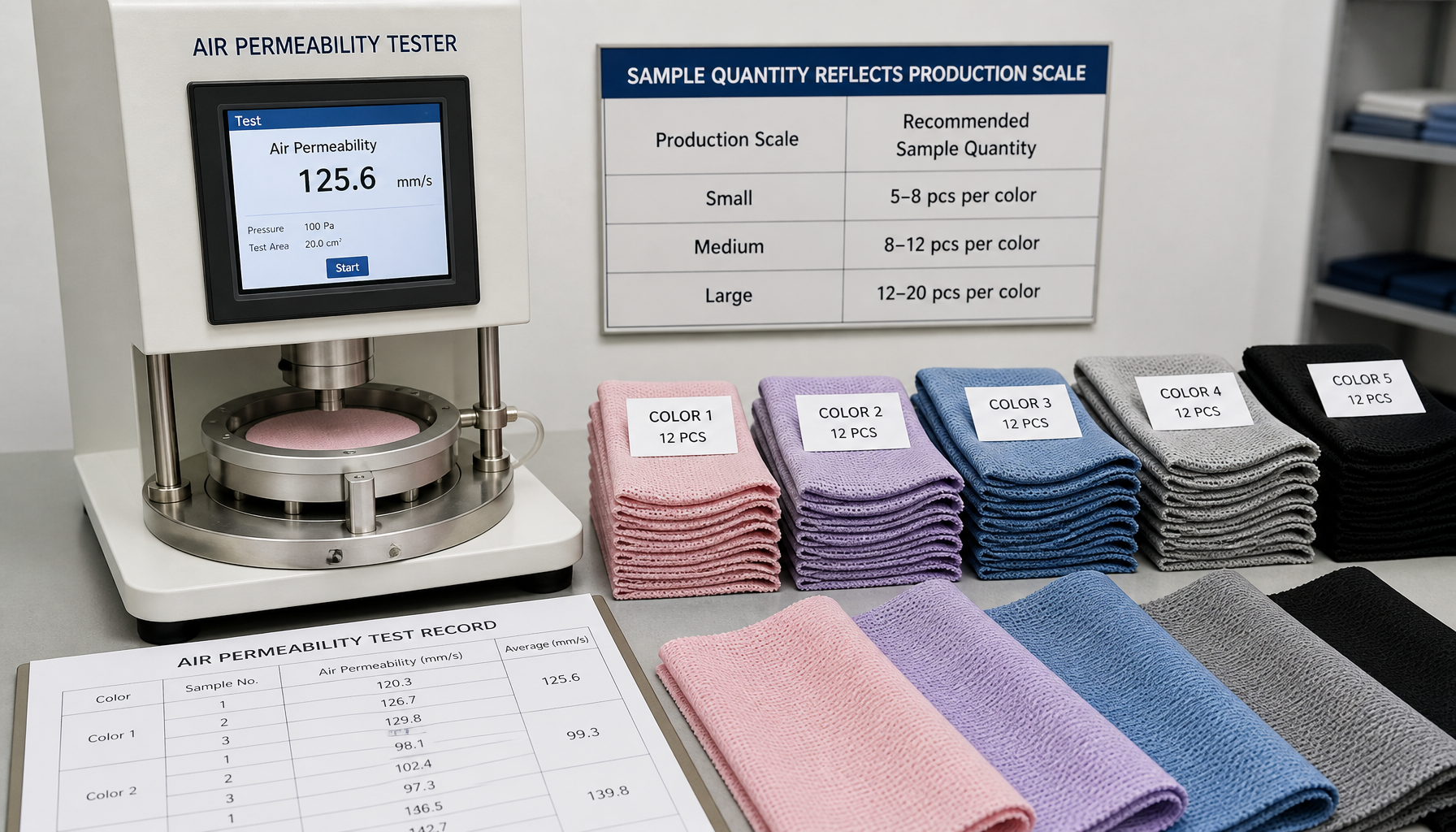
    There is no reliable universal sample count for air-permeability testing. The required number depends on the selected test method, fabric variability, lot structure, and the buyer’s acceptance plan. Buyers should ask the laboratory to state the number of test areas required by the method, then distribute those readings across representative fabric positions and production rolls instead of treating repeated readings from one swatch as proof of lot consistency.

    Technician preparing knitted fabric specimens for air permeability testing
    Air-permeability specimens should be conditioned, identified, and taken from representative positions rather than repeatedly tested from one small area.

    Separate test areas, specimens, and production samples

    These terms are often confused. A laboratory may take several readings from one conditioned specimen, but those readings describe only the submitted piece. Multiple pieces cut from one roll improve knowledge of within-roll variation, while samples from different rolls are needed to assess a production lot. The test report should therefore identify the submitted roll, dye lot, fabric face, test direction where relevant, conditioning procedure, pressure differential, test-head area, and the location and number of readings.

    Build the sampling plan around the decision

    Air-permeability sampling decisions
    Decision Sampling emphasis Limitation
    Screening a new construction Several separated areas from a clearly identified development sample Does not establish bulk consistency
    Approving a pilot lot Beginning, middle, and end positions where accessible Represents only the sampled roll or trial
    Accepting bulk production Rolls selected across the lot using the agreed inspection plan Unsampled rolls retain residual risk
    Investigating a claim Known conforming and disputed garments or rolls under identical conditions Results are invalid if methods differ

    Do not average away unstable fabric

    Hypothetical example: suppose five readings from one area are 210, 215, 208, 212, and 211 in the laboratory’s stated units. Their average is 211.2, but it says nothing about another roll. If five readings from a second roll cluster near 150 under identical settings, combining all ten into one average conceals a material difference. Report results by specimen and roll, review dispersion, and investigate process or sampling causes before deciding whether the lot is acceptable.

    Air passing through a controlled test area of performance knit fabric
    The reported airflow value is meaningful only when pressure differential, test area, conditioning, and specimen preparation are held constant.

    Control variables before comparing results

    Air-permeability values cannot be compared when laboratories use different pressure differentials, test-head areas, conditioning environments, fabric tension, or units. Brushing, calendaring, resin treatment, moisture, relaxation, and laundering can also change the open structure. The purchase specification should name the method edition, test settings, reporting unit, specimen state, face orientation where applicable, number of readings, and pass rule. “Test according to an international standard” leaves too many commercial decisions undefined.

    Connect laboratory data to the garment

    Higher airflow is not automatically better. A team jersey may need ventilation, while a base layer may require a different balance among air exchange, warmth, moisture movement, and wind exposure. Seams, prints, bonded films, double layers, and garment fit can alter the result experienced by the wearer. Use fabric testing to control material consistency, then validate the shortlisted construction in a finished garment under its intended layering and activity conditions.

    What to send the laboratory

    • Fabric code, composition, construction, color, finish, lot and roll identifiers.
    • The agreed method, pressure differential, test area, units and conditioning state.
    • The number and location of submitted pieces and whether edges or defects are excluded.
    • Individual readings, average, variation data and the buyer’s acceptance rule.
    • Instructions for retaining specimens when confirmation or dispute testing may be required.

    Before bulk approval, ask the laboratory to propose a method-compliant specimen plan and ask the supplier for a lot map so the submitted pieces represent production. ClothFactory can provide identified sample yardage for evaluation, but the buyer and laboratory should jointly define the final sampling frequency and acceptance limits. This keeps the result traceable and prevents a small, unusually open or closed swatch from representing an entire order.

  • How Should Buyers Compare Suppliers of Fabric for Ski Base Layers?

    How Should Buyers Compare Suppliers of Fabric for Ski Base Layers?

    Compare ski base-layer fabric suppliers against one written specification, one conditioning and test protocol, and representative production samples. A low quotation is not comparable when composition, knit structure, finished GSM, usable width, thermal behavior, moisture transport, stretch recovery, colorfastness, or tolerances differ. Supplier selection should therefore be based on the cost of fabric that passes garment-level validation, not on price per kilogram alone.

    Fabric supplier comparison for a ski base layer program
    A ski base-layer sourcing decision should compare verified fabric performance, bulk consistency, and production controls under the same specification.

    Define the base-layer use case before requesting fabric

    A ski base layer worn directly against the skin must manage sweat while remaining comfortable under insulating and shell layers. The specification should state whether the garment is intended for high-output touring, resort skiing, or lower-intensity cold-weather use; the expected fit; the target climate; and the layering system. These conditions change the acceptable balance among warmth, drying behavior, air permeability, surface softness, opacity, and stretch recovery. “Thermal fabric” or “moisture-wicking fabric” is not a measurable purchasing requirement.

    Compare equivalent fabric constructions

    Fiber content alone does not predict base-layer performance. Polyester-spandex and nylon-spandex fabrics can be engineered with different yarn sizes, filament counts, knit structures, brushing levels, and finishes. Ask each supplier to identify the finished composition, knit construction, finished GSM, usable width, stretch direction, and relevant finishing route. If one quotation covers brushed interlock and another covers lightweight jersey, their prices and test results do not represent equivalent products even when the fiber percentages appear similar.

    Issue one performance and test matrix

    Supplier comparison fields for ski base-layer fabric
    Decision area Buyer should specify Evidence to compare
    Fit retention Stretch direction, extension target, recovery condition and tolerance Laboratory report plus worn-garment trial
    Moisture and drying Selected methods, specimen conditioning and acceptance criteria Reports produced using the same methods
    Comfort Approved hand standard, seam placement and skin-contact face Identified swatch and prototype garment
    Durability Wash cycle, pilling, abrasion and dimensional-stability requirements Pre- and post-wash results on the proposed quality
    Bulk control GSM, usable width, shade and roll-level tolerances Inspection method and lot records

    The buyer should name the required test method and acceptance criterion rather than asking whether a fabric “passes.” Results obtained under different extension levels, loads, wash cycles, specimen directions, or conditioning periods cannot be compared directly. Where the brand has no established limits, test shortlisted fabrics under identical conditions, make garments from the best candidates, and convert the selected result into the approved bulk specification.

    Evaluate commercial yield, not only quoted price

    Illustrative calculation: Supplier A quotes USD 8.00/kg at 190 GSM and 1.50 m usable width. One linear metre weighs 0.190 × 1.50 = 0.285 kg, so its material cost is USD 2.28 per usable metre before loss. Supplier B may quote a lower price per kilogram yet deliver a narrower usable width or higher finished GSM, increasing cost per metre and per marker. Replace these hypothetical figures with measured bulk values and actual marker efficiency before awarding the order.

    Audit the path from sample to bulk

    Ask how the supplier identifies yarn, greige fabric, dye lot, finishing route, and finished rolls; which measurements are taken per lot; and how out-of-tolerance material is isolated. Confirm whether the approved sample is a laboratory development, a production trial, or material cut from an existing bulk lot. A supplier should also explain how shade continuity, width variation, GSM, bow or skew, and finishing changes are controlled. Certificates without sample and lot traceability provide limited protection to the buyer.

    Use a controlled supplier trial

    Shortlist suppliers using the same RFQ, then request identified yardage sufficient for laboratory testing, spreading, sewing, fitting, and repeated laundering. Record roll or sample identity on every report. Approve a sealed reference for color, face, hand, construction, and appearance, while keeping numerical tolerances in the purchase specification. Before bulk commitment, confirm lead time, minimum dye-lot conditions, re-order controls, claim handling, and which party pays for retesting or replacement when agreed criteria are not met.

    Procurement decision

    Select the supplier that can reproduce the approved construction within documented tolerances and provide traceable evidence under agreed test conditions. Send ClothFactory or any shortlisted supplier the garment use case, target composition and construction, finished GSM and usable width, stretch and recovery requirements, wash protocol, color plan, forecast quantity, and acceptance matrix. This creates quotations that purchasing, development, and quality teams can compare without relying on marketing descriptions.

  • Geometric Brick Interlock for Structured Activewear

    Geometric Brick Interlock for Structured Activewear


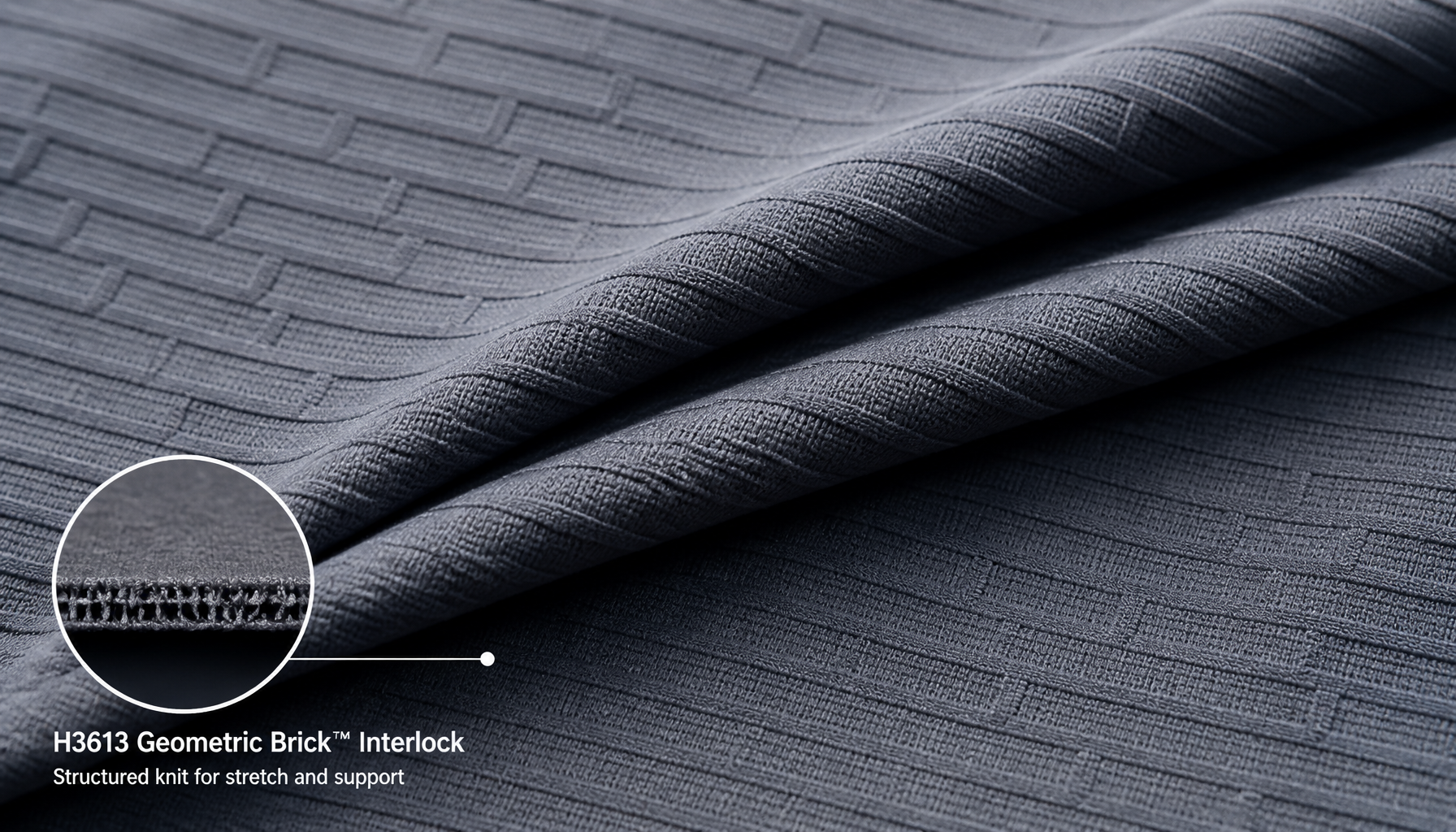
    Precision Fine-Grid Interlock is a 165 g/m² nylon-spandex interlock (78% nylon, 22% spandex, 165 cm nominal width) for activewear that needs a visibly structured surface, controlled stretch and more body than a lightweight jersey. Its raised geometric brick pattern is a visual feature, not proof of compression or support. Buyers should qualify the fabric through finished measurements and garment trials because appearance alone does not establish recovery, pilling resistance or wash stability.

    Illustration: Close-up view of geometric brick interlock fabric for activewear development
    Illustrative image; not a test record or production evidence.

    Where This Structure Fits

    The raised geometric surface can support sports bras, fitted training tops, leggings panels and shapewear details where visual texture is part of the design brief. Interlock construction generally provides a more stable face and back than a single jersey, but the finished result still depends on yarn selection, stitch density, elastane content and finishing. A buyer should describe the garment zone, target support and required stretch direction instead of requesting “structured fabric” without measurable conditions. Treat the catalogue GSM and width as nominal until they are verified on the approval sample.

    Separate Appearance From Performance

    Texture changes how light and color move across a garment, which can make a solid shade look more dimensional. It can also affect printing, bonding, seam appearance and abrasion at raised points. None of those effects can be accepted from a swatch photograph. Review the fabric flat, stretched and sewn, then assess whether the motif distorts at the extension expected in the finished garment.

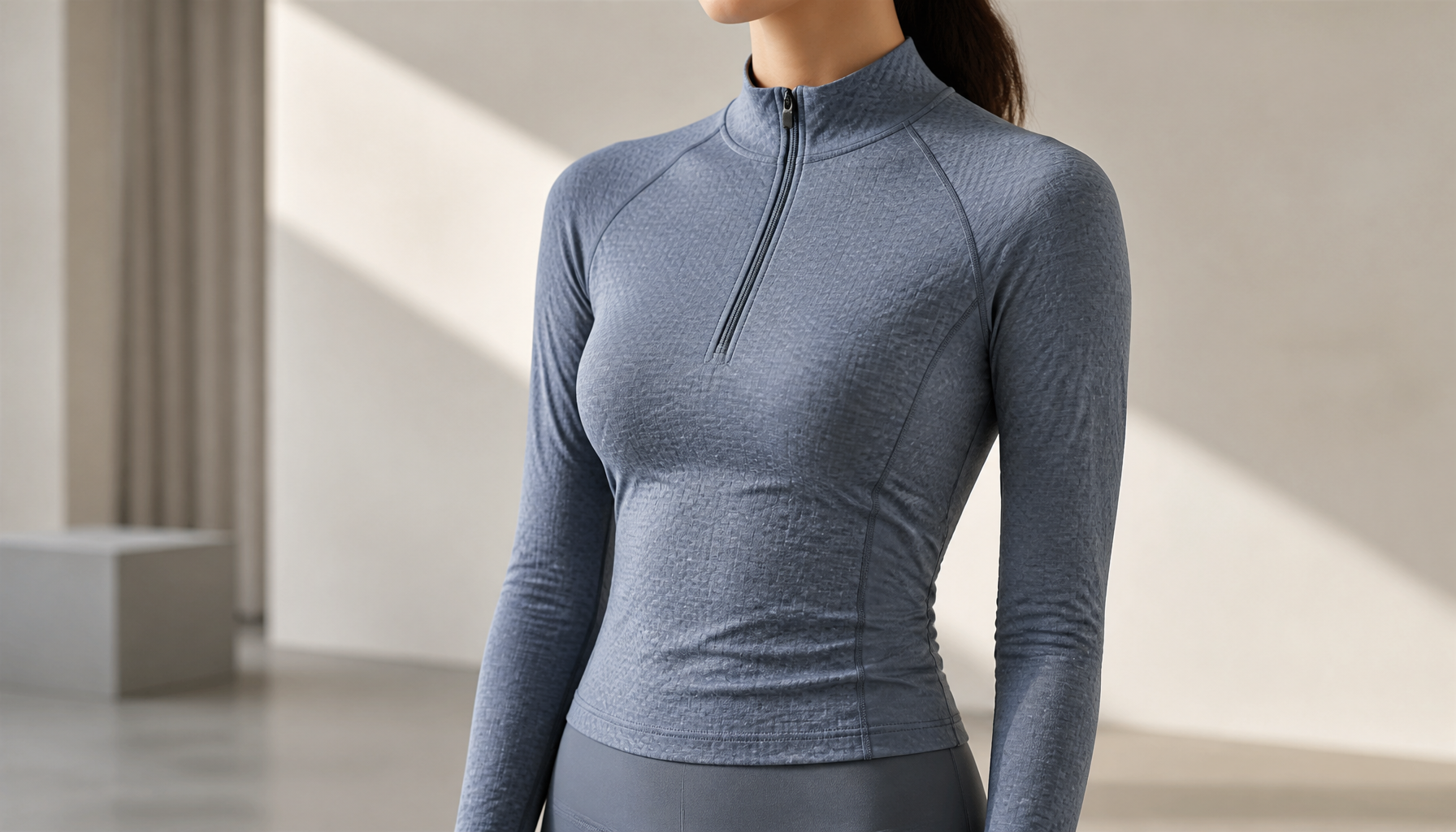
    Illustration: Structured geometric interlock shown in a technical activewear application
    Illustrative image; not a test record or production evidence.

    Build a Comparable Sample Request

    Ask the supplier to state fiber composition, finished GSM, usable width, stretch and recovery by direction, color, surface finish and applicable care conditions. Define how the sample will be evaluated: relaxed and stretched appearance, opacity, seam response, dimensional change after laundering and surface change after abrasion or pilling exposure. The sampling basis for the stretch element is covered in how many samples buyers should test for stretch ratio. Functional finishes should be listed separately and treated as optional until their application and durability are confirmed.

    Use a Garment-Level Decision

    A lab result cannot show whether the textured surface remains balanced across curved panels or under elastic tension. Cut the candidate into the intended pattern, keep seam type and sewing settings consistent, and compare fit after the same conditioning and wash sequence. For an illustrative comparison, if two samples have equal relaxed width but one grows after repeated extension, the apparently similar fabrics will not hold the same garment dimensions.

    Buyer Risk Check

    • Do not infer compression from a firm hand feel.
    • Do not approve bulk color from an unconditioned digital image.
    • Do not compare stretch percentages measured with different loads or holding times.
    • Check raised areas for snagging, glazing and visible wear at garment contact points.
    • Confirm that the approved sample represents the same yarn, construction and finish planned for bulk production.

    Information to Send Before Sampling

    Provide the garment type, panel location, target GSM and usable width, required stretch directions, intended color, desired surface definition, care procedure and acceptance tests. Submit those requirements to ClothFactory through the contact page, and ClothFactory can then screen Precision Fine-Grid Interlock and prepare an appropriate sample. Bulk approval should follow only after the physical fabric and sewn prototype meet the written specification.

  • Fish-Scale Textured Fabric for Performance Polo Shirts

    Fish-Scale Textured Fabric for Performance Polo Shirts


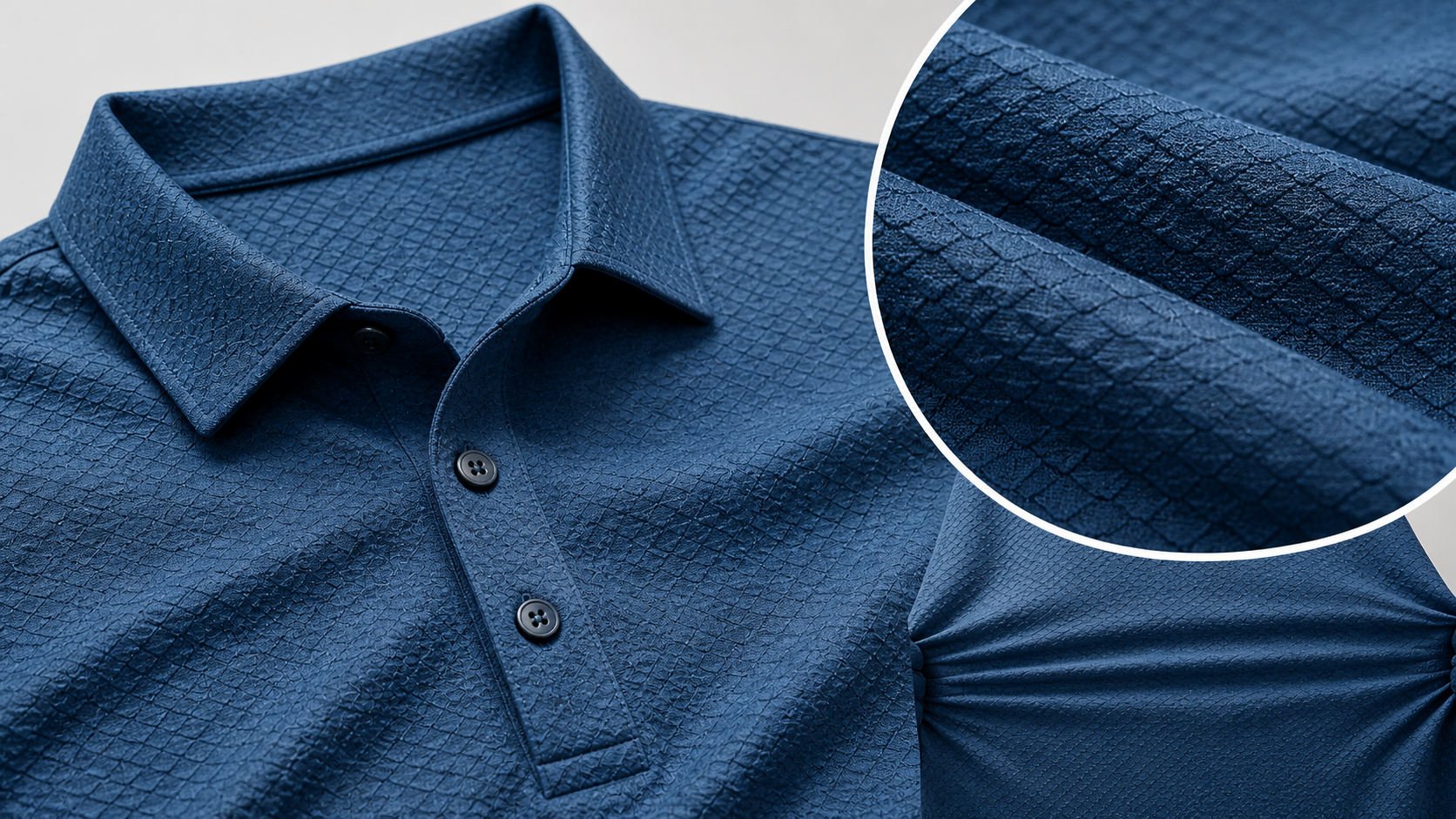
    Fish-Scale Pique Nylon Spandex Fabric is a 180 g/m² knit (83% nylon, 17% spandex, 165 cm nominal width) that gives performance polos a distinctive surface. The texture should be approved together with stretch, dimensional stability, snagging risk and moisture-management requirements. Buyers should treat visual ventilation and actual drying performance as separate questions unless comparable test data confirms both.

    Illustration: Close-up of fish-scale textured knit fabric for performance polo development
    Illustrative image; not a test record or production evidence.

    Why the Texture Matters

    The fish-scale effect creates highlights and shadow across a solid color, helping a polo look differentiated without relying on a printed graphic. “Bio-Armor” is a trade name; it does not by itself establish biological origin, antimicrobial performance or certification. The same relief can influence collar compatibility, placket appearance and contact abrasion. Review the pattern at garment scale because a texture that looks balanced on a small swatch may appear too dominant across a full front panel or distort around seams. Catalogue values are nominal; confirm finished GSM and usable width on the approval sample.

    Convert the Design Brief Into Specifications

    Do not source this fabric by surface name alone. State the required fiber composition, finished GSM, usable width, stretch direction, recovery condition, hand feel, color and care procedure. If airflow, quick drying or moisture management is important, identify the required test method and acceptance condition. A textured surface can create air spaces, but that observation does not by itself establish a performance claim.

    Illustration: Fish-scale knit texture evaluated for a performance polo shirt
    Illustrative image; not a test record or production evidence.

    Evaluate the Polo as a System

    The body fabric must work with the collar, placket, interlining, thread and seam construction. A soft, extensible body paired with a rigid collar may pull out of alignment after laundering; a heavier texture may also affect placket drape. Produce a sewn prototype and check front-panel hang, collar balance, seam puckering, recovery at the hem and dimensional change under the intended care cycle. For a related polo quality, see fine-rib nylon spandex for performance polo shirts.

    Compare Commercial Risk, Not Just Price

    Two textured fabrics with similar quoted GSM can produce different usable yields if their widths, shrinkage allowances or defect rates differ. Use the same pattern and size ratio for marker comparison, and calculate consumption from usable rather than nominal width. A lower price per kilogram can be offset by extra cutting loss, shade separation or rejected panels, so the purchase decision should use acceptable-garment cost.

    Buyer Risk Check

    • Confirm whether the texture remains clear after dyeing and finishing.
    • Check snagging and pilling at shoulder, underarm and bag-contact zones.
    • Evaluate shade under more than one lighting condition.
    • Test darker and lighter colorways separately when appearance or heat exposure matters.
    • Require bulk to match the approved construction and finishing route.

    Sampling Brief

    Send the polo silhouette, intended market, target hand feel, GSM and width requirements, color standard, stretch direction and care label. Add separate acceptance criteria for dimensional stability, colorfastness, pilling or snagging, and any claimed moisture function. ClothFactory can use that brief, submitted through the contact page, to assess the fabric without presenting an unverified surface effect as confirmed performance.

  • Micro-Perforated Fabric for High-Intensity Activewear

    Micro-Perforated Fabric for High-Intensity Activewear


    Perforated Breathable Nylon Spandex Fabric is a 170 g/m² nylon-spandex knit (83% nylon, 17% spandex, 165 cm nominal width) intended for activewear zones where air exchange and low bulk are priorities. The perforated appearance is a design feature, not evidence of airflow. Buyers still need controlled tests for air permeability, drying behavior, stretch recovery and durability before making ventilation or comfort claims.

    Illustration: Micro-perforated stretch fabric prepared for high-intensity activewear
    Illustrative image; not a test record or production evidence.

    Choose the Garment Zone First

    Micro-perforated fabric can be considered for training-shirt bodies, ventilation panels, sports-bra inserts and other areas exposed to heat and perspiration. The correct placement depends on coverage, support and abrasion requirements. Catalogue values are nominal; confirm finished GSM, hole pattern, repeat direction and usable width on a production-equivalent sample. A fabric suitable for an upper-back panel may not provide enough opacity or stability for a high-tension lower-body application, even when both products are described as activewear.

    Define Airflow as a Measurable Requirement

    Visible holes do not quantify airflow. Ask for the test method, specimen condition, pressure differential and reported unit when comparing air-permeability results. Values obtained under different methods or pressure settings are not directly comparable. If quick drying is also required, evaluate it separately because air permeability, liquid spreading and drying rate describe different moisture-transfer mechanisms. Related training-shirt options are described in custom fabric options for high-performance training shirts.

    Check Stretch Around the Perforations

    Perforations concentrate strain along their edges. During sampling, examine whether openings elongate unevenly, remain enlarged after extension or initiate snagging and laddering near seams. Record stretch and recovery in both directions under one agreed procedure. The sample should also be inspected after the intended wash and drying sequence because heat and finishing can change dimensions and surface response.

    Illustration: Micro-perforated fabric assessed in an activewear garment application
    Illustrative image; not a test record or production evidence.

    Balance Ventilation, Coverage and Yield

    A more open structure can improve airflow while reducing visual coverage and increasing sensitivity to pattern placement. For an illustrative garment review, stretch the candidate to the extension measured at the intended body zone and place it over the planned lining or skin-tone reference. This does not replace a formal test, but it exposes whether ventilation has been gained at the expense of opacity or seam stability.

    Buyer Risk Check

    • Do not translate “micro-perforated” directly into a breathability claim.
    • Confirm usable width and whether edge distortion reduces marker efficiency.
    • Check needle selection and seam type on the actual fabric.
    • Evaluate abrasion and snagging at raised or open areas.
    • Verify optional wicking, cooling or antibacterial finishes separately and after the agreed laundering condition.

    Sampling Brief

    Provide the garment type, panel location, target GSM, usable width, stretch directions, coverage requirement, color, finishing request and care procedure. Define which results must be tested on fabric and which must be confirmed on a sewn prototype. Submit the brief through the contact page so ClothFactory can evaluate the fabric against it rather than relying on the product name as proof of performance.