分类: Application guides

  • How Should Buyers Compare Suppliers of Fabric for Yoga Leggings?

    How Should Buyers Compare Suppliers of Fabric for Yoga Leggings?


    There is no universal sample count for checking fabric stretch ratio. The selected test method determines the required laboratory specimens, while the buyer's sampling plan must separately cover the rolls, dye lots, fabric directions, and locations needed to represent the sourcing decision.

    Define what “stretch ratio” means before sampling

    Suppliers and buyers may use “stretch ratio,” “elongation,” and “stretch percentage” differently. The test request should define the calculation and reporting unit instead of relying on the phrase alone.

    For percentage stretch:

    Stretch (%) = (extended length − initial length) ÷ initial length × 100

    Illustrative calculation — not a ClothFactory test result: a marked length that increases from 100 mm to 150 mm has:

    (150 mm − 100 mm) ÷ 100 mm × 100 = 50% stretch

    The same result could be described as an extended-length ratio of 1.5:1, so the report must state which convention it uses. It should also distinguish maximum extension from force at a specified extension, recovery after release, and residual growth. These values answer different procurement questions.

    Separate laboratory specimens from production coverage

    Stretch testing involves several sampling levels:

    • Production lot: the quantity covered by one acceptance decision.
    • Rolls or production groups: represent dye lots, knitting positions, finishing groups, dates, or other traceable sources.
    • Locations within a roll: reveal variation along the roll length or across its usable width.
    • Fabric directions: normally require separate evaluation because coursewise and lengthwise behavior can differ.
    • Test specimens: pieces prepared and measured according to the selected method.

    Several specimens cut beside each other improve repeatability for that sampled location, but they do not demonstrate consistency across multiple rolls. Ten specimens from one roll still represent one roll.
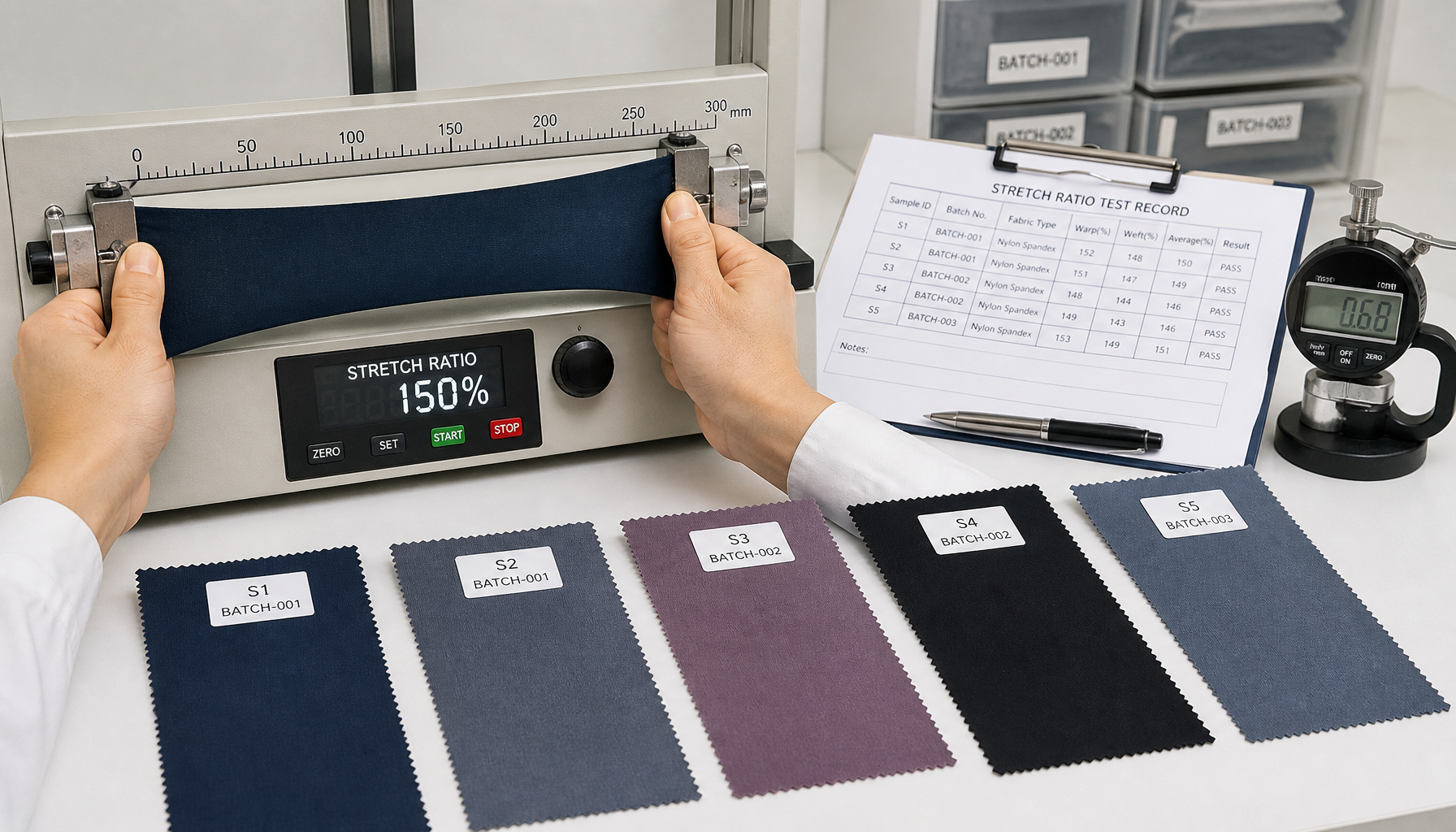
    Stretch fabric specimens prepared for elongation testing

    Let the test method set the specimen count

    Stretch methods differ in specimen dimensions, gauge length, load or force, extension rate, cycling, hold time, recovery time, and calculation. Select the method first, then complete its required specimen set for every sampling group in the buyer's plan.

    The report should state:

    • method identifier and edition;
    • specimen count and direction;
    • conditioning and relaxation procedure;
    • gauge length and specimen dimensions;
    • applied load or target extension;
    • extension rate, hold time, and number of cycles;
    • recovery interval and residual-growth calculation;
    • pre-wash or post-wash condition;
    • individual results, average, range, and specimen origin.

    Do not divide one method-required specimen set among unrelated rolls unless the method and purchase agreement explicitly permit that design.
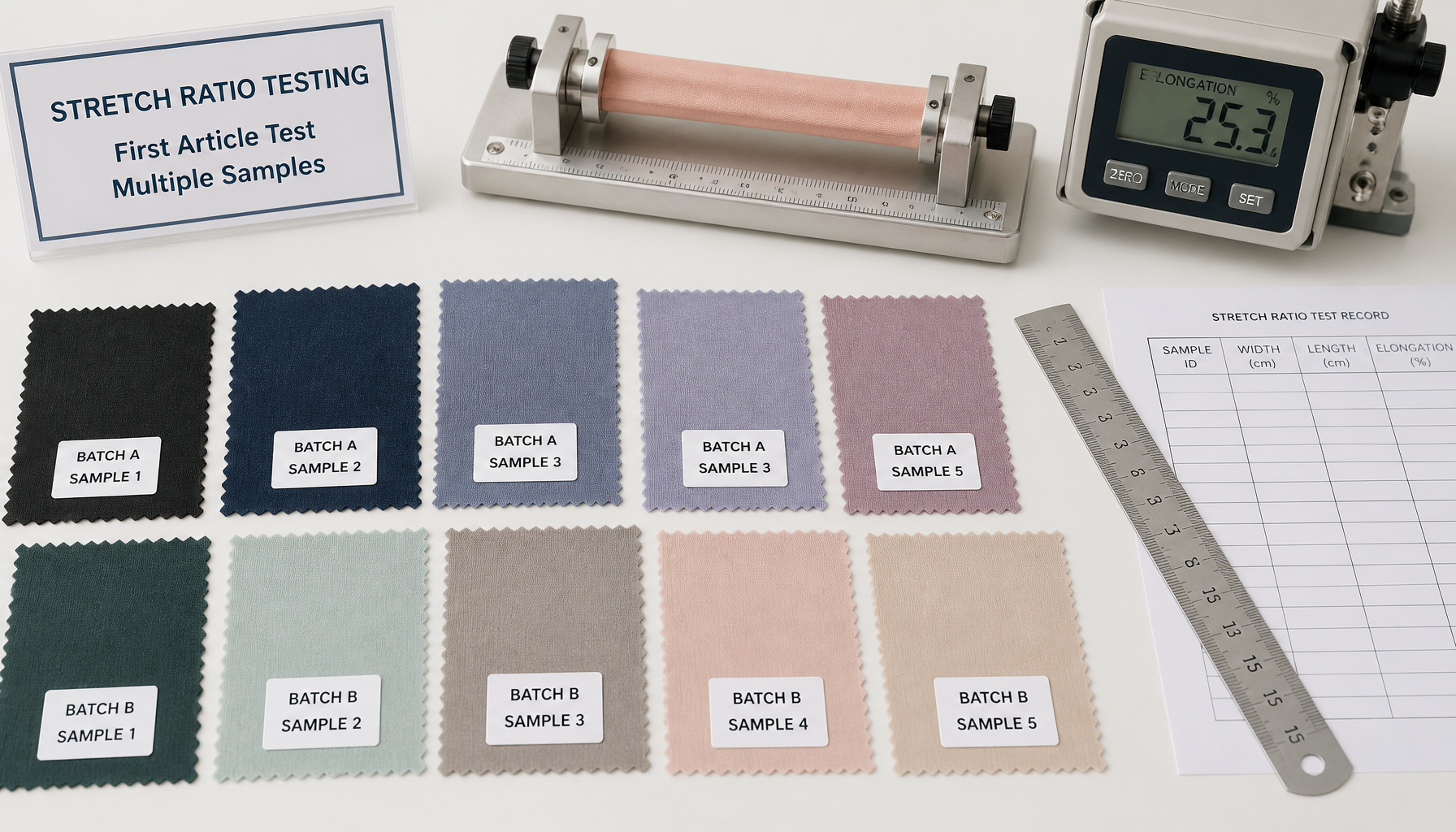
    Knitted stretch fabric being measured under controlled extension

    Adjust production coverage to the sourcing stage

    Stage Decision being made Appropriate sampling logic
    Candidate screening Is this construction worth developing? Test one complete method-required set from each candidate under identical conditions. Results represent only the submitted samples.
    Finished-fabric development Did dyeing, heat setting, or another finish change the response? Test complete sets from matched, identified material before and after the relevant process or wash condition.
    Pre-production confirmation Is the approved construction reproducible? Cover more than one identified production position or roll where available, with complete sets for each sampling group.
    Bulk-lot acceptance Can the shipment be released? Select rolls across each defined dye lot or production group using a written contractual or risk-based plan.

    The plan should state how to handle an outlying roll or group. Options may include adjacent resampling, expanded roll coverage, investigation, segregation, reprocessing, or rejection. A passing overall average should not automatically release a roll with unacceptable recovery or force behavior.

    Use an illustrative sampling calculation correctly

    The following is a hypothetical buyer-defined plan, not an industry standard or ClothFactory test result. Suppose a buyer selects four representative rolls and samples two locations per roll:

    4 rolls × 2 locations = 8 sampling groups

    If both principal directions are evaluated separately:

    8 sampling groups × 2 directions = 16 direction-specific groups

    Each group must then supply the complete number of specimens required by the selected method. If that number is n, the total is:

    16 direction-specific groups × n method-required specimens

    The correct number of rolls depends on lot size, dye-lot structure, color and finish groups, earlier quality history, construction risk, and the purchase agreement. The example shows the calculation logic, not a default requirement.

    Measure more than maximum stretch

    Maximum elongation alone does not show whether a fabric will provide support or maintain fit. For leggings, sports bras, underwear, or shapewear, buyers may also need:

    • force at the extension expected in the garment;
    • recovery after a defined hold and relaxation period;
    • residual growth after repeated cycling;
    • results after the intended wash and drying procedure;
    • appearance, cover, or print integrity under an agreed extension.

    Spandex percentage is not a substitute for these measurements. Yarn size, knit geometry, spandex feeding, heat setting, finishing, and specimen direction all influence the result.

    Keep every comparison condition consistent

    Stretch results are comparable only when the conditions match. Use the same specimen direction, dimensions, conditioning, gauge length, load or extension, rate, cycles, hold time, recovery interval, and laundering condition across candidates.

    Record the exact fabric code, color, finish, roll, dye lot, and sampling location. Test the finished construction rather than relying only on greige fabric or an unfinished development swatch. Dark colors, special finishes, or different heat-setting conditions may need separate confirmation when they create a different production risk.

    Interpret variation before averaging

    Review individual and group results, not only the mean. A wide range can indicate variation by roll, direction, location, finish, or test preparation. Investigate that source before adding more results to an average.

    Retesting adjacent material can help determine whether an unusual result is local or representative, but the original result should remain in the record. The purchase agreement should define whether acceptance applies to each roll, each production group, or the lot as a whole.

    Information buyers should include in the request

    Provide the supplier or laboratory with:

    • fabric code, composition, knit construction, finished GSM, and usable width;
    • intended garment, body zone, fit, and expected extension;
    • selected test method and reporting convention;
    • specimen directions and production sampling locations;
    • conditioning, cycling, hold, recovery, and wash requirements;
    • required force, stretch, recovery, or growth limits;
    • lot definition and roll-selection rule;
    • report format showing individual results and full traceability.

    Procurement next step

    Choose the stretch method and reporting convention first. Then build a separate production sampling plan that covers the rolls, dye lots, directions, and locations relevant to the order. ClothFactory can prepare identified nylon-spandex or polyester-spandex specimens, but the buyer and supplier should agree the method, sampling coverage, garment extension, recovery interval, and acceptance limits before using the results for bulk approval.
  • Which Knit Structure Should Buyers Consider for Golf Shirts?

    Which Knit Structure Should Buyers Consider for Golf Shirts?

    Pique, interlock and jersey are all candidates for golf shirts; none is automatically best. Choose the structure against the intended silhouette, playing conditions, logo process and care expectations. Fibre composition, yarn specification, fabric density and finishing must be considered alongside the knit name. A “performance pique” label is not evidence of airflow, recovery or moisture management.

    Start with the shirt’s commercial role

    A club-uniform polo may need a consistent textured appearance, reliable embroidery and repeat ordering. A lightweight tournament shirt may prioritise freedom of movement and reduced material mass. A premium travel polo may prioritise a smooth face and a stable silhouette. Those briefs can lead to different structures even when all three use polyester-spandex or nylon-spandex yarns.

    Set the non-negotiable requirements first: fit, opacity in selected colours, care procedure, logo method and target material cost. Treat hand feel and surface character as approved references rather than trying to describe every preference with “soft” or “premium.”

    Understand what each structure offers to the design

    Structure-based starting points, not guaranteed performance rankings
    Candidate Reason to sample it Question to resolve
    Pique A textured face associated with classic polo styling. Does the actual construction deliver the desired texture, snag resistance and logo appearance?
    Interlock A double-knit option for a smooth, substantial appearance. Can the chosen weight and finish meet the brief without excessive warmth or stiffness?
    Single jersey A candidate for a lighter, more fluid silhouette. Will edge behaviour, dimensional change and placket assembly remain controlled?

    Ask suppliers to identify the actual construction rather than relying only on a trade name. Pique variants can differ, and a photograph cannot reliably identify yarns or loop geometry. Compare finished samples with their technical sheets and relevant measurements.

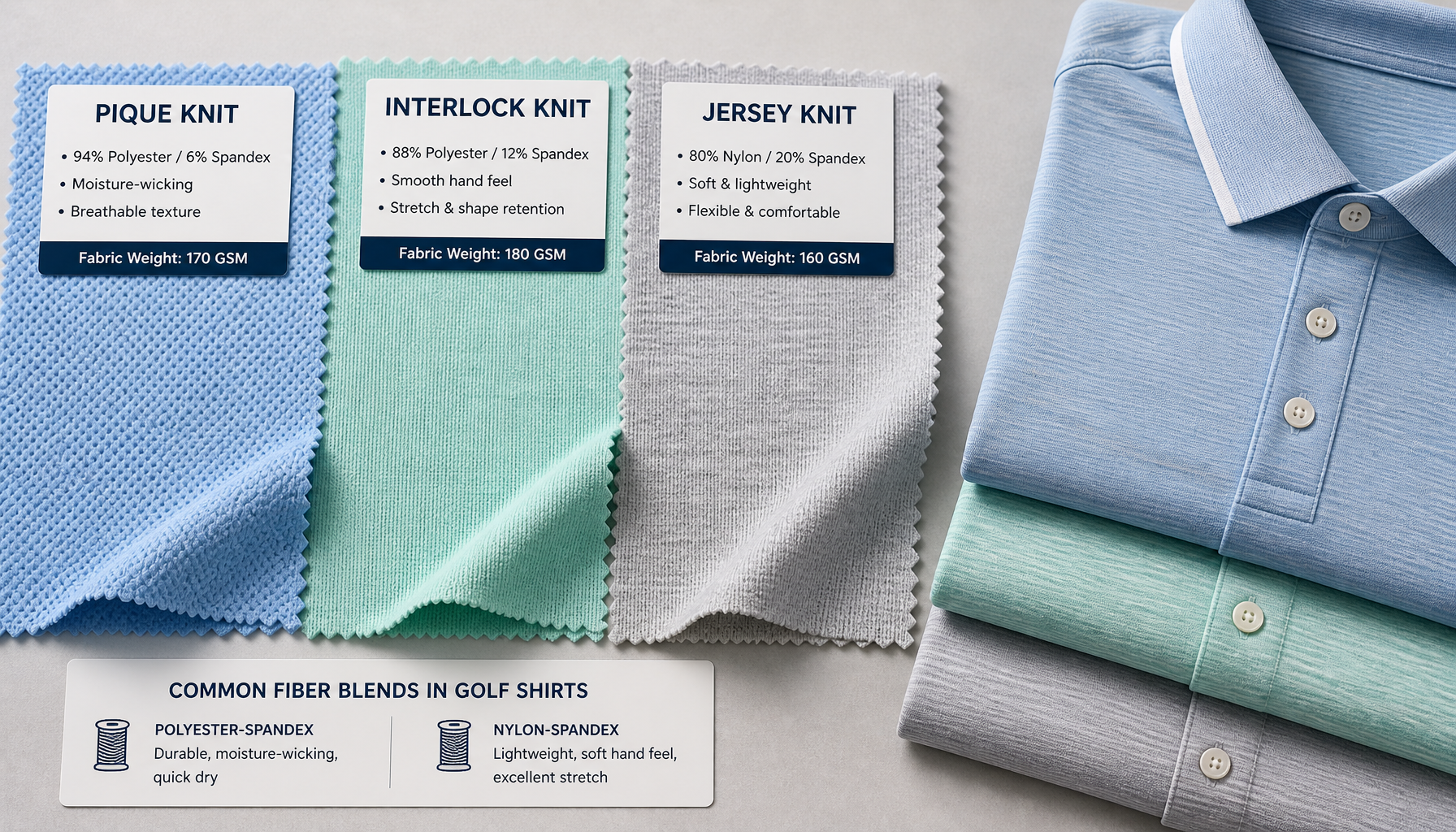
    Pique, interlock and jersey golf-shirt concepts with close-up fabric illustrations
    Structure and styling illustration. Airflow, moisture handling, stretch and durability must be assessed on the selected fabrics; the graphics are not test results.

    Evaluate movement at the shoulder and sleeve

    A golf swing places directional demands on the back, armhole and sleeve. More spandex does not automatically mean easier movement: extension force and pattern geometry both matter. Trial the shirt during address, backswing and follow-through, checking hem lift, placket distortion and pulling across the shoulder.

    For an illustrative strain estimate, a fabric span increasing from 42 cm to 50.4 cm extends by 20%. A laboratory comparison at that extension should examine the force required and subsequent recovery, not merely whether both materials can be pulled to that length. Confirm the actual critical strain on the garment before setting a test condition.

    Separate texture, mass and comfort evidence

    A visibly textured surface does not prove higher air permeability than a smooth one. Compare the candidate fabrics under the same method and preparation. ISO 9237 measures air permeability; drying and liquid-moisture behaviour require different evaluations. If sun protection is part of the sales claim, obtain relevant UV evidence rather than inferring it from colour or density.

    Fabric mass also needs a garment context. If an illustrative shirt contains 0.85 m² of net fabric area, a 160 g/m² material contributes 136 g, while a 190 g/m² material contributes 161.5 g: a 25.5 g difference before trims. This is not purchased marker consumption or total garment weight. Decide whether that difference is meaningful to the brief instead of treating lower GSM as an automatic quality improvement.

    Approve the collar, placket and decoration as an assembly

    The body fabric cannot solve every collar or placket problem. Interfacing, collar construction, sewing feed and component dimensional change affect whether the front stays flat. Wash the assembled sample under the intended care conditions and inspect twisting, puckering, collar shape and differential shrinkage between components.

    Run embroidery or transfer trials at the intended logo size and location. Check local stiffness, distortion, surface damage and durability after care. A logo that looks acceptable on an unstretched swatch may pucker on a lightweight chest panel or restrict movement on a fitted sleeve.

    Choose the production option through a controlled trial

    Shortlist structures using the technical brief, then make comparable garments with documented construction settings. Where pattern or process adjustments are necessary, record them and include their cost. Compare measured usable width, marker consumption, sewing time and the cost of achieving the approved appearance.

    Release the selected fabric against a named construction and finish revision, approved colours, dimensional requirements and garment standard. Keep a retained washed sample for production comparisons. The right structure is the one that meets the shirt’s performance and appearance requirements repeatedly at an acceptable cost, not the one with the most familiar marketing name.

  • How Can Buyers Compare Fabric Quotes When GSM, Width, Composition, and Finishing Are Different?

    How Can Buyers Compare Fabric Quotes When GSM, Width, Composition, and Finishing Are Different?

    Compare fabric quotes only after separating technical suitability from price conversion. A kilogram price, a linear-metre price and a price for a different usable width are not directly comparable. First establish which candidates meet the garment brief. Then convert the quotations to a common basis and calculate the cost of producing acceptable garments.

    Confirm what each price actually buys

    Record currency, price unit, delivery term and named place, tax treatment, quotation validity, minimum order by colour and any surcharges. Confirm whether weight excludes packaging and whether width means full width or usable cutting width. For tubular fabric, establish whether the stated width is laid-flat or opened width before applying any area conversion.

    Ask whether the quoted article includes the approved dyeing and finishing route. A price for unfinished or differently finished material does not cover the same product as a finished fabric ready for cutting. Keep the technical-sheet revision beside the quote so a commercial comparison does not silently compare different constructions.

    Convert kilogram prices using the billed fabric dimensions

    For open-width fabric with consistent mass per area, theoretical kilograms per linear metre = GSM × full width in metres ÷ 1,000. A kilogram quote multiplied by that result gives a theoretical linear-metre price. If invoiced mass includes unusable edges, using only usable width in this conversion understates the cost.

    Usable-area cost is then linear-metre price ÷ usable width in metres. This is a screening calculation, not garment yield. It assumes the quoted weight and width are representative; actual invoiced mass, measured length and agreed usable width should reconcile the production costing.

    Hypothetical quote comparison; these are not supplier offers
    Input or result Fabric A Fabric B
    Quotation $10.00/kg $3.50/linear m
    Finished weight 220 g/m² As specified in B’s approved technical sheet
    Full / usable width 1.65 m / 1.60 m 1.55 m / 1.50 m
    Calculated mass per metre 0.363 kg/m Not needed to convert a metre quote
    Linear-metre price $3.63 $3.50
    Price per usable square metre Approximately $2.27 Approximately $2.33

    B has the lower metre price, while A has the lower usable-area price. Neither result decides the order: both materials still need technical approval, and the cutting marker determines how much each garment consumes.

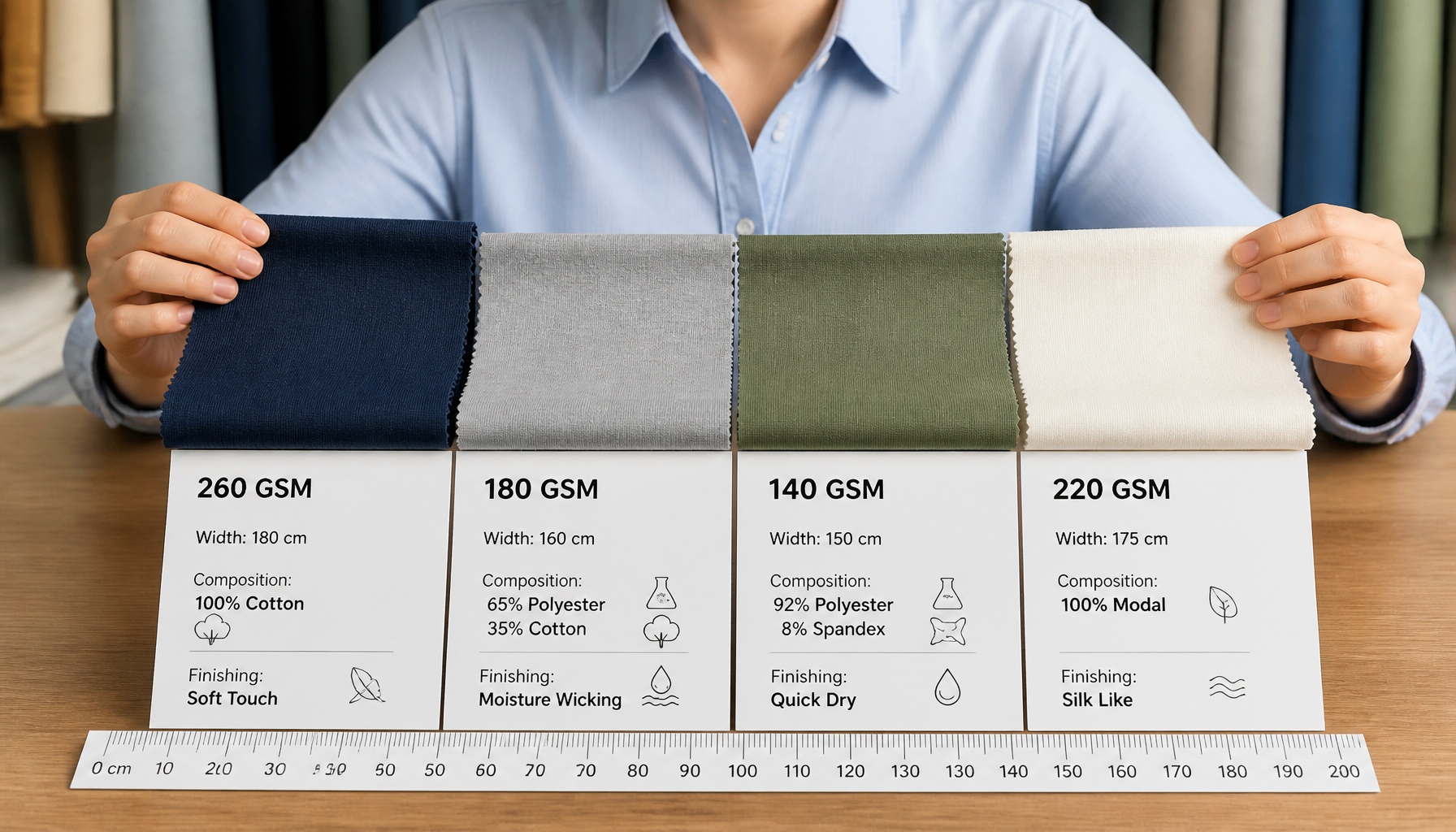
    Fabric swatches displayed with composition, weight, width and finish labels
    Illustrative comparison layout. Printed specifications are not verified quotations or a substitute for the approved technical sheets.

    Run the marker before ranking the fabrics

    Use the actual pattern, size ratio, minimum usable width and any nap or one-way restrictions. A few centimetres of usable width can determine whether another panel fits across the marker. Area cost alone cannot capture that step change.

    Continuing the hypothetical example, suppose approved markers consume 0.90 m per garment for A and 1.00 m for B. Material cost is $3.63 × 0.90 = $3.267 for A and $3.50 × 1.00 = $3.50 for B. A would save about $0.23 per garment under those assumptions. The consumption values must come from actual markers, not from assuming that wider fabric always produces a fixed percentage saving.

    Price the performance gap and process changes

    Different composition, weight and finishing can change support feel, surface durability, decoration compatibility and care behaviour. Remove any candidate that cannot meet a mandatory requirement. If an alternative needs lining, a different seam or an extra finishing operation, cost the revised garment rather than pretending the fabrics are interchangeable.

    Ask whether a claimed moisture-management finish or surface treatment is included in the quote and represented in the sample. Request appropriate evidence for any required durability after care. A soft initial hand feel does not establish equivalent long-term performance.

    Allocate order-level costs without hiding waste

    Sampling, laboratory work, small-lot dyeing charges and freight may be fixed or partly fixed. As an illustration, a $300 order-level charge adds $0.10 per garment to 3,000 accepted garments, but $0.50 to 600. Use the realistic order quantity and distinguish development costs from recurring production costs.

    Define what the consumption figure already includes. If marker consumption includes cutting waste, do not add the same allowance again. Additional roll defects, end losses or rejected garments need separate, justified assumptions. Under an illustrative 98% accepted-garment yield, a production cost of $3.30 per piece started becomes $3.30 ÷ 0.98, or about $3.37 per accepted piece, before any recovery value.

    Make the comparison auditable

    The final comparison should link each price to the approved specification, sample, marker and delivery basis. Show assumptions and unresolved deviations beside the total, not in a separate email chain. Confirm the commercial terms again when quantities, colours or specifications change.

    Select the lowest defensible cost for an acceptable garment, not the lowest isolated price unit. A quote is decision-ready when another buyer can reproduce the conversion and understand exactly which technical and commercial risks remain.

  • How Should Buyers Set Fabric Specifications for Squat-Proof Yoga Leggings Before Requesting Quotes?

    How Should Buyers Set Fabric Specifications for Squat-Proof Yoga Leggings Before Requesting Quotes?

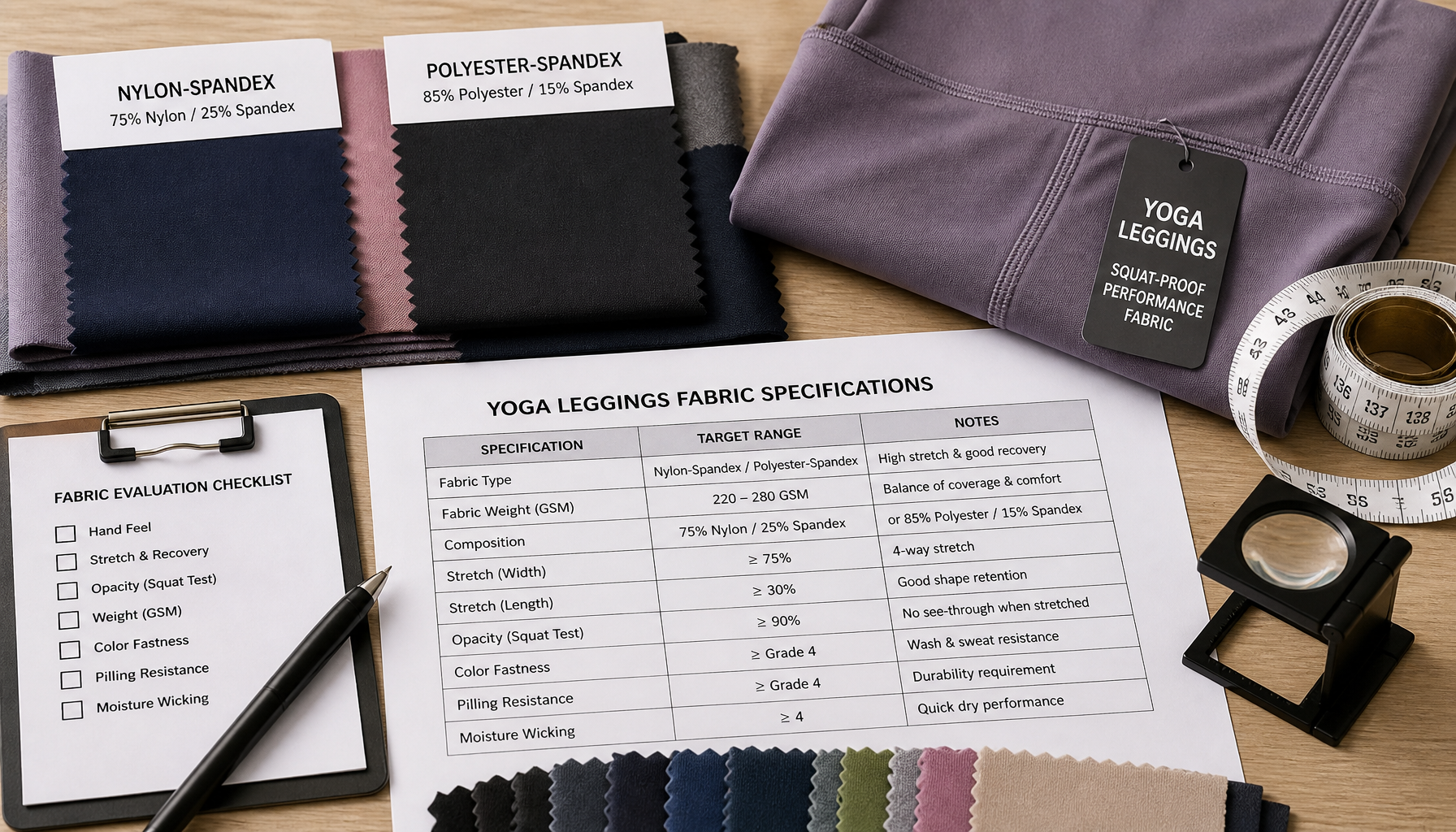
    Specify squat-proof yoga-legging fabric through a defined garment coverage assessment, supported by construction, elasticity and production controls. Do not reduce the brief to a minimum GSM or spandex percentage. Coverage depends on the fabric, colour, pattern strain, seam placement and assessment conditions. A supplier cannot price the requirement reliably if “squat-proof” is the only acceptance instruction.

    Translate the fit into a fabric-strain requirement

    Start with the approved size chart, pattern and intended compression level. Identify high-strain locations during a squat, including the seat, upper thigh and seam intersections. A flat swatch stretched by hand does not reproduce the distribution of strain in a garment.

    In an illustrative example, an 80 cm relaxed garment circumference fitted around a 100 cm body has 20% negative ease relative to the body. The fabric extension is (100 − 80) ÷ 80 × 100 = 25%. Confusing those two percentages can lead to an opacity assessment at insufficient extension. Use pattern calculations to plan the trial, then confirm the critical locations on the finished garment.

    Size grading also matters. Do not assume that approving a medium size establishes coverage in every size. Review where the graded pattern produces the greatest local strain and include those fit conditions in the approval plan.

    Make the coverage assessment reproducible

    Agree the lighting arrangement, viewing distance, backing or underwear contrast, fabric extension, garment movements and pass/fail reference before comparing candidates. Photograph the setup and retain an approved garment for comparison. If appearance is judged visually, record that fact instead of presenting an invented numerical “opacity grade” as a recognised laboratory standard.

    Evaluate relevant colours separately. A dark sample may conceal contrast that is visible through a pale colourway. Include dry and damp conditions when both are relevant to the use claim, and specify the care sequence before reassessment. The objective is a repeatable brand acceptance protocol, not a promise of invisibility under every possible light and viewing angle.

    Connect the specification to the failure risk

    RFQ fields that turn a coverage brief into a testable purchase requirement
    Field What to define Why it matters
    Construction and finish Approved article or construction revision; permitted changes. A finish change can alter hand feel, dimensions and stretched appearance.
    Finished mass and width Agreed GSM range and minimum usable width after the specified preparation. Controls consistency and marker feasibility without treating weight as proof of opacity.
    Elasticity Directions, load or extension, cycles, recovery interval and acceptance limits. Separates support feel from residual growth.
    Coverage Colours, garment sizes, strain locations, lighting and visual reference. Connects the material to the actual product claim.
    Care and durability Wash/dry procedure, evaluation stages and appearance limits. Prevents approval from covering only an unwashed prototype.

    Set numerical limits with the garment team and laboratory using the approved reference and end use. A universal GSM threshold or arbitrary recovery percentage would create false precision rather than a defensible specification.

    Measure support and recovery as different properties

    A high-spandex fabric can feel easy to stretch or relatively firm depending on construction. Request force at a defined extension when support feel matters, and residual extension after a defined recovery period when bagging is the concern. Specify both fabric directions and the relevant care history.

    ISO 20932-1 provides strip-test methods for elasticity. Agree the applicable procedure and conditions with the laboratory; the method name alone does not set a garment pass limit. Pair the report with a wear-and-movement assessment because seams, waistband construction and panel orientation change the finished result.

    Ask for a quote against an approval sequence

    Send suppliers the specification, colour quantities, usable-width requirement, target delivery basis and intended decoration. Ask them to identify deviations explicitly. An alternative composition may be worth testing, but it should not silently replace the quoted reference while retaining its approval status.

    Separate initial sampling, colour approval, pilot-garment approval and bulk release. Require traceable sample identification and confirmation of whether the sample uses the proposed bulk construction and finish. A fabric chosen from stock for a fast fitting is not automatically representative of the later production lot.

    Compare the cost of compliant garments

    Consider an illustrative material option saving $0.20 per metre at 0.90 m consumption: the nominal saving is $0.18 per legging. If that option requires a lining costing $0.45 per garment to meet the coverage brief, it is already $0.27 more expensive before additional sewing. The comparison has changed from two equivalent fabrics to two different garment constructions.

    Release the selected option only when the approved garment, colour scope, test records and bulk specification agree. Hold approval when the supplier can offer only a GSM number, a stretched-hand photograph or a generic “squat-proof” statement. The purchase requirement is demonstrable coverage in the intended leggings, with controlled repeatability across the order.

  • When Can Free-Cut Fabric Be Used Without Hemming in Activewear?

    When Can Free-Cut Fabric Be Used Without Hemming in Activewear?


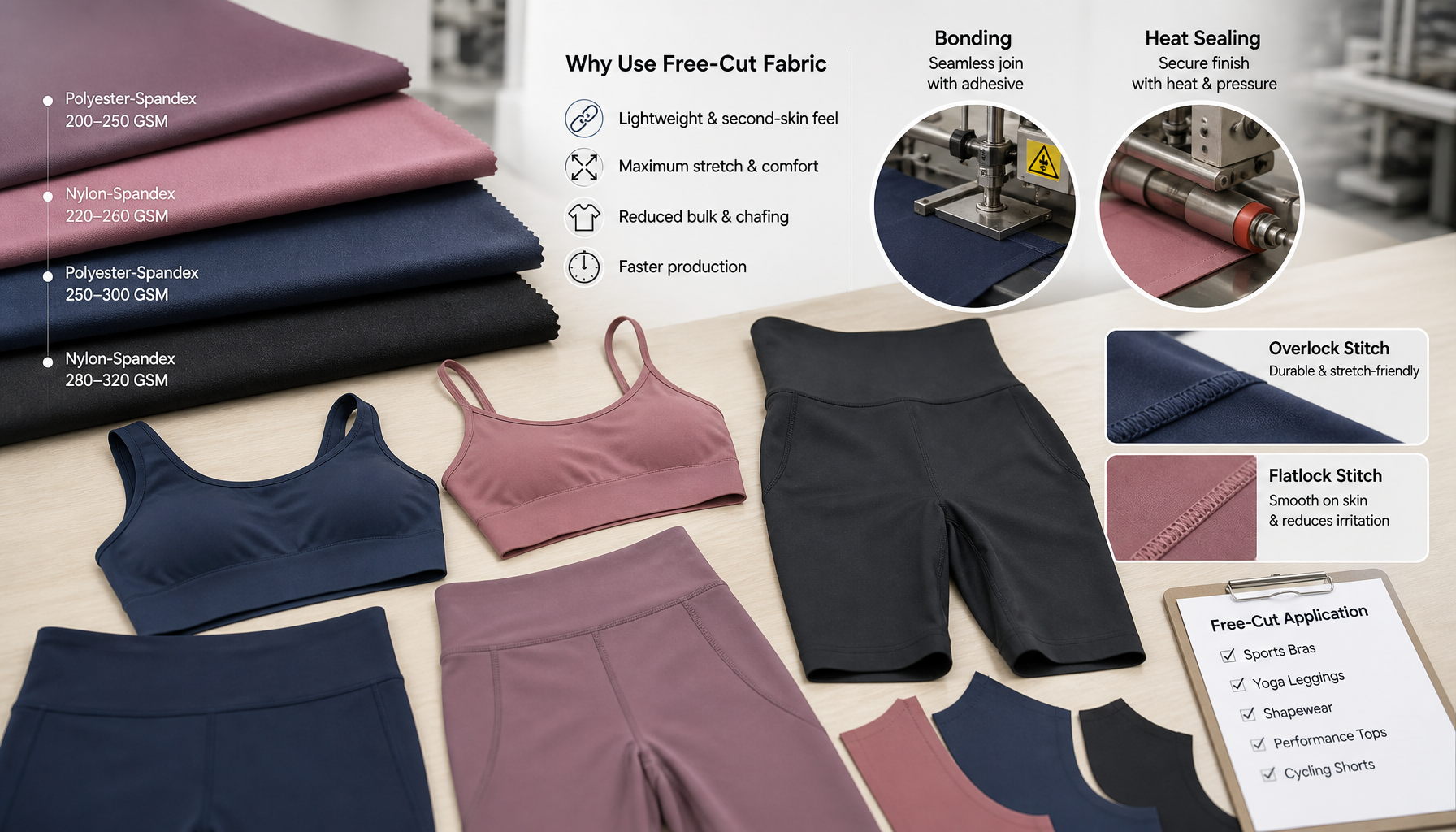
    Free-cut fabric can be used without a sewn hem only when the raw edge remains stable, comfortable, and durable in the finished garment. Buyers should approve the actual fabric construction, cut method, edge treatment, garment zone, and wash cycle together; a nylon-spandex or polyester-spandex label alone is not enough.

    Treat free-cut as a construction decision

    In this context, free-cut means a panel is cut to its final outline without a traditional folded hem. The edge may remain raw, or it may be stabilized by laser cutting, heat sealing, ultrasonic bonding, binding, or another process. These methods are not interchangeable. A raw knitted edge and a bonded edge have different failure risks and must be specified separately.

    The correct question is not whether a fabric is “free-cut.” It is whether the chosen edge can maintain its shape and appearance at the garment’s actual extension, abrasion points, and care conditions.

    Check the fabric before choosing the edge treatment

    Composition and knit construction

    Nylon-spandex and polyester-spandex knits are common candidates for activewear, but composition does not determine edge performance. Record the knit type, yarn information available from the supplier, finished GSM, usable width, stretch direction, and any finishing treatment. Compare samples from the same construction and finish when evaluating edge behavior.

    Curl, fray, and recovery

    Inspect cut strips in both principal directions. Record whether the edge rolls, curls, ladders, frays, or develops a hard line after cutting. Then extend the strip to the level expected at the waistband, leg opening, bra armhole, or shapewear opening and check whether the edge returns without permanent distortion.

    GSM and edge stability

    GSM can help compare mass and cover, but it is not an acceptance rule. A heavier fabric may still curl if the knit structure is unstable, while a lighter fabric may perform well when the edge is bonded or placed in a low-stress zone. Confirm edge behavior on the finished fabric rather than approving by weight alone.

    Cut edge of stretch knit fabric being evaluated for activewear

    Match the edge method to the garment zone

    Garment use When a free-cut edge may be considered What must still be checked
    Sports-bra armhole or hem A stable knit with a controlled raw, laser-cut, or bonded edge in a low-abrasion zone Skin comfort, repeated extension, edge rolling, and wash durability
    Compression short or shapewear opening A construction that holds the edge under sustained extension and pressure Local pressure, growth, adhesive or bonding durability, and recovery after laundering
    Yoga-legging hem or panel edge A stable fabric and edge process that match the pattern and movement range Cover, appearance under stretch, snagging, and abrasion at the hem
    Lingerie edge A soft edge treatment with controlled contact against skin Friction, irritation, colorfastness, and dimensional stability
    High-abrasion or load-bearing edge Usually requires a hem, binding, enclosed seam, or another reinforcement Whether the edge survives wear testing and production handling

    This table is a screening framework, not a blanket approval. A design that works on a sports-bra armhole may fail at a leg opening because the extension, friction, and seam forces are different.

    Separate raw edges from bonded or enclosed edges

    Heat sealing and ultrasonic bonding can stabilize an edge without a folded hem, but they introduce their own development variables: equipment settings, adhesive or film compatibility where applicable, line strength, hand feel, and wash durability. Overlock and flatlock stitching secure an edge through sewing and should not be described as an unprocessed free-cut edge.

    Ask the garment factory to identify the edge process on the tech pack. The fabric supplier should then evaluate the matched fabric and process combination, not an isolated swatch cut with an unrelated tool.

    Use a defined edge-approval test

    1. Cut specimens in the main and crosswise directions using the intended production method.
    2. Record the initial edge length, width, GSM, and visual condition after relaxation.
    3. Extend the edge to the garment’s intended strain and record curl, fray, laddering, and residual growth.
    4. Launder the specimens using the planned care cycle, then repeat the relaxed and extended inspection.
    5. Expose the edge to the relevant abrasion or repeated-extension condition.
    6. Make a garment or seam mock-up and inspect comfort, appearance, and edge stability at the actual placement.
    7. Approve a sealed reference sample with the cut method, edge treatment, tolerances, and wash condition recorded.

    Illustrative calculation — not a ClothFactory test result: if a 100 mm raw edge is extended by 30%, its temporary length is:

    100 mm × (1 + 0.30) = 130 mm

    After release, measure the remaining length and edge shape. This calculation defines the extension condition; it does not establish a universal pass limit. The buyer and supplier must agree the acceptable residual growth and appearance for the garment zone.

    When hemming or reinforcement is usually safer

    Use a hem, binding, enclosed seam, or another edge reinforcement when:

    • the knit is open, lightweight, or visibly prone to laddering or fraying;
    • the edge carries high tension, repeated abrasion, or concentrated seam load;
    • the edge will contact skin and a raw or bonded line feels harsh;
    • the design requires a precise visible edge or stable opening dimension;
    • the cut process or bonding method is not controlled in bulk production;
    • wash or wear testing shows permanent curl, growth, delamination, or distortion.

    Information to include in a sample request

    Send the supplier and garment factory the same brief:

    • garment type and exact edge location;
    • fabric composition, knit construction, finished GSM, and usable width;
    • stretch direction and expected extension at the edge;
    • intended cut tool or edge process;
    • wash method, number of cycles, and any abrasion or wear condition;
    • required appearance, comfort, recovery, and dimensional tolerances;
    • reference sample or pattern section showing the edge geometry.

    Do not approve a free-cut construction from a relaxed fabric swatch alone. A successful sample must represent the production fabric, cut method, edge process, garment pattern, and care cycle.

    Procurement next step

    For a free-cut activewear request, send a pattern section or edge sketch together with the target composition, GSM, extension, finish, cut process, and care requirements. Ask for cut-edge specimens and a small garment or seam mock-up before bulk approval. ClothFactory can compare a suitable nylon-spandex or polyester-spandex construction, but the final decision should remain tied to the tested edge process and garment placement.

  • What Should Buyers Check When Reviewing Gym Shorts Fabric Samples?

    What Should Buyers Check When Reviewing Gym Shorts Fabric Samples?


    When reviewing gym shorts fabric samples, buyers should approve the finished construction against the garment brief—not just the fiber blend or hand feel. The critical checks are stretch and recovery, coverage and weight, moisture and air behavior, surface durability, colorfastness, and consistency after the agreed care cycle.

    Define the gym-shorts brief before judging the swatch

    Gym shorts may use a loose outer shell, a close-fitting liner, or both. A shell intended for high-sweat training has different priorities from a liner that must stay opaque and recover after repeated extension. Before comparing samples, record the garment layer, body coverage, target fit, climate, color range, wash method, and whether the fabric will be used next to skin.

    For example, a buyer developing a close-fitting training short should review the fabric at the extension expected around the seat and thigh, not only in its relaxed state. A looser shell may place more weight on drape, air exchange, and abrasion at the hem. These are application decisions; no single GSM or composition is correct for every gym-short design.

    Check composition and construction together

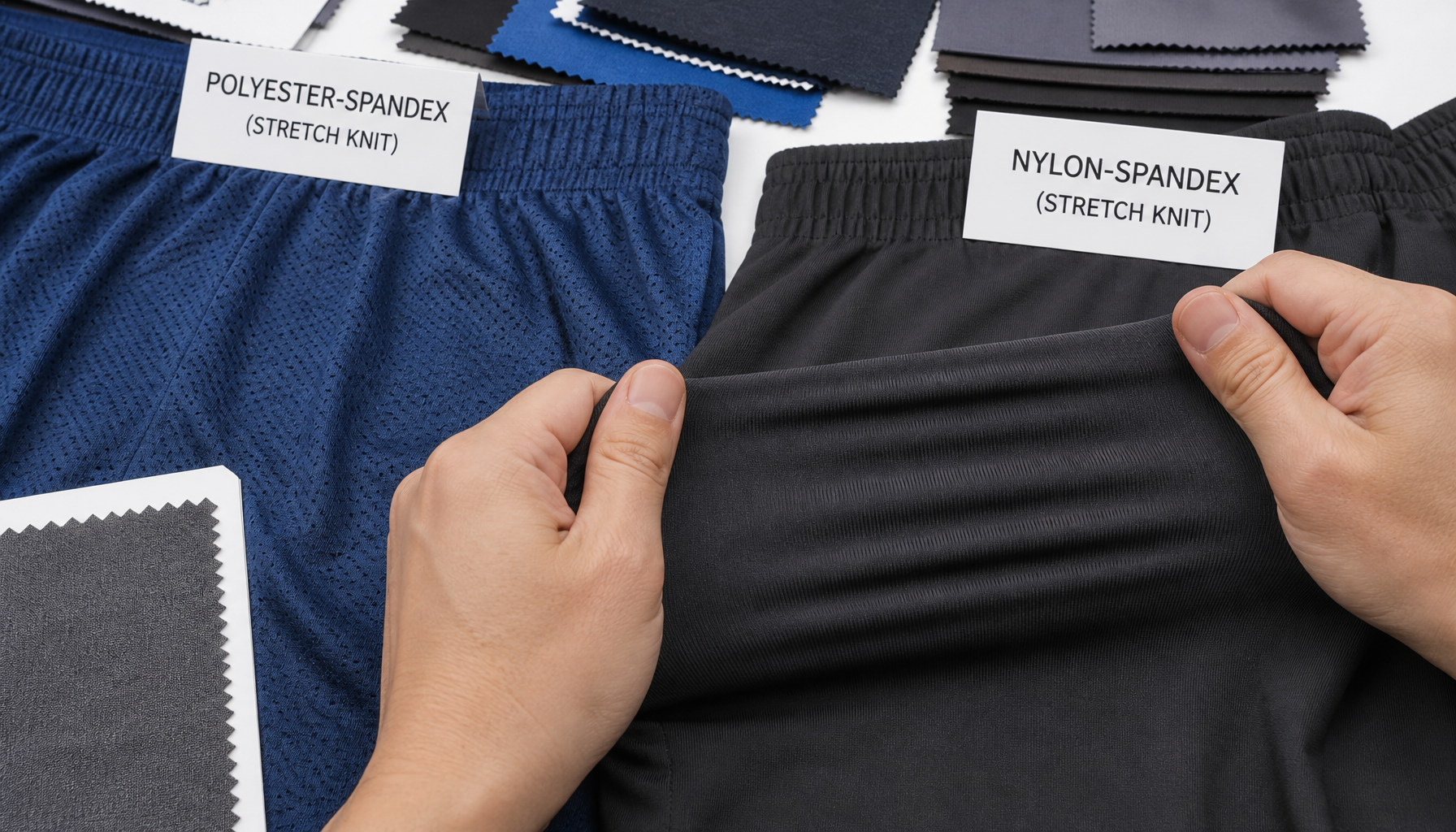
    Nylon-spandex and polyester-spandex knitted fabrics are both reasonable starting points. Nylon-spandex may be shortlisted when a smooth hand and close-to-skin comfort are important. Polyester-spandex may be considered for constructions targeting quick drying or repeated-use durability. Neither conclusion is automatic: yarn, knit geometry, finishing, color, and garment design can change the result.

    Ask the supplier to state the fiber composition, knit construction, finished GSM, usable width, and any finishing treatment on the sample sheet. Do not treat a reference color card or a blend name as proof of a finished performance property.

    Evaluate stretch and recovery under defined conditions

    Hand-stretching a swatch is useful for screening, but it cannot replace a comparable measurement. Request stretch and recovery in the main and crosswise directions, with the extension level, hold time, recovery time, conditioning, and wash history recorded. A fabric can feel flexible while still showing unwanted growth after wear.

    Review the sample both relaxed and extended. Look for loss of cover, distorted courses, shine, or a recovery delay that could affect the waistband, leg opening, or liner fit. Approve the final construction only after a garment sample confirms that the fabric response matches the pattern and seam design.

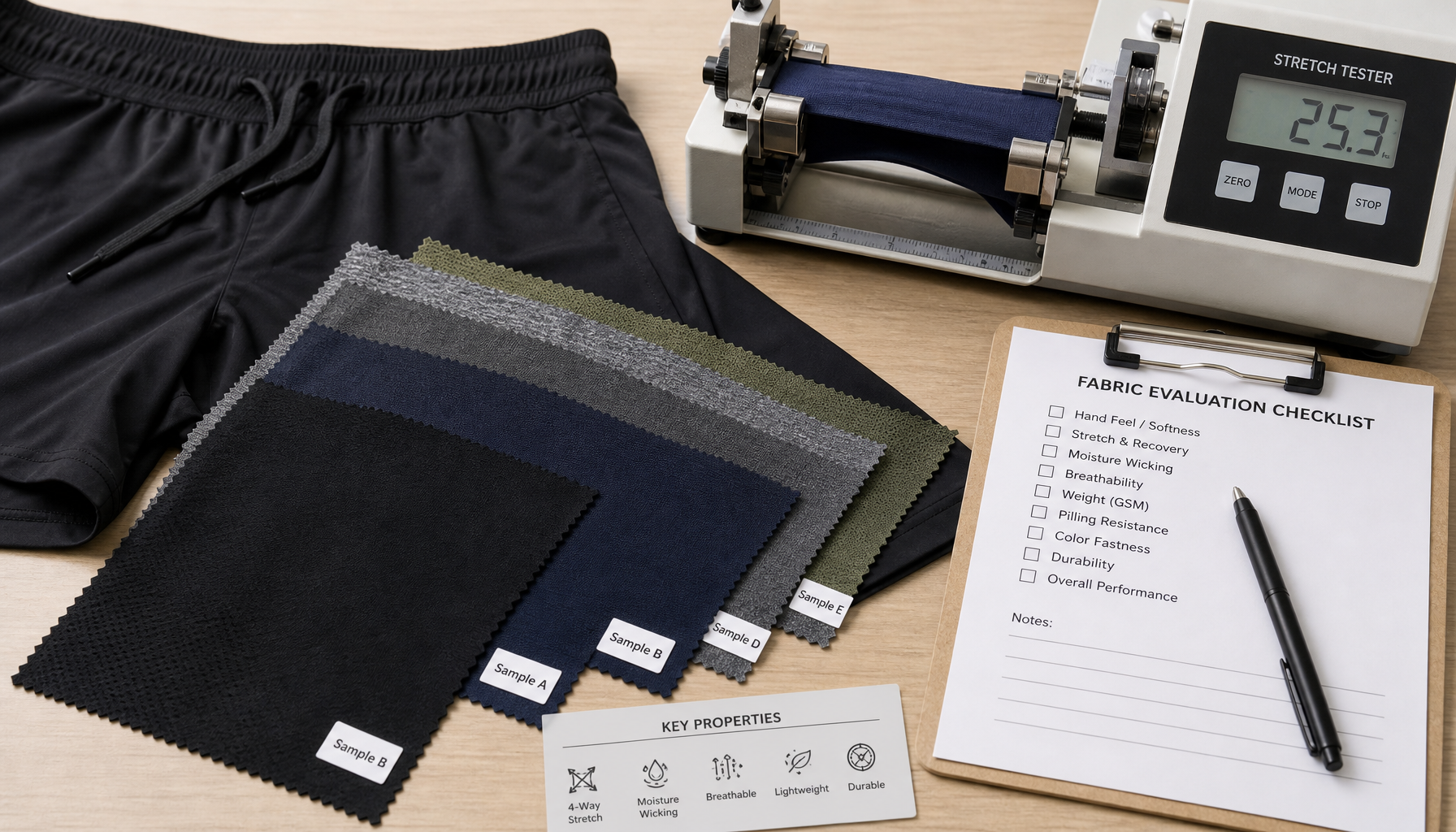
    Stretch fabric sample being reviewed for gym shorts development

    Use GSM to compare weight and consumption, not to promise comfort

    GSM helps estimate garment mass, marker consumption, and the amount of material used in each size. It does not independently establish breathability, opacity, or durability. Thickness, cover, yarn size, loop structure, and finishing must be reviewed with it.

    Illustrative calculation — not a ClothFactory test result: assume a finished gym short uses 0.9 m² of one fabric before cutting waste. At 180 gsm, the fabric contribution is:

    0.9 m² × 180 g/m² = 162 g

    At 220 gsm, the same area contributes approximately 198 g, a difference of 36 g before seams, trims, waste, and any lining. Use this calculation to compare weight and costing. Confirm comfort and coverage with the finished garment rather than inferring them from GSM alone.

    Check moisture behavior, surface durability, and color

    If the product brief includes moisture-management language, request a defined test on the finished fabric. A topical treatment or a supplier description is not enough to support a garment claim. Record the test method, conditioning, and pass requirement so results from different samples remain comparable.

    For repeated gym use, review pilling, abrasion, snagging, dimensional stability, and seam-area distortion. Inspect the fabric after the agreed wash procedure and compare the surface before and after laundering. Confirm colorfastness for the actual shade range; one approved color does not automatically represent every dark, bright, or neon color.

    Request evidence that can be compared

    Sample item What to request Why it matters
    Construction Composition, knit type, finished GSM, usable width, and finish Links the swatch to a reproducible specification.
    Stretch response Direction, extension, hold time, recovery time, and post-wash result Shows whether the sample can support the intended fit.
    Coverage Relaxed and extended appearance, thickness or opacity requirement where relevant Reduces the risk of show-through or panel mismatch.
    Moisture behavior Defined wicking or drying method and conditioning Prevents unsupported quick-dry claims.
    Durability Pilling, abrasion, snagging, and dimensional-stability results Connects sample approval to expected use and care.
    Color and lot control Shade standard, dye-lot identification, and colorfastness requirements Helps control variation during bulk production.

    Send identical requirements to each candidate supplier. Comparing one supplier’s finished GSM with another supplier’s greige GSM, or comparing recovery values from different test conditions, produces misleading conclusions.

    Use a controlled sample-approval workflow

    1. Confirm the garment brief, pattern intent, color standard, and care label.
    2. Record each sample’s composition, construction, GSM, width, finish, and supplier reference.
    3. Screen hand, drape, stretch, recovery, and coverage in relaxed and extended states.
    4. Run the agreed laboratory and wash checks on matched specimens.
    5. Make a garment sample and inspect waistband, leg opening, seams, opacity, and post-wash shape.
    6. Approve a sealed reference swatch and written tolerances before bulk production.

    Avoid common sample-review mistakes

    • Approving by touch alone. A soft hand does not confirm recovery, coverage, or durability.
    • Treating fiber content as a complete specification. The same blend can behave differently at different GSMs, constructions, and finishes.
    • Using GSM as a comfort guarantee. Added mass may increase weight without improving airflow or wear comfort.
    • Testing only a relaxed swatch. Gym shorts experience extension at the waistband, seat, and leg opening.
    • Assuming one color represents the range. Dye depth and finishing can affect hand, stretch response, and fastness.
    • Leaving test conditions open. Results cannot be compared reliably when extension, wash, conditioning, or recovery time changes.

    Procurement next step

    Send the supplier a one-page brief stating the gym-short layer, target composition, GSM and width, fit, color, finish, care cycle, and required tests. Ask for identified swatches and a specification sheet, then approve the fabric only after the garment sample and test conditions match the intended product. ClothFactory can use that brief to compare an existing nylon-spandex or polyester-spandex construction with a development option without treating an unverified performance claim as a finished specification.

  • Which Fabric Composition Options Should Brands Compare for Thermal Underwear?

    Which Fabric Composition Options Should Brands Compare for Thermal Underwear?


    For thermal underwear, compare nylon-spandex and polyester-spandex against next-to-skin comfort, moisture conditions, insulation targets, stretch recovery, and the planned care cycle. Fiber composition alone cannot predict warmth or fit; GSM, knit construction, finishing, and test conditions should be approved together before bulk sourcing.

    Start with the garment brief

    A close-fitting base layer worn under another garment has different requirements from a standalone winter top. Before requesting samples, record the intended climate, layering position, body zones that need coverage, target fit, color range, and wash instructions. These inputs determine whether the priority is a light hand and low bulk, a more stable surface, moisture transfer, or additional insulation.

    For example, a brand developing a thin base layer for indoor-to-outdoor commuting may prefer a lower-bulk construction that fits under a sweater. A heavier winter layer may accept more fabric mass if the added coverage and air volume justify it. This is a product brief decision, not a conclusion that one fiber family is universally warmer.

    Compare composition without treating it as a performance guarantee

    Nylon-spandex and polyester-spandex are both viable starting points for stretch thermal underwear. Use composition to narrow the candidate list, then compare the finished fabric under the same test conditions.

    Procurement question What the fiber choice may indicate What still requires confirmation
    Next-to-skin hand Nylon-spandex is often considered when a smooth, soft hand is important. Polyester-spandex can also be engineered for a soft hand through yarn selection and finishing. Hand feel after dyeing, finishing, and the specified wash cycle.
    Moisture handling Polyester is often considered for quick-dry constructions, but wicking depends on yarn, knit geometry, finishing, and garment design. Wicking and drying results on the finished fabric, with the method and conditioning stated.
    Warmth and coverage Either fiber family can be used in lightweight or more substantial constructions. Finished GSM, thickness, cover, knit structure, and any brushing or other thermal finish.
    Stretch and recovery Spandex content can support stretch, but the percentage does not define the final fit response. Stretch and recovery in both directions, extension level, hold time, recovery time, and results after washing.
    Surface durability Fiber selection is only one part of abrasion and pilling performance. Pilling, abrasion, snagging, and dimensional stability for the actual construction and finish.

    This comparison prevents a common sourcing error: approving a composition name while leaving the construction and acceptance conditions undefined.

    Use GSM to estimate garment mass, not to claim warmth

    GSM is useful for costing, marker planning, and garment-weight estimates. It is not a standalone thermal rating. Yarn size, loop geometry, thickness, air volume, surface treatment, and garment coverage can change the warmth and moisture behavior of fabrics with similar GSM.

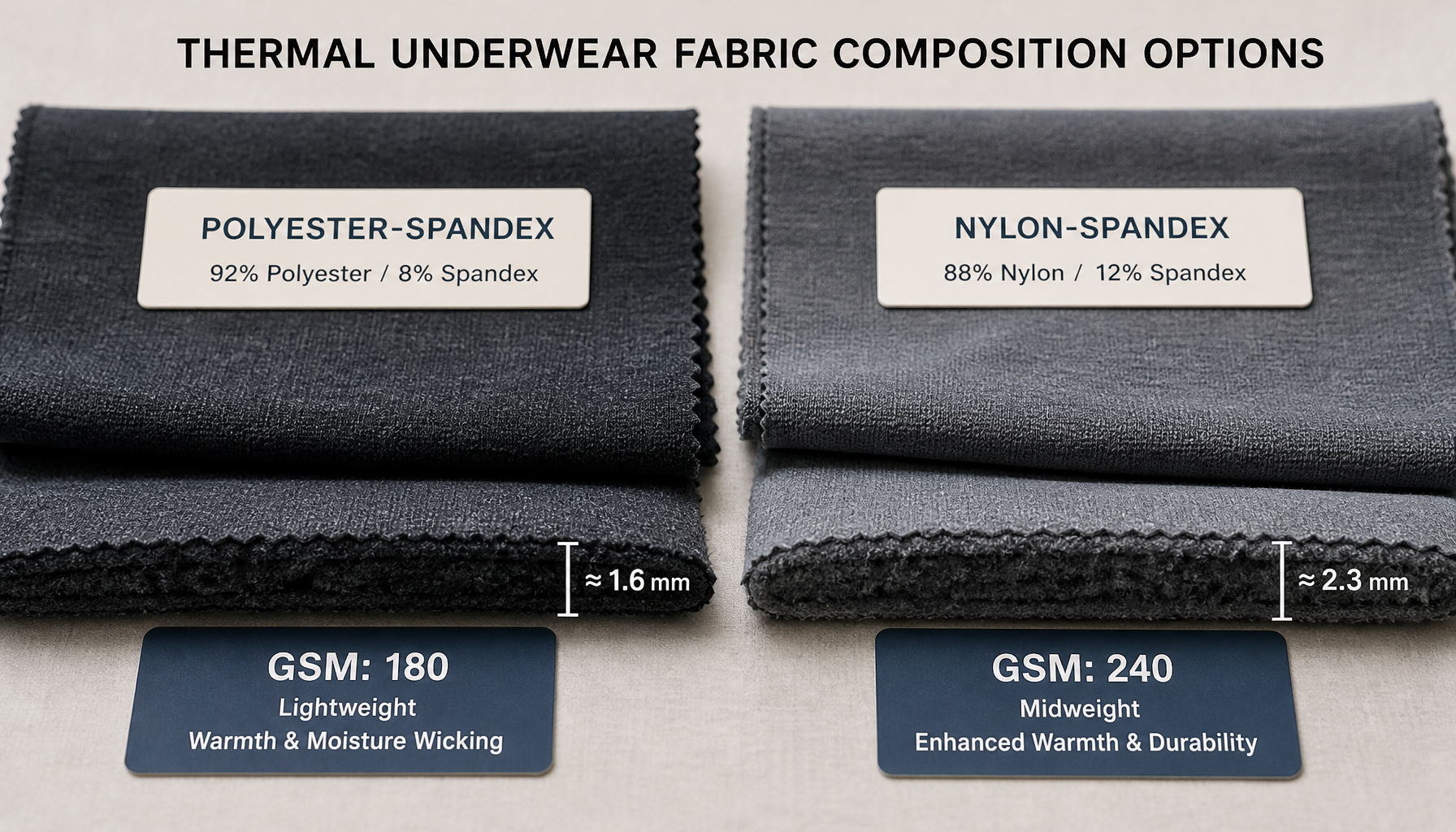
    Illustrative calculation — not a ClothFactory test result: if the finished fabric area in a garment is assumed to be 1.2 m², a 180 gsm fabric contributes approximately:

    1.2 m² × 180 g/m² = 216 g

    A 240 gsm option would contribute approximately 288 g under the same area assumption, a difference of 72 g before seams, trims, cutting waste, and any panels in other materials. Use the calculation to compare garment mass and consumption; verify warmth through the finished construction and garment sample.

    Specify knit structure and finishing separately

    The same fiber blend can produce very different thermal underwear depending on how it is knitted and finished. Ask the supplier to identify the construction, finished width, GSM, thickness if relevant, and any surface treatment. If a brushed or other thermal finish is proposed, confirm whether it is part of the standard specification or an optional development step.

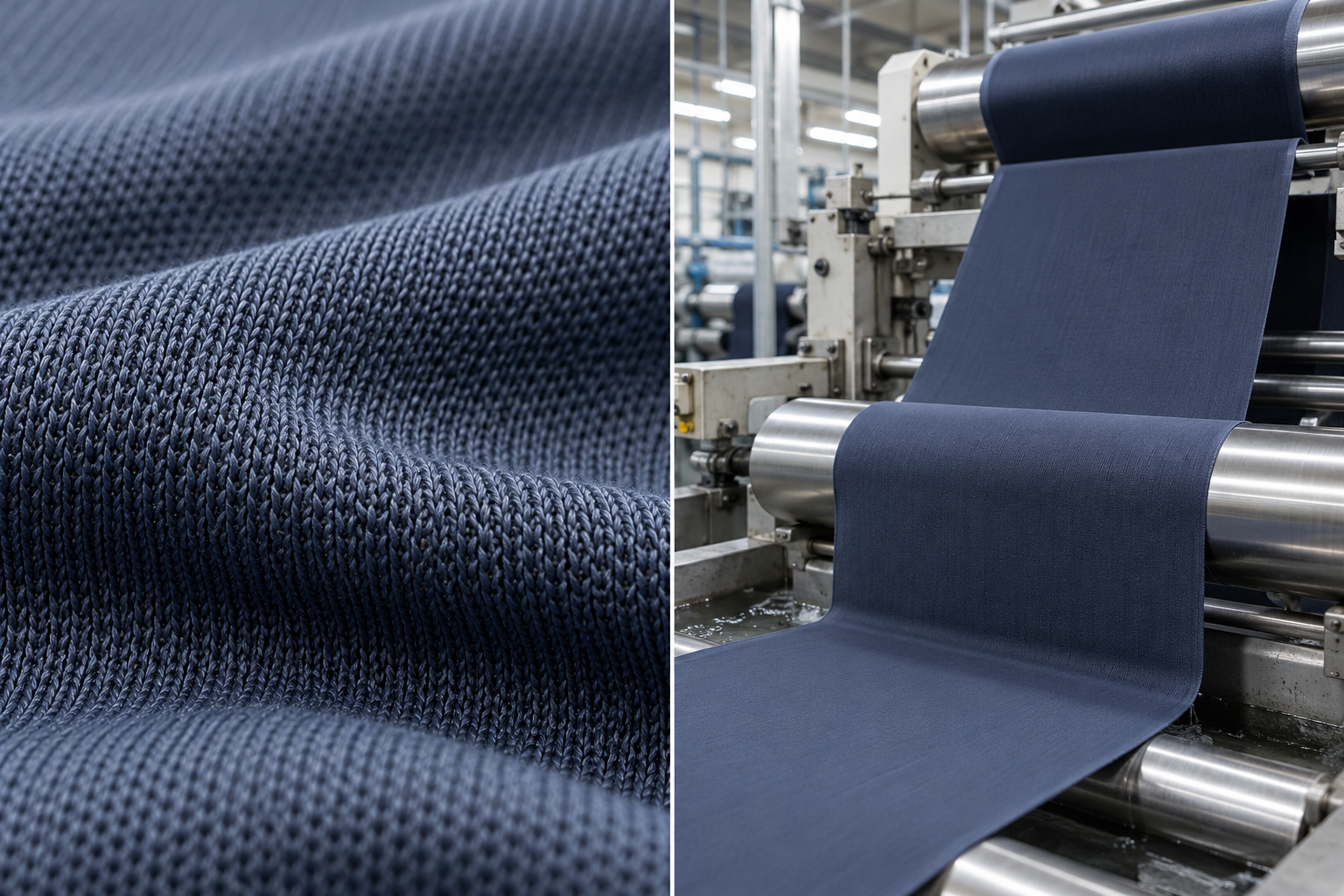
    Close-up of knitted stretch fabric beside fabric passing through finishing rollers
    Knitted loop structure and finishing are separate specification points for a stretch thermal fabric.

    Finishing may change hand feel, moisture behavior, pilling, color appearance, and dimensional stability. A fabric that feels suitable before washing may not provide the same surface or recovery after the agreed care cycle. Approval should therefore use finished, laundered samples where the end product will be sold with a care label.

    Build a comparable sample request

    Send the same brief to each candidate supplier. At minimum, request:

    • target composition and any permitted tolerance;
    • finished GSM range, usable width, and knit construction;
    • stretch and recovery requirements by direction, including extension, hold time, and recovery time;
    • dimensional stability and spirality after the specified wash procedure;
    • pilling, abrasion, colorfastness, and snagging requirements relevant to the end use;
    • hand-feel reference, target shade, and whether the finish is required or optional;
    • sample identification that links each swatch to its specification sheet.

    Do not compare one supplier’s finished GSM with another supplier’s greige GSM, or compare recovery values produced with different extension levels and recovery times. The numbers may look comparable while describing different tests.

    Avoid these approval mistakes

    • Selecting by blend name alone. A nylon-spandex label does not specify knit density, finish, GSM, or recovery.
    • Using GSM as a warmth guarantee. Higher mass may increase coverage or weight without delivering the expected insulation.
    • Approving one color for every color. Dye depth and finishing can affect hand, stretch response, and colorfastness; confirm the production shade range separately.
    • Treating a fabric test as a garment result. Fit, seam placement, paneling, and laundering can change the wear outcome.
    • Leaving the care cycle open. Test conditions should reflect the intended label and the buyer’s quality threshold.

    Procurement next step

    Prepare a one-page brief with the end use, layering position, target composition, GSM and width, fit intent, shade, finish, care cycle, and required tests. Ask for identified samples and a specification sheet, then approve the fabric only after the construction and test conditions match the product brief. ClothFactory can use that information to compare an existing nylon-spandex or polyester-spandex base fabric with a development option, while keeping any unconfirmed performance requirement open for sampling and verification.

  • How to Select Fabric for High-Compression Yoga Leggings

    How to Select Fabric for High-Compression Yoga Leggings


    Shortlist a nylon-spandex double-knit with a matte face or a smooth double-sided interlock. Approve the fabric only after checks on a legging sample at the intended fit. Catalogue descriptions help select candidates, but opacity and compression under stretch remain sample decisions.

    Candidate Constructions for High-Compression, Four-Way-Stretch Yoga Leggings

    Use H2894 Matte Performance Double-Knit as the catalogue matte double-knit reference. The table compares it with a smooth-surfaced interlock and a ribbed option. These are sampling candidates, not interchangeable approvals: the ribbed face suits a different surface brief.

    Catalogue parameters and listed features for sampling candidates; features are descriptions, not measured garment results.

    Catalogue model Catalogue composition and construction Catalogue weight and nominal width Listed surface or recovery feature
    Catalogue model: H2894 Catalogue composition: 75% nylon, 25% spandex; matte double-knit Catalogue parameters: 230 GSM; 165cm nominal width Catalogue features: full opaque, superior matte finish, high recovery compression
    Catalogue model: H113 Catalogue composition: 72% nylon, 28% spandex; double-sided interlock Catalogue parameters: 220-230 GSM; 165cm nominal width Catalogue features: shark-skin texture, high shape retention; description lists four-way stretch
    Catalogue model: H3827 Catalogue composition: 75% nylon, 25% spandex; ribbed fabric Catalogue parameters: 220 GSM; 150cm nominal width Catalogue features: four-way stretch, ribbed texture, high recovery

    Select the knit face before comparing quotes. A flat, matte appearance points toward the double-knit; a sleek surface makes the interlock worth sampling. Keep the ribbed construction only if visible texture is acceptable.

    How Weight, Density, and Stretch Conditions Drive Opacity

    Catalogue weight describes fabric mass per area. It does not tell a buyer how much coverage remains when the panels stretch across the seat and thigh. Knit structure and the extension imposed by the pattern also affect what the wearer sees. Inspect each candidate over a consistent backing at the extension expected in the intended size and fit. Record the viewing conditions and approve coverage on that basis, including during a squat. A heavier catalogue option may change hand feel or material use without resolving show-through.
    Blue-violet yoga leggings in a squat pose with nylon-spandex fabric stretched over a contrasting backing for opacity inspection

    Surface Finish: Matching Matte, Smooth, or Ribbed Character to the Design Brief

    Use H113 Shark-Skin Double-Sided Interlock as the catalogue smooth-surface comparison. Its description also calls the face shark-skin textured, so compare an actual swatch with the matte double-knit under the lighting used for approval. Check sheen after stretching the panel; a surface that looks suitable at rest may look different on the garment.

    Recovery and Compression Trade-Offs Across Candidate Elastane Levels

    Catalogue elastane percentages and listed recovery features identify candidates, but they do not establish the pressure or fit of a finished legging. Stretch each sample in both fabric directions, release it, and compare its return with the approved fit target after repeated extensions. Use H3827 LULU High-Stretch Rib Fabric as a catalogue ribbed recovery reference only when that texture fits the design. If the standard constructions miss the target, a supplier development brief can specify the required structure, hand feel, stretch, and recovery.

    Sample and Pre-Production Checks Before Bulk Commitment

    Set the fit target, backing, lighting, and surface reference when the sample is approved. The same conditions give the factory a clear pre-production comparison. Hold a candidate for adjustment when coverage, recovery, or appearance misses the agreed target; approve bulk only against the accepted fabric and garment sample.

    Proposed pre-production checks against the buyer’s agreed legging target; no results are implied.

    Check Observable signal Approval decision
    Coverage at intended fit See-through areas during extension and a squat, viewed against the agreed backing Approve if coverage meets the agreed target; otherwise hold for fabric or fit adjustment
    Stretch and recovery Movement in both fabric directions and return after repeated extension Approve if movement and return match the agreed fit target; otherwise hold for adjustment
    Surface at rest and under stretch Sheen and visible texture under the agreed lighting Approve if the appearance matches the accepted surface reference; otherwise reject that finish

    Cost and MOQ Implications of Each Candidate Construction

    Catalogue parameter: the minimum order quantity is 200 KG for each candidate. Catalogue parameters: stated yields are 2.6m/kg for the matte double-knit, 2.7m/kg for the interlock, and 3.0m/kg for the ribbed fabric. These figures do not rank cost per legging. Compare supplier prices and marker consumption on the same pattern, size mix, and quality requirement; usable cutting width and actual fabric use determine the purchase estimate.

  • What Is Modal Fabric and Is It Good for Activewear Sets?

    What Is Modal Fabric and Is It Good for Activewear Sets?


    Modal is a rayon-family cellulosic fibre known for a soft, breathable handle, but for activewear sets requiring stretch, elastic recovery, quick drying, and body-hugging coverage, a synthetic knit such as a nylon and spandex performance double-knit is the more dependable specification. Modal suits low-intensity lifestyle pieces where softness and airflow outweigh elastic recovery. Keep in mind that fibre-level characteristics always require physical confirmation on the actual garment pattern.

    Modal’s Advantages and Drawbacks for Activewear Sets

    When evaluating modal for activewear sets, buyers must weigh its natural comfort against mechanical limitations. Modal offers superior heat management and breathability compared to standard polyester. As a cellulosic option, it is stronger and lighter than viscose, making it better suited for garments requiring durability alongside softness. However, modal provides limited elastic recovery on its own and dries slower than engineered synthetic performance knits. Without blending, it cannot support high-movement fit retention.

    Modal’s Advantages and Drawbacks for Activewear Sets

    Feature Category Modal Advantage Modal Drawback
    Fibre Comfort Superior breathability and heat management Slower drying than synthetic performance knits
    Durability Stronger and lighter than viscose Requires blending to add stretch and strength

    How Modal and Synthetic Knits Compare on Stretch, Recovery, and Fit

    High-performance activewear sets rely heavily on elongation and fit retention. Synthetic options deliver superior 4-way elastic recovery and compression architecture. For example, a catalogue parameter of 75% nylon and 25% spandex at a 230 GSM weight provides opaque, second-skin coverage and high recovery compression. While blended modal fabrics may add some stretch, they do not inherently match the permanent vertical structure of synthetic double-knits or rib constructions.

    Comparing Modal Fibre Profiles to Synthetic Performance Knits

    Comparison Criteria Modal Fibre Profile Synthetic Performance Knit
    Composition & Weight Cellulosic rayon family; weight varies heavily by blend Commonly 75% Nylon / 25% Spandex at 220-230 GSM
    Stretch & Recovery Provides softness but limited standalone elastic recovery Engineered for 4-way stretch and high recovery compression
    Best-Fit Scenario Low-intensity lifestyle pieces prioritizing airflow High-movement sets requiring second-skin fit retention

    Applying the Choice to Leggings, Tops, and Matching Sets

    The garment pattern dictates the final fabric specification. For high-compression leggings and matching sets needing complete coverage and fit retention, specify a synthetic knit like the H2894 Matte Performance Double-Knit or the H3827 LULU High-Stretch Rib Fabric. For premium yoga tops or lightweight lifestyle sets where a silky handfeel is the primary goal, a nylon blend mimicking modal such as the H949 Lyocell-Touch Technical Grid can succeed. Note that drying behaviour and opacity follow the specific knit construction and fabric weight, not the fibre name alone.

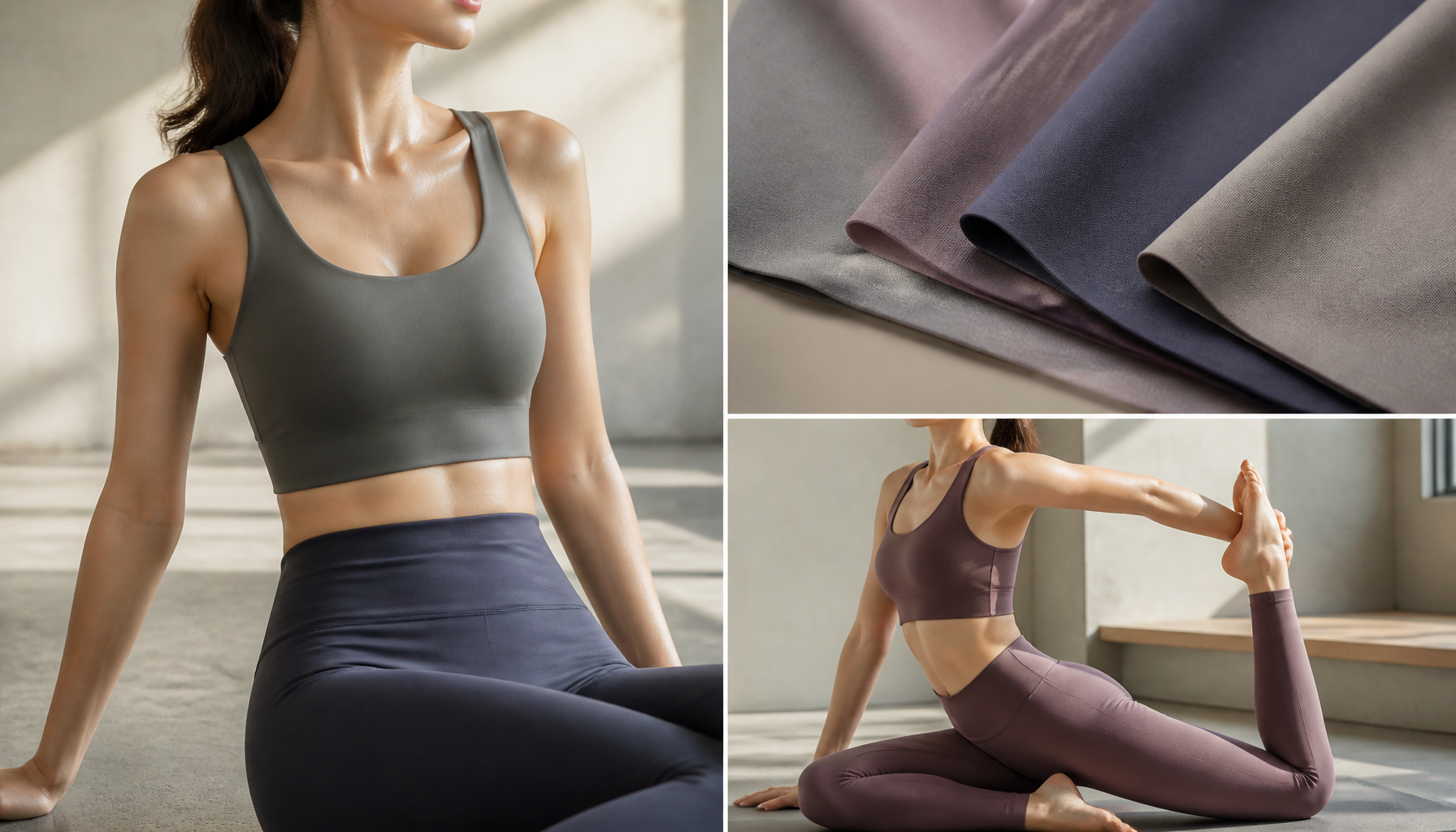
    Editorial illustration of a matte knit swatch alongside a matching athletic top and leggings, showing a fabric-to-garment application.
    Editorial illustration of a matte knit swatch alongside a matching athletic top and leggings, showing a fabric-to-garment application.

    Sampling, Approval, and the Selection Rule

    Before bulk production, confirm elongation, recovery, drying speed, and coverage by sampling the selected fabric on the actual garment pattern. Use standard test methods to evaluate stretch and recovery rather than relying on supplier reference ranges or fibre reputation alone. The final selection rule is straightforward: specify synthetic performance knits for high-movement, high-fit-retention activewear sets, and reserve modal for low-intensity applications where softness and breathability dictate the purchase.

  • Why H168 Free-Cut Nylon Spandex Fabric Is the Premier Choice for UPF 50+ Sun Protection Jackets and Outdoor Activewear

    Why H168 Free-Cut Nylon Spandex Fabric Is the Premier Choice for UPF 50+ Sun Protection Jackets and Outdoor Activewear

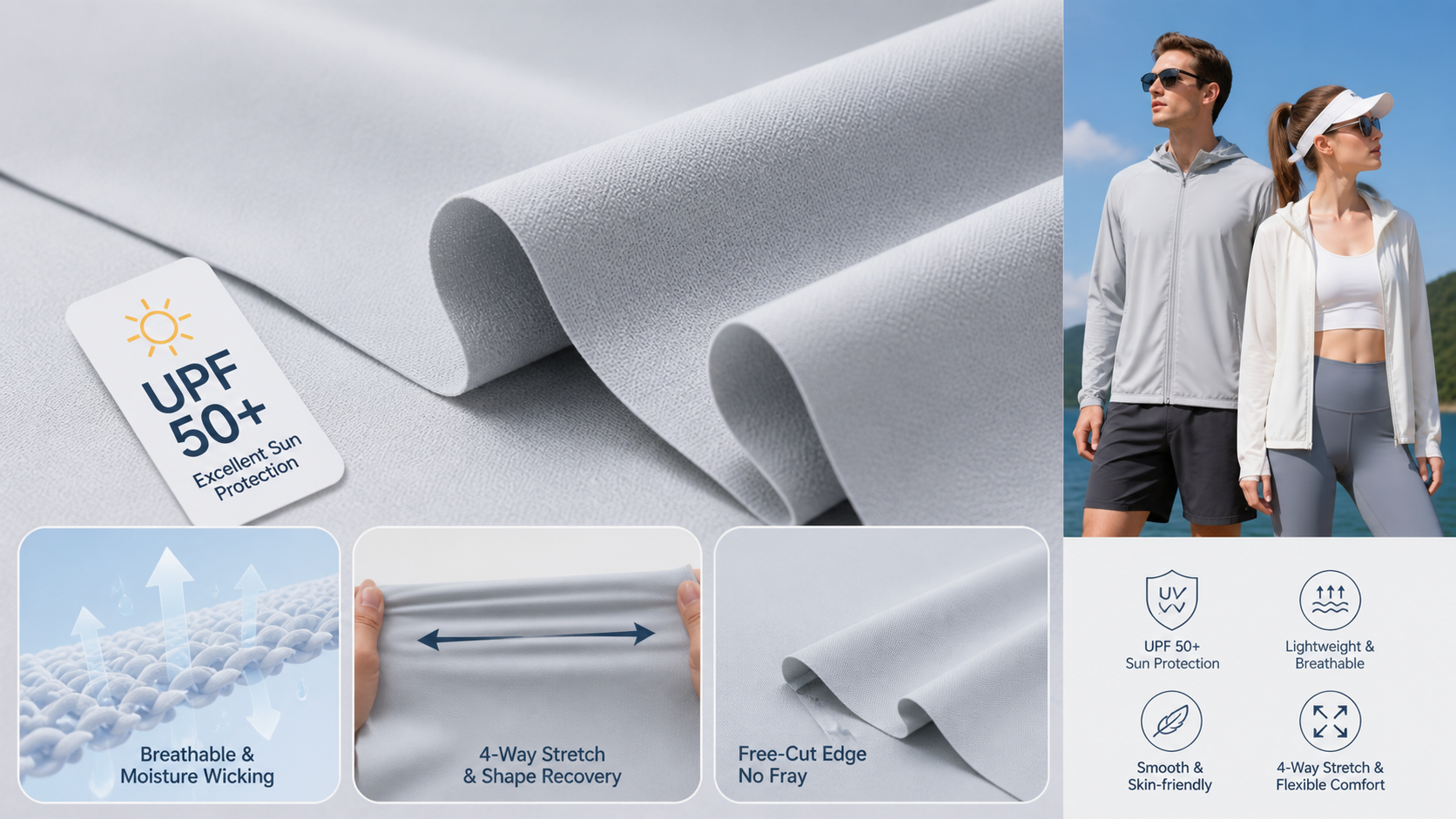
    H168 can be evaluated for lightweight sun-protection jackets, but “free-cut” construction and a UPF claim are separate approval decisions. ClothFactory’s catalogue lists 74% nylon, 26% spandex, 170 g/m² and 165 cm width. Treat those figures as nominal specifications. The title’s UPF 50+ positioning must be supported by a relevant report for the supplied fabric and the intended market; composition alone cannot establish it.

    What free-cut construction can actually change

    A free-cut fabric is intended to leave selected edges unfinished without unacceptable curling or unravelling. It does not make a sewn jacket seamless, and it does not automatically qualify the fabric for bonding. An exposed hem, a curved cuff and a thumb opening experience different strain and abrasion, so each proposed edge needs its own trial.

    For a sun jacket with extended cuffs, inspect the cut edge immediately after cutting, after repeated hand insertion and after the agreed care sequence. Record cut direction, cutting equipment and edge geometry. A straight swatch edge that lies flat on a table is insufficient evidence for a small-radius thumb opening under tension.

    Release the sun-protection claim through evidence

    Ask for a report identifying the article, colour, finish, specimen preparation and test method. AATCC TM183 measures ultraviolet radiation transmission or blocking through fabric, including dry or wet evaluation. A test result and a market-compliant garment label are not the same deliverable; confirm the applicable labelling requirements separately.

    Establish whether stretching, wetting and care treatments relevant to the garment are covered by the evaluation. A relaxed dark swatch must not be used as blanket evidence for a stretched pale sleeve. Request the supporting report before printing hangtags, and avoid explanations about “embedded UV particles” unless the material supplier has documented that mechanism for the actual article.

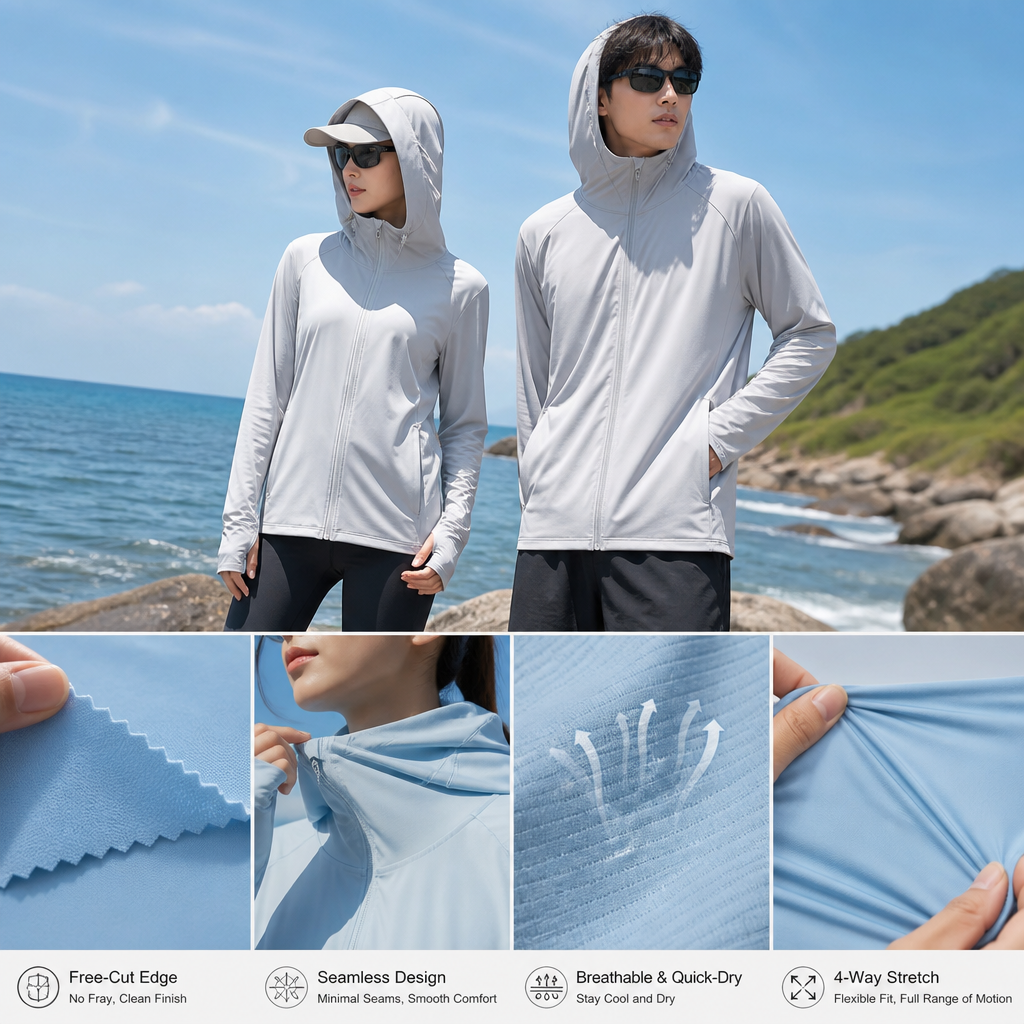
    Hooded outdoor jacket concepts with fabric edge and stretch illustrations
    Concept artwork, not a UV test certificate. Sun-protection and free-cut performance require approval of the supplied material and garment.

    Balance coverage, fit and summer comfort

    A close-fitting sleeve can reduce loose fabric around the wrist, but it also increases local fabric extension. A roomier sleeve changes coverage, air exchange and fabric consumption. Evaluate the garment during reach, elbow flexion and thumb-loop use, not only in a standing fit photograph.

    Do not combine contact coolness, airflow, moisture transport and drying into one “breathability” result. They describe different behaviour. For example, ISO 9237 addresses air permeability; it does not prove ultraviolet protection or drying speed. Specify the property that matters to the end use and compare candidates under the same test conditions.

    Check whether removing a hem really reduces cost

    Use an assembly trial to calculate the value of a free-cut edge. In a hypothetical costing exercise, removing one operation saves $0.08 per jacket. If edge-related rework affects 5% of jackets and costs $1.20 per affected piece, its expected cost is $0.06 per jacket. Only $0.02 of the initial saving remains, before inspection, scrap or any fabric premium. These are illustrative inputs, not ClothFactory prices or defect rates.

    At 170 g/m² and 1.65 m full width, nominal fabric mass is 0.2805 kg per linear metre, equivalent to about 3.57 m/kg before losses. Compare actual marker consumption at the approved usable width. Eliminating a folded hem may change the pattern allowance, but the saving cannot be assumed until the pattern and cutting plan are revised.

    Write a sample-to-bulk control plan

    Approve the fabric, edge treatment and garment claim as three linked records. The fabric record should contain the agreed weight, width, composition and elasticity requirements. The edge record should show acceptable curl, fraying and appearance at defined garment locations after the specified evaluation. The claim record should link each supported colour or product grouping to its evidence.

    Any change in yarn, construction, colour, finish or garment fit should be reviewed for its effect on those approvals. H168 is commercially useful when the production garment passes both the edge and protection requirements at an acceptable cost. Neither a smooth hand feel nor a UPF icon in an image is sufficient authority to release bulk production.