分类: Application guides

  • What Should Brands Confirm Before Bulk Approval of Fabric for Joggers?

    What Should Brands Confirm Before Bulk Approval of Fabric for Joggers?

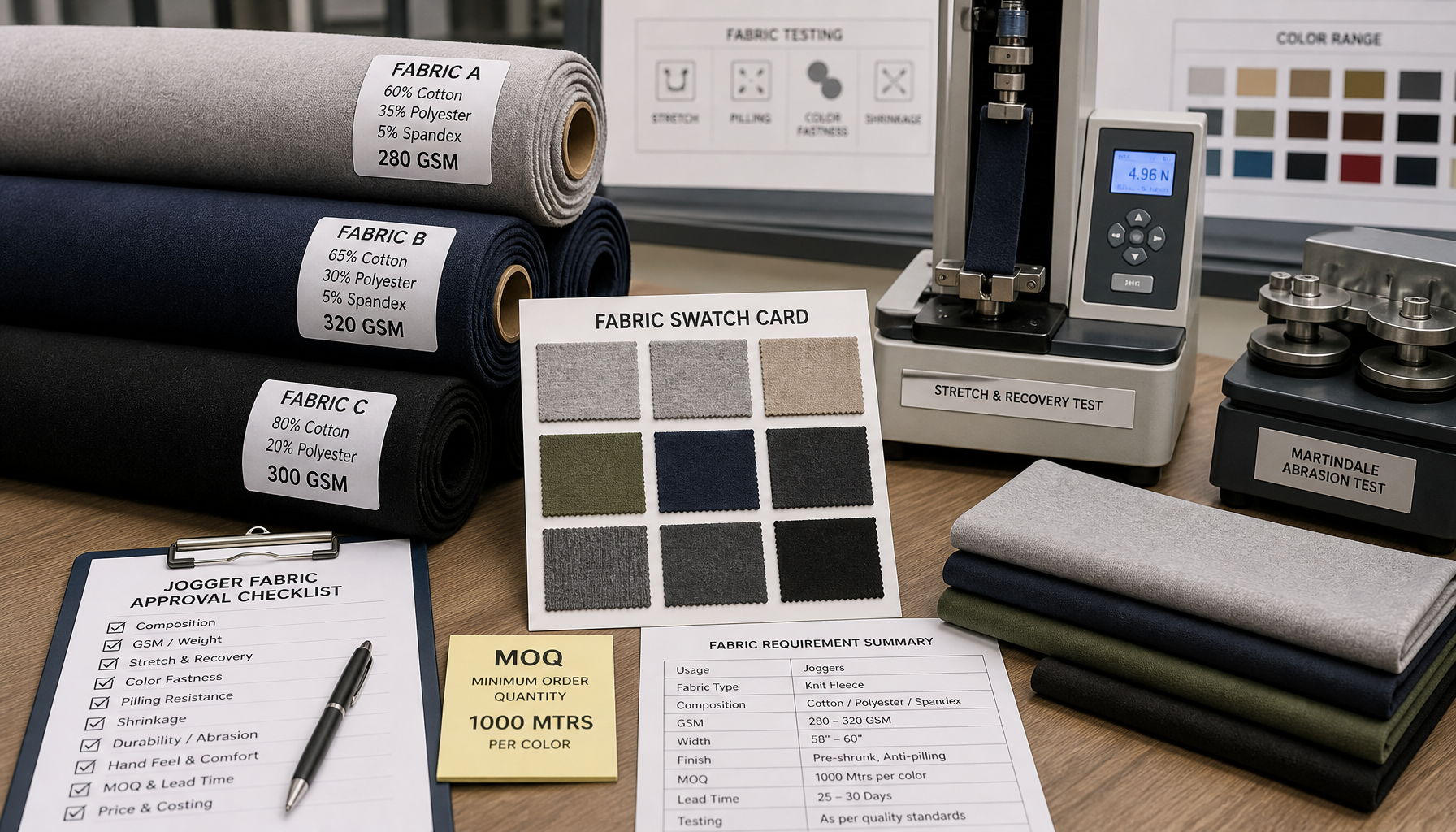
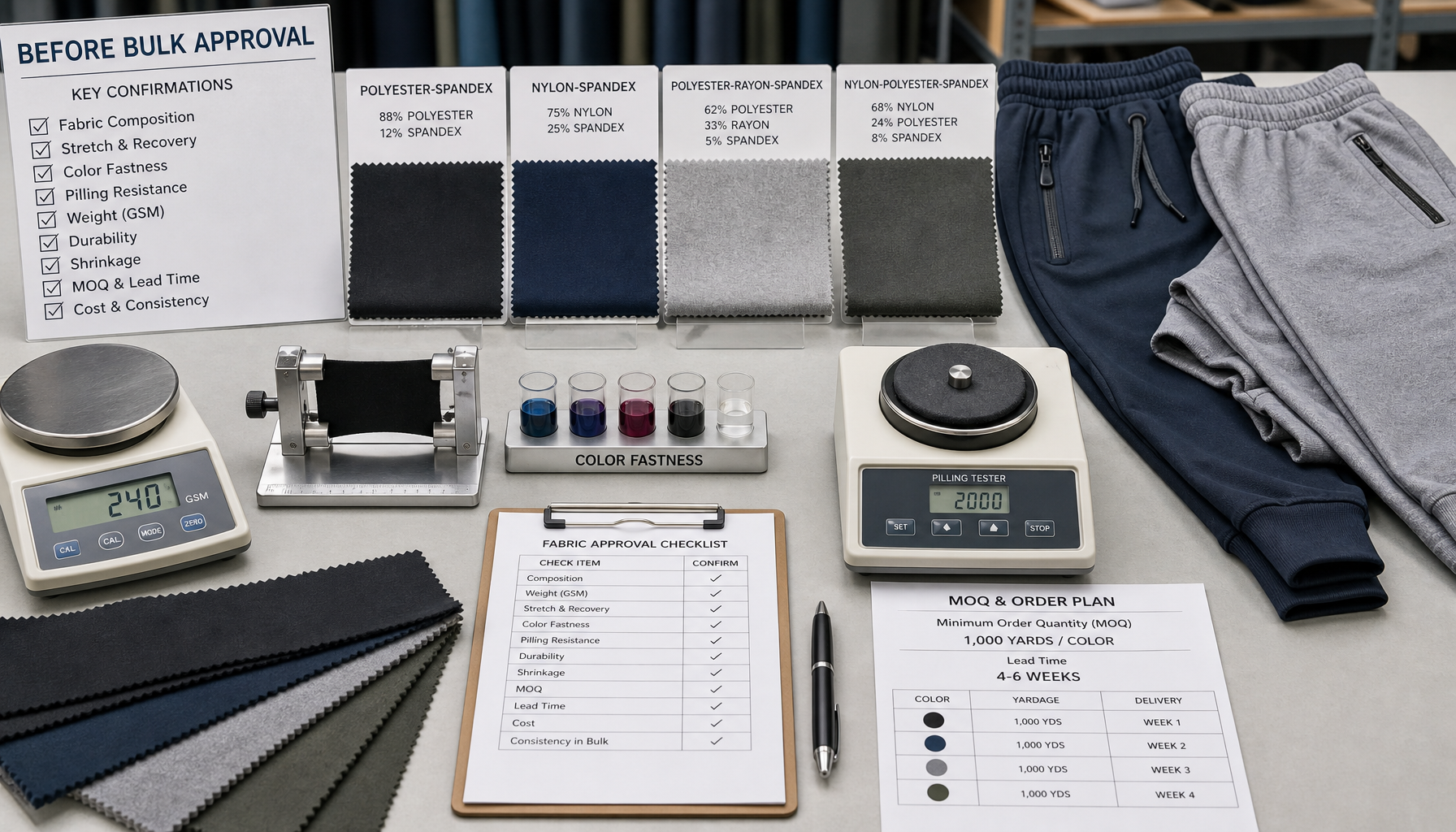
    Approve jogger fabric only after confirming knee and seat recovery, pocket stability, dimensions after care, surface durability, and cutting yield in the intended garment. Tie that approval to an identified fabric version, physical reference, and numerical tolerances so bulk inspection can reproduce the decision.

    Begin with the worn silhouette

    A tapered travel jogger worn while seated has a different brief from a brushed lounge jogger or a lightweight training style. Define fit, intended season, pocket load, cuff construction, and wear duration. A soft hand alone does not establish resistance to knee bagging, and a higher spandex percentage does not establish the desired support.
    What Should Brands Confirm Before Bulk Approval of Fabric for Joggers?

    Use sitting and pocket load to reveal fit problems

    Assess repeated sitting, knee flexion, and recovery after the agreed rest period on the sewn prototype. Check the intended pocket contents: a phone can pull a lightweight pocket area out of shape even if the body fabric passes a strip recovery test. Record garment size, panel orientation, seam and pocket construction so a fit problem can be traced to material behavior or design.

    Measure the consequence of dimensional change

    Hypothetical calculation: an 80 cm inseam that shortens by 3% becomes 77.6 cm, a 2.4 cm change. This is an illustration, not an acceptance limit. Establish the finished-garment tolerance first, then evaluate fabric dimensional change and prototype measurements under the intended washing and drying procedure.

    Adding pattern length can compensate for predictable length change, but does not correct twisting seams or unequal behavior between body fabric, waistband and cuffs. Review those components together before adjusting the pattern.
    What Should Brands Confirm Before Bulk Approval of Fabric for Joggers?

    Distinguish softness from surface durability

    For brushed or sueded candidates, inspect how the surface changes at the inner thigh, seat and pocket openings after relevant wear and care. Ask the laboratory to use the agreed pilling or abrasion method and report the exposure conditions. Pilling appearance, abrasion damage and hand are separate judgments; one passing result should not stand in for the others.

    Check cutting economics before freezing the quality

    Run the graded production marker at the minimum accepted usable width. Where the surface has a directional appearance, confirm whether panels must face one way; that constraint can change yield. Record finished GSM, billed width, usable width, and the conversion from weight price to garment consumption. A softer or heavier version may require a fresh costing even if the fiber percentages remain unchanged.

    Release bulk against a defined record

    • Sealed hand and appearance reference, approved colors and construction revision.
    • GSM and usable-width limits with agreed measurement conditions.
    • Direction-specific recovery and post-care dimensional requirements.
    • Colorfastness and surface-durability criteria tied to named methods.
    • Roll identification, sampling coverage and action for failed results.

    Request production-relevant yardage for sewing and care trials before bulk authorization. Once approved, require notification of changes to yarn specification, construction, brushing or finishing that could alter the result. Release each shipment using its own identified records rather than relying solely on the development sample.
  • Which Knit Structure Should Buyers Consider for Trail-Running Tops?

    Which Knit Structure Should Buyers Consider for Trail-Running Tops?

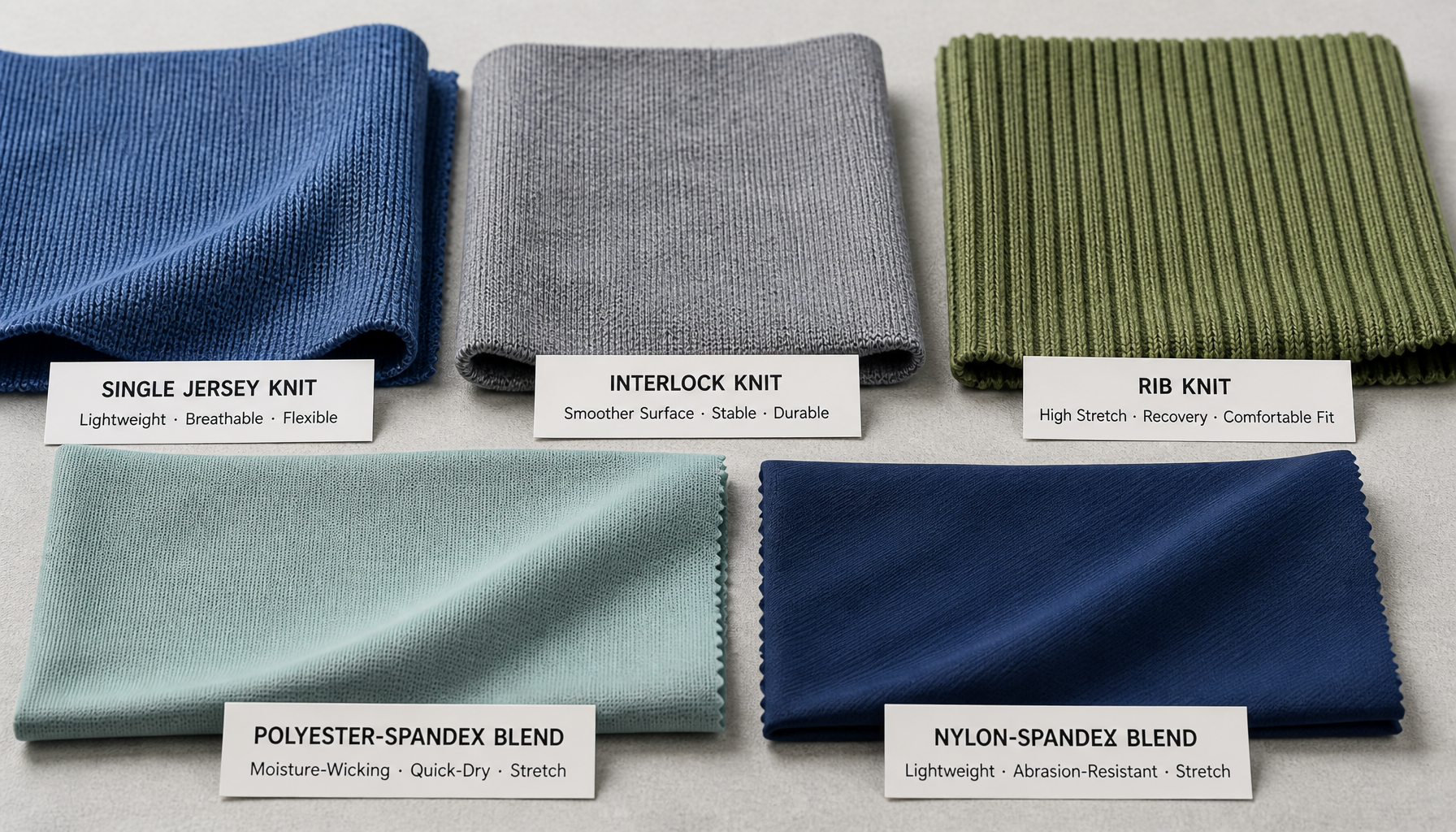
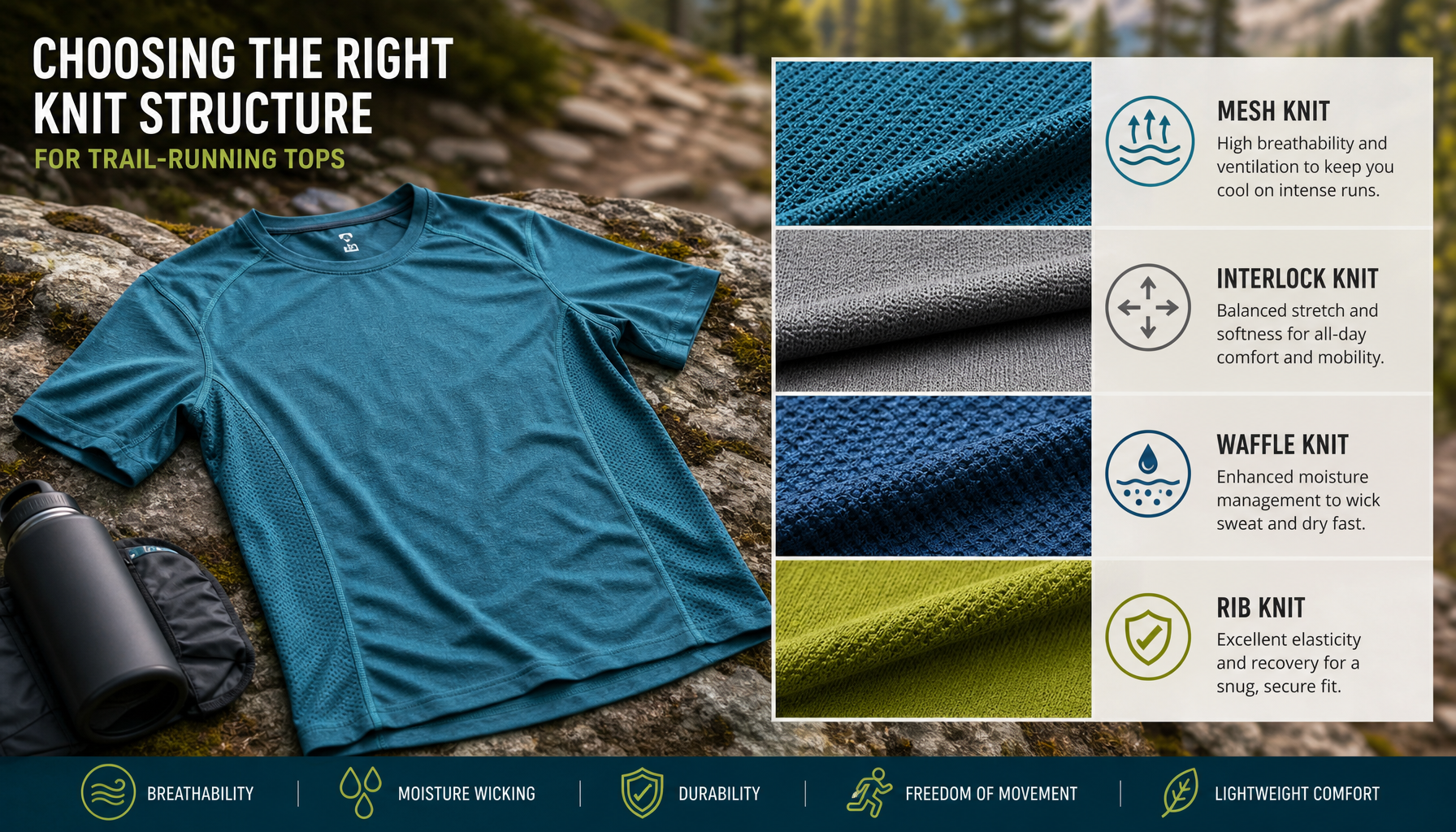
    For trail-running tops, shortlist jersey, interlock, or mesh according to pack contact, ventilation needs, coverage, and garment fit. The structure name narrows the development route, but yarn, stitch density, finish, and panel placement determine whether a particular fabric works.

    Map the running vest before selecting mesh

    Consider a warm-weather top worn beneath a loaded hydration vest. The shoulder and upper-back zones experience contact that exposed side panels do not. An open construction selected for ventilation needs a snag and contact assessment in those zones. Ventilation under a covering vest also depends on the entire layering arrangement, so airflow measured on an uncovered swatch cannot describe the complete garment.

    Which Knit Structure Should Buyers Consider for Trail-Running Tops?

    Compare candidates by panel function

    Candidate Development role Issue to resolve
    Single jersey A body-fabric option where low mass and drape matter Edge curl, post-care rotation and coverage in the proposed construction
    Interlock A double-knit candidate for panels requiring a more substantial feel Whether its actual weight and drying behavior fit the brief
    Mesh or pinhole knit A candidate for deliberately ventilated panels Snagging, opacity and seam behavior around open areas
    Rib A candidate for neck or other fitted components Recovery and compatibility with the adjoining body fabric

    These are screening roles, not guaranteed performance rankings. Compare the finished candidates at their actual GSM and width; equal fiber percentages do not make different constructions equivalent.

    Is panel zoning worth the added complexity?

    Using a more open side panel and a separate shoulder fabric can address different requirements, but adds seams, inventory, shade matching, and potentially separate minimum orders. For a small launch, one fabric that passes the contact and comfort brief may be commercially preferable. For a larger program, calculate whether the functional benefit justifies the added cutting and sewing operations.

    Which Knit Structure Should Buyers Consider for Trail-Running Tops?

    Separate structure from functional finishing

    Specify any moisture-management or odor-control finish separately from the knit. Confirm its contribution after the agreed care procedure and check whether it changes hand, shade, or printing response. Neither nylon-spandex nor polyester-spandex composition alone verifies a drying or odor claim.

    Approve in the intended running system

    Make the top with production seams and decoration, then assess reach, hem movement, wet cling, and contact with the intended vest. Pair that trial with laboratory measurements chosen for the material risks. Record the vest configuration and garment size so comparisons are repeatable. Request candidate yardage with construction, finished GSM, minimum usable width, finish, and lot identity, then select the simplest panel arrangement that meets the brief.

  • How Should Buyers Define Fabric Requirements for Training Tanks?

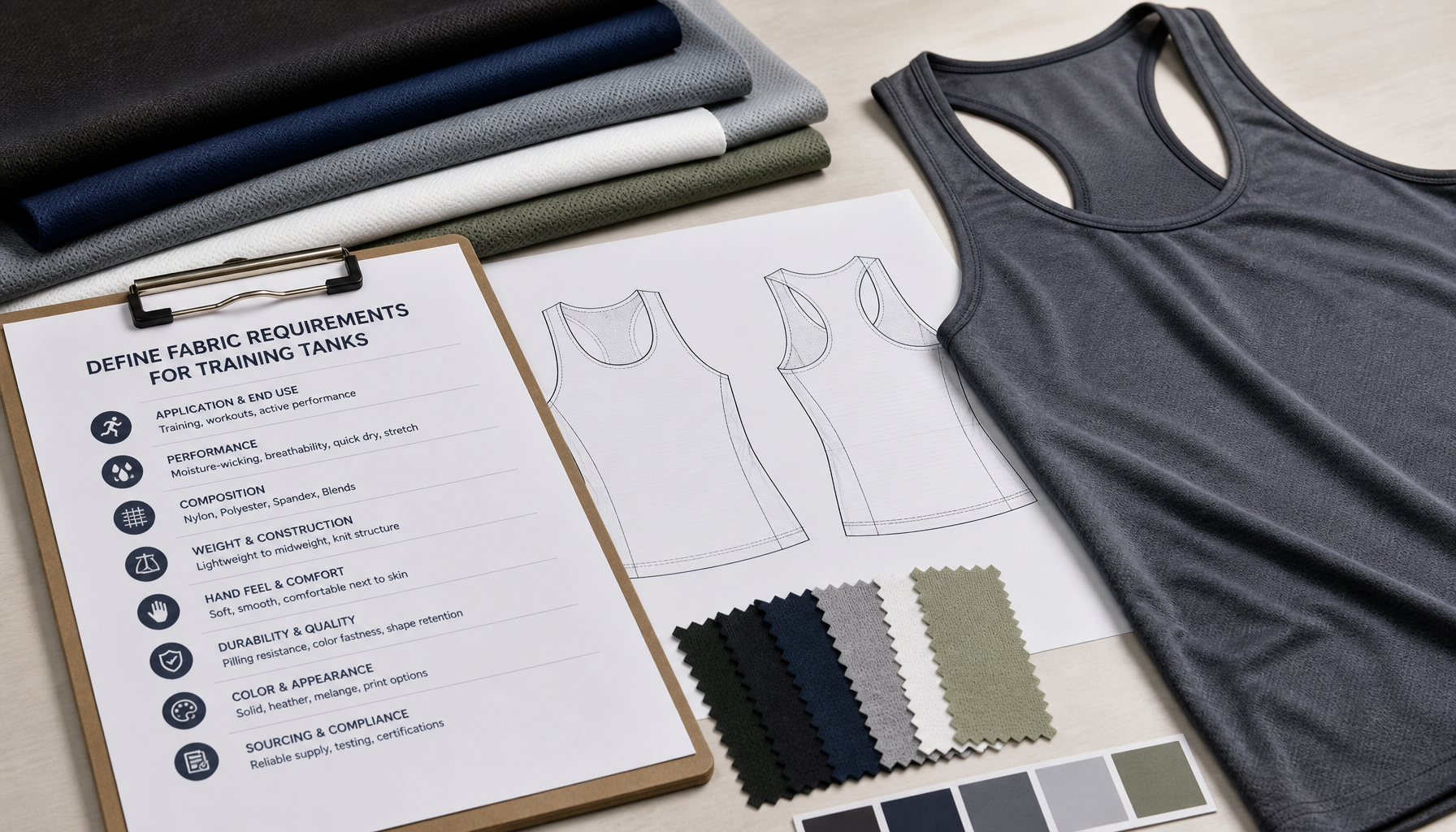
    How Should Buyers Define Fabric Requirements for Training Tanks?

    Define training-tank fabric from garment fit, armhole construction, movement, and required coverage before choosing composition or GSM. A loose gym tank and a fitted yoga tank need different balances of drape, recovery, ventilation, and edge stability.

    Start at the armhole

    Consider a fitted racerback tank used for overhead lifting. The chest and back panels extend during movement, while the armhole must return without gaping. An easy-stretch body fabric paired with stiff binding can restrict movement; a weak binding can distort the opening. Supply the fabric developer with the pattern, panel direction, binding method, and reference fit rather than requesting “high stretch” alone.

    How Should Buyers Define Fabric Requirements for Training Tanks?

    Choose coverage and weight together

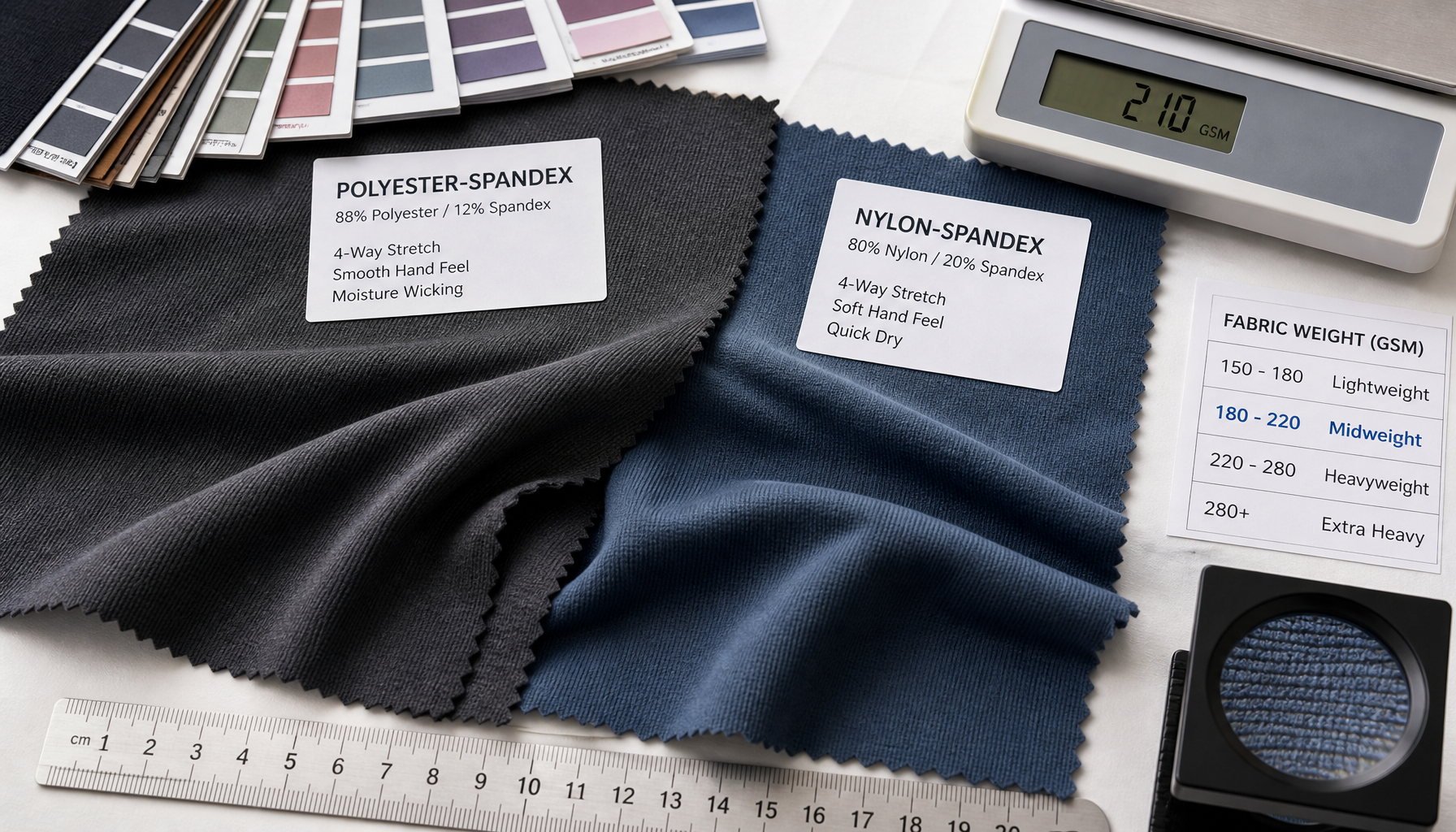
    A lightweight candidate can reduce garment mass, but its suitability depends on coverage in the selected color and at garment extension. For pale tanks, assess the finished garment under agreed lighting, both relaxed and stretched, and include wet-state assessment where relevant. A dense knit may improve coverage yet change drape and thermal comfort. GSM describes mass per area; it is not a direct measure of opacity or airflow.

    Hypothetical calculation: if the cut panels contain 0.50 m² of body fabric, changing from 150 to 180 g/m² adds 0.50 × 30 = 15 g before binding, thread, labels, or decoration. This is a garment-weight comparison, not a consumption estimate including cutting waste.

    Keep moisture claims distinct

    Water spreading, drying time, and air permeability answer different questions. Ask which property supports the proposed claim and compare candidates using the same specimen preparation and test conditions. Polyester-spandex and nylon-spandex labels do not establish these results. Where performance depends on a finish, assess the agreed washed state as well as the delivered fabric.

    How Should Buyers Define Fabric Requirements for Training Tanks?

    Use a short sewing trial to expose hidden costs

    • Check armhole and neckline recovery after movement and care.
    • Review hem curl, seam puckering, needle damage and side-seam rotation.
    • Apply the intended print or transfer before approving appearance and dimensions.
    • Run the actual size mix at the minimum usable width to establish consumption.

    A fabric that handles poorly during binding or cutting can consume more labor and produce more rejected garments despite a lower material price. Record the sewing setup and sample identity so the trial can be repeated when the material changes.

    Send a specification the supplier can act on

    Provide the silhouette, size range, fit reference, knit preference, target finished GSM, minimum usable width, color plan, binding method, and required care conditions. Separate mandatory performance limits from preferences. Request identified yardage for a complete tank trial, then freeze the approved construction and tolerances before placing the bulk order.

  • How Should Apparel Brands Compare Fabric Quotation Structure Across Fabric Suppliers?

    How Should Apparel Brands Compare Fabric Quotation Structure Across Fabric Suppliers?

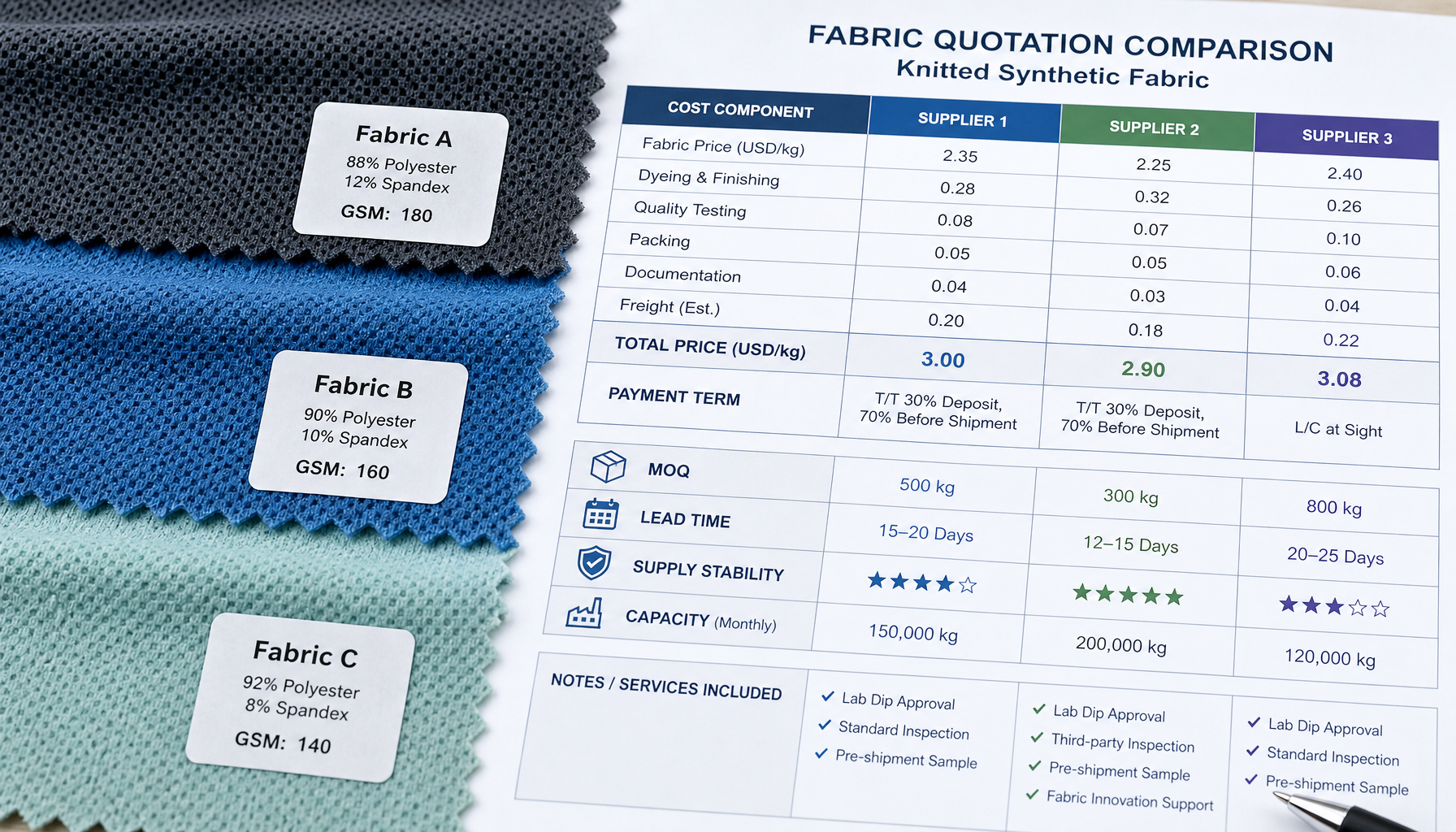
    Compare fabric quotations by matching the technical specification, billing unit, order quantity, included services, and delivery scope before ranking prices. Then calculate material cost against the actual garment marker, including unusable edges and agreed production allowances.

    Establish what each supplier is pricing

    For a nylon-spandex leggings program, two offers with the same composition can cover different knit constructions, finished weights, widths, and finishing routes. Ask suppliers to identify the quoted sample and specification revision. A quotation for an unfinished base cannot be compared directly with a dyed, finished fabric whose recovery and appearance have already been approved.

    How Should Apparel Brands Compare Fabric Quotation Structure Across Fabric Suppliers?

    Convert the price without hiding edge waste

    Illustrative calculation: assume USD 8/kg, 200 g/m², and a total billed width of 1.60 m. One linear metre weighs approximately 0.200 × 1.60 = 0.320 kg and costs USD 2.56. If only 1.50 m is usable, the edge loss is still included in the paid weight; multiplying price by usable width alone would understate the cost.

    If the production marker consumes 0.90 linear metres per garment at that usable width, baseline fabric cost is USD 2.304 per garment. Add documented spreading, defects, and other allowances without counting losses already included in the marker twice. These hypothetical figures assume uniform GSM and net fabric billing; verify whether cores and packaging are excluded.

    Separate recurring cost from development cost

    Quotation component Question to resolve
    Finished fabric Which color, finish, width, tolerance and quantity does the price cover?
    Development and samples Is the charge per construction, color, trial or revision?
    Testing and inspection Which tests and lots are included, and who pays for retesting?
    Packing and transport Which costs are included up to the named delivery location?
    Repeat orders Does the quoted price depend on the first-order volume or yarn commitment?

    Check minimums at color level

    A program requiring several small colors can cost more than one large color even at the same total weight. Request the minimum per construction and per dye lot, small-lot charges, permitted quantity variation, and quote validity. No fixed kilogram-to-metre conversion applies across different weights and widths.

    Close the gaps before awarding the order

    Send shortlisted suppliers the same comparison sheet and ask them to mark exclusions explicitly. Keep technical acceptance separate from commercial ranking: a cheaper fabric that fails coverage, recovery, or the production marker is not an equivalent offer. Approve the sample reference, cost basis, inspection responsibilities, and treatment of nonconforming rolls together.

  • How Should Buyers Compare Suppliers of Fabric for Hiking Shirts?

    How Should Buyers Compare Suppliers of Fabric for Hiking Shirts?

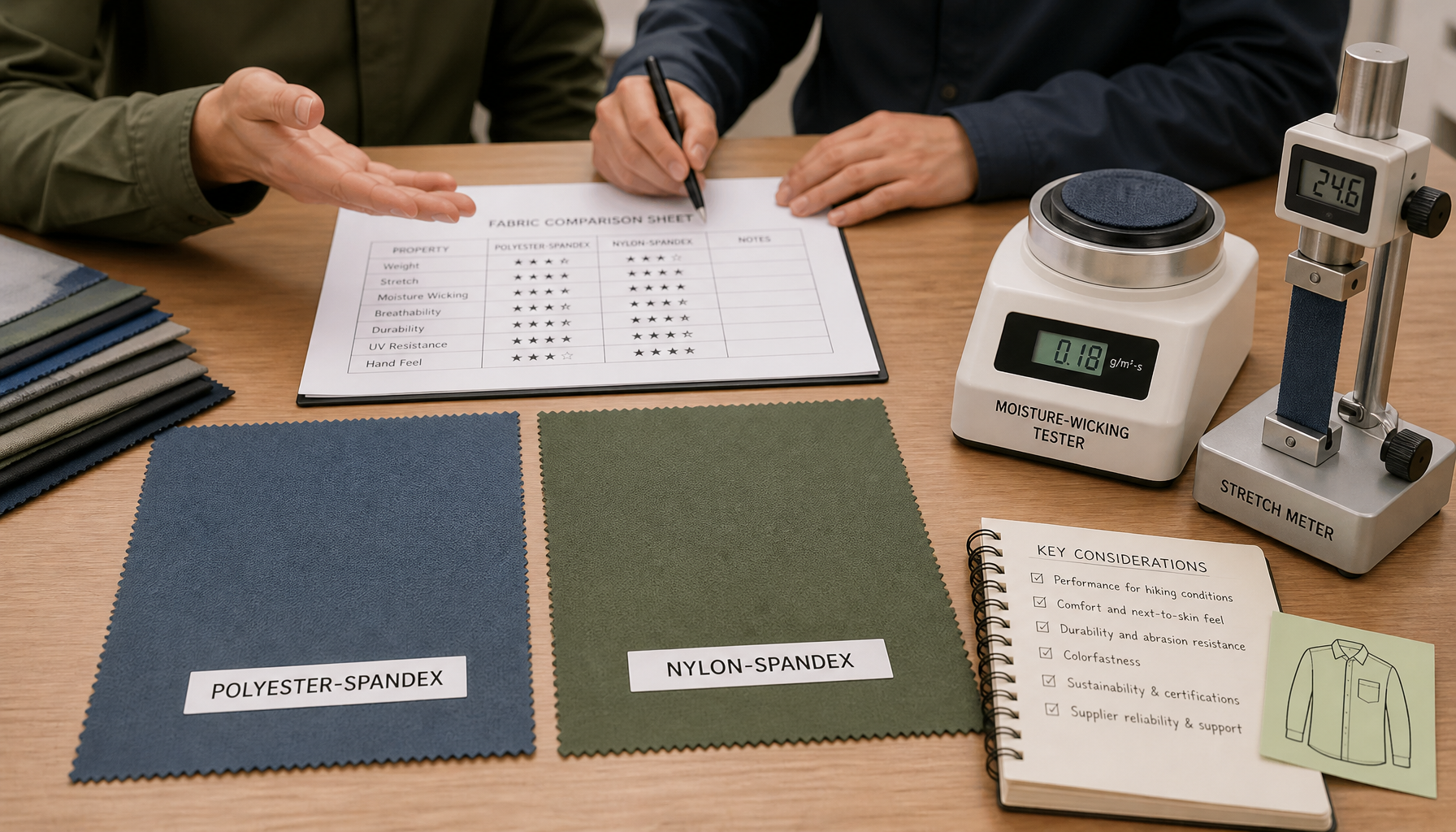
    Helpful tips: Compare hiking-shirt fabric suppliers on verified performance under one specification, not on fiber content, feature lists, or price per kilogram. The brief should define climate, trip intensity, pack contact, garment fit, care conditions, finished GSM, usable width, stretch, drying or moisture requirements, durability, and optional finishes. Evaluate candidate fabrics in the intended garment, then audit how each supplier reproduces the approved construction across colors, lots, and repeat orders.

    Hiking shirt fabric candidates prepared for supplier comparison
    Hiking-shirt suppliers should be compared with the same fabric brief, test conditions, garment trial, and bulk-control requirements.

    Define the hiking scenario

    A lightweight shirt for humid day hikes, a close-fitting stretch top under a backpack, and a cool-weather trekking layer require different trade-offs. State expected temperature and humidity if the brand has a defined use range, exertion level, duration, pack weight and contact zones, layering, fit, sun exposure, and wash access. These inputs determine whether the project prioritizes airflow, drying, warmth, surface durability, low wet cling, stretch recovery, coverage, or garment mass.

    Compare constructions, not generic fiber claims

    Polyester-spandex and nylon-spandex can both support hiking apparel, but fiber names do not establish air permeability, drying time, abrasion resistance, snagging, hand, or recovery. Yarn form, filament size, knit structure, stitch density, dye route, and finishing matter. Require each supplier to disclose the finished composition, construction, GSM, usable width, stretch directions, surface treatment, and which performance claims depend on an optional finish. Compare only candidates developed for the same shirt and test matrix.

    Build a risk-based verification matrix

    Supplier evidence for hiking-shirt fabric
    Use risk Evidence to request Garment check
    Sweat and drying Agreed moisture or drying method with full conditions Wet cling and comfort during representative wear
    Backpack contact Relevant abrasion, pilling or snag evaluation Shoulder and back-panel trial
    Movement Directional stretch and recovery results Reach, arm lift, hem movement and fit retention
    Repeated care Dimensional stability, appearance and colorfastness Measurement and appearance after agreed cycles
    Optional claim Method, acceptance limit and durability condition Claim wording limited to verified evidence

    Issue the same methods, specimen states, units, and acceptance criteria to every supplier. A report produced on another color or construction is background information, not approval evidence for the submitted fabric. When the brand lacks a limit, test several candidates under identical conditions, use a validated reference garment where available, and set the purchasing threshold from the chosen performance level. Avoid selecting the highest isolated value when overall comfort and durability require balance.

    Compare total material cost

    Illustrative calculation: a fabric at 145 GSM and 1.55 m usable width weighs 0.145 × 1.55 = 0.22475 kg per linear metre. At USD 8.20/kg, theoretical cost is approximately USD 1.84 per usable metre before cutting loss. A second fabric with a lower kilogram price may cost more per shirt if it is heavier, narrower, or less efficient in the graded marker. Replace these figures with actual quotations and marker consumption.

    Verify optional finishes and their trade-offs

    Odor-control, cooling, water-repellent, or UV-related claims should never be inferred from the base fiber. Ask whether the effect comes from construction, fiber, dyeing, or a finish; which test supports it; and how laundering changes the result. Evaluate any change in hand, shade, air permeability, wicking, print compatibility, cost, and lead time. Approving an untreated sample while ordering a treated bulk version creates a new material state and should trigger relevant revalidation.

    Audit sample-to-bulk control

    Ask each supplier how sample identity links to yarn, greige batch, dye lot, finishing route, test report, and finished rolls. Review controls for GSM, width, shade, bow or skew, defects, and relevant performance properties. Confirm change-notification rules for yarn source, settings, chemicals, plant, or subcontractor. Repeat-order capability should be judged from documented records and retained standards, not from a promise that the same fabric code will always behave identically.

    Run a production-relevant trial

    Request identified yardage sufficient for laboratory tests, decoration, spreading, sewing, fitting, backpack-contact evaluation, and the agreed care cycles. Test representative light and dark colors when color chemistry may affect results. Record every deviation before approval. Send ClothFactory or another supplier one RFQ containing the garment scenario, construction and dimension targets, performance matrix, forecast quantity, color plan, timeline, and bulk acceptance procedure so price and capability are evaluated on the same basis.

  • How to Specify GSM and Usable Width for Team Jersey Fabric

    How to Specify GSM and Usable Width for Team Jersey Fabric

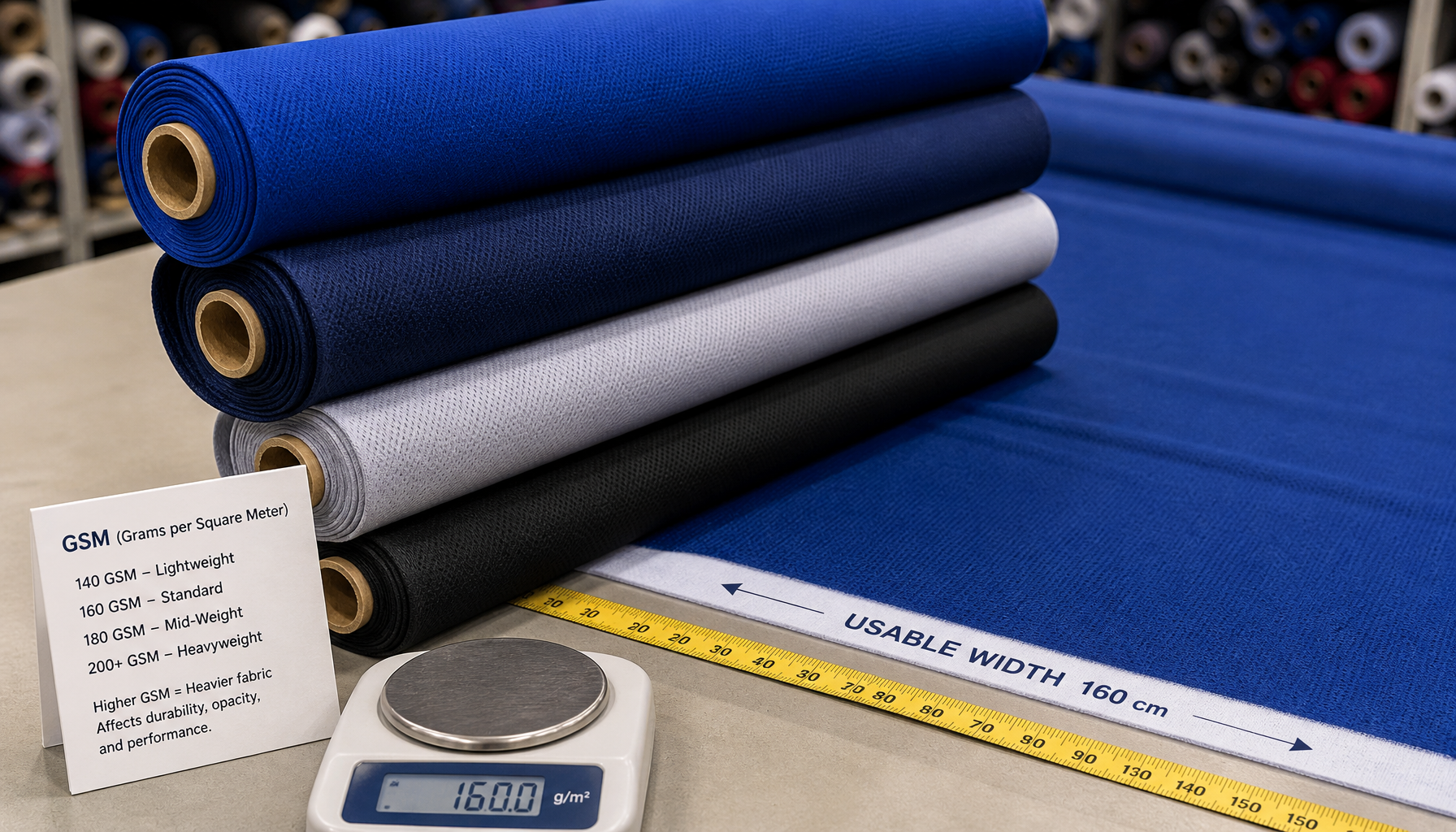
    Please note: Choose team-jersey GSM from the required garment weight, coverage, climate, print process, and durability target; choose usable width from the actual graded marker. Do not approve either value in isolation. The purchasing specification should state finished GSM and usable width with tolerances, measurement conditions, and a rule for edge defects, because nominal width and quoted price per kilogram do not reveal the material cost per acceptable jersey.

    Team jersey panels arranged across the usable width of knitted fabric

    GSM and usable width should be evaluated together because both influence garment weight, marker yield, and material cost.

    Start with the jersey system, not a generic GSM range

    A training jersey used in hot weather, a match jersey carrying dense sublimation graphics, and a contact-sport top do not impose the same material demands. Lower GSM can reduce garment mass but may reduce coverage, snag resistance, sewing stability, or print appearance. Higher GSM may improve structure yet increase heat burden and drying time. Define the sport, fit, climate, contact level, decoration process, panel construction, and target garment mass before asking a supplier to recommend a polyester-spandex or nylon-spandex knit.

    Translate GSM into estimated garment mass

    Illustrative calculation: if the marker uses 0.78 m² of fabric per jersey and the selected fabric is 150 g/m², the theoretical fabric mass is 0.78 × 150 = 117 g before cutting loss, trims, thread, printing, and process allowances. At 180 g/m², the same area contributes 140.4 g, or 23.4 g more. This calculation does not identify the better fabric; it shows how a GSM decision changes the finished product and should be checked against a sewn sample.

    Define usable width from the graded marker

    Usable width is the defect-free cutting width after excluding edges that cannot be spread or cut reliably. Ask the marker team to test the complete size ratio, including names, numbers, stripe direction, print registration, and grain requirements. A wider roll provides no benefit if the extra edge is distorted or cannot accommodate another panel. Conversely, a small width difference can change whether two body panels nest side by side, causing a step change in consumption rather than a gradual one.

    Compare cost on an equivalent basis

    Illustrative calculation: fabric at 160 GSM with a 1.55 m usable width weighs 0.160 × 1.55 = 0.248 kg per linear metre. At USD 7.50/kg, the theoretical cost is USD 1.86 per usable metre. This remains incomplete until marker consumption and cutting loss are known. If a narrower quality requires more length per jersey, its lower kilogram price may still produce a higher fabric cost per garment.

    Inputs needed before approving team-jersey GSM and width
    Input Why it changes the decision How to verify
    Finished GSM Affects garment mass, coverage and handling Conditioned measurement across representative positions
    Usable width Controls panel nesting and marker efficiency Measure defect-free width under agreed tension
    Print or decoration May change opacity, hand and dimensional behavior Approve decorated garment, not blank fabric alone
    Size ratio Changes marker utilization Run the production size mix through the marker
    Dimensional stability Changes post-process panel dimensions Test after the agreed wash or heat exposure

    Write tolerances and measurement conditions

    Specify whether GSM is measured on conditioned finished fabric and how many positions are checked. Define usable width as a minimum acceptable cutting width, not merely total laid-flat width, and state whether edge curl, pin marks, shading, holes, or distortion reduce it. The purchase order should also cover width variation within and between rolls, because an average can pass while individual sections are too narrow for the approved marker. Agree on the action for nonconforming rolls before shipment.

    Validate with production-relevant samples

    Request enough identified yardage to print or decorate, relax, spread, cut, sew, wash, and fit the full jersey size range. Measure GSM and usable width before and after relevant processing, then compare actual marker consumption with the estimate. Approval should link the physical fabric standard to numerical tolerances and the finished garment result. A hand swatch can screen color and touch, but it cannot establish cutting yield, printing response, or size stability.

    RFQ fields for a comparable quotation

    Send suppliers the sport and climate, garment fit, composition preference, knit structure, target finished GSM and tolerance, minimum usable width, size ratio, decoration route, dimensional-stability requirement, color plan, test methods, forecast volume, and acceptance procedure. ClothFactory can use these inputs to match or develop candidate knitted stretch fabrics. The buyer should award the order only after measured width, marker yield, decorated appearance, and garment performance meet the same written approval basis.

  • How Should Buyers Define Fabric Requirements for Cycling Shorts?

    How Should Buyers Define Fabric Requirements for Cycling Shorts?

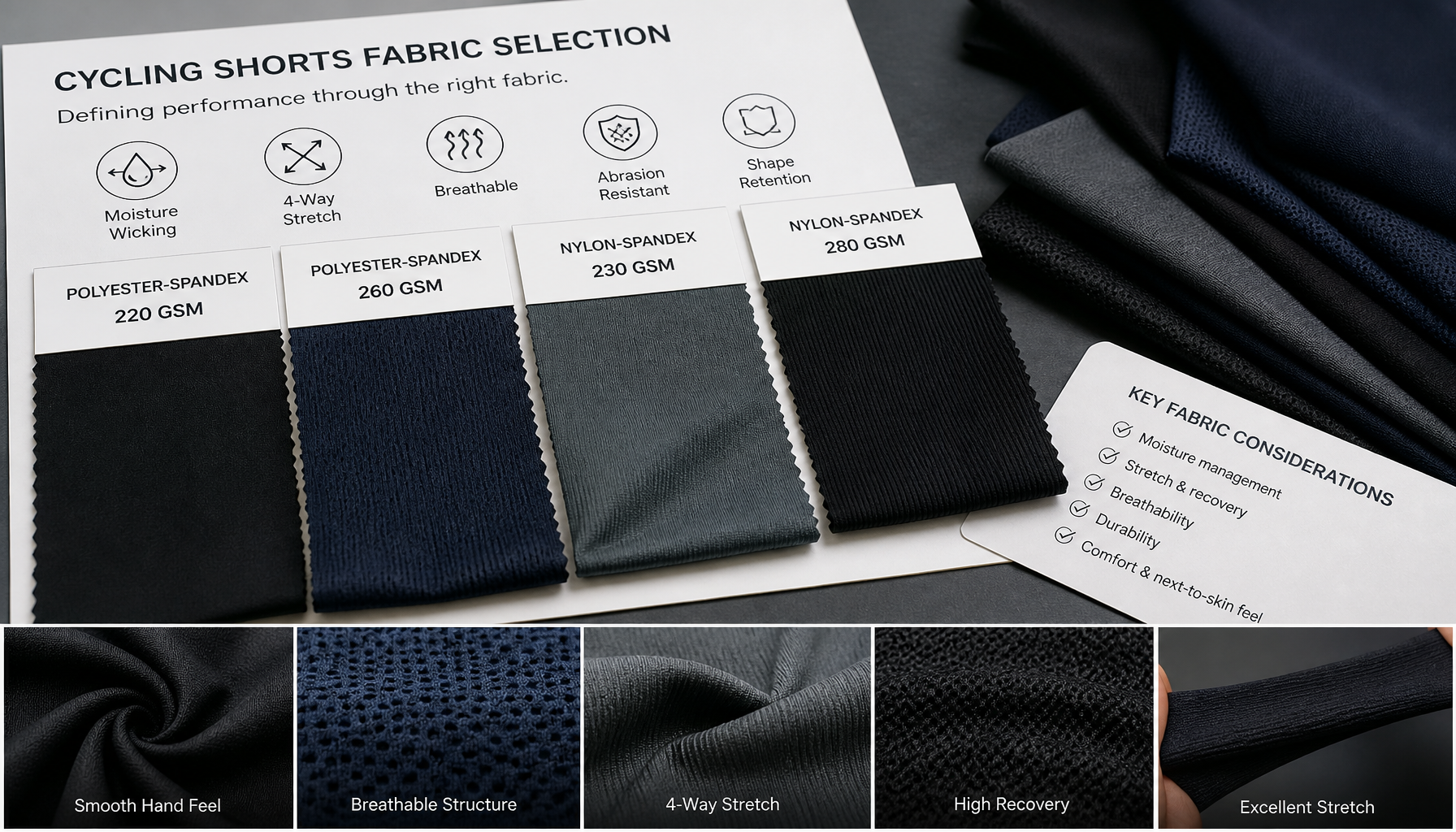
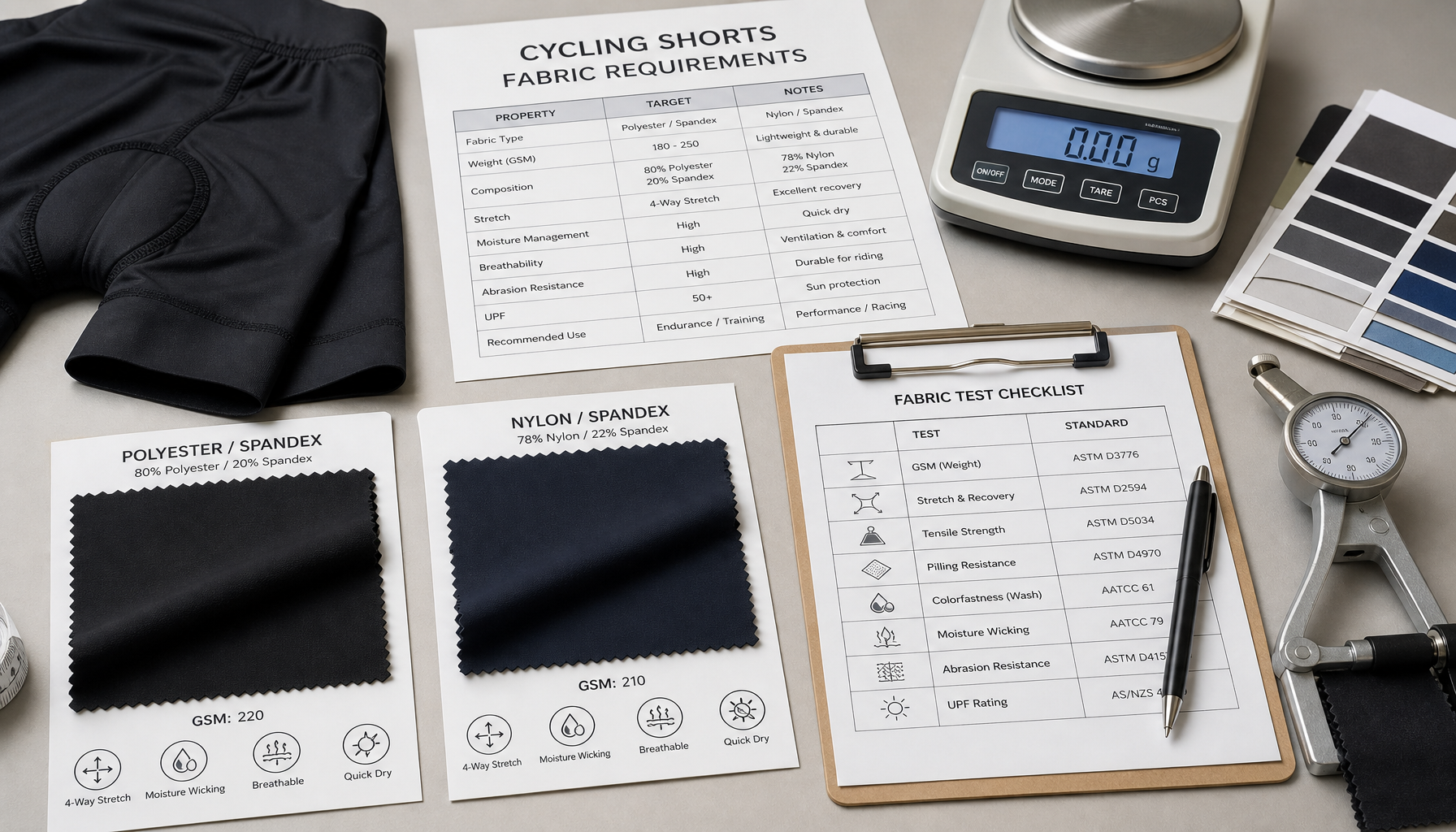
    A cycling-short fabric specification should define riding discipline, garment fit, panel orientation, support, stretch and recovery, opacity at use extension, skin-contact comfort, finished GSM, usable width, durability, moisture and drying requirements, color, and care conditions. Buyers should validate the fabric in a sewn short with its chamois, seams, and waistband. Fiber percentage and a hand swatch cannot predict pressure, movement, coverage, or fit retention in the riding position.

    Stretch fabric specification being prepared for cycling shorts
    Cycling-short fabric requirements should begin with riding position, panel strain, support, coverage, and contact-zone durability.

    Describe the cycling application

    State whether the garment is for road, indoor, commuter, gravel, or mountain use; the expected ride duration; climate; compression intent; size range; and whether it is a bib or waist short. Include chamois construction, pocket load, panel count, seam type, and high-abrasion zones. The forward-flexed riding posture stretches hip and seat panels differently from standing fit, so requirements must be based on the actual garment geometry and intended motion.

    Specify stretch by direction and panel orientation

    Define the required extension and recovery in the directions used around the body and along the leg. Provide the supplier and laboratory with panel orientation, test method, load or extension, cycle count, hold time, relaxation time, and allowable growth. “Four-way stretch” is not an acceptance criterion. A fabric can extend easily yet recover poorly, creating knee, seat, or waistband bagging after prolonged riding. Compare directional data under identical conditions and confirm it in fit trials.

    Cycling short panels showing different stretch and abrasion zones
    Seat, thigh, waistband, pocket, and chamois zones impose different extension, recovery, opacity, and abrasion demands.

    Set coverage at the intended extension

    Opacity should be assessed in the approved color while the fabric is stretched to a condition representative of the finished garment. A flat, relaxed swatch can hide show-through caused by reduced stitch coverage, pale shades, print, wetting, or excessive negative ease. Define the specimen extension and viewing or instrumental method, then confirm the result on the sewn garment in the riding posture. Passing one dark color does not automatically approve pale or printed colorways.

    Balance support, mass, and thermal comfort

    Higher GSM can improve coverage and structure but may increase garment mass, drying time, and heat burden; lower GSM may improve lightness while reducing support or durability. Knit density and yarn selection matter alongside weight. Establish a target from reference garments and trial fabrics rather than using a generic range. Ask the supplier to state finished GSM with tolerance and measure representative positions after conditioning and any relevant heat or wash exposure.

    Convert the fabric choice into garment mass

    Illustrative calculation: if the cycling-short marker uses 0.62 m² and the fabric is 230 GSM, theoretical fabric mass is 0.62 × 230 = 142.6 g before cutting loss, chamois, elastic, pockets, thread, and trims. At 250 GSM, the same area contributes 155 g, or 12.4 g more. This does not decide performance; it quantifies a weight trade-off that should be reviewed with coverage, support, drying, and fit.

    Control skin contact and durability

    Evaluate the skin-contact face, seam interaction, edge behavior, wet cling, pilling, abrasion, snagging, and surface change after the intended care cycles. Seat and inner-thigh zones may require more attention than low-contact panels. If the garment uses sublimation, transfer printing, silicone grippers, bonding, or adhesive films, process representative fabric before approval because heat and chemicals can change shade, stretch, recovery, hand, or dimensions.

    Cycling-short fabric specification fields
    Field Required purchasing detail
    Construction Composition, knit, face, reverse and finished state
    Dimensions Finished GSM, minimum usable width and tolerances
    Mechanical behavior Directional stretch, recovery or growth, and test conditions
    Appearance Color, opacity at extension, luster and physical standard
    Durability Care procedure and relevant pilling, abrasion and stability criteria
    Bulk control Sampling frequency, roll limits, traceability and change notification

    Approve through a garment trial

    Request enough identified yardage for testing, marker work, sewing, fit sessions, riding evaluation, decoration, and repeated care. Assess multiple sizes or the highest-risk sizes, and record the chamois, seam, elastic, and panel orientation used. Send ClothFactory or any candidate supplier the full use case, specification, color plan, forecast quantity, tests, and approval stages. Release bulk production only when the physical standard, numerical results, and finished-short performance refer to the same fabric version.

  • Everyday Underwear Fabric RFQ Checklist

    Everyday Underwear Fabric RFQ Checklist

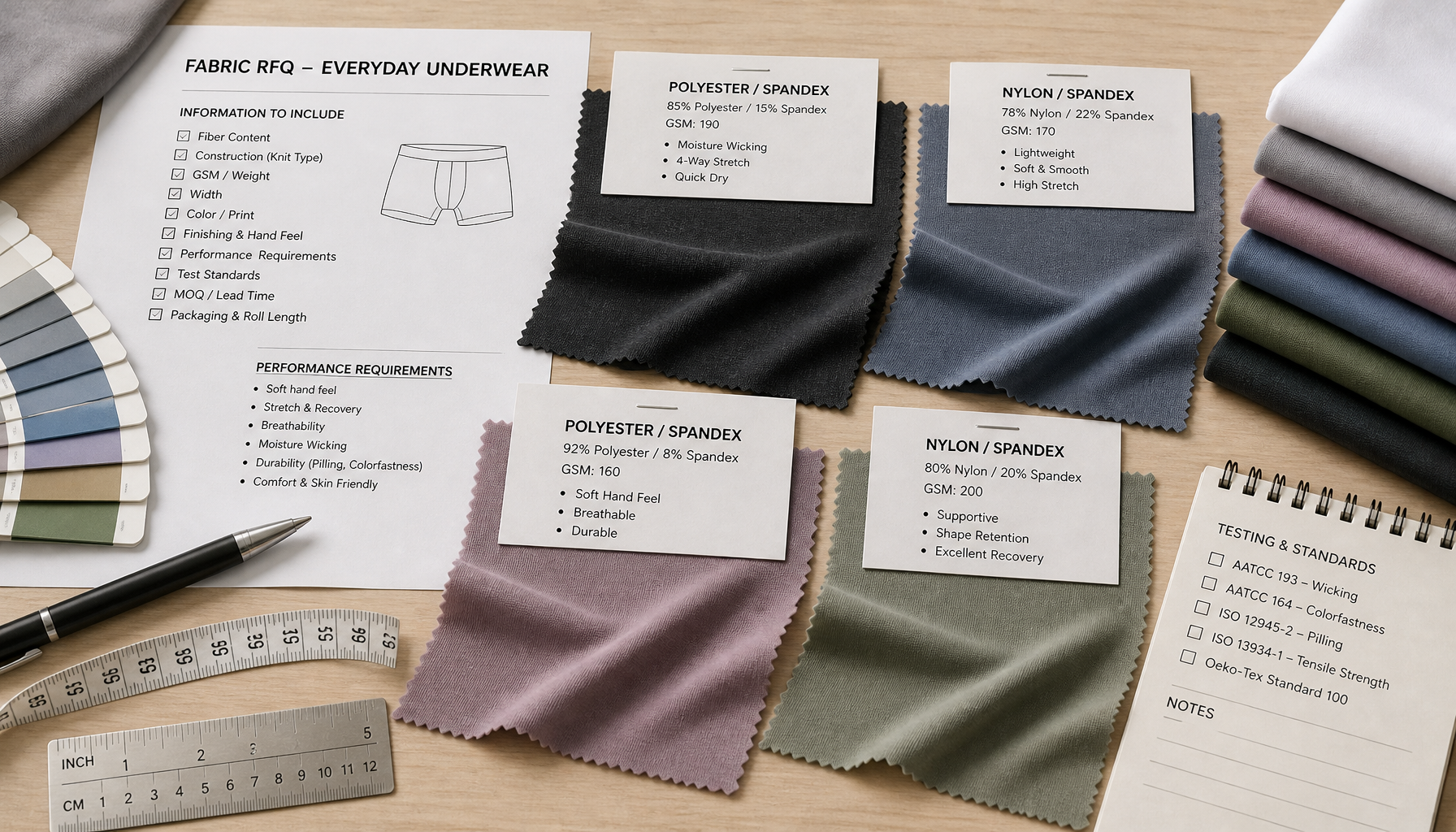
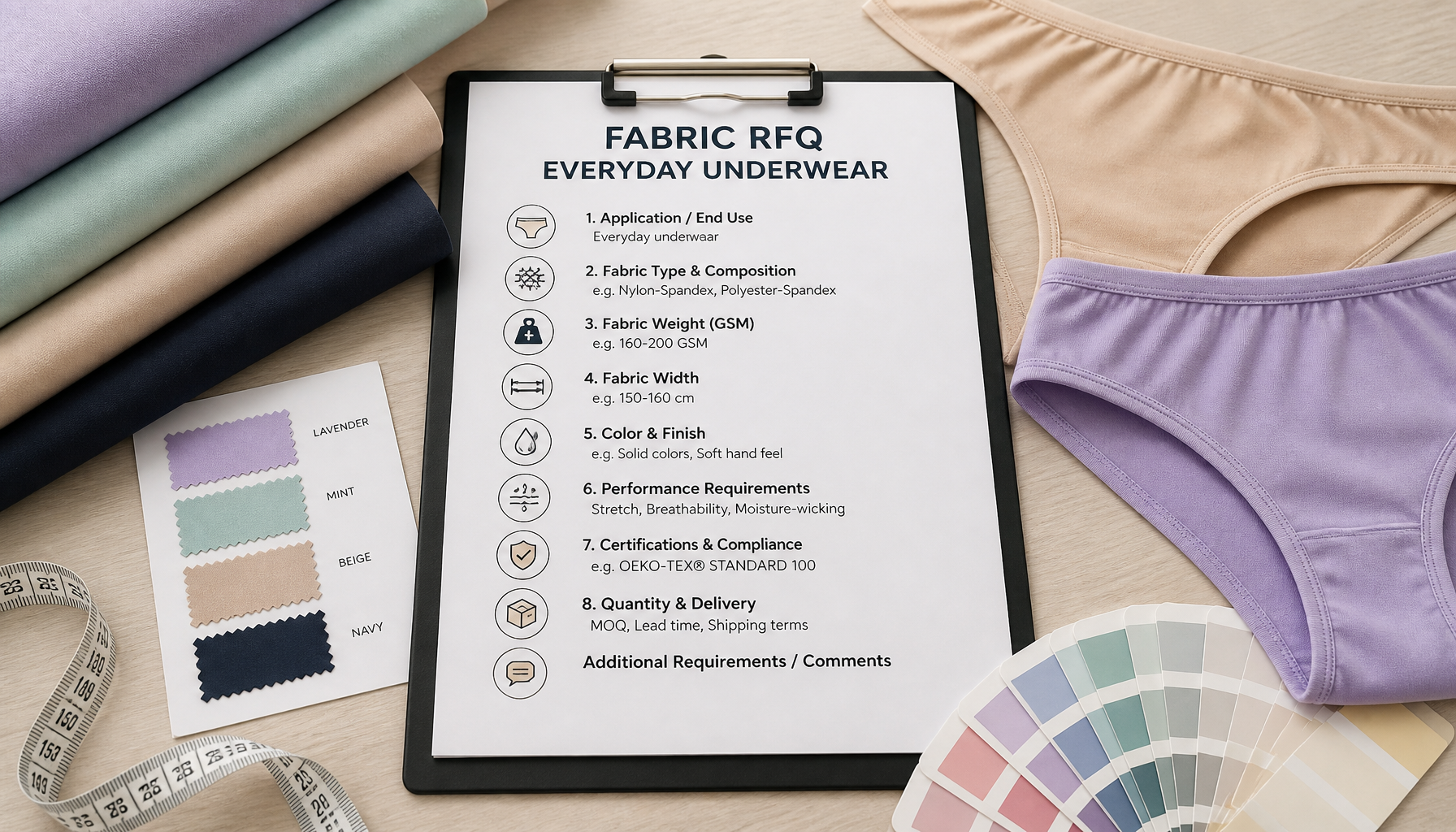
    An everyday-underwear fabric RFQ should define the wearer, garment construction, skin-contact face, composition and knit preferences, finished GSM, usable width, stretch and recovery, opacity, color, finish, care conditions, test requirements, quantities, and approval process. It should distinguish mandatory limits from development preferences. Suppliers cannot prepare comparable quotations when the request contains only a fiber blend, a photo, or terms such as “soft,” “breathable,” and “high quality.”

    Everyday underwear fabric requirements being prepared for an RFQ
    An effective underwear fabric RFQ converts comfort, fit, appearance, and durability expectations into comparable supplier inputs.

    Describe the garment and wearer first

    State whether the program covers briefs, boxer briefs, seamless-style cut-and-sew underwear, waistbands, gussets, or lining, because each panel may require a different material. Include wearer segment, intended fit, size range, climate, contact duration, seam type, lining, elastic integration, and target retail position. A close-fitting daily garment prioritizes low irritation and recovery after repeated wear, but the required support, coverage, and thermal comfort differ between silhouettes and markets.

    Specify construction and measurable dimensions

    • Preferred fiber composition and acceptable alternatives, without assuming composition guarantees performance.
    • Knit structure, face and reverse, finished GSM, minimum usable width and tolerances.
    • Required stretch direction, extension, recovery or growth, and test conditions.
    • Color, opacity at relevant extension, surface appearance, hand standard and edge behavior.
    • Dimensional stability under the intended wash and drying procedure.

    Nylon-spandex and polyester-spandex may both be suitable starting points, but yarn type, knit geometry, finishing, and garment design determine the final experience. If the buyer accepts either family, ask suppliers to explain the commercial and technical trade-off rather than naming a preferred fiber without a reason. Where softness is critical, submit an identified reference swatch and describe which face touches the skin; subjective language alone cannot be priced or inspected consistently.

    Knitted stretch fabric sample prepared for underwear fit and wash trials
    Representative sample yardage is needed to assess sewing, recovery, opacity, skin contact, and dimensional change in the finished underwear design.

    State functional claims as validation tasks

    If the product brief requests moisture management, cooling sensation, odor control, or another function, identify whether it is mandatory, the intended mechanism if known, the test method, acceptance criterion, care cycles, and claim market. Do not assume every candidate fabric has these properties or that an optional finish remains effective after laundering. The supplier should quote the base construction and any requested functional route clearly enough for the buyer to compare cost, durability, hand change, and testing responsibility.

    Include garment and color risks

    Underwear can expose risks that a flat swatch hides: seam grin, edge curl, elastic recovery mismatch, show-through, crocking, staining, and dimensional change after repeated care. Pale and dark colors may not behave identically, and passing one shade does not approve the range. Ask for development and bulk color procedures, controlled light-source assessment, shade continuity rules, and appropriate colorfastness requirements. Validate representative light and dark garments in the intended wash system.

    Give suppliers a usable quantity forecast

    Provide expected kilograms or metres by color, launch quantity, repeat-order forecast, target delivery window, and destination. Ask each supplier to state minimum dye-lot or order conditions, sample charges, lead-time assumptions, over- or under-delivery tolerance, and whether quotation is by kilogram, metre, or yard. Do not insert an unverified “standard MOQ” into the RFQ. Order conditions depend on construction, yarn availability, dyeing route, color, and supplier capacity and must be confirmed for the proposed quality.

    Compare cost per approved garment

    Illustrative calculation: at 170 GSM and 1.50 m usable width, one linear metre weighs 0.170 × 1.50 = 0.255 kg. If the quotation is USD 8.00/kg, theoretical fabric cost is USD 2.04 per usable metre before cutting loss. Actual underwear cost requires the production marker, relaxation, defects, shade segregation, and process loss. Request finished GSM and minimum usable width so quotations can be converted to the same commercial basis.

    Documents to request with an underwear fabric quotation
    Document or sample Purpose
    Technical data Confirms proposed construction, dimensions and stated test conditions
    Identified swatch Supports face, hand, shade and appearance review
    Sample yardage Enables sewing, fit, opacity, wash and marker trials
    Test report Provides evidence tied to the exact quality and sample state
    Commercial quotation States unit basis, quantities, lead-time assumptions and exclusions

    End the RFQ with a clear development gate: initial proposal, identified sample, laboratory and garment trial, color approval, production-relevant confirmation, and bulk release. State who owns testing and what requires reapproval after a change. ClothFactory can assess the brief against knitted synthetic stretch options, while the buyer retains the final performance limits. A structured RFQ reduces repeated sampling and makes technical suitability and total material cost visible before commitment.

  • Base Layer Fabric Bulk Approval Checklist

    Base Layer Fabric Bulk Approval Checklist

    Before approving base-layer fabric for bulk production, confirm the exact construction, finished dimensions, skin-contact comfort, stretch recovery, moisture and thermal requirements, color performance, durability, and lot-control plan. Approval must be based on identified production-relevant material and agreed methods—not composition, GSM, or a hand swatch alone. The final decision should also reflect the complete garment after sewing, decoration, laundering, and its intended layering conditions.

    Base layer fabric being reviewed before bulk approval
    Bulk approval should connect the selected base-layer fabric to measurable specifications, a sealed reference, and garment-level validation.

    Confirm the use case and layering conditions

    Define whether the product is for cold-weather skiing, high-output running, everyday thermal wear, or another application. State whether the garment is next to skin, its intended fit and compression level, the expected temperature and activity range if the brand has validated one, and the layers worn above it. These inputs determine the acceptable trade-off among insulation, air exchange, drying, moisture transfer, softness, seam comfort, and garment mass. A single fabric cannot be assumed to optimize every condition.

    Freeze the finished fabric specification

    • Fiber composition and knit structure, with the approved face and reverse identified.
    • Finished GSM and usable width, including measurement conditions and tolerances.
    • Stretch direction, extension and recovery requirements under named conditions.
    • Color, finish, hand, luster, surface appearance, bow, skew and edge requirements.
    • Dimensional stability after the brand’s specified care or production exposure.

    Polyester-spandex and nylon-spandex describe broad material families, not guaranteed performance. Yarn selection, stitch density, knit geometry, dyeing, heat setting, brushing, and chemical finishing can change the behavior of fabrics with similar labels. Keep a sealed physical reference for subjective characteristics and numerical limits for measurable ones. Identify the approved version and ensure that the supplier, garment factory, buying team, and laboratory are working from the same specification.

    Review test evidence under controlled conditions

    The buyer should select tests from the actual product risk: stretch and recovery, dimensional stability, colorfastness, pilling, abrasion, bursting strength, air permeability, drying or moisture behavior, and any regulated chemical requirements relevant to the destination market. State the method edition, specimen condition, direction, wash cycle, units, and acceptance limit. Results from a different construction, color, finish, or test condition should not be used as evidence for the proposed bulk quality.

    Check the garment after production-relevant processing

    Cut and sew enough trial garments to assess the full size range or the sizes most likely to expose fit risk. Apply the intended print, transfer, bonding, or brushing process, then perform the agreed care cycles. Review seam grin, edge curl, spirality, opacity at extension, recovery at knees or elbows, skin-contact irritation, dimensional change, and layered comfort. Laboratory fabric results support control, but they do not predict every interaction created by garment design and processing.

    Convert tolerances into a bulk-release rule

    Hypothetical calculation: if a base-layer marker consumes 0.90 m² and the approved fabric is 180 GSM, theoretical fabric mass is 0.90 × 180 = 162 g before cutting loss and trims. A bulk shift to 195 GSM raises theoretical mass to 175.5 g, an increase of 13.5 g per garment. Whether that change is acceptable depends on the agreed tolerance and garment validation; the example shows why average GSM cannot be treated as a minor purchasing detail.

    Evidence required for bulk approval
    Approval item Buyer evidence Bulk control
    Construction Identified production-relevant sample Traceable yarn, greige and finish route
    Appearance and color Signed physical standard Roll and lot shade assessment
    Performance Reports tied to the approved sample Agreed verification frequency
    Garment suitability Processed and washed prototype No unapproved process change
    Dimensions GSM, width and stability results Individual roll limits plus lot rules

    Release the order only after responsibilities are clear

    Record who supplies and selects bulk samples, who pays for testing, who releases lots, and what happens when a result falls outside tolerance. Confirm production lead time, color sequence, minimum dye-lot constraints, packing, retained samples, claim period, and re-order controls. Send ClothFactory or any supplier the signed specification and approval pack before the purchase order becomes final. This makes bulk approval a controlled production decision rather than acceptance of an attractive development sample.

  • How Should Buyers Compare Suppliers of Fabric for Ski Base Layers?

    How Should Buyers Compare Suppliers of Fabric for Ski Base Layers?

    Compare ski base-layer fabric suppliers against one written specification, one conditioning and test protocol, and representative production samples. A low quotation is not comparable when composition, knit structure, finished GSM, usable width, thermal behavior, moisture transport, stretch recovery, colorfastness, or tolerances differ. Supplier selection should therefore be based on the cost of fabric that passes garment-level validation, not on price per kilogram alone.

    Fabric supplier comparison for a ski base layer program
    A ski base-layer sourcing decision should compare verified fabric performance, bulk consistency, and production controls under the same specification.

    Define the base-layer use case before requesting fabric

    A ski base layer worn directly against the skin must manage sweat while remaining comfortable under insulating and shell layers. The specification should state whether the garment is intended for high-output touring, resort skiing, or lower-intensity cold-weather use; the expected fit; the target climate; and the layering system. These conditions change the acceptable balance among warmth, drying behavior, air permeability, surface softness, opacity, and stretch recovery. “Thermal fabric” or “moisture-wicking fabric” is not a measurable purchasing requirement.

    Compare equivalent fabric constructions

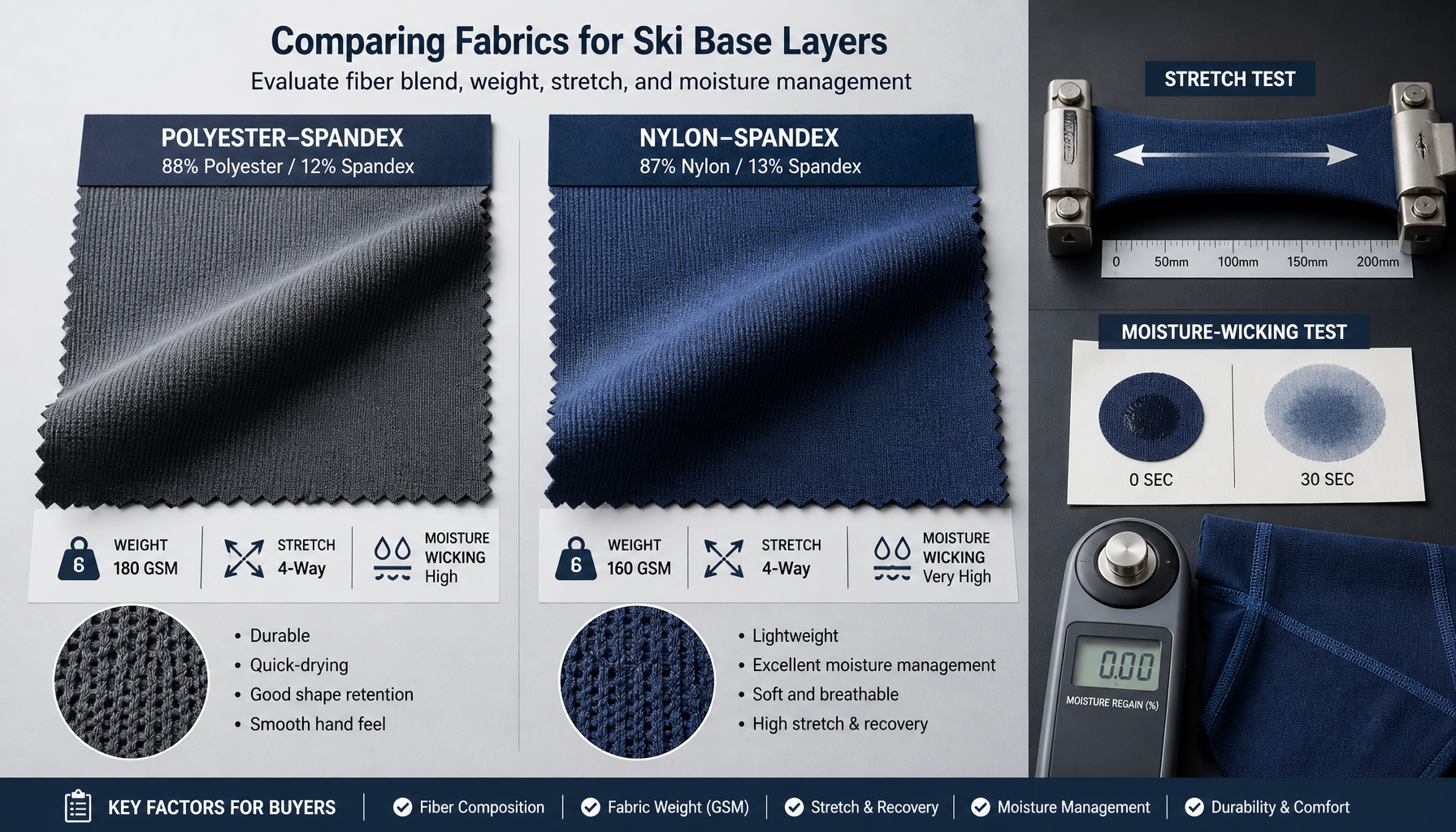
    Fiber content alone does not predict base-layer performance. Polyester-spandex and nylon-spandex fabrics can be engineered with different yarn sizes, filament counts, knit structures, brushing levels, and finishes. Ask each supplier to identify the finished composition, knit construction, finished GSM, usable width, stretch direction, and relevant finishing route. If one quotation covers brushed interlock and another covers lightweight jersey, their prices and test results do not represent equivalent products even when the fiber percentages appear similar.

    Issue one performance and test matrix

    Supplier comparison fields for ski base-layer fabric
    Decision area Buyer should specify Evidence to compare
    Fit retention Stretch direction, extension target, recovery condition and tolerance Laboratory report plus worn-garment trial
    Moisture and drying Selected methods, specimen conditioning and acceptance criteria Reports produced using the same methods
    Comfort Approved hand standard, seam placement and skin-contact face Identified swatch and prototype garment
    Durability Wash cycle, pilling, abrasion and dimensional-stability requirements Pre- and post-wash results on the proposed quality
    Bulk control GSM, usable width, shade and roll-level tolerances Inspection method and lot records

    The buyer should name the required test method and acceptance criterion rather than asking whether a fabric “passes.” Results obtained under different extension levels, loads, wash cycles, specimen directions, or conditioning periods cannot be compared directly. Where the brand has no established limits, test shortlisted fabrics under identical conditions, make garments from the best candidates, and convert the selected result into the approved bulk specification.

    Evaluate commercial yield, not only quoted price

    Illustrative calculation: Supplier A quotes USD 8.00/kg at 190 GSM and 1.50 m usable width. One linear metre weighs 0.190 × 1.50 = 0.285 kg, so its material cost is USD 2.28 per usable metre before loss. Supplier B may quote a lower price per kilogram yet deliver a narrower usable width or higher finished GSM, increasing cost per metre and per marker. Replace these hypothetical figures with measured bulk values and actual marker efficiency before awarding the order.

    Audit the path from sample to bulk

    Ask how the supplier identifies yarn, greige fabric, dye lot, finishing route, and finished rolls; which measurements are taken per lot; and how out-of-tolerance material is isolated. Confirm whether the approved sample is a laboratory development, a production trial, or material cut from an existing bulk lot. A supplier should also explain how shade continuity, width variation, GSM, bow or skew, and finishing changes are controlled. Certificates without sample and lot traceability provide limited protection to the buyer.

    Use a controlled supplier trial

    Shortlist suppliers using the same RFQ, then request identified yardage sufficient for laboratory testing, spreading, sewing, fitting, and repeated laundering. Record roll or sample identity on every report. Approve a sealed reference for color, face, hand, construction, and appearance, while keeping numerical tolerances in the purchase specification. Before bulk commitment, confirm lead time, minimum dye-lot conditions, re-order controls, claim handling, and which party pays for retesting or replacement when agreed criteria are not met.

    Procurement decision

    Select the supplier that can reproduce the approved construction within documented tolerances and provide traceable evidence under agreed test conditions. Send ClothFactory or any shortlisted supplier the garment use case, target composition and construction, finished GSM and usable width, stretch and recovery requirements, wash protocol, color plan, forecast quantity, and acceptance matrix. This creates quotations that purchasing, development, and quality teams can compare without relying on marketing descriptions.