分类: FAQ

  • Why Raw Knit Edges Curl During Garment Sampling

    Why Raw Knit Edges Curl During Garment Sampling


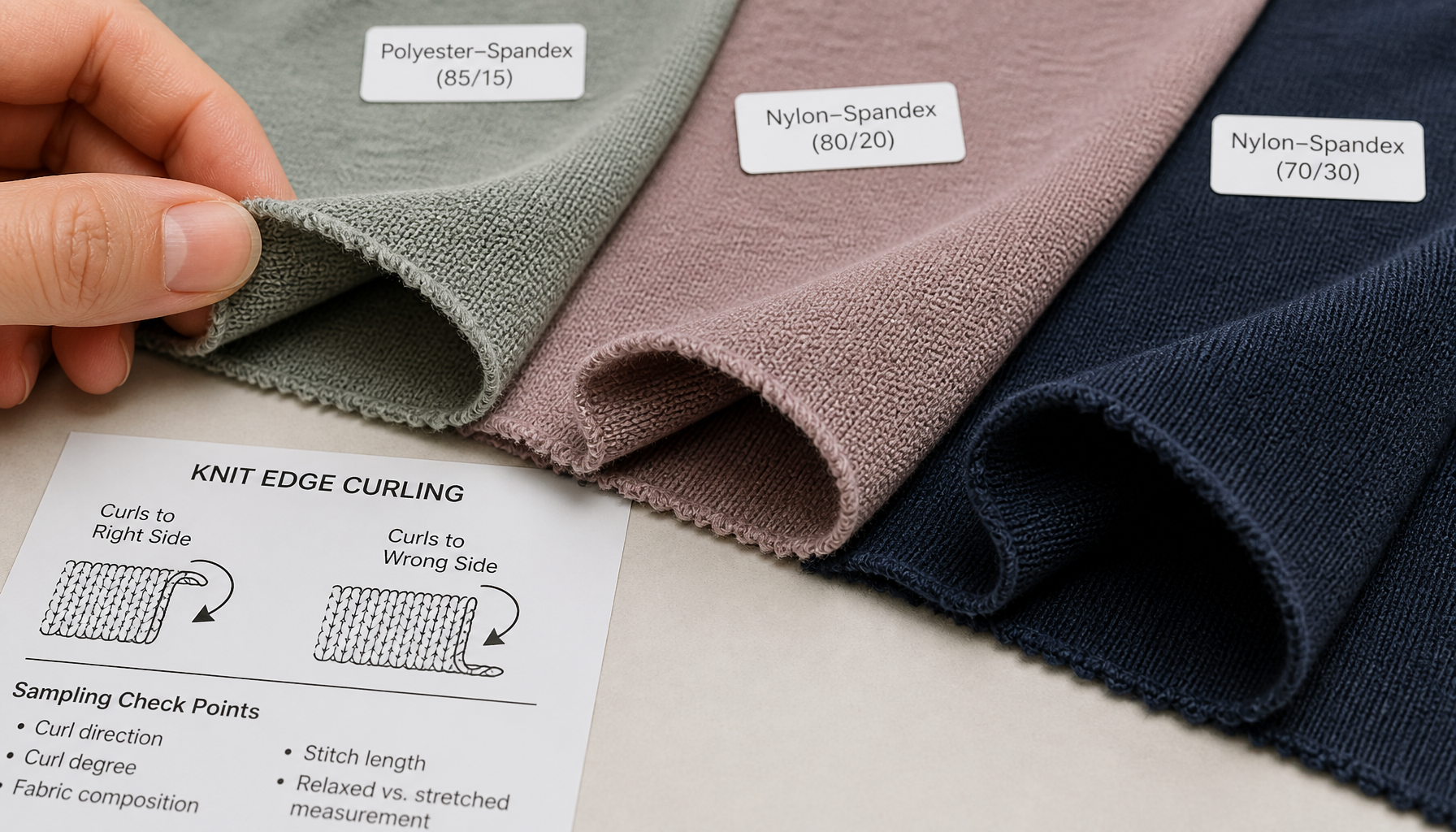
    Raw knit edges curl because cutting releases unbalanced loop stresses at the fabric boundary. Curl direction and severity depend mainly on knit structure, yarn and spandex arrangement, finishing, relaxation, cut direction, and panel geometry; fiber blend or GSM alone cannot predict the result.

    Raw knitted fabric edge showing curl after cutting

    What causes the edge to move

    Knitted loops are held in balance inside the fabric. At a cut edge, that balance is interrupted and stored tension can pull the edge toward one face or along one direction. Single-knit structures often behave differently from double knits, ribs, or bonded constructions, but actual curl must be checked on the finished fabric.

    Dyeing, heat setting, brushing, compacting, and relaxation can change residual stress. A sample cut immediately after unrolling may behave differently after conditioning, so record relaxation time before comparing candidates.

    Test both directions and the real panel shape

    Cut straight strips in both fabric directions, then cut the curves, notches, and narrow sections used in the garment. A straight edge may remain manageable while an armhole, leg opening, or bonded curve rolls enough to affect alignment.

    Observe the edge relaxed and at the extension expected during sewing and wear. Record curl direction, rolled width, consistency along the edge, and change after the intended wash cycle. The aim is not to eliminate every visible movement; it is to decide whether production can control it without unacceptable cost or defects.

    Cut knit panel reference for edge-stability sampling

    Connect curl to the intended construction

    For a conventional sewn seam, moderate curl may be manageable with spreading control, temporary stabilization, adjusted handling, or seam allowance. For bonded, laser-cut, or exposed raw-edge designs, the tolerance is usually tighter because the edge remains visible or must align precisely.

    Do not label a fabric “free cut” from one hand sample. Test the selected cutting method, edge direction, bonding or stitching process, garment extension, and laundering. Edge stability is a system result involving fabric and process.

    Check the production consequences

    Curl can affect:

    • marker accuracy and ply alignment;
    • cutting speed and panel dimensions;
    • seam allowance consistency;
    • bonding width and adhesive contact;
    • operator handling time;
    • finished opening shape and symmetry.

    A lower fabric price may be offset by slower cutting, extra stabilization, or panel rejection. Include these effects when comparing candidates.

    Sampling record

    Document composition, construction, finished GSM and width, finish, color, relaxation time, cut direction, panel geometry, cutting method, and care cycle. Photograph or measure the edge under a repeatable setup so buyer and supplier are discussing the same condition.

    Procurement next step

    Send the supplier the garment panel drawings, seam or raw-edge method, expected extension, cutting process, care cycle, and acceptable edge condition. Request enough identified finished fabric for directional cuts, curved panels, sewing or bonding, and washing. Approve the material only after the production trial shows that curl can be controlled within the intended garment process.

  • Why Yoga Leggings Become See-Through During Squats

    Why Yoga Leggings Become See-Through During Squats


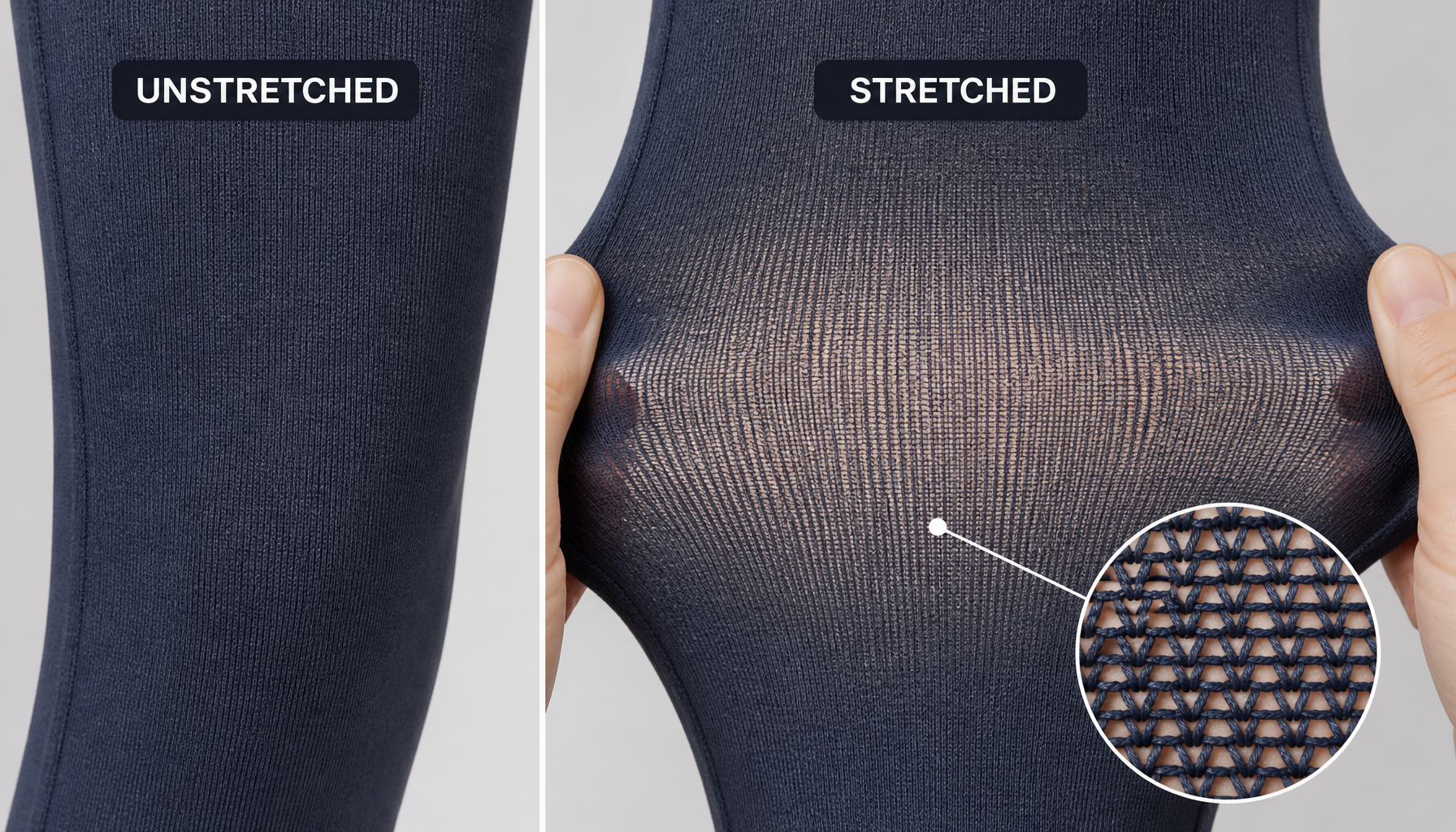
    Yoga leggings become see-through during a squat when extension opens the knitted structure enough to increase light transmission through the seat and thigh. The result depends on yarn coverage, loop density, thickness, color, stretch level, and garment fit—not simply fiber composition or GSM.

    What changes when the fabric stretches

    As a knitted fabric extends, loops change shape and the distance between yarns can increase. The same material that appears opaque while relaxed may reveal the background at the extension created by a deep squat.

    Pattern reduction matters because a smaller garment stretches the fabric further on the body. Size grading, seam placement, and body measurements can therefore change coverage even when every garment uses the same fabric lot.

    Stretch knitted fabric structure reference for squat coverage

    Why GSM is not a squat-proof rating

    GSM measures mass per square metre. It does not specify thickness, yarn diameter, loop density, stretch force, or the amount of extension in the garment. A higher-GSM fabric may provide greater coverage, but it can still become transparent if its structure opens substantially or the garment is undersized.

    Compare fabrics at the same controlled extension rather than ranking them by GSM alone. Record the finished GSM and thickness because dyeing, finishing, and relaxation can alter both.

    Color and lighting change the result

    Pale colors, bright colors, and dark colors can transmit or reflect light differently. A coverage result from black fabric should not be applied automatically to white, pastel, or neon shades. Dye depth and finishing can also affect surface appearance under stretch.

    Use consistent front and back lighting with a defined contrasting background. Avoid an uncontrolled hand test near a window, which is difficult to reproduce between suppliers or colorways.

    Yoga-legging movement reference for extended coverage assessment

    Build a repeatable sample check

    1. Condition the sample and record its color, construction, GSM, thickness, and direction.
    2. Define the extension that represents the critical garment zone.
    3. Mount each candidate at the same extension over the same contrasting background.
    4. Inspect under fixed lighting and viewing distance.
    5. Repeat after the intended wash cycle.
    6. Confirm the result in a fitted garment across relevant sizes and body zones.

    The fabric screen and garment squat test answer related but different questions. The fabric screen compares materials; the garment test captures pattern reduction, seams, size, and wearer movement.

    Common sourcing errors

    • Approving only a relaxed swatch. The failure occurs under extension.
    • Using one color for the range. Shade can change apparent coverage.
    • Specifying only spandex percentage. Blend ratio does not define loop opening or garment force.
    • Using GSM as the pass limit. Weight does not describe the full optical structure.
    • Ignoring washing. Dimensional change and finish loss can alter fit and coverage.

    Procurement next step

    Send the supplier the legging pattern intent, critical extension, color range, target construction, GSM and width, care cycle, and coverage-assessment setup. Request identified swatches in representative colors and enough material for fitted, washed garment samples. Approve the requirement in measurable terms rather than using “squat-proof” without defined conditions.

  • What Should Buyers Confirm About the Sample-Yardage Plan Before Requesting a Fabric Quote?

    What Should Buyers Confirm About the Sample-Yardage Plan Before Requesting a Fabric Quote?


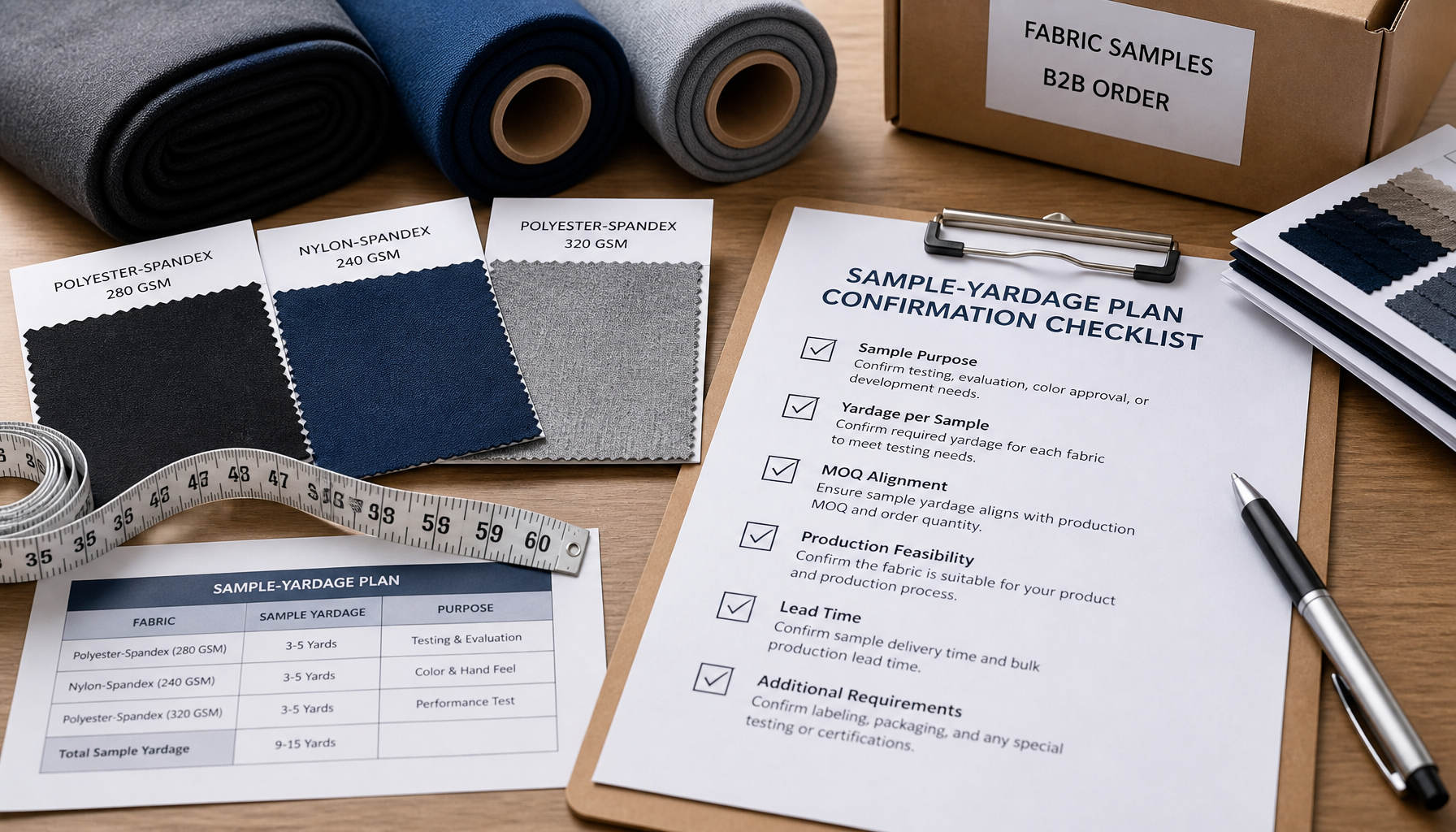
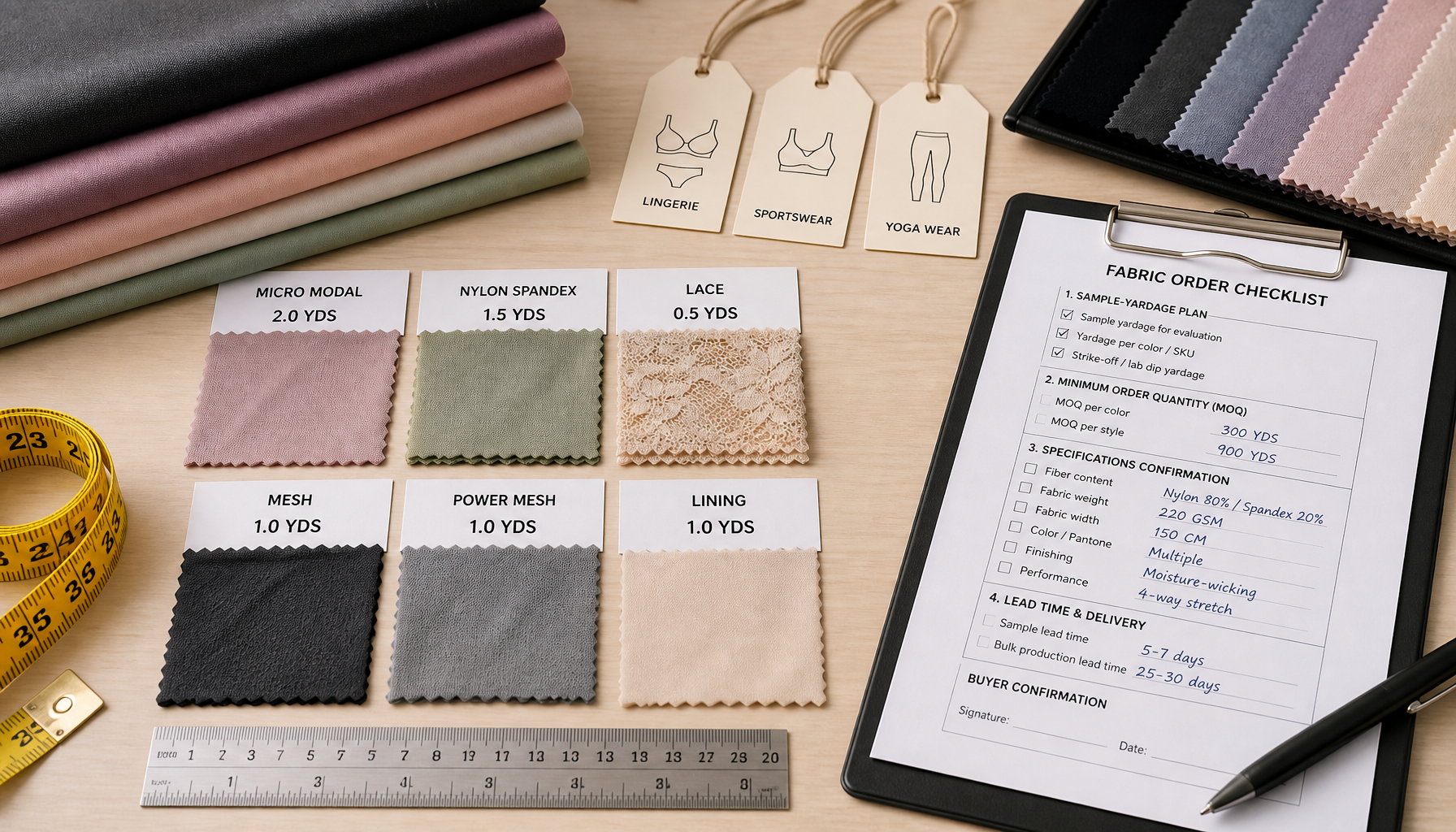
    Before requesting a fabric quote, buyers should define what the sample yardage must prove, how much material each evaluation step requires, and whether the sample will come from existing stock or a new development run. The quote should separate sample costs from bulk terms and identify the fabric specification, color, finish, testing allocation, lead time, freight, and approval status.

    Fabric sample yardage prepared for buyer evaluation

    Identify the sample type and decision

    “Sample” can refer to several different materials. Each answers a different question:

    Sample type Main purpose What it does not automatically prove
    Swatch or hanger Screen color, hand, surface, and broad construction suitability Garment yield, complete testing, or bulk consistency
    Existing sample yardage Produce prototypes and conduct limited evaluation from available material Exact custom color, finish, or future bulk lot
    Development yardage Evaluate a requested construction, finish, or color at a limited scale Full-scale production repeatability unless specifically validated
    Lab dip Approve a solid-color direction under agreed viewing conditions Finished hand, GSM, width, or complete performance
    Print strike-off Approve print color, scale, repeat, registration, and appearance All physical properties or bulk print consistency
    Pre-production or bulk-lot sample Confirm defined characteristics from a production-representative lot Automatic acceptance of the remaining shipment without an agreed plan

    The quote should name the sample type. A stock sample that is useful for pattern development should not be described as an exact bulk-production reference unless its construction, color, and finish are traceable and confirmed.

    Sample yardage being allocated for garment development and testing

    Calculate yardage from the evaluation plan

    Start with the garments, tests, retained references, and contingency required. Ask the garment factory for marker consumption at the confirmed usable width rather than estimating solely from garment category.

    A sample-yardage plan may include:

    • fit samples in required sizes;
    • color, print, finish, or construction variants;
    • duplicate garments for wash or wear evaluation;
    • laboratory specimens and conditioning allowance;
    • seam, bonding, raw-edge, or component trials;
    • buyer, supplier, and factory retained references;
    • cutting loss, end allowance, and replacement contingency.

    Illustrative calculation

    The following is a hypothetical planning example, not a ClothFactory requirement. Assume a buyer needs two garments in each of three sizes, the sample marker uses 0.85 m per garment, and a 20% cutting and contingency allowance is applied:

    2 garments × 3 sizes × 0.85 m = 5.10 m

    5.10 m × 1.20 = 6.12 m

    Round-up rules and extra material for laboratory testing, retained references, or failed cutting attempts should be added separately. A percentage allowance is not a substitute for an actual sample marker.

    Provide a quotable fabric specification

    The supplier cannot price sample yardage accurately from an application name such as “yoga fabric” or “underwear fabric.” Provide the known requirements and label unknown items as open for recommendation.

    Include:

    • intended garment and exact fabric location;
    • nylon-spandex, polyester-spandex, or permitted composition alternatives;
    • knit construction or approved reference sample;
    • target finished GSM and tolerance;
    • minimum usable width and measurement condition;
    • stretch direction, expected garment extension, recovery, or force requirement;
    • hand-feel reference and fabric face;
    • color reference, number of colors, and viewing conditions;
    • required finish and whether it is optional or mandatory;
    • planned care cycle and required tests;
    • expected sample quantity and potential bulk quantity stated separately.

    Do not describe optional moisture-management, cooling, antibacterial, brushing, or other finishing as a default fabric property. Each requested treatment can affect price, sample lead time, hand, color, and minimum production requirements.

    Confirm whether the sample represents bulk production

    Ask the supplier to state the sample's source:

    • existing stock and lot identity;
    • an earlier production lot;
    • laboratory or pilot development;
    • newly produced sample yardage;
    • first production lot.

    Record which characteristics are expected to match bulk and which may change. Small-scale dyeing, printing, heat setting, brushing, coating, or bonding trials may not reproduce full-scale results exactly. The approval workflow should therefore identify whether a later pre-production or bulk-lot confirmation is required.

    The sample should carry a fabric code, composition, construction, finished GSM, usable width, color or lot reference, finish, and issue date. Without this traceability, an approved garment sample may not provide a reliable bulk reference.

    Allocate material before cutting begins

    Divide the sample yardage in writing so garment sampling does not consume material reserved for testing. A practical allocation record can identify:

    Allocation Information to record
    Garment development Sizes, quantities, marker width, and factory destination
    Laboratory testing Test list, specimen condition, and laboratory destination
    Wash or wear evaluation Garment or fabric quantity and care cycle
    Process trials Bonding, printing, seam, edge, elastic, or other trial quantity
    Retained reference Buyer, supplier, and garment-factory retention quantity
    Contingency Reason for reserve and who may authorize its use

    If the available quantity is limited, prioritize the decisions that must be made before bulk commitment. Do not cut every available meter into garments and then discover that no identified material remains for verification or comparison.

    Separate every quoted cost and condition

    The sample quotation should state:

    • sample-yardage unit price and quantity basis;
    • development, dyeing, printing, finishing, or setup charges;
    • testing, inspection, courier, tax, and freight responsibility;
    • sample lead time and the event that starts it;
    • stock reservation period, if any;
    • payment terms and cancellation conditions;
    • whether any charge is refundable or creditable to bulk production;
    • applicable bulk MOQ and whether it is per color, construction, finish, or order;
    • expected bulk pricing basis and validity period, if offered;
    • whether sample and bulk may differ in shade, width, GSM, hand, or finish.

    Sample pricing is not necessarily a scaled version of bulk pricing. Limited quantities may use stock fabric, special handling, separate dyeing, or development work that changes the cost basis.

    Define the approval path before ordering samples

    Use a written sequence such as:

    1. Buyer confirms the application brief and open technical questions.
    2. Supplier identifies suitable existing material or defines a development route.
    3. Both parties confirm sample type, quantity, cost, source, and lead time.
    4. Supplier issues traceable sample yardage and a specification sheet.
    5. Buyer allocates material to garments, tests, process trials, and retained references.
    6. Buyer records approval, conditional approval, or rejection against the identified sample.
    7. Supplier confirms what must be re-approved on pre-production or bulk material.
    8. Bulk production begins only after the agreed written authorization and payment event.

    Avoid common sample-yardage mistakes

    • Requesting an arbitrary number of meters. Calculate from marker consumption, tests, variants, and retained references.
    • Assuming stock yardage equals future bulk. Confirm construction, lot, color, and finish traceability.
    • Using sample yardage for every decision. Lab dips, strike-offs, performance tests, and garment prototypes serve different purposes.
    • Leaving usable width open. Marker consumption becomes unreliable when the quoted width differs from the cutting width.
    • Testing after all fabric has been cut. Reserve identified material before sample-room use.
    • Treating sample price as bulk price. Ask for separate commercial bases and validity.
    • Approving an unrecorded finish. Optional treatments must appear in the sample specification and bulk order.

    Procurement next step

    Prepare a sample-yardage worksheet listing garment quantities, marker consumption, tests, process trials, retained references, contingency, and delivery destinations. Send it with the target composition, construction, GSM, usable width, stretch requirements, color, finish, and care cycle. ClothFactory can then identify whether an existing nylon-spandex or polyester-spandex sample is suitable or whether a development step is required, while keeping sample-yardage terms separate from the eventual bulk commitment.

  • What Risks Should Buyers Review When Assessing the Minimum Order Quantity Policy?

    What Risks Should Buyers Review When Assessing the Minimum Order Quantity Policy?


    Before accepting a fabric MOQ, buyers should verify what the minimum applies to, how much usable garment output it creates, and which costs remain at risk if demand changes or the fabric fails approval. The policy should identify the unit, construction, color, finish, tolerance, delivery arrangement, and payment commitment rather than state only one minimum number.

    Fabric rolls representing a minimum-order commitment

    Confirm what the MOQ actually covers

    An MOQ may apply per fabric construction, color, finish, print design, dye lot, production run, or purchase order. It may be quoted in kilograms, linear meters, yards, rolls, or another unit. These bases are not interchangeable.

    Before comparing suppliers, ask:

    • Is the MOQ per color or for the complete order?
    • Does it apply to greige material, finished fabric, or shipped quantity?
    • Are width, GSM, composition, or finish changes treated as separate constructions?
    • Is the quantity measured by ordered, produced, inspected, or usable material?
    • What overproduction or under-delivery tolerance is permitted?
    • Are sampling, lab dips, strike-offs, setup charges, and freight separate?
    • Does a repeat order use the same minimum, or must it be reconfirmed?

    A low headline MOQ may still create a large commitment when it applies separately to every color or specification.

    Convert kilograms and meters using the real specification

    Buyers should not rely on a fixed conversion between kilograms and linear meters. The relationship depends on finished GSM and usable width:

    Approximate kg = linear meters × usable width (m) × finished GSM ÷ 1,000

    Illustrative calculation — not a ClothFactory MOQ or production result: assume 600 m of finished fabric, 1.5 m usable width, and 200 gsm:

    600 m × 1.5 m × 200 g/m² ÷ 1,000 = 180 kg

    If width or GSM changes, the kilogram requirement changes even when the linear meters remain the same. Confirm whether commercial settlement uses actual delivered weight, invoiced meters, or another agreed basis.

    Calculate usable garment output, not only ordered quantity

    MOQ risk depends on how many saleable garments the fabric can produce. Include marker consumption, size mix, cutting loss, inspection defects, shade segregation, testing allowance, and replacement material.

    Hypothetical planning example: if an order contains 600 usable meters, theoretical consumption is 0.80 m per garment, and the buyer assumes a 92% usable yield:

    600 m ÷ 0.80 m × 92% = 690 garments

    This is a planning example, not a universal yield or ClothFactory output. The actual result must use the approved marker, usable width, defect map, size ratio, and production allowance.
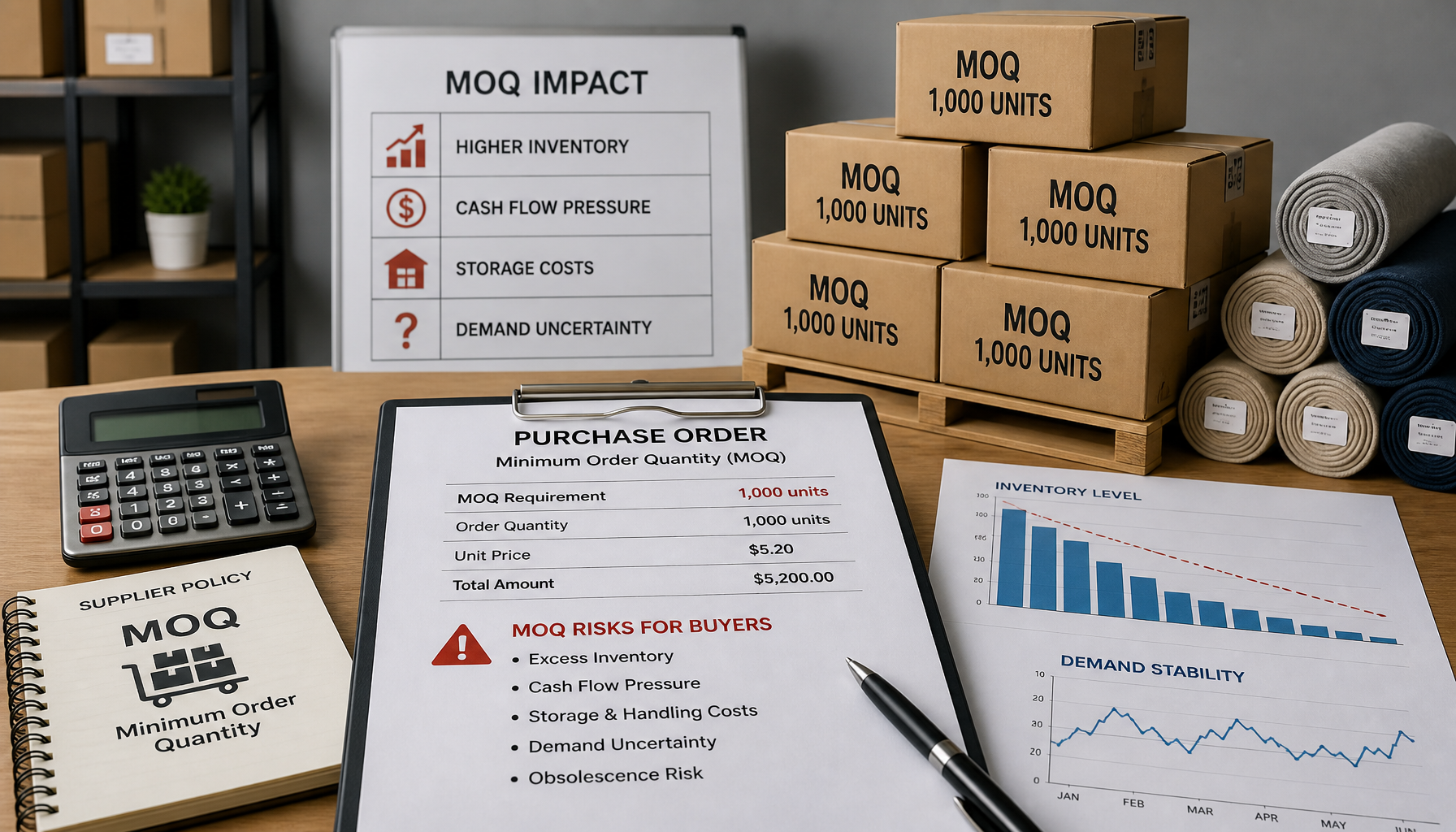
    Fabric inventory being evaluated against planned garment demand

    Review the main commercial risks

    Risk What can go wrong What buyers should confirm
    Demand risk Forecast demand is lower than the garment output created by the MOQ Launch quantity, replenishment plan, season length, and exit route for unused fabric
    Cash-flow risk Deposit and balance payments are committed before garment sales Payment schedule, approval gates, cancellation terms, and working-capital impact
    Color fragmentation Each color carries a separate MOQ, multiplying inventory MOQ basis per color, permitted color grouping, and whether repeat shades can be reordered
    Specification fragmentation Small changes in GSM, width, composition, finish, or print create separate minimums Which changes require a new production run or setup charge
    Approval risk Material is produced before color, hand, print, or performance is approved Lab-dip, strike-off, development-sample, testing, and written bulk-release sequence
    Yield risk Ordered meters do not equal usable garment output Usable width, roll length, defect allowance, shade grouping, and over/under-delivery tolerance
    Obsolescence risk Custom color or finish cannot be redirected to another style or season Compatibility with future styles, storage conditions, and ownership of unused material
    Supply risk A low MOQ is accepted, but repeat availability is uncertain Repeat-order policy, raw-material continuity, lead-time confirmation, and lot-to-lot controls

    Separate sampling quantity from bulk MOQ

    Sample yardage, lab dips, print strike-offs, and development lots serve approval decisions; they should not be assumed to follow the same quantity or pricing as bulk production. Confirm which samples are available, what each sample proves, and whether sample or setup charges are credited to the bulk order.

    Do not approve a bulk MOQ merely because a small swatch looks acceptable. The approval plan may need to cover color, hand, finished GSM, width, stretch and recovery, dimensional stability, colorfastness, surface durability, and any claimed functional finish.

    Link payment to approval and production events

    The quotation or purchase agreement should state:

    1. what payment reserves or purchases;
    2. whether raw materials are committed before lab-dip or sample approval;
    3. which approval authorizes dyeing, finishing, printing, or bulk production;
    4. whether setup and development charges are refundable or creditable;
    5. what happens after buyer-requested specification changes;
    6. how rejected material, short delivery, excess production, or delayed approval is handled;
    7. when ownership and storage responsibility transfer to the buyer.

    An MOQ does not by itself guarantee refund rights, production priority, repeat availability, or acceptance of unused material. Those outcomes require written commercial terms.

    Check whether customization increases commitment

    Custom dyeing, printing, brushing, moisture-management finishing, or other treatments can reduce the supplier's ability to redirect unused material. The buyer should confirm whether each treatment creates its own MOQ, setup charge, color minimum, or lead-time condition.

    Optional finishing should not be treated as a standard property of every fabric. Approve the finished sample and define the performance requirement before allowing the customization to proceed across the MOQ.

    Compare total qualified cost instead of unit price

    The lowest fabric price per kilogram or meter may not produce the lowest qualified garment cost. Compare:

    • material price and setup charges;
    • testing, sampling, courier, and inspection costs;
    • marker consumption and usable-width efficiency;
    • expected cutting loss and defect allowance;
    • financing and storage cost;
    • risk of markdown, redesign, or unused stock;
    • cost of replacement if a lot fails the agreed specification.

    This comparison helps explain why accepting a higher unit price at a more suitable commitment can be commercially safer than purchasing excess material at a lower price.

    Questions to resolve before accepting the MOQ

    • What exact fabric code, construction, color, finish, width, and GSM does the MOQ cover?
    • What quantity unit appears on the purchase order and invoice?
    • What production tolerance may be shipped and billed?
    • How are unusable defects, shade groups, and short rolls treated?
    • Which approvals must be completed before production starts?
    • Can delivery be split, and who owns undelivered material?
    • Are repeat orders subject to new raw-material or color confirmation?
    • Which changes trigger a new MOQ or setup cost?
    • What records will connect the bulk rolls to the approved sample?

    Procurement next step

    Convert the quoted MOQ into kilograms, usable meters, estimated garment output, color-level inventory, and committed cash before approving it. Send the supplier a written specification and approval schedule, then record the quantity basis, tolerance, payment events, and treatment of excess or rejected material in the purchase agreement. ClothFactory can confirm the applicable MOQ for a selected nylon-spandex or polyester-spandex construction only after the color, finish, width, GSM, and development scope are defined.

  • How Should Apparel Brands Compare Sample-Yardage Plans Across Fabric Suppliers?

    How Should Apparel Brands Compare Sample-Yardage Plans Across Fabric Suppliers?

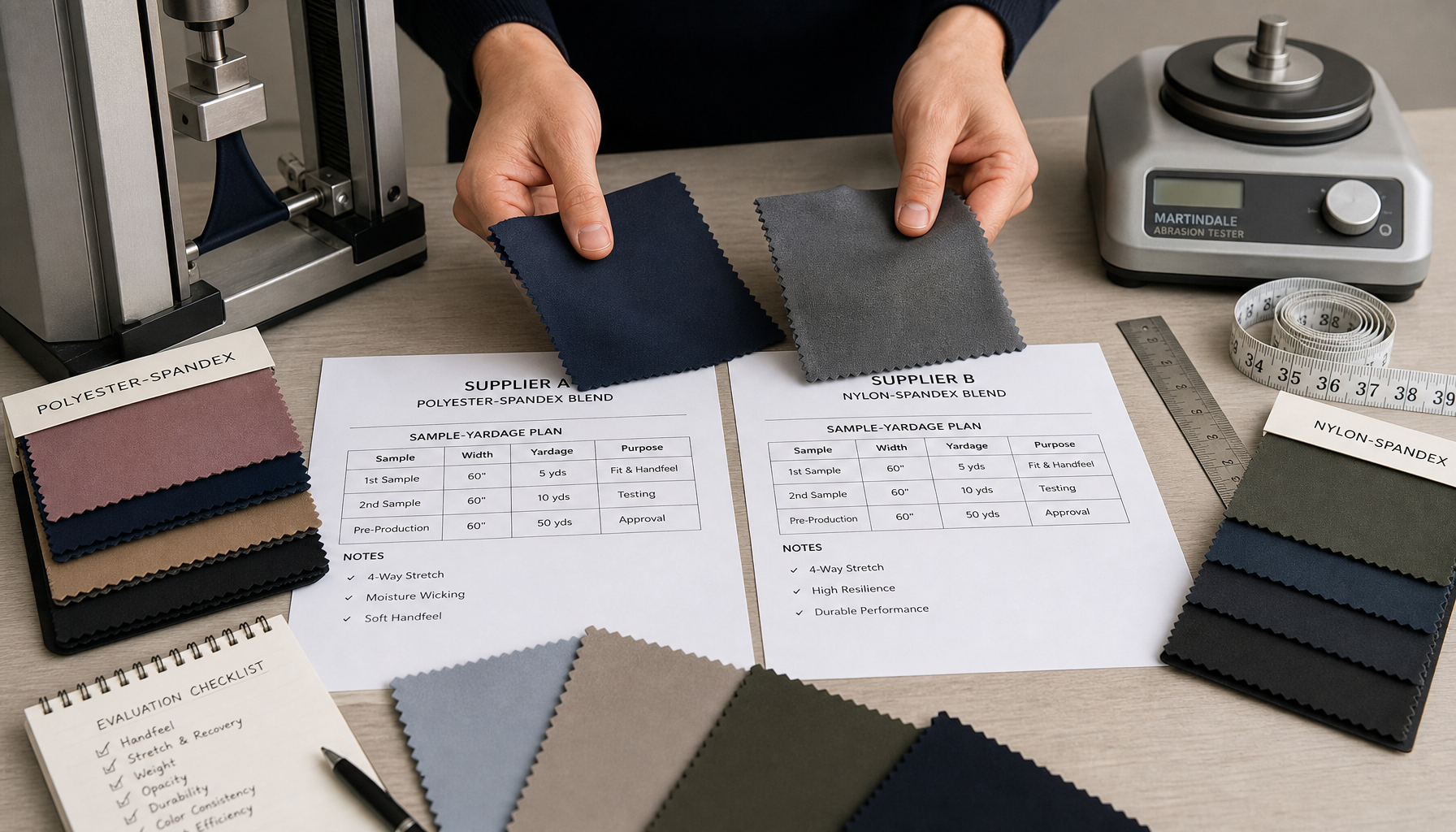
    Compare sample-yardage plans by the decisions they allow you to make, not by the number of free metres offered. A stock cutting, a development length and a production-representative sample may look similar but support different approvals. The useful plan provides enough correctly identified material for the required tests and garments without presenting unresolved assumptions as bulk approval.

    What is each sample intended to approve?

    Ask the supplier to state whether the material is for initial hand-feel selection, pattern development, colour approval, performance evaluation or production confirmation. A stock fabric can help establish a silhouette while differing from the proposed bulk colour or finish. That does not make it useless; it limits what the buyer can approve from it.

    Record known differences in yarn, construction, dyeing and finishing. A sample described only as “similar quality” cannot support a precise technical sign-off. Ask which differences will disappear in the next sample and which remain part of the commercial proposal.

    How much sample yardage is actually needed?

    Build the request from the sampling plan. Include the number of garments and sizes, laboratory specimen requirements, retained references and any second-round sewing trials. Confirm laboratory cutting instructions before allocating fabric; different methods and repeat counts need different quantities.

    In a hypothetical plan, six garments at 0.90 m each require 5.40 m. Adding an agreed 2.00 m for laboratory work and 1.00 m for retention gives 8.40 m before a separate contingency. The 2.00 m allowance is illustrative, not a universal laboratory requirement. Use consumption from a marker at the sample’s actual usable width.

    Confirm units. Ten yards equals 9.144 m, not 10 m. That 0.856 m difference could remove almost one garment from the illustrative plan. Specify whether the requested quantity must be one continuous full-width length or can include separate pieces.

    Is the sample representative of the proposed bulk order?

    Request the article revision, sample lot, colour, finish, measured weight and usable width. Ask whether the material was produced through the proposed bulk route or prepared using a different development process. A supplier should identify any remaining scale-up or process differences so the buyer can plan confirmation testing.

    For stretch activewear, a change in finish can alter hand feel and measured dimensions even when the commercial article name remains unchanged. Keep the approved cutting and a record of its preparation and care history. Do not approve production against memory of a sample viewed weeks earlier.

    How should we compare two different offers?

    Suppose Supplier A offers 12 m of stock fabric in a substitute finish, while Supplier B offers 9 m using the proposed production construction and finish. These are hypothetical offers. Against the 8.40 m plan, B appears sufficient before contingency only if width, continuity and specimen needs match the plan. A supplies more length but may leave performance and finish approval unresolved.

    Choose according to the development stage. A may be useful for an early pattern trial if the differences are acceptable and documented. B may reduce the need for a later material-confirmation round, but it still does not prove consistency of an unseen bulk lot. Compare the total number of remaining decisions, not just metres supplied.

    Which costs and timing terms should be written down?

    Separate fabric charges, development fees, colour charges, cutting fees, shipping and laboratory work. Confirm whether any fee is credited against an order, the conditions for that credit and whether a changed specification triggers another charge. “Free samples” can still create courier costs and repeat-development expense.

    Ask when the lead-time clock starts: brief acceptance, payment, yarn availability or colour approval. Distinguish material-ready dates from dispatch and receipt. Specify who approves substitutions; an unannounced substitute can arrive on time while failing to support the planned testing.

    How do we keep sample approvals traceable?

    Assign a sample identifier and keep it on the cutting, technical sheet, test request, garment and approval record. Record receipt date, usable dimensions, visible defects and deviations from the request before cutting. Reserve the retention piece so it is not consumed by an unexpected extra fitting.

    Use a change log to state what is approved, what is rejected and what remains open. If a fit sample passes but recovery testing fails, do not write a general “sample approved” message. State that pattern approval is conditional and material approval remains on hold pending the named correction and retest.

    What makes a sample plan ready to place?

    A workable plan identifies purpose, quantity, units, usable width, continuity, material revision, permitted differences, cost, timing and the next approval gate. It also assigns responsibility for test results and for replacing non-representative material.

    For a ClothFactory enquiry, send the garment brief and that sampling plan together. The aim is to purchase enough reliable information to decide whether to proceed, revise or stop. Extra yardage has little value if its identity and approval scope are unclear.

  • How Can Buyers Verify the Strike-Off Approval Process Before Paying a Fabric Deposit?

    How Can Buyers Verify the Strike-Off Approval Process Before Paying a Fabric Deposit?


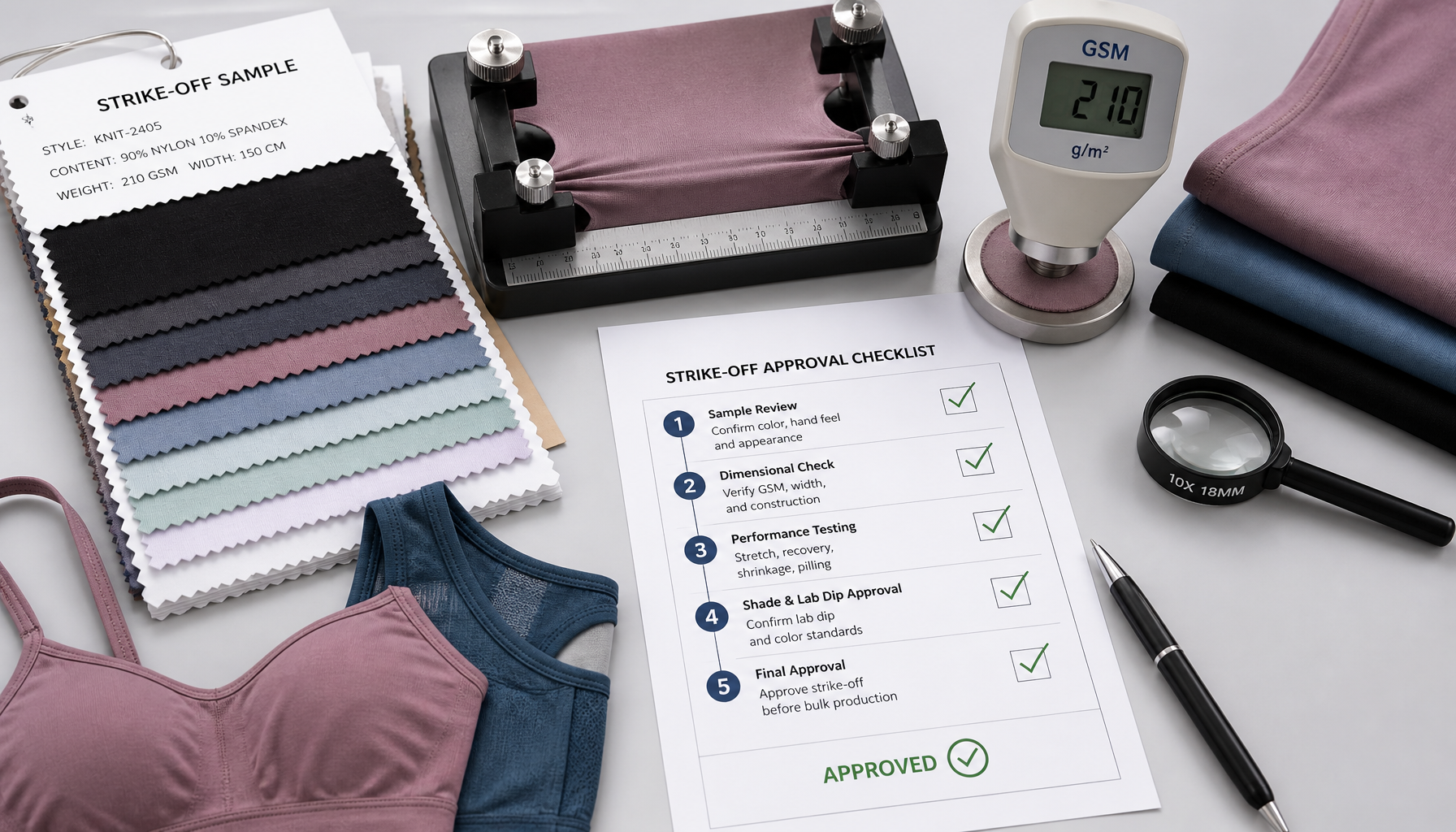
    Before paying a fabric deposit, buyers should obtain a written approval matrix that defines the sample type, reference standard, acceptance criteria, revision responsibility, approval authority, and the exact event that authorizes bulk production. For printed fabric, that sample may be a strike-off; for a solid dyed nylon-spandex or polyester-spandex fabric, the relevant color approval is usually a lab dip rather than a strike-off.

    Fabric sample presented for strike-off approval

    Confirm what the supplier means by “strike-off”

    Terminology must be resolved before discussing payment. A strike-off normally shows how a print artwork, color combination, scale, and placement reproduce on a specified fabric. It is not automatically a first article, a bulk-lot sample, or proof that the finished fabric meets every performance requirement.

    Use the correct approval item for the decision being made:

    Buyer requirement Appropriate approval item What it confirms
    Solid dyed color Lab dip or another agreed color submission Shade direction under the agreed viewing conditions
    Printed artwork Strike-off Print color, repeat, scale, registration, and visual reproduction on the submitted base fabric
    Hand feel or finish Finished development swatch or sample yardage Surface, drape, hand, and the proposed finish
    Fabric construction Identified development sample with a specification sheet Composition, knit structure, GSM, width, and stretch response of that sample
    Bulk conformity Pre-production or bulk-lot approval defined in the purchase agreement Whether production material matches the approved references and tolerances

    A buyer may need more than one approval item. Approving a print strike-off does not automatically approve GSM, usable width, stretch recovery, dimensional stability, colorfastness, or bulk shade consistency.

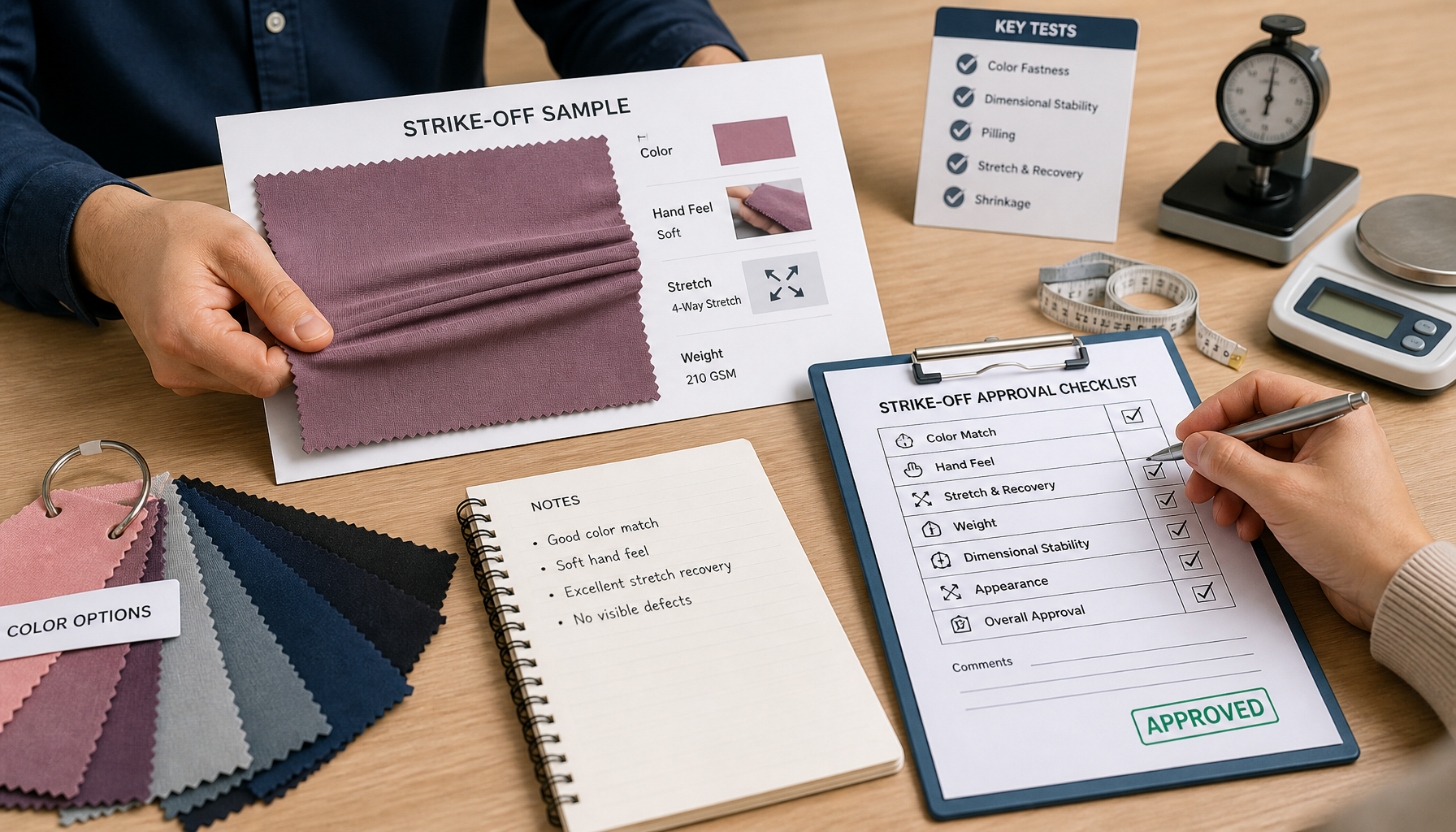
    Color and print strike-off samples under review

    Build a traceable approval package

    The supplier should identify every submission with information that links it to the order. At minimum, the approval package should record:

    • buyer style or project reference;
    • supplier fabric code and base-fabric specification;
    • artwork file name, version, repeat size, and orientation for printed designs;
    • color reference and viewing conditions;
    • submission number and date;
    • proposed finish and any optional treatment;
    • physical sample location or courier reference;
    • approver's name, decision, date, and written comments.

    Use one status for each submission: approved, approved with stated conditions, or rejected with correction instructions. Avoid comments such as “close,” “almost right,” or “proceed carefully,” because they do not define whether the supplier is authorized to continue.

    Define acceptance criteria before the sample is produced

    The approval criteria should match the type of submission. For a printed strike-off, buyers may need to confirm:

    • print colors against the named reference under an agreed light source;
    • artwork scale, repeat, direction, and placement;
    • registration between colors and sharpness of printed details;
    • strike-through, surface coverage, and appearance when the fabric is extended;
    • hand-feel change caused by ink, binder, curing, or another print process;
    • whether the submitted base fabric matches the intended construction.

    If instrumental color measurement is required, identify the instrument conditions, specimen preparation, color-difference formula, and tolerance in the agreement. There is no responsible universal ΔE limit for every fabric, shade, customer, and end use.

    For stretch activewear, inspect the print both relaxed and at the extension expected in the garment zone. A print that appears continuous on a table may show white grinning, cracking, distortion, or loss of detail when used across a seat, thigh, waistband, or sports-bra panel.

    Separate visual approval from fabric-performance approval

    A strike-off is usually too small to establish every bulk-performance result. Keep a separate checklist for the finished fabric specification, including the requirements relevant to the product:

    • composition, knit construction, finished GSM, and usable width;
    • stretch and recovery by direction under defined conditions;
    • dimensional stability and spirality after the agreed care cycle;
    • colorfastness, pilling, abrasion, or snagging requirements;
    • moisture-management or other functional claims, where applicable;
    • bulk shade, print, and lot-consistency controls.

    The contract should state which results are needed before bulk production, which can be checked on the first production lot, and what happens if the result falls outside the agreed tolerance.

    Link the deposit to written commercial terms

    Do not assume that a deposit is automatically refundable when a strike-off is rejected. Some suppliers require payment before development work begins; others charge a separate sampling fee or credit approved development costs against the order. The correct arrangement is the one recorded in the quotation, pro forma invoice, purchase order, or development agreement.

    Before payment, confirm in writing:

    1. what the deposit pays for;
    2. whether strike-off or lab-dip costs are included;
    3. how many submissions or correction rounds are included;
    4. who pays for additional revisions, courier charges, screens, cylinders, artwork preparation, or other setup costs;
    5. whether any amount is refundable, non-refundable, or credited to bulk production;
    6. what happens if the buyer rejects the submission or changes the brief;
    7. whether material purchasing or production capacity is reserved before final approval;
    8. which written approval authorizes bulk production.

    Illustrative approval-loop calculation

    Assume a hypothetical program has three print colorways and the agreement includes an initial strike-off plus one correction for each colorway. The planned submission capacity is:

    3 colorways × 2 submissions = 6 strike-off submissions

    This is a planning example, not a ClothFactory commercial term. It shows why the number of colorways and included revision rounds should be written into the quotation before the deposit is paid.

    Use a no-production-without-approval control

    The safest workflow separates sample approval from bulk authorization:

    1. Buyer issues the confirmed artwork, color references, base-fabric specification, and acceptance criteria.
    2. Supplier acknowledges the submission scope, charges, timing, and revision terms.
    3. Supplier produces an identified strike-off, lab dip, or development sample.
    4. Buyer records an approval decision against that exact submission.
    5. Supplier confirms any conditions and the final approved reference.
    6. Buyer issues written authorization for bulk production according to the payment agreement.
    7. Supplier retains the approved reference for bulk comparison and quality control.

    An email or approval form should state that silence, courier receipt, or payment alone does not constitute visual approval unless the commercial agreement explicitly says otherwise.

    Red flags before paying a deposit

    • The supplier cannot explain whether the approval item is a strike-off, lab dip, sample yardage, or bulk-lot sample.
    • The quotation does not identify the base fabric, colorways, revision rounds, or setup charges.
    • The supplier asks for “approval” without a submission code or physical reference.
    • Print scale, repeat, stretch condition, and viewing light are left undefined.
    • The deposit terms do not state whether development charges are refundable or creditable.
    • Bulk production can begin without named written authorization.
    • The supplier treats strike-off approval as proof of all fabric-performance requirements.

    Procurement next step

    Before paying, send the supplier a one-page approval matrix covering the sample type, base-fabric code, artwork version, color references, acceptance criteria, revision rounds, charges, decision authority, and bulk-release point. For a ClothFactory development request, also identify whether the project uses an existing nylon-spandex or polyester-spandex base fabric or requires a new construction; the strike-off should be evaluated on the same confirmed base fabric intended for production.

  • Who We Are and Why Apparel Brands Choose ClothFactory as Their Fabric Sourcing Partner

    Who We Are and Why Apparel Brands Choose ClothFactory as Their Fabric Sourcing Partner

    ClothFactory is a specialized fabric manufacturer focused on knitted synthetic stretch fabrics. We have expertise in Nylon Spandex and Polyester Spandex materials. We serve a wide range of B2B customers—including apparel brands, activewear labels, lingerie companies, garment manufacturers, wholesalers, distributors, and emerging fashion businesses. We offer direct-from-factory sourcing and product development support. As a wholesale fabric supplier, we help align fabric selection with garment needs and production plans.

    Our products fall into two main categories: Nylon Spandex fabrics, known for their softness and stretch, and Polyester Spandex fabrics, valued for their versatility in activewear, sportswear, leggings, and other apparel. Working with our fabric mill team, customers can specify fiber composition, weight (GSM), width, stretch and recovery, hand feel, appearance, color, and performance. The final properties depend on the chosen construction and finishing process.

    Editorial illustration of knitted nylon-spandex and polyester-spandex fabrics for apparel sourcing

    ClothFactory also acts as an OEM/ODM fabric vendor during product development. We help identify suitable fabric options and develop materials to meet detailed specifications. Our services include color matching from a library of over 400 shades and custom dyeing confirmed through lab dips and fabric samples. Sampling allows customers to evaluate the material before bulk production begins.

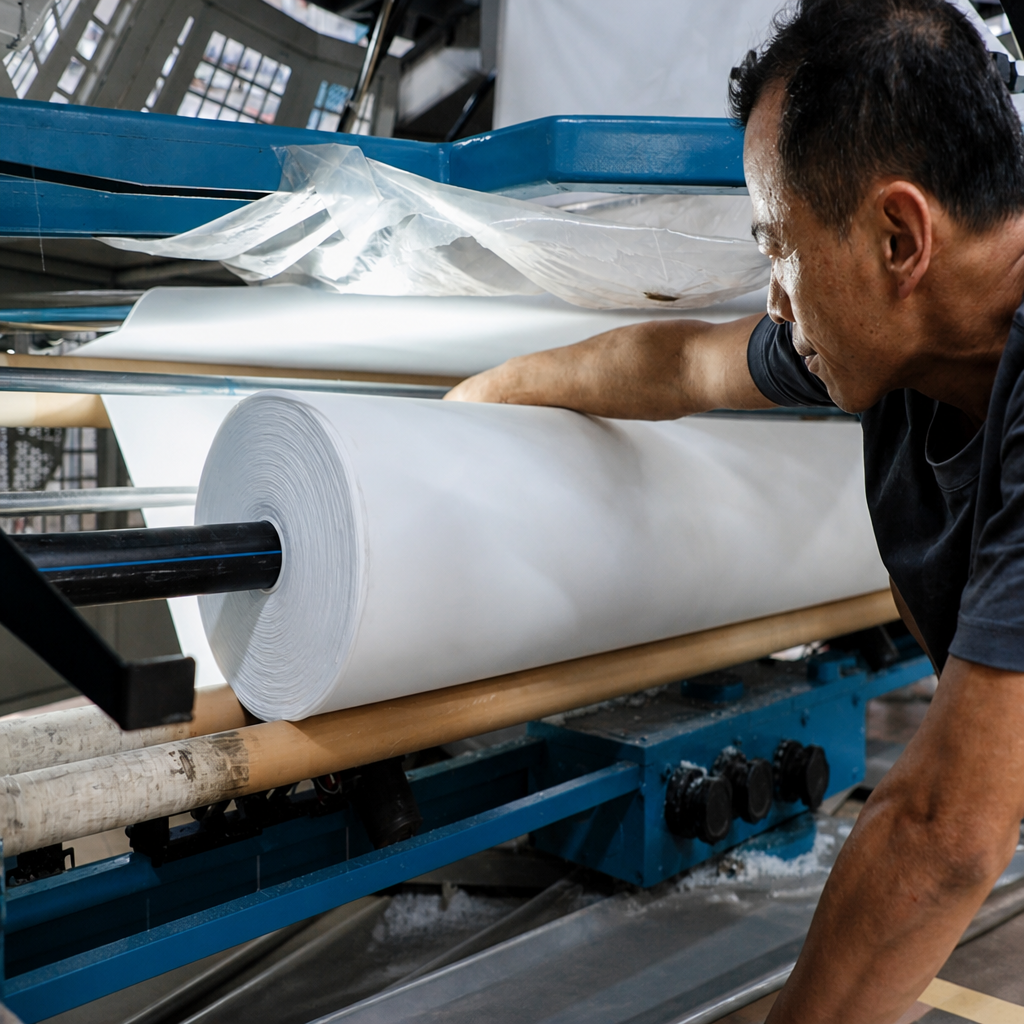
    Experienced workers are checking the fabric.

    Our development workflow covers initial fabric needs, selection, sampling, color approval, bulk production, quality control, and export delivery. This approach simplifies coordination among suppliers and keeps specifications and communication connected throughout the order. For buyers looking for a Tier 1 fabric supplier, we can discuss manufacturing scope, quality requirements, and delivery responsibilities from the start.

    ClothFactory’s expertise in knitted synthetic stretch fabrics and functional textiles, along with practical sourcing advice, supports apparel brands in need of specialized fabric solutions. Whether you are an established label or a new activewear startup, our team can help translate your product needs into fabric specifications, sampling decisions, and a clear production plan.