分类: FAQ

  • What Should Buyers Confirm About the Packing And Shipping Terms Before Requesting a Fabric Quote?

    What Should Buyers Confirm About the Packing And Shipping Terms Before Requesting a Fabric Quote?

    Before requesting a fabric quote, specify roll format, packing protection, net billing quantity, destination, transport assumptions, and delivery scope. Ask suppliers to separate fabric-ready dates from arrival estimates and identify every packing or transport charge excluded from the price.

    Describe what the receiving factory can handle

    A garment factory with limited lifting capacity may not accept the same roll weight as a mechanized warehouse. State maximum roll dimensions and weight, core requirements, whether fabric must remain open width, and how joins or short pieces are handled. For stretch knits, request a winding arrangement that avoids visible distortion and verify relaxation needs with the cutting team.

    What Should Buyers Confirm About the Packing And Shipping Terms Before Requesting a Fabric Quote?

    Separate paid fabric from shipment weight

    Illustrative calculation: 20 rolls containing 25 kg net fabric each equal 500 kg of fabric. If cores and wrapping add 1.2 kg per roll, gross shipment weight is 524 kg before any pallet. At a fabric price of USD 8/kg, confusing gross with net would add USD 192 to the fabric charge. These are hypothetical figures; confirm the actual tare and billing convention.

    Freight quotations can also depend on package dimensions and the carrier’s charging basis. Request gross weight and dimensions alongside net fabric weight so the forwarder can quote against the intended packing rather than a guessed shipment size.

    Put the delivery scope in writing

    Item Information required in the quote
    Delivery basis Agreed trade term, applicable version and precise named place
    Included charges Packing, collection, transport and handling included in the offer
    Excluded charges Costs the buyer must obtain or budget separately
    Schedule Production completion, inspection release, dispatch and estimated arrival
    Insurance Whether coverage is included and its documented scope
    What Should Buyers Confirm About the Packing And Shipping Terms Before Requesting a Fabric Quote?

    Preserve identity through receiving

    Require each roll label to show the fabric reference, color, dye lot, roll number, net quantity, and any agreed defect or join markings. The packing list should reconcile these identifiers. Mixing unmarked lots can create shade problems at cutting even when individual rolls were acceptable at dispatch. Confirm whether shade groups need separate packing and spreading instructions.

    Plan protection and the receiving check

    Agree on wrapping, end protection, handling and moisture precautions appropriate to the route. Record package condition at dispatch and receipt. Set a receiving procedure for damaged wrapping, wet material, missing rolls, or quantity discrepancies, including who is notified and what records are retained before material enters production.

    Send the RFQ with destination and receiving constraints, then obtain a proposed packing list and package dimensions before booking transport. Keep sample-courier charges separate from bulk freight, since sample delivery experience does not establish the cost or timing of the production shipment.
  • How Can Buyers Verify the First Bulk-Lot Approval Process Before Paying a Fabric Deposit?

    How Can Buyers Verify the First Bulk-Lot Approval Process Before Paying a Fabric Deposit?

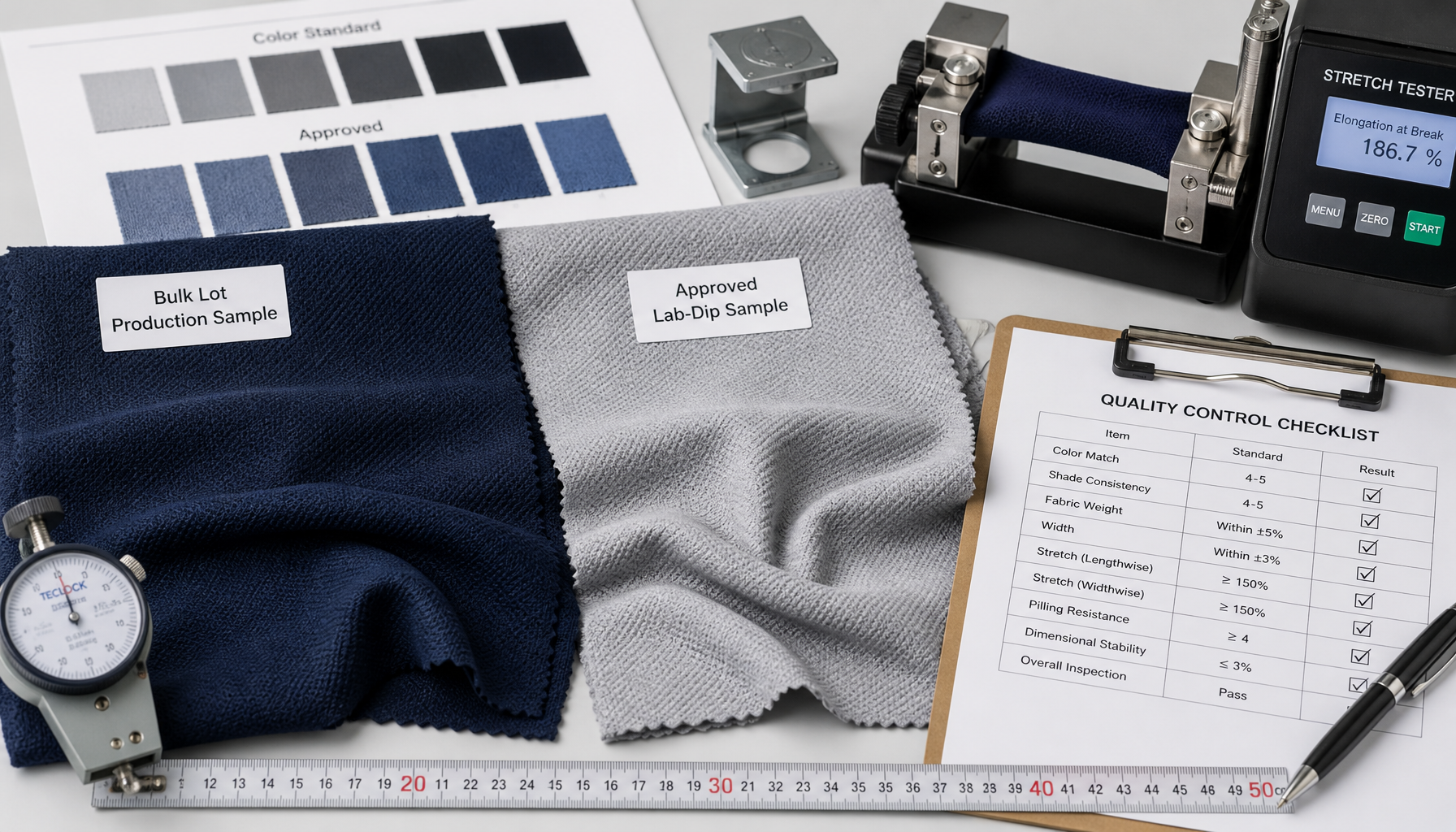
    Before paying a fabric deposit, verify the written first-lot approval procedure, sample references, inspection access, and release responsibilities. If production has not started, the bulk lot cannot yet be approved; the decision at this stage is whether the proposed controls are sufficiently clear to place the order.

    Distinguish the three approvals

    1. Development approval: the proposed fabric and garment trial meet the brief.
    2. Production authorization: the buyer confirms specifications, quantities and agreed commercial conditions.
    3. Bulk release: identified production material meets the agreed inspection and test criteria.

    A lab dip approves a color-development reference within its stated scope. It does not establish bulk width, recovery, defects, or garment behavior. Each approval record should state what it covers and what remains open.

    How Can Buyers Verify the First Bulk-Lot Approval Process Before Paying a Fabric Deposit?

    Ask the supplier to demonstrate the record flow

    Request a blank inspection form or an anonymized example showing how roll numbers connect to dye lots, measurement records, test samples, and packing lists. An example demonstrates documentation capability, not the quality of the future order. Confirm who selects bulk samples and whether the buyer or its inspector can access the rolls before release.

    Define the first-lot hold point

    For a new stretch-knit construction, specify whether the first production lot is held before later lots proceed. This can limit the amount requiring correction if the finish changes hand or recovery, but it also adds time to the schedule. Agree on what evidence must be available, who reviews it, and how quickly an approval or rejection is expected.

    How Can Buyers Verify the First Bulk-Lot Approval Process Before Paying a Fabric Deposit?

    Make “approved” measurable

    • Identify the signed construction and color references and the specification revision.
    • Set finished GSM, usable-width and other critical tolerances.
    • Define inspection coverage, test methods, specimen conditions and acceptance limits.
    • Assign responsibility for investigating, correcting and retesting nonconforming material.
    • Document authorization for any deviation or process change.

    Hypothetical example: the cutting marker requires at least 150 cm usable width, but a finished roll measures 148 cm at an inspected section. A passing lot-average width does not resolve that cutting problem. The agreed procedure must identify whether the affected roll is held, re-planned with buyer approval, or replaced.

    Confirm commercial milestones explicitly

    Ask the supplier to acknowledge how inspection and approval dates relate to the agreed payment and shipment milestones. Do not assume a deposit includes all testing, that an inspection automatically postpones payment, or that sample approval authorizes shipment. These arrangements must be confirmed for the order.

    Before proceeding, obtain one acknowledged approval pack containing the specification, sample register, first-lot hold point, responsible contacts, inspection schedule, and unresolved exceptions. Keep that version with the order so later decisions refer to the same requirements.

  • What Risks Should Buyers Review When Assessing the Usable Fabric Width?

    What Risks Should Buyers Review When Assessing the Usable Fabric Width?

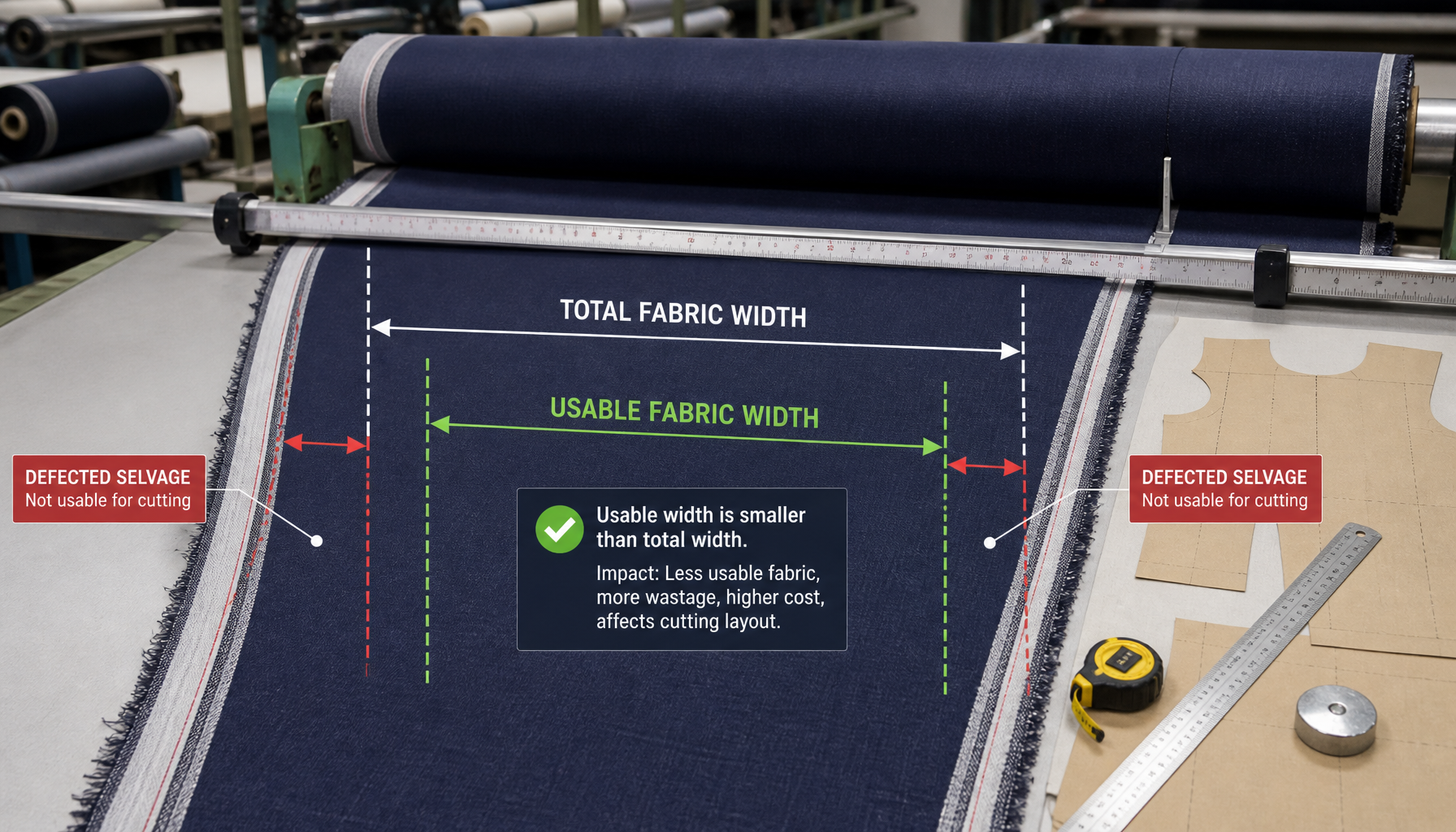
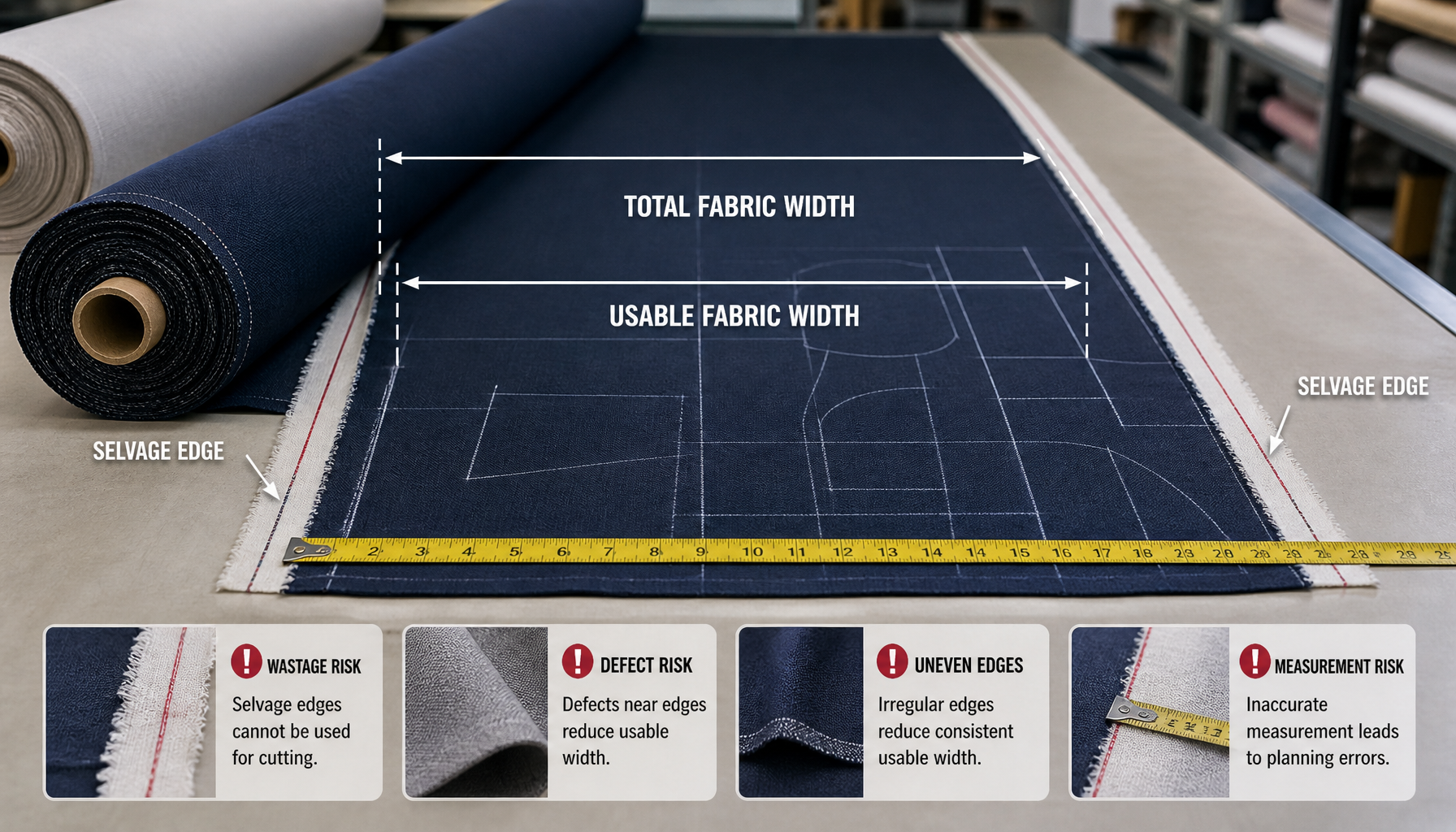
    Please keep in mind: Usable width is a cutting specification, not simply the total distance from one fabric edge to the other. Buyers should define the minimum defect-free width, measurement tension, relaxation and conditioning state, excluded edge conditions, within-roll sampling, and action for narrow sections. The largest commercial risk is approving an average or nominal width that cannot accommodate the production marker, causing higher consumption, panel rotation, extra seams, or cutting stoppages.

    Measuring the usable width of finished knitted fabric
    Usable width excludes edges, distortion, and defects that cannot enter the approved garment marker.

    Define usable width in the purchase specification

    State whether width is measured open, tubular, or laid flat; whether the value is total or usable; and how edge curl, pin marks, holes, glue, discoloration, distortion, or unstable selvedges are excluded. Knitted fabric should be measured under controlled, minimal tension after the agreed relaxation or conditioning period. If the supplier and garment factory use different tension or exclusion rules, both can report a correct number while referring to different cutting areas.

    Test the width against the actual marker

    A width tolerance matters only in relation to panel geometry. Run the complete graded size ratio, grain direction, nap or print direction, matching constraints, and permitted panel rotation through the marker. A reduction of one centimetre may have little effect on one style but can prevent two panels from nesting side by side in another. Approve the minimum usable width required by the production marker and retain a contingency for normal spreading and cutting control.

    Garment marker positioned within the defect-free width of stretch fabric
    Marker validation reveals whether a width difference changes panel nesting, consumption, or the permissible size ratio.

    Do not rely on the lot average

    Hypothetical example: five measured sections are 152, 152, 151, 148, and 152 cm usable width. The average is 151 cm, but a marker requiring 150 cm fails at the 148 cm section. Specify a minimum section or roll value where that reflects production risk, not only an average. Record measurements by roll and position so narrow areas can be segregated, re-planned, or rejected before they interrupt spreading.

    Account for relaxation and dimensional change

    Width can change after finishing, packing tension, warehouse relaxation, steaming, washing, printing, or heat treatment. Define the state in which incoming width is accepted and the state needed for marker planning. If the garment process exposes fabric to heat or moisture before cutting, reproduce that exposure during development. A relaxed wider fabric may shorten in length, while a tensioned roll can appear wider than it behaves on the cutting table; both effects influence consumption.

    Connect width, GSM, and quotation units

    Illustrative calculation: fabric at 200 GSM and 1.50 m usable width weighs 0.200 × 1.50 = 0.300 kg per linear metre. At 1.45 m usable width, the same GSM gives 0.290 kg per metre, but more linear metres may be required if marker efficiency falls. A kilogram quotation cannot be compared fairly until finished GSM, minimum usable width, marker consumption, and expected cutting loss are converted into cost per acceptable garment.

    Usable-width risks and purchasing controls
    Risk Required control
    Edge curl or damage Define excluded edge and measure only stable cutting width
    Within-roll variation Measure at agreed intervals and retain position records
    Lot variation Sample rolls across dyeing and finishing batches
    Marker mismatch Validate the production size ratio at minimum width
    Process shrinkage Measure before and after relevant relaxation, heat or wash exposure

    Set a response for nonconforming rolls

    The purchase order should define whether narrow material is rejected, segregated, downgraded, re-planned, or compensated through additional length. State who measures width, which equipment and interval are used, how disputes are confirmed, and whether the supplier must identify affected roll sections. Without a pre-agreed action, the garment factory may consume extra fabric to protect delivery while purchasing discovers the cost only after cutting.

    Approval checklist

    Send ClothFactory or any shortlisted supplier the open or tubular format, minimum usable width, width tolerance, finished GSM, fabric face, measurement condition, excluded-edge rule, marker requirement, processing route, and bulk inspection plan. Request representative sample yardage rather than relying on a small swatch. Approve the construction only after relaxed width, production marker efficiency, relevant dimensional change, and roll-level control can support the planned garment quantity and cost.

  • Pre-Production Fabric Approval Risks Buyers Should Control

    Pre-Production Fabric Approval Risks Buyers Should Control

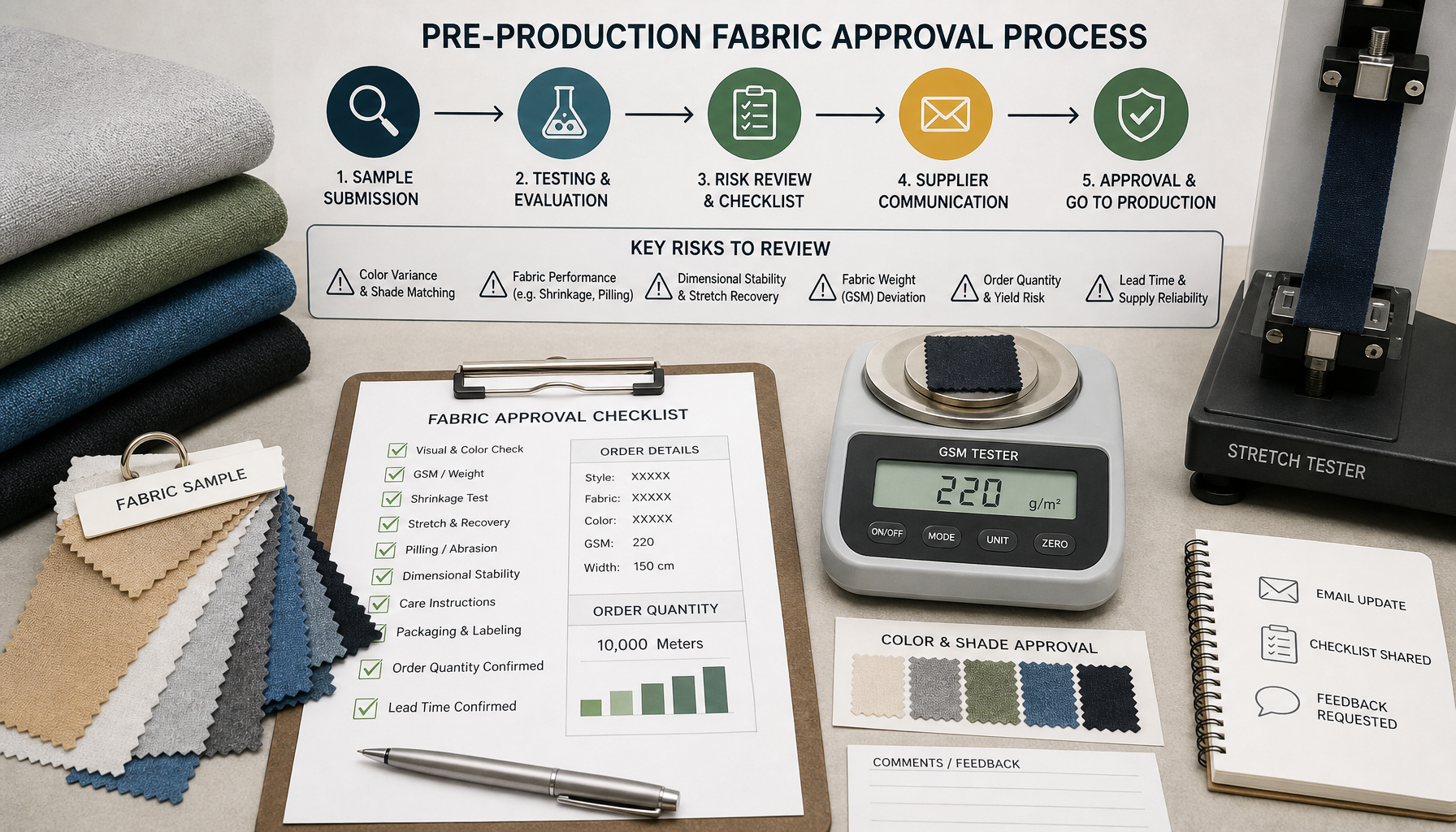
    The principal pre-production risk is approving an attractive sample without defining what bulk production must reproduce. Buyers should freeze the fabric construction, finished specifications, color standard, test conditions, garment validation, and change-control procedure before production starts. Every approval should identify the exact sample and version; verbal comments, unlabeled swatches, or a single “approved” email leave composition, performance, appearance, and tolerance disputes unresolved.

    Buyer reviewing a pre-production fabric approval package
    A complete approval package links the physical fabric sample, numerical specification, color standard, test reports, and production lot identity.

    Risk 1: the approval sample is not production-representative

    A handloom, laboratory-dyed swatch, available-quality cutting, and production trial may pass through different yarn, knitting, dyeing, and finishing conditions. Buyers should ask what the submitted sample represents and which steps can still change. If performance depends on bulk finishing, approve material from a production-relevant trial before releasing the order. Record fabric code, composition, knit structure, color, finish, date, lot identity, and approval status directly in the sample register.

    Risk 2: subjective approval replaces measurable criteria

    “Soft,” “supportive,” “quick-drying,” and “good recovery” are development directions, not acceptance limits. Convert critical requirements into agreed methods, specimen conditions, units, tolerances, and reporting rules. Keep an identified physical standard for hand, face, luster, color, and appearance, because these may not be captured fully by numbers. The physical standard and written specification must agree; when they conflict, the purchase contract should state which requirement controls and who authorizes an exception.

    Fabric samples and test records arranged for pre-production approval
    Version-controlled samples and reports prevent an early development swatch from being mistaken for the final bulk standard.

    Risk 3: garment processes are excluded

    A fabric can meet incoming tests and still fail after printing, heat transfer, bonding, washing, or sewing. For stretch garments, seam selection and panel direction may also change fit and recovery. The approval route should reproduce the intended decoration and care cycle, then assess dimensions, shade, surface, hand, stretch behavior, and fit on a sewn prototype. Approving blank fabric alone is insufficient when the garment process exposes it to heat, chemicals, tension, or multiple layers.

    Risk 4: averages conceal roll-level failure

    Hypothetical example: a four-roll lot has usable widths of 151, 150, 148, and 151 cm. The average is 150 cm, but the 148 cm roll may not fit a marker requiring a 149 cm minimum. Acceptance rules should therefore identify minimum or maximum roll-level limits as well as lot averages. Apply the same logic to GSM, shade, dimensional stability, bow and skew, and other properties where one nonconforming roll can interrupt cutting.

    Risk 5: color approval has no controlled reference

    Color decisions should identify the reference, illuminants, instrument conditions if used, visual assessment conditions, and acceptable lot-to-lot or roll-to-roll variation. A screen image or color name is not an approval standard. Confirm whether approval covers a laboratory dip, pilot dyeing, or bulk lot, and keep the signed reference protected from light and contamination. Dark, pale, fluorescent, and different fiber bases may require separate development; passing one color does not prove all colorways will behave identically.

    Risk 6: unapproved process changes remain possible

    Require written notification before changes to yarn source, yarn specification, knit settings, dye recipe, finishing route, plant, subcontractor, or test method. Define which changes require documentation, a new sample, garment validation, or full reapproval. This is particularly important when an optional finish supplies odor control, cooling sensation, moisture management, or another claimed function. A fiber blend should not be assumed to deliver a finish-dependent performance after the approved route changes.

    Minimum pre-production approval record
    Record Required control
    Fabric specification Composition, construction, finished GSM, usable width and tolerances
    Physical standards Identified hand, face, shade and appearance references
    Performance evidence Method, conditions, individual results, report date and sample identity
    Garment validation Decoration, sewing, wash, fit and end-use checks
    Bulk plan Sampling frequency, inspection rules, release authority and nonconformity action

    Before issuing bulk approval, hold a cross-functional review with purchasing, product development, quality, and the garment factory. Send the supplier one signed approval pack and require acknowledgment of every tolerance and exception. ClothFactory can align candidate knitted stretch fabrics with this pack, but the brand should retain approval authority and document any waiver. Production should begin only when unresolved items, test responsibility, and change-control triggers are visible to all parties.

  • What to Confirm Before Requesting Fabric Samples

    What to Confirm Before Requesting Fabric Samples


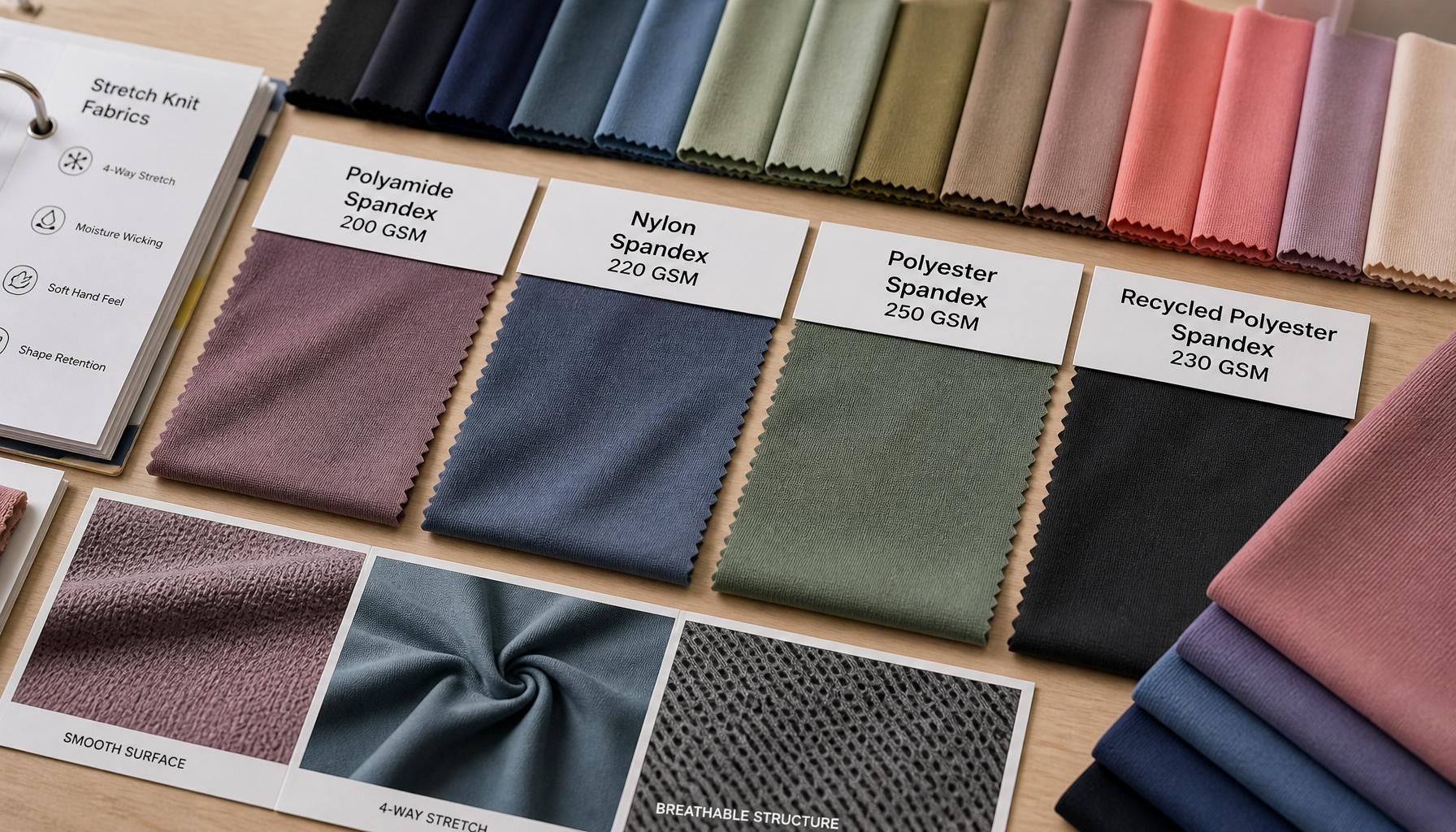
    Before requesting fabric samples, an apparel buyer should give the supplier enough information to screen out unsuitable materials. At minimum, define the garment, target construction and composition, GSM and usable width, stretch direction, color, finish, care conditions and tests required for approval; otherwise, receiving many swatches creates activity without producing a comparable sourcing decision.

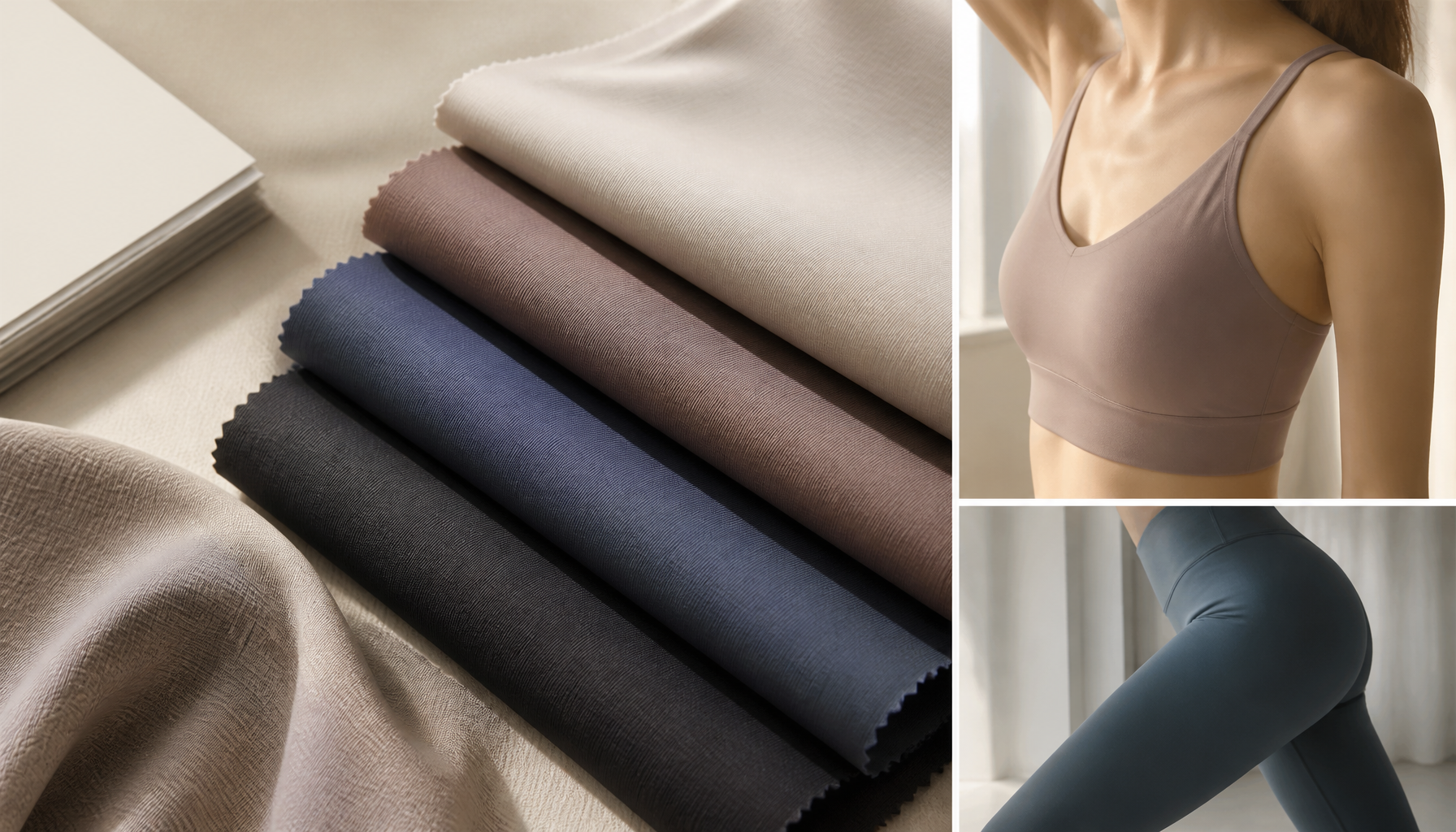
    Illustration: Fabric swatches reviewed against an apparel development brief
    Illustrative image; not a test record or production evidence.

    Start With the Garment, Not a Generic Fabric Name

    “Fabric for activewear” is too broad for useful sampling. A running shirt, sports bra and yoga legging place different demands on coverage, stretch, recovery, support and surface durability. State the garment zone and expected use, including whether the material touches skin, carries elastic tension, faces repeated abrasion or must remain opaque under strain. This lets the supplier explain why a candidate fits instead of sending whichever swatches are readily available.

    Define the Technical Comparison Fields

    Ask every supplier to report the same fields: fiber content, knit structure, finished GSM, usable width, stretch and recovery by direction, finishing route and recommended care. Specify whether width is open, tubular, relaxed or usable after excluding unstable edges. Numbers collected under different definitions cannot support a fair comparison, even when they appear in the same spreadsheet.

    Separate Core Construction From Optional Finishes

    List moisture management, cooling, antibacterial treatment, brushing or other finishing requirements separately from the base fabric. Ask whether each property comes from fiber, structure or an applied finish and how it should be verified after laundering. A swatch with an attractive initial hand feel does not prove that an optional finish will remain effective through the product’s intended care cycle. For finish-related evidence, see comparing supplier reports for moisture management.

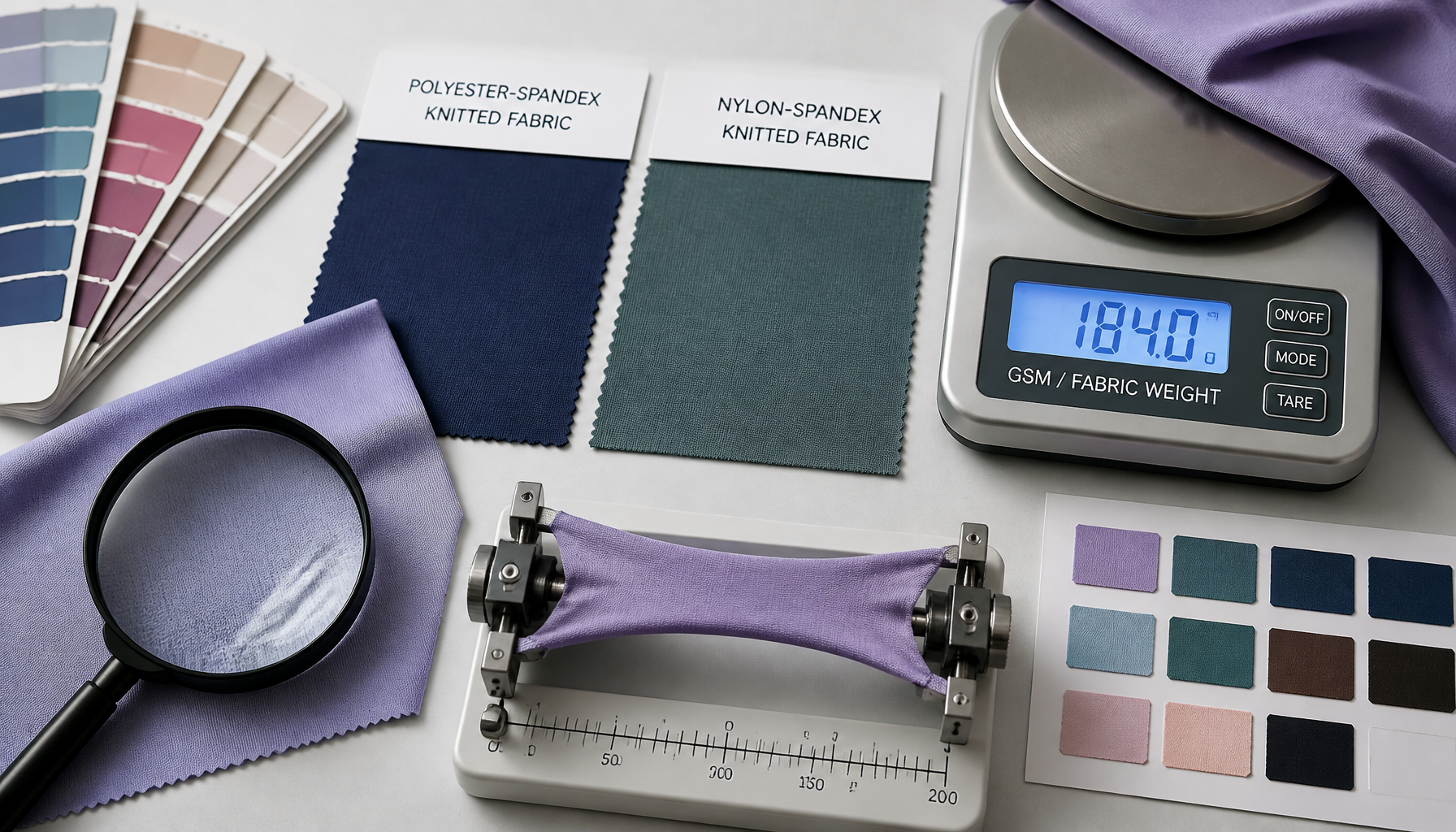
    Illustration: Buyer comparing stretch fabric samples and specification records
    Illustrative image; not a test record or production evidence.

    Agree on the Sample’s Purpose

    Clarify whether the request is for an available quality swatch, a color lab dip, sample yardage or a production-representative approval lot. These materials answer different questions. A small swatch can confirm color direction and surface character, but it cannot support a full marker, garment wash trial or statistically meaningful bulk inspection. Record what the sample is allowed to approve and which decisions remain open. A sample-yardage plan is compared in how buyers compare sample-yardage plans across fabric suppliers.

    Confirm Commercial Conditions Before Development

    Ask for MOQ by quality and color, sample charges, development charges, estimated sampling sequence, bulk lead-time assumptions, payment terms and how repeat colors are controlled. Do not rely on a generic MOQ copied from another fabric because yarn availability, dyeing route, color and finishing can change the production threshold. Request written confirmation for the specific quality and color plan under review.

    Sample Request Checklist

    • Garment type, target consumer and use conditions
    • Composition, knit structure, GSM and usable width targets
    • Stretch direction, recovery, coverage and hand-feel requirements
    • Color standard and approval method
    • Optional finishes and durability conditions
    • Required fabric and garment tests
    • Expected order quantity and color breakdown
    • Sample type, quantity and decision deadline

    Approval Gate

    Issue one written sample brief and assign a reference to every received candidate. Record deviations instead of silently accepting them, then move only technically suitable materials into garment sampling. ClothFactory can use this information, submitted through the contact page, to match existing options or discuss development, while the buyer retains a traceable record connecting the original requirement, physical sample, test results and eventual bulk approval.

  • MOQ, Lead Time and Color Planning for Custom Activewear Fabric

    MOQ, Lead Time and Color Planning for Custom Activewear Fabric


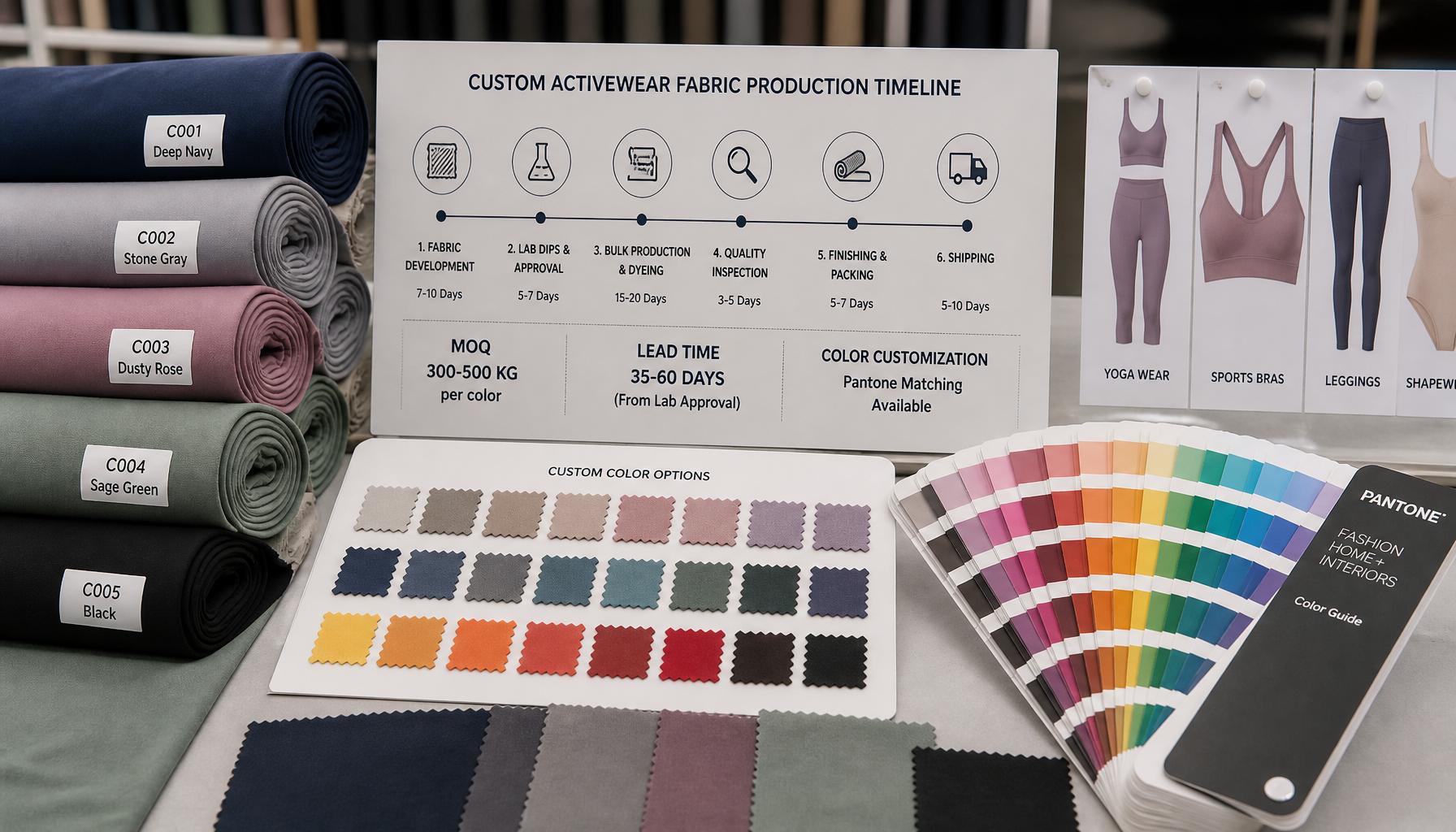
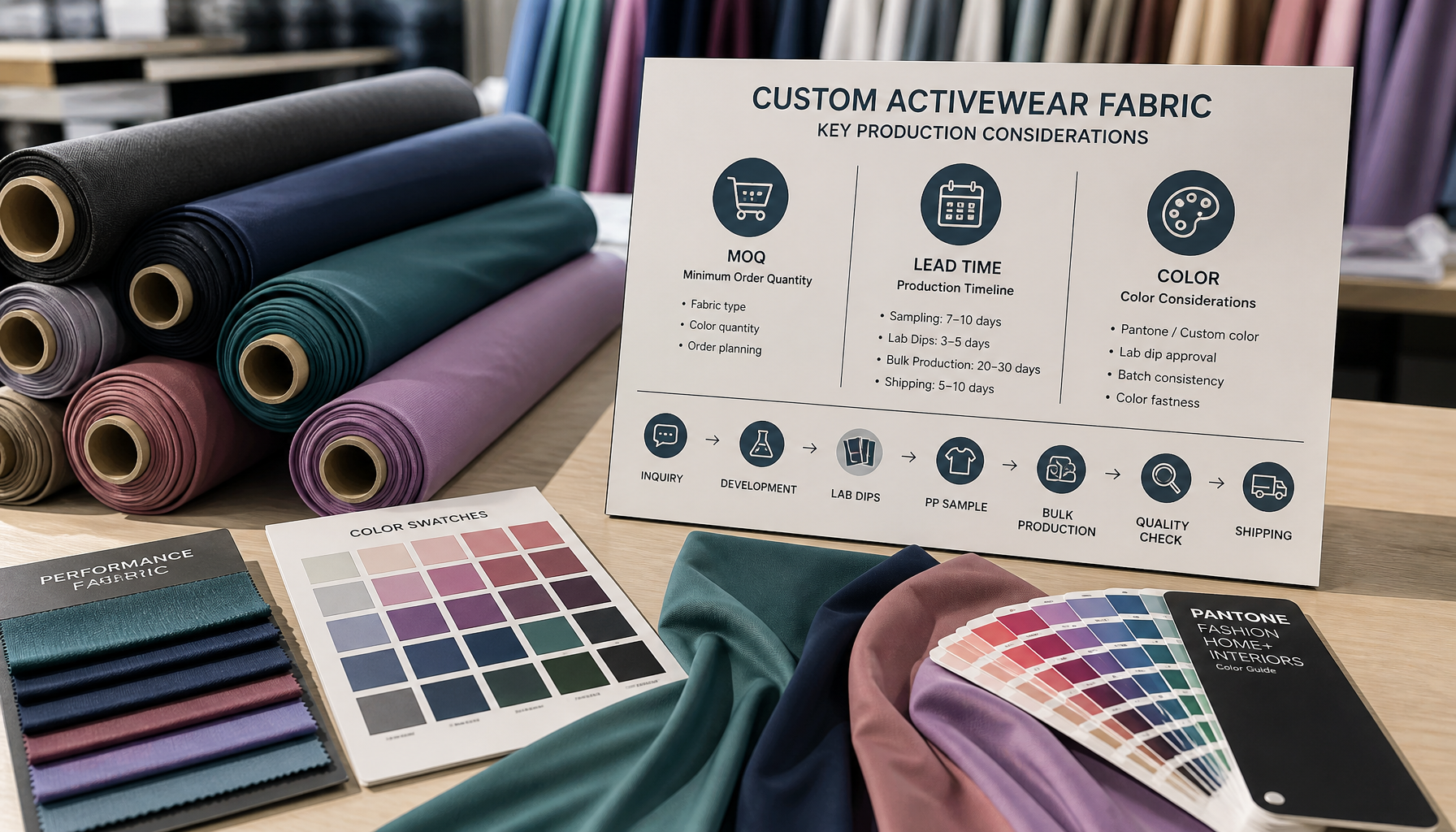
    Custom activewear fabric should not enter development until MOQ, lead-time assumptions and color approval responsibilities are confirmed for the specific construction and finishing route. These three variables interact: increasing the number of colors can divide volume below a workable dye-lot quantity, while color corrections or added finishes can extend the schedule beyond the buyer’s launch plan.

    Illustration: Activewear fabric development plan showing color and production requirements
    Illustrative image; not a test record or production evidence.

    Treat MOQ as a Production Condition

    MOQ may be stated by fabric quality, color, dye lot, weight or length, so a single headline number is not enough. Ask whether the quoted minimum applies to one color and one finishing route, and whether greige, yarn or special chemical commitments create separate thresholds. A buyer dividing one order among several colors must verify each color independently rather than assuming the combined quantity satisfies production conditions. The policy risks are reviewed in assessing the minimum order quantity policy.

    Model the Color Plan Before Sampling

    Use a simple allocation check before approving a palette. In an illustrative example, a planned order of 900 kg divided equally among six colors gives 150 kg per color; changing to nine colors reduces each allocation to 100 kg. This arithmetic does not establish any supplier’s MOQ, but it shows why a larger total order can still fail a per-color requirement and create surcharges or excess inventory.

    Illustration: Color swatches arranged for custom activewear fabric approval
    Illustrative image; not a test record or production evidence.

    Build Lead Time From Approval Gates

    Do not ask only for “days to delivery.” Request a dated sequence covering technical confirmation, sample preparation, lab dip submission, buyer review, corrections, bulk production, inspection and dispatch. Identify which steps can overlap and which begin only after written approval. The delivery commitment should also state what happens when the buyer changes color, construction, quantity or test requirements after sampling has started. Commercial terms should be compared on a like-for-like basis; see comparing fabric quotes when GSM, width and finishing differ.

    Define Color Approval Evidence

    Name the color reference, substrate, light sources, visual or instrumental tolerances and approval authority. Confirm whether approval applies to a lab dip, sample yardage or bulk dye lot. Stretch fabrics should be assessed relaxed and at the extension relevant to the garment because surface coverage and perceived shade can change under strain. Different fiber blends and finishes may also require separate standards.

    Commercial Trade-Offs

    Adding colorways can support merchandising but increases the number of approvals, dye lots and shade-control points. Selecting a lower MOQ option may raise unit cost or narrow the available construction and finish choices. A faster schedule may reduce time for corrections and garment testing. Buyers should choose the combination that protects the launch and acceptable-garment cost, not optimize each variable independently.

    Buyer Risk Check

    • Obtain MOQ in writing for each quality, color and finish.
    • Distinguish sample timing from bulk production and shipping time.
    • Reserve buyer review time in the calendar.
    • Define shade bands and whether mixed shades can enter one garment order.
    • Reconfirm lead time after every material change.
    • Do not treat a reference color library as proof of ready stock.

    Information to Confirm With ClothFactory

    Submit the construction, composition, GSM, usable width, finish, target quantity, color breakdown, reference standard, required tests and delivery destination. ClothFactory can then confirm applicable development steps and commercial conditions through the contact page. No MOQ or lead-time value should be treated as fixed until it is tied to that exact requirement and recorded in the quotation or order confirmation.

  • Pre-Production Fabric Approval Sample Checklist

    Pre-Production Fabric Approval Sample Checklist


    A pre-production fabric approval sample should confirm the exact construction, color, finish and measurable properties intended for bulk production. Buyers should approve it against a signed specification and recorded test conditions, not by appearance and hand feel alone, then identify which characteristics still require bulk-lot verification.

    Illustration: Pre-production stretch fabric sample inspected against an approval specification
    Illustrative image; not a test record or production evidence.

    Confirm Sample Identity

    Record the supplier, quality name, composition, knit structure, color, dye-lot or sample reference, finishing route and date received. Ask whether the sample was made on the intended production route and whether any yarn, machine or finish will change in bulk. A sample cannot serve as a reliable standard when its origin is unclear or when the supplier expects to substitute critical inputs after approval. The approval sits inside the wider sequence described in what happens between fabric sampling and bulk-production approval.

    Measure Construction and Dimensions

    Verify finished GSM, usable width, appearance, thickness where relevant, and stretch and recovery in both directions. Define conditioning and measurement procedures so the numbers can be repeated on bulk fabric. For highly extensible knits, width and GSM should be measured without uncontrolled tension. Record individual observations rather than only writing “approved,” because bulk inspection needs objective comparison points.

    Review Color and Surface

    Compare shade with the agreed physical reference under specified lighting and inspect relaxed and stretched fabric. Check bow, skew, barre, creases, holes, contamination and uneven finishing. If several garment panels must match, establish shade grouping rules before cutting. Digital photographs can document the review, but they should not replace physical color approval because cameras and displays alter color.

    Illustration: Buyer checking shade, surface and stretch on a fabric approval sample
    Illustrative image; not a test record or production evidence.

    Test End-Use Performance

    Select tests from the garment risk assessment. Close-fitting activewear may require dimensional stability, colorfastness, stretch recovery, pilling or abrasion, opacity under strain and seam compatibility. Moisture, cooling or antibacterial claims need separate methods and durability conditions. The test report should identify the specimen, method, unit and result; a pass statement without those fields cannot support later comparison. For the verification step, see how to verify GSM tolerance before paying a fabric deposit.

    Validate in a Sewn Prototype

    Use production-intended thread, needle, seam and elastic where possible. Evaluate fit, seam grin, puckering, edge curl, recovery, coverage and appearance after the planned wash and drying sequence. Fabric-level approval does not guarantee garment performance because pattern strain, panel direction and sewing tension change how the material behaves. Record any construction restrictions with the approved sample.

    Approval Record

    • Physical sample reference and retained piece
    • Signed specification with tolerances
    • Color standard and lighting conditions
    • Test reports and laundering conditions
    • Garment trial observations
    • Approved deviations or open actions
    • Bulk inspection and release requirements

    Release Decision

    Approve, reject or approve conditionally in writing. Conditional approval should name the unresolved item, responsible party and deadline before bulk cutting. ClothFactory and the buyer should retain matching records so that bulk fabric can be traced to the same construction and finish; send the signed approval record through the contact page. If a critical input changes, request a new approval sample instead of treating the original signature as permanent authorization.

  • Supplier Capability Audit Risks for Fabric Buyers

    Supplier Capability Audit Risks for Fabric Buyers


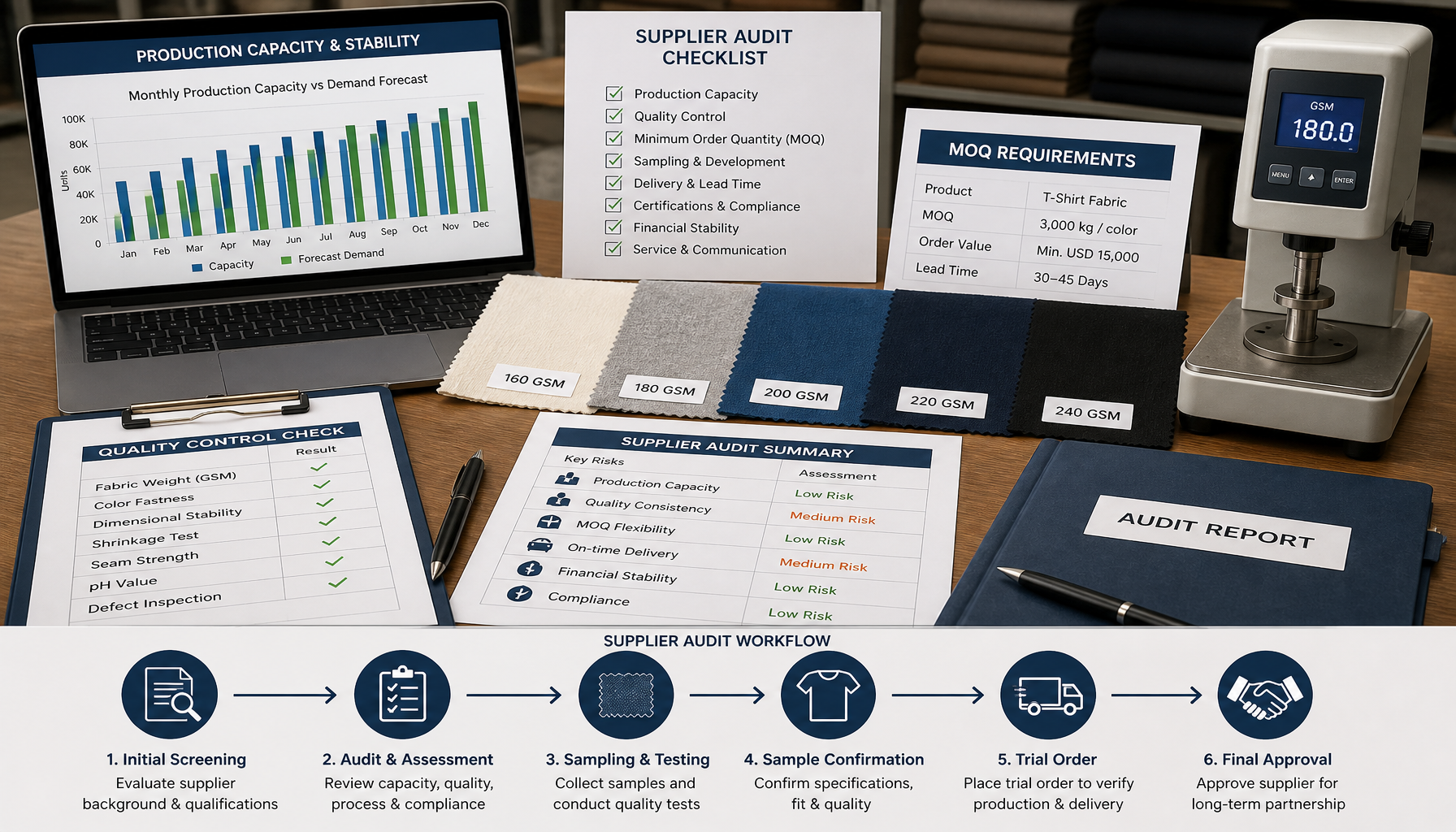
    A supplier capability audit should test whether the actual supply route can reproduce the approved fabric, detect variation and respond before a defect reaches garment cutting. Buyers should focus on traceability, process control, subcontractor oversight, test capability, capacity evidence and corrective action rather than treating certificates, showroom samples or stated monthly capacity as sufficient proof.

    Illustration: Fabric buyer reviewing supplier capability and production-control evidence
    Illustrative image; not a test record or production evidence.

    Scope Mismatch

    Confirm which legal entity, location and production processes the audit covers. A report for one facility does not automatically cover knitting, dyeing, finishing, printing or inspection performed elsewhere. Map the proposed product route and identify who owns each control point. The risk is not subcontracting itself; it is an unrecorded handoff where specifications, lot identity or corrective actions can be lost. The effect on sampling and bulk planning is covered in how a supplier capability audit affects fabric sampling and bulk planning.

    Unsupported Capacity

    Compare claimed capacity with machinery or partner allocation, working pattern, current loading, historical output and the requested construction. Total factory volume may not represent capacity available for a specific gauge, dye route or finish. Ask how production slots are reserved and what constraint controls delivery. Capacity should be evaluated for the proposed order and period, not accepted as a permanent headline number.

    Weak Specification Control

    Review how the supplier converts a buyer requirement into yarn, construction, color, finish, test and inspection instructions. Check revision control, approval signatures and how obsolete versions are removed from use. If operators or subcontractors rely on informal messages, a later correction may not reach every process, creating bulk fabric that matches an earlier specification instead of the final approved sample.

    Illustration: Quality records and fabric samples examined during a supplier audit
    Illustrative image; not a test record or production evidence.

    Inadequate Test and Inspection Evidence

    Confirm which tests are performed internally, which are outsourced, how equipment is controlled and how results link to a lot or roll. Review actual records for GSM, usable width, shade, defects and application-specific properties. A checklist marked “pass” without method, unit, sampling frequency or result does not show process capability and cannot support a buyer’s later claim investigation.

    Poor Nonconformance Control

    Ask for recent examples showing identification, segregation, root-cause analysis, disposition and effectiveness review. The supplier should explain who can authorize use under concession and how affected customers are informed. Repeated defects with different superficial explanations indicate that corrective action is closing paperwork rather than controlling the production cause.

    Audit Evidence Table

    Risk Evidence to inspect Warning sign
    Traceability Lot and roll records Manual relabeling without history
    Capacity Schedule and output records Unsupported monthly total
    Specifications Controlled revisions Instructions stored in chat only
    Testing Raw results and methods Pass/fail without data
    Subcontracting Approved route and responsibilities Undisclosed process location
    Corrective action Closed cases and verification Repeated issue without prevention

    Audit Conclusion

    Rate each risk against the intended product, then assign corrective actions, owners and deadlines before bulk approval. ClothFactory or any competing supplier should be approved only for the evaluated product and process scope; request the audit scope through the contact page. Reassessment is appropriate when production location, construction, critical yarn, dyeing route or finishing method changes, because the original audit evidence may no longer represent the order. Use the verification points in what buyers should verify in a nylon-spandex manufacturer to close the gaps.

  • When to Reconfirm Lead Time for Repeat Fabric Orders

    When to Reconfirm Lead Time for Repeat Fabric Orders


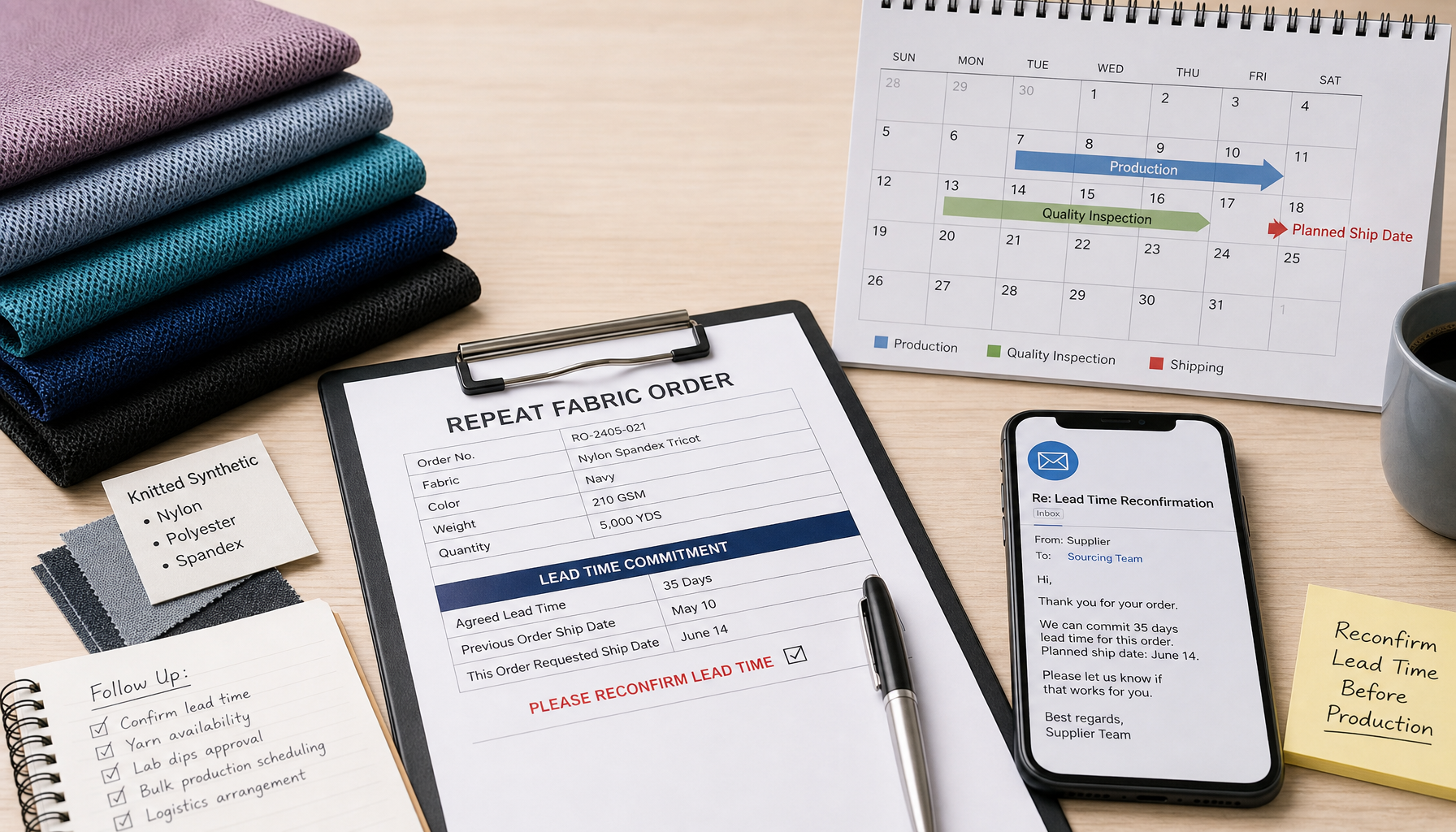
    Lead time should be reconfirmed before every repeat fabric purchase order and again after any change to quantity, color, construction, finishing, testing, raw-material availability or required ship date. A previous delivery is useful history, but it is not a current commitment because capacity, material allocation and approval requirements can change between order cycles.

    Illustration: Repeat fabric order schedule reviewed before purchase-order release
    Illustrative image; not a test record or production evidence.

    Before the Purchase Order

    Request a dated commitment based on the exact quality, color breakdown, quantity, finish, tests and delivery term. Separate supplier production time from buyer approval time, logistics and customs. Ask which date starts the clock: deposit, purchase order, color approval, greige allocation or another event. Without a defined start point, two parties can agree on the same number of days while expecting different delivery dates.

    After Any Specification Change

    A “repeat” order stops being operationally identical when the buyer changes shade, width, GSM, hand feel, finish, packaging or testing. Even a familiar color may need a new dye lot or lab dip. Send a revised specification and require the supplier to confirm material availability, process route and schedule again. Do not rely on the original quotation after the technical basis has changed. The risks that shape a first quotation are covered in assessing the minimum order quantity policy.

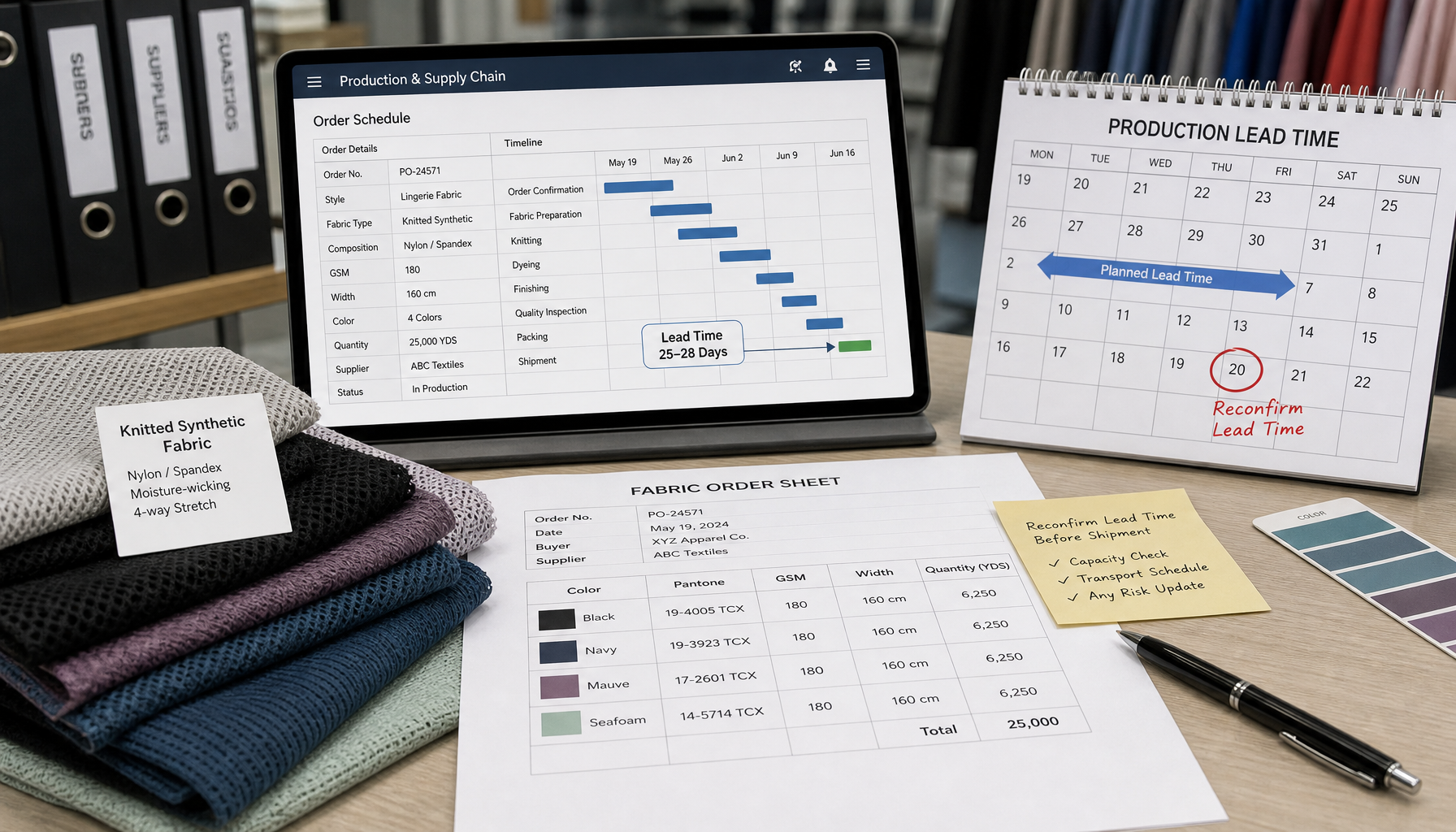
    Illustration: Fabric production milestones aligned for a repeat order
    Illustrative image; not a test record or production evidence.

    At Approval and Production Gates

    Reconfirm the remaining schedule when color or production samples are approved, when bulk knitting or dyeing begins, and before shipment booking. These checks do not replace the original commitment; they expose changes early enough to protect the garment plan. Request actual milestone dates rather than a general statement that production is “on schedule,” and record who owns any delayed approval. Current capability should also be checked against what buyers should verify in a nylon-spandex manufacturer.

    When Demand or Supply Conditions Shift

    Quantity increases can require more yarn or another production slot, while reductions can fall below the conditions used for the original plan. Holidays, maintenance, constrained yarns, finishing capacity and transport disruption can also change availability. Ask the supplier to identify the current constraint and recovery plan. An earlier promise should not be silently reused when known conditions have materially changed.

    Lead-Time Record

    Milestone Date or condition to record
    Order accepted Technical and commercial confirmation complete
    Materials secured Yarn or greige allocation confirmed
    Color approved Lab dip or production shade signed
    Bulk processing Knitting, dyeing and finishing windows
    Quality release Tests and roll inspection complete
    Dispatch Booking, handover and delivery term

    Buyer Risk Check

    • Keep approval time separate from supplier processing time.
    • Reconfirm after changing colors or finishes.
    • Require a revised date when a milestone slips.
    • Link the commitment to the exact purchase order revision.
    • Check logistics availability before declaring the launch protected.
    • Do not assume repeat color means ready stock.

    Repeat-Order Action

    Send ClothFactory the prior order reference together with the new quantity, color plan, specification revision, tests and required delivery date through the contact page. Request a fresh milestone schedule and document any assumptions. The repeat order should be released only after technical equivalence and current capacity are confirmed; familiarity with the product reduces review work but does not remove supply risk.

  • How to Compare Fabric Roll-Length Requirements

    How to Compare Fabric Roll-Length Requirements


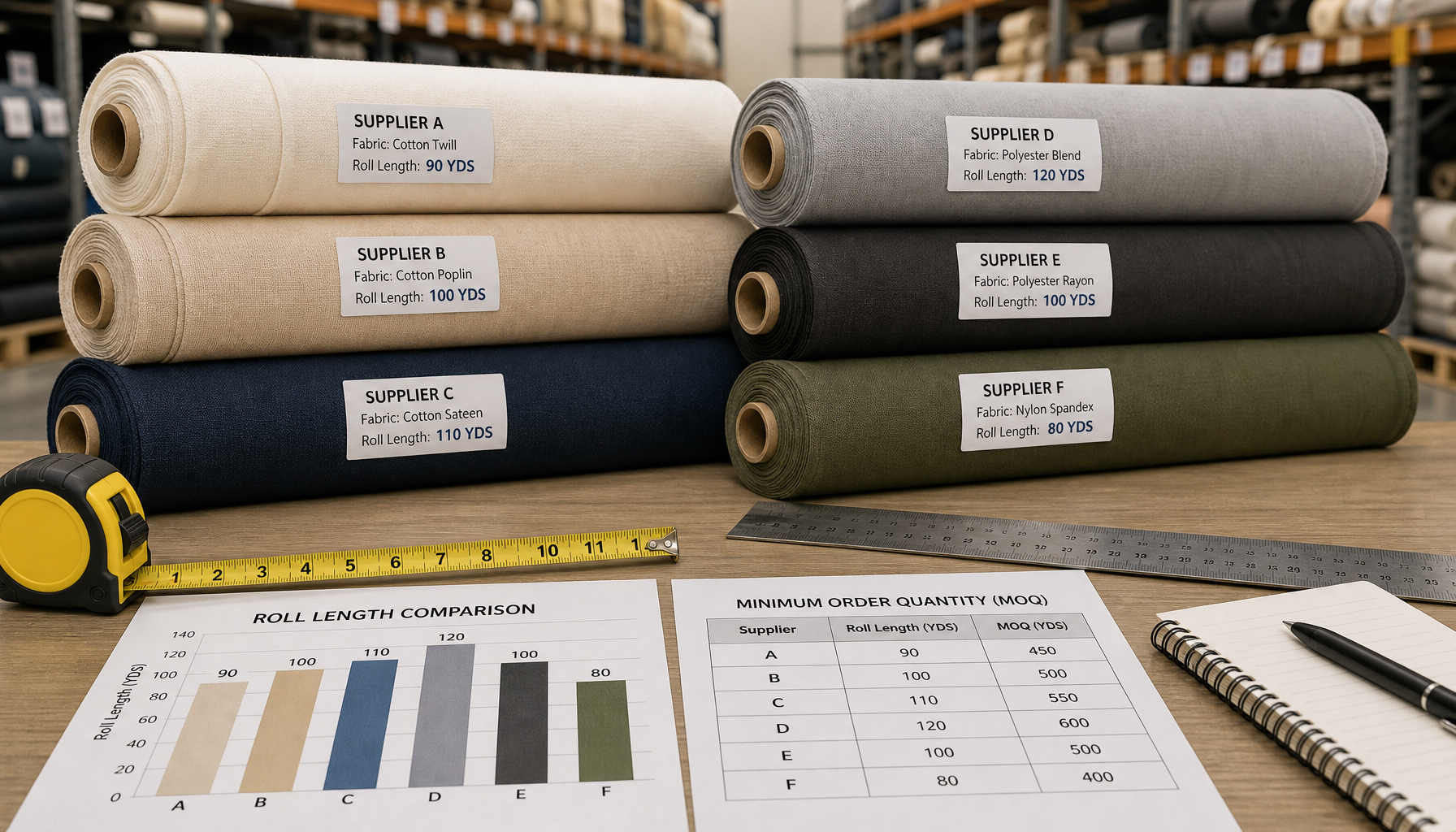
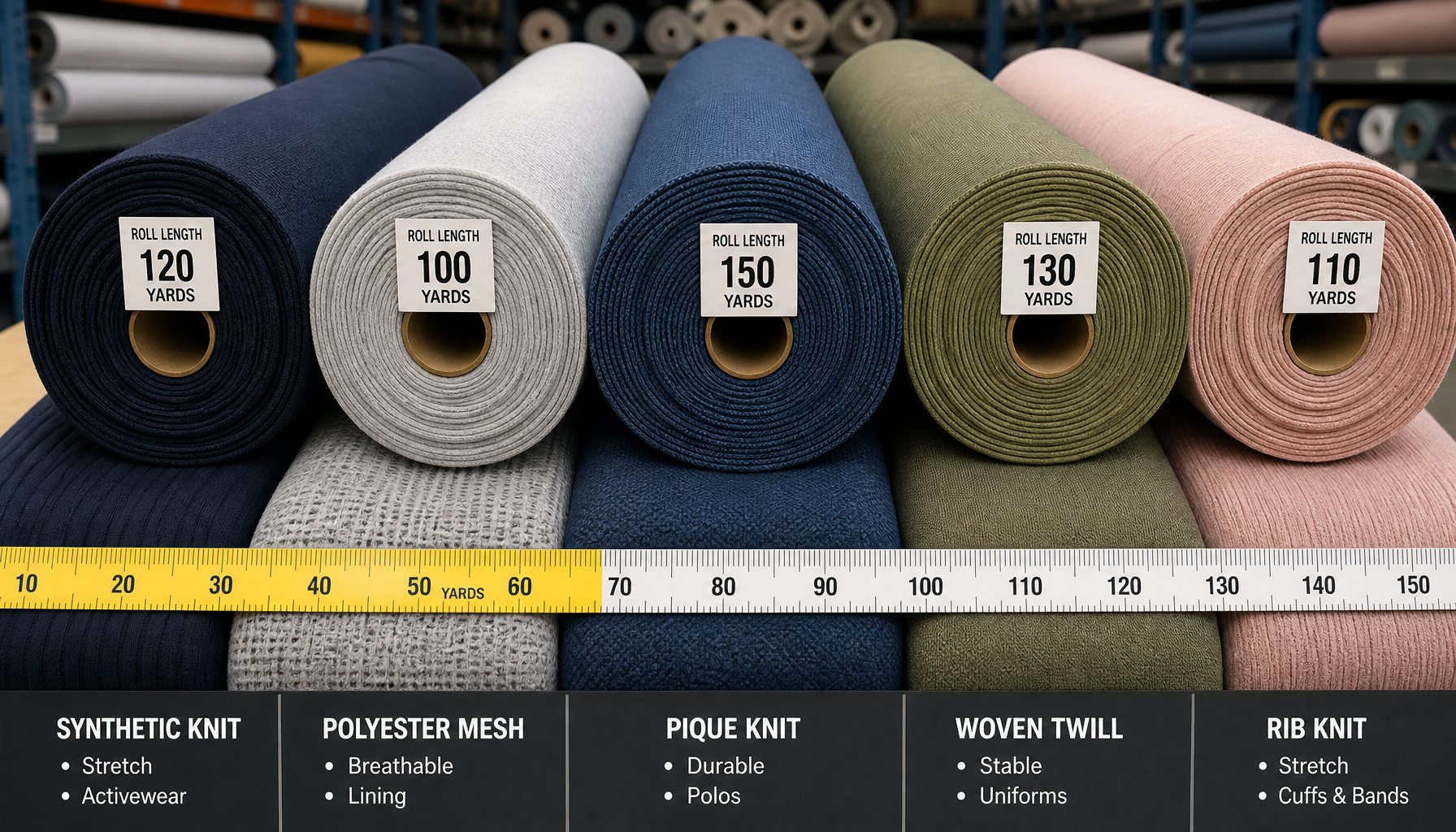
    Compare supplier roll-length requirements by normalizing the minimum and maximum roll lengths, short-roll allowance, joints, quantity unit, shade-lot rules and usable yield. MOQ and roll length are different controls: MOQ governs total production commitment, while roll distribution affects cutting efficiency, handling and the amount of fabric lost at each roll end.

    Illustration: Fabric roll lengths and cutting requirements compared for sourcing
    Illustrative image; not a test record or production evidence.

    Ask for the Roll Distribution

    A supplier quoting 1,000 meters may deliver ten 100-meter rolls or a mixture of long and short rolls. Those shipments have the same total length but can produce different spreading labor and end loss. Request the expected roll-length range, maximum proportion of short rolls, minimum acceptable piece, joint policy and packing method. Define whether the supplier needs buyer approval before shipping an exceptional short roll. Where length is verified, ISO 22198 provides a method for determining fabric length and width; the purchase order should still state sampling, tolerance and the measurement device.

    Keep Units Comparable

    Suppliers may quote or sell stretch fabric in kilograms, meters or yards. Conversion requires measured GSM and usable width for the specific quality; nominal figures can distort the result. Use verified data and retain the calculation basis. Do not describe an MOQ in kilograms as though it were the length of one roll, because a production quantity can be divided among many rolls.

    Calculate End Loss

    An illustrative example: if a cutting process loses 0.6 meter at each roll end, ten rolls create 6 meters of end loss while twenty rolls create 12 meters, before defects or marker remnants are considered. This is not a universal loss factor; buyers should replace it with factory data. The calculation shows why average roll length belongs in usable-cost comparison rather than being treated as a packing preference. The same usable-yield logic applies when comparing fabric quotes with different GSM, width and finishing.

    Illustration: Fabric roll tickets checked for length, shade lot and usable quantity
    Illustrative image; not a test record or production evidence.

    Include Shade and Defect Constraints

    Long rolls are not automatically better if shade varies within the roll or defects interrupt usable lays. Ask how shade lots are separated, how defects are marked, whether measured length includes unusable sections and what inspection system applies. Cutting plans should prevent mixing incompatible shades within one garment while still using roll remnants efficiently.

    Comparison Table

    Field Supplier response required
    Order unit kg, m or yd and conversion basis
    Standard roll Target and permitted range
    Short rolls Minimum length and maximum share
    Joints Number, marking and allowance
    Shade lots Identification and separation rule
    Length verification Measurement method and tolerance
    Claims Remedy for shortage or unusable material

    Purchase-Order Decision

    Use the garment factory’s spreading limits and historical end loss to set requirements before placing the order. ClothFactory should confirm the planned roll profile for the exact quality, width, GSM, color and quantity rather than reuse a generic figure, and verify the requirement through the contact page. Write the accepted distribution and remedy into the purchase order so receiving inspection can release or segregate rolls consistently. A related deposit-stage check is described in how to verify GSM tolerance before paying a fabric deposit.