分类: Fabric Knowledge

  • Double-Sided Cooling Pique for Professional Teamwear

    Double-Sided Cooling Pique for Professional Teamwear


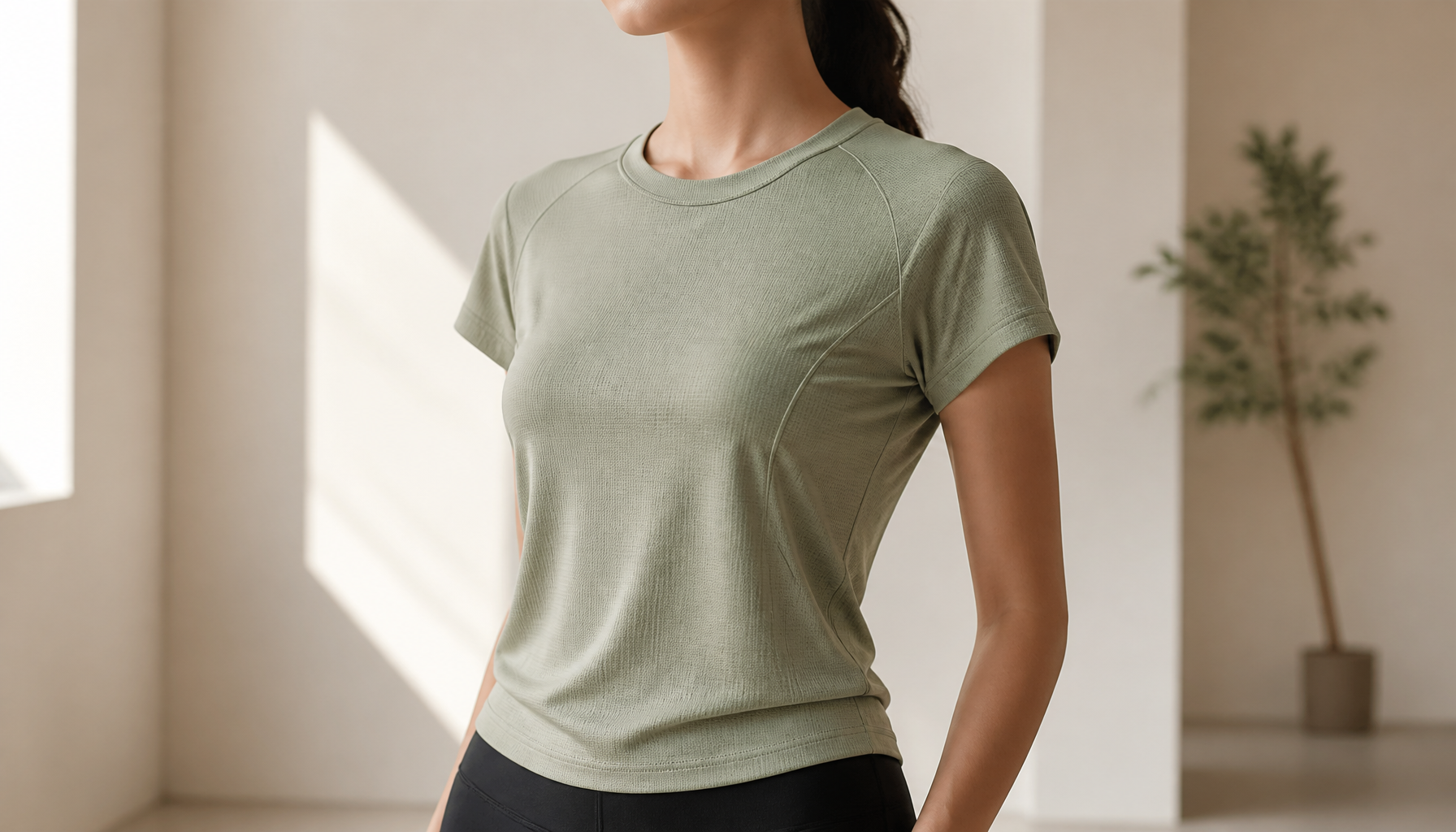
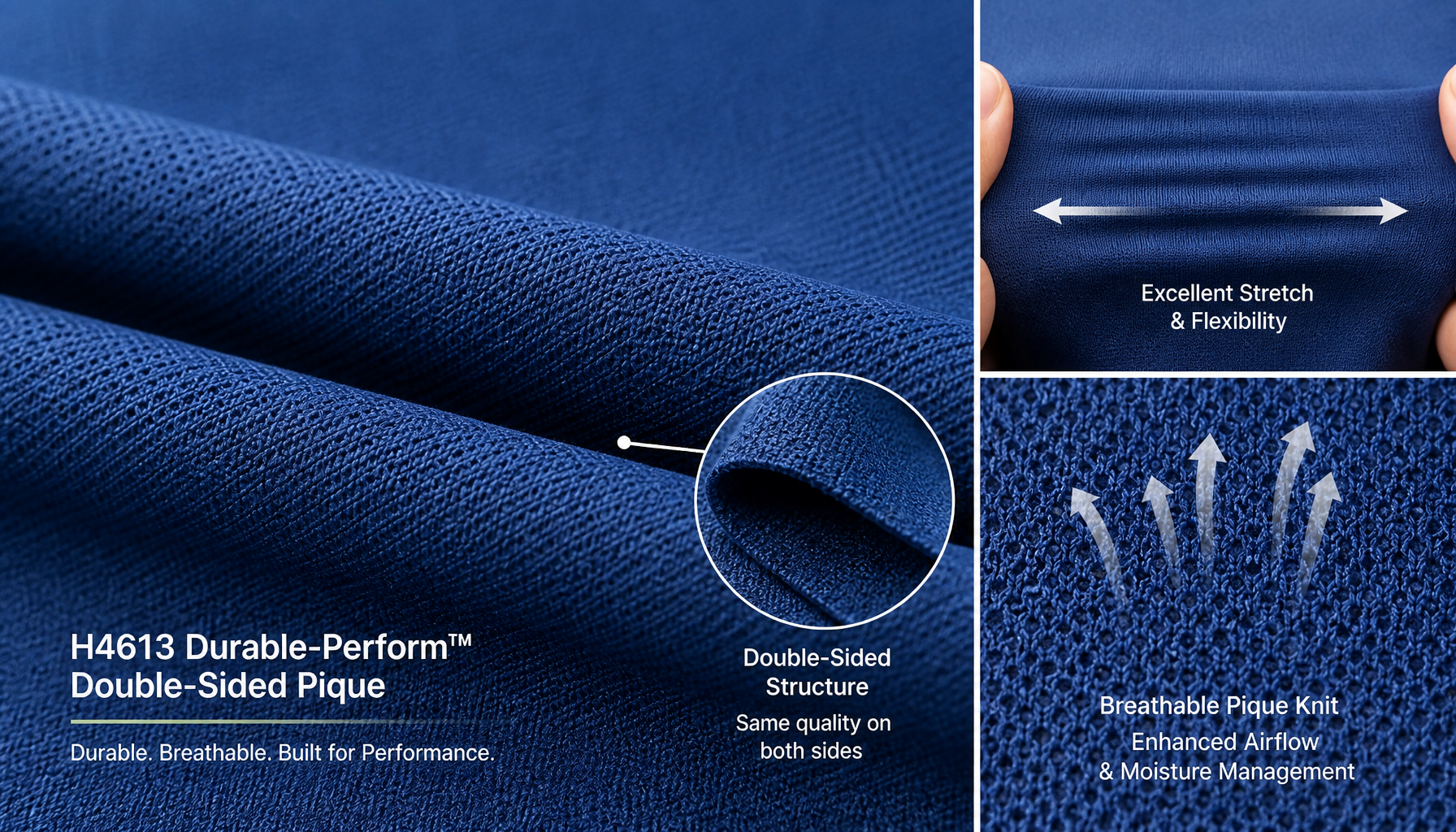
    Double-Sided Cooling Pique is an 84% nylon/16% spandex fabric specified at 170 GSM and 165 cm finished width. It can be a useful teamwear candidate when the programme requires a clean outer face and controlled inner surface, but abrasion, pilling, stretch recovery, shade consistency, dimensional stability and any cooling claim still require approval.

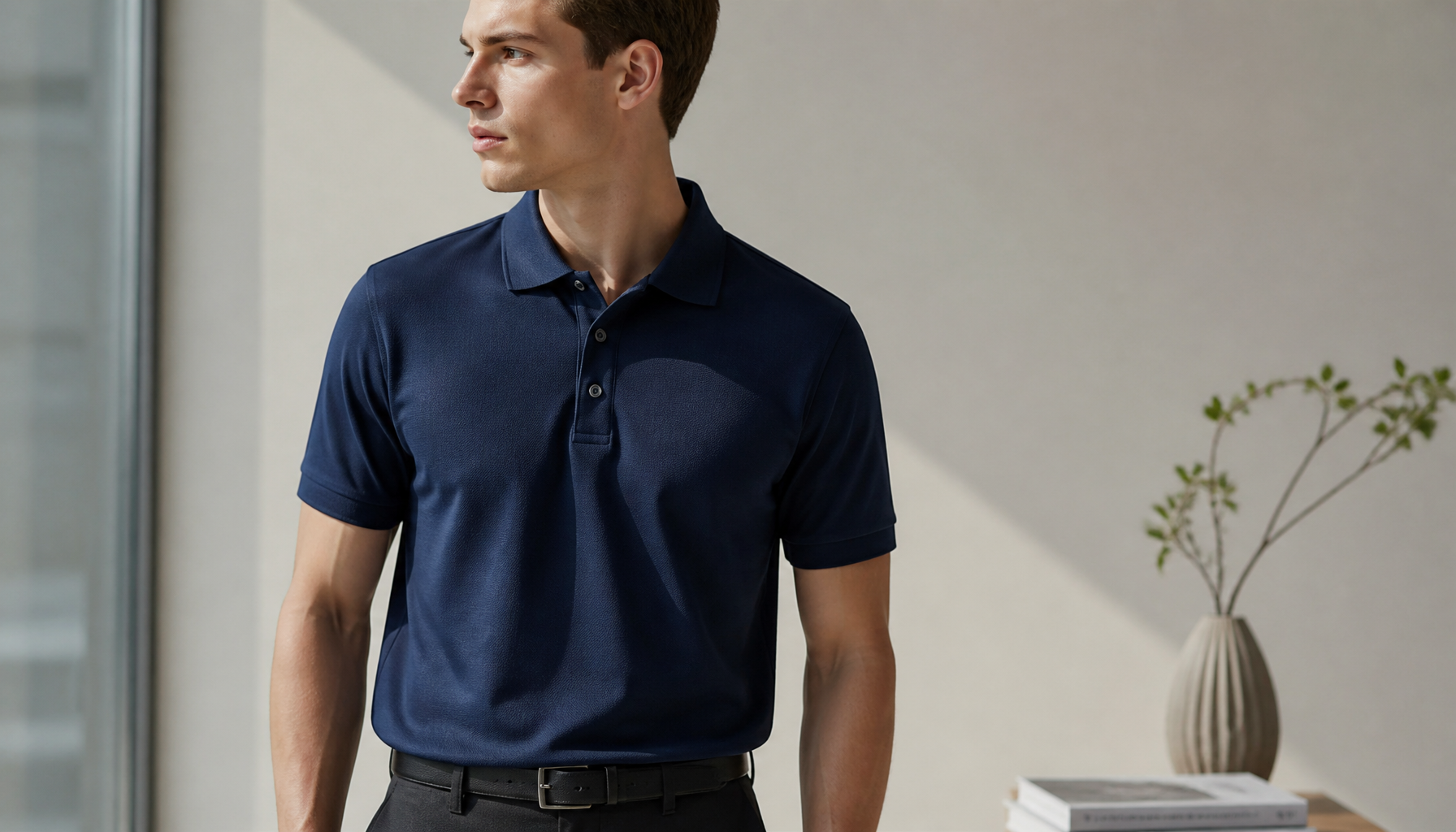
    Double-sided pique fabric reference for teamwear

    Build the specification around the uniform programme

    Teamwear may be used for competition, training, staff uniforms, or travel. The fabric decision changes with contact risk, activity level, climate, fit, decoration method, and laundering frequency. A match jersey may prioritize low bulk and moisture release, while a staff polo may require greater shape stability and a more formal surface.

    State which garment panels will use the pique, whether the fabric contacts skin, and which areas receive printing, heat transfer, embroidery, or badges. Decoration can change local stiffness, stretch, and heat exposure, so it must be included in sampling.

    Verify both fabric surfaces

    Record the approved face and reverse. Compare texture, hand, pilling, and moisture spreading on each side; do not assume both sides have the same function because they come from one construction.

    Inspect panel orientation and surface reflection before bulk cutting. If either side can be mistaken during spreading, define face marking and roll identification requirements. A reversal error may not be visible until garments are assembled under production lighting.

    Set durability conditions that reflect use

    “Repeated laundering” is not a complete test condition. The purchase specification should state wash and drying route, number of cycles, conditioning time, and acceptance points for shrinkage, spirality, shade, pilling, surface abrasion, and stretch recovery.

    For contact sports or equipment-heavy training, consider snagging and abrasion at shoulders, hips, and side panels. For uniforms, examine collar, placket, hem, and side-seam appearance after the intended industrial or domestic care route.

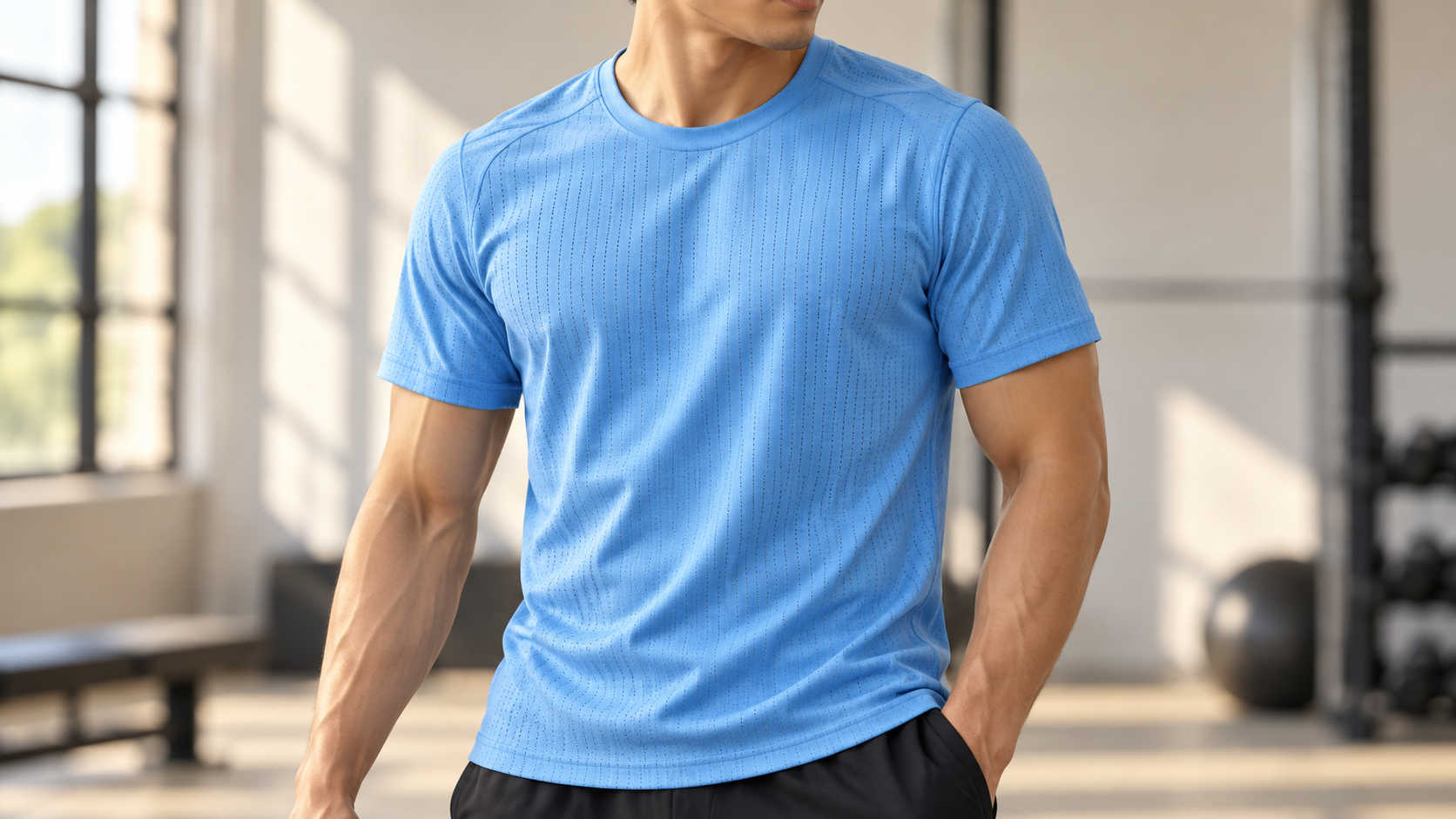
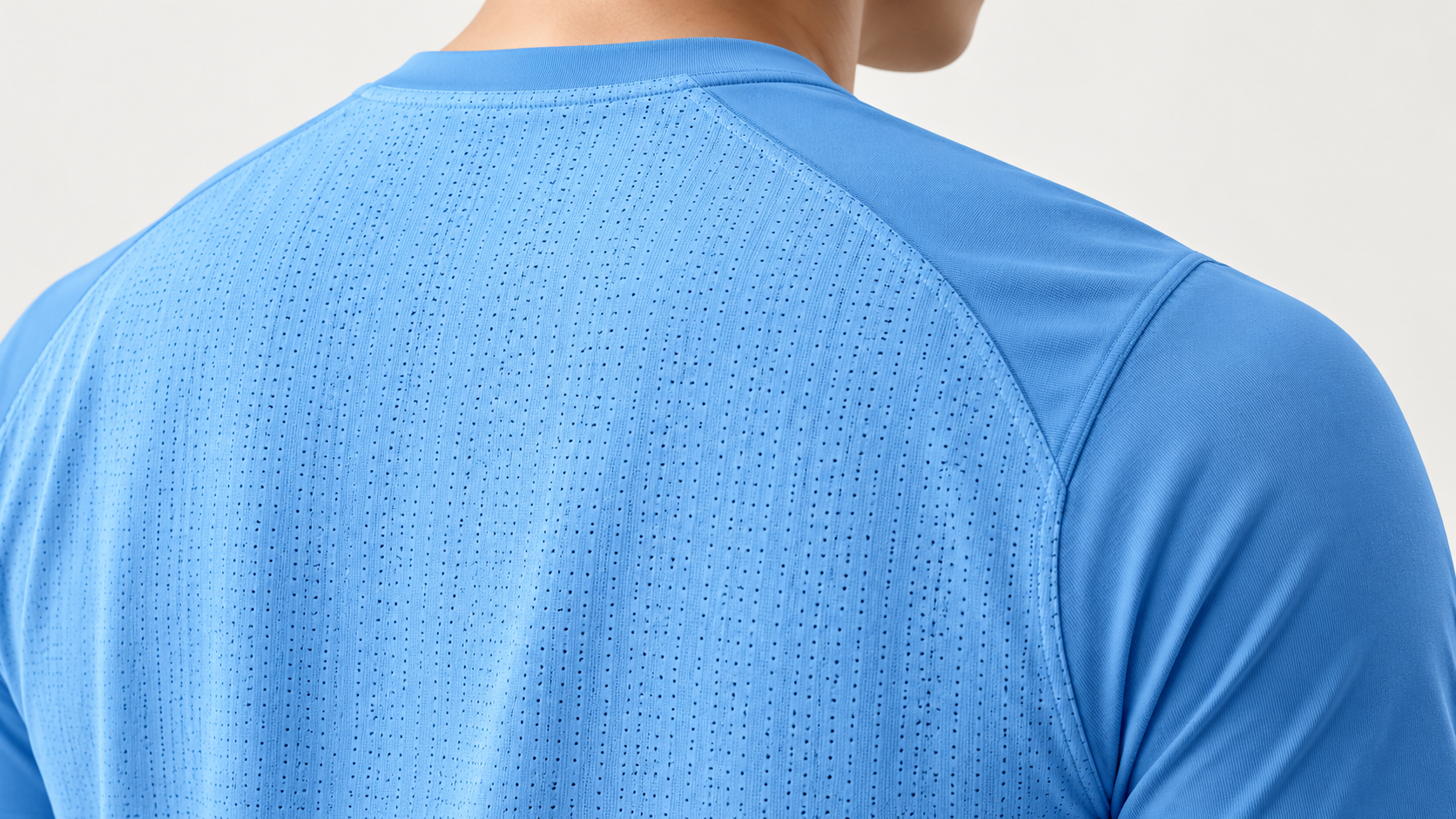
    Teamwear application reference using textured pique fabric

    Compare samples on the same basis

    Item Required record Procurement purpose
    Fabric identity Composition, construction, finished GSM, width, face and finish Connects the swatch to the bulk order.
    Mechanical response Stretch and recovery by direction and after washing Protects fit and seam appearance.
    Surface durability Pilling, abrasion and snagging conditions Reflects wear and equipment contact.
    Color control Shade standard, lot grouping and colorfastness Supports team-wide visual consistency.
    Decoration trial Method, temperature, pressure and dwell time Confirms compatibility with logos and numbers.

    Do not compare results produced with different conditioning, wash, or loading methods. A lower fabric price has little value if shade sorting, decoration failure, or panel rejection reduces usable garment yield.

    Procurement next step

    Send the supplier the teamwear category, activity, garment panels, fit, decoration method, care route, color range, and required durability tests. Request identified finished samples and enough material for decoration, sewing, laundering, and wear-relevant trials. Use a sealed approval sample and written tolerances as the bulk reference.

  • Motion Performance Pique for Summer Polo Shirts

    Motion Performance Pique for Summer Polo Shirts


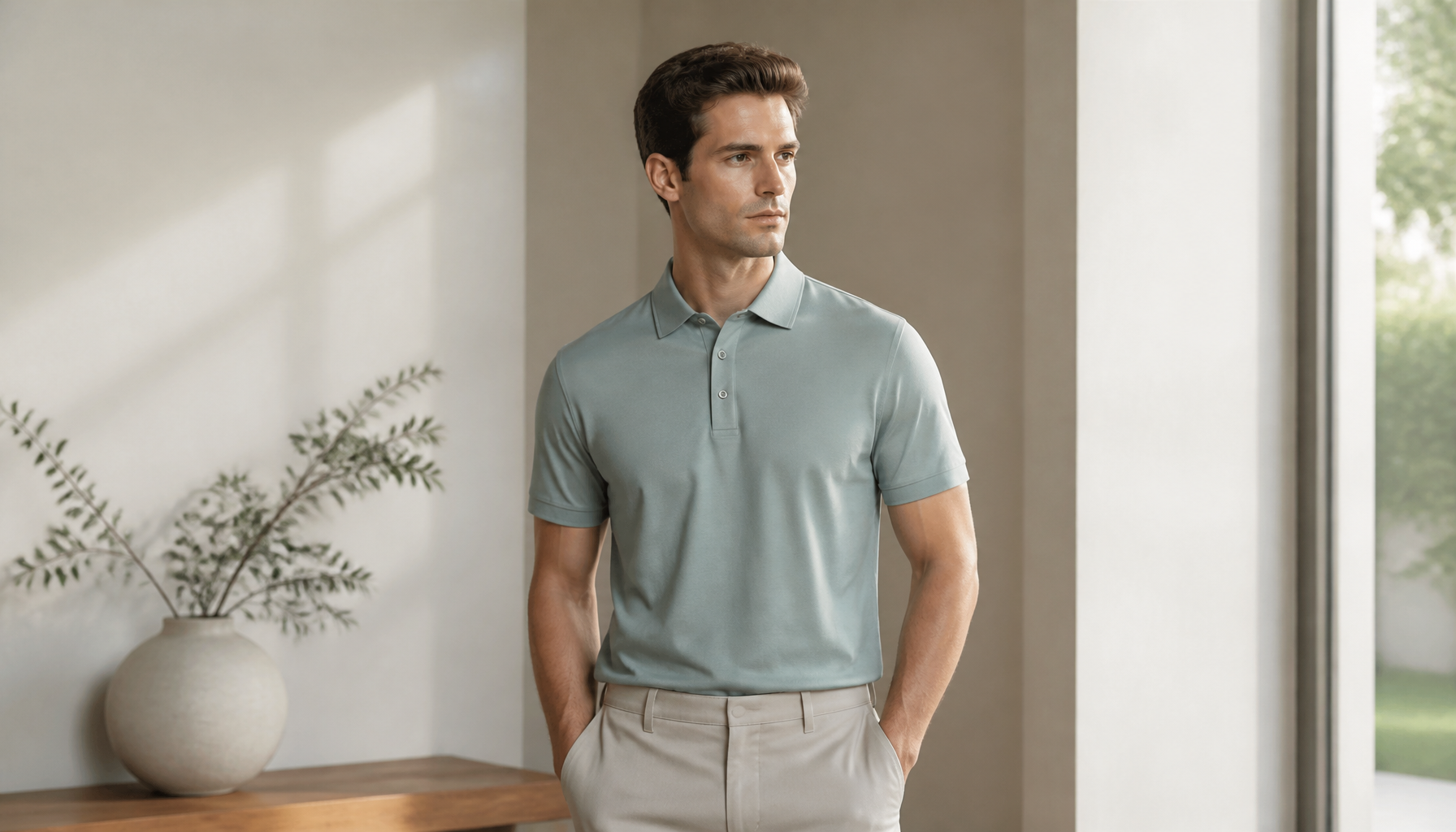
    Motion Performance Pique is an 88% nylon/12% spandex pique specified at 170 GSM and 165 cm finished width. It should be shortlisted for summer polos only when its surface, moisture behavior, and collar-placket performance match the garment brief; a silky hand or cool first touch does not prove sustained cooling, breathability or wash durability.

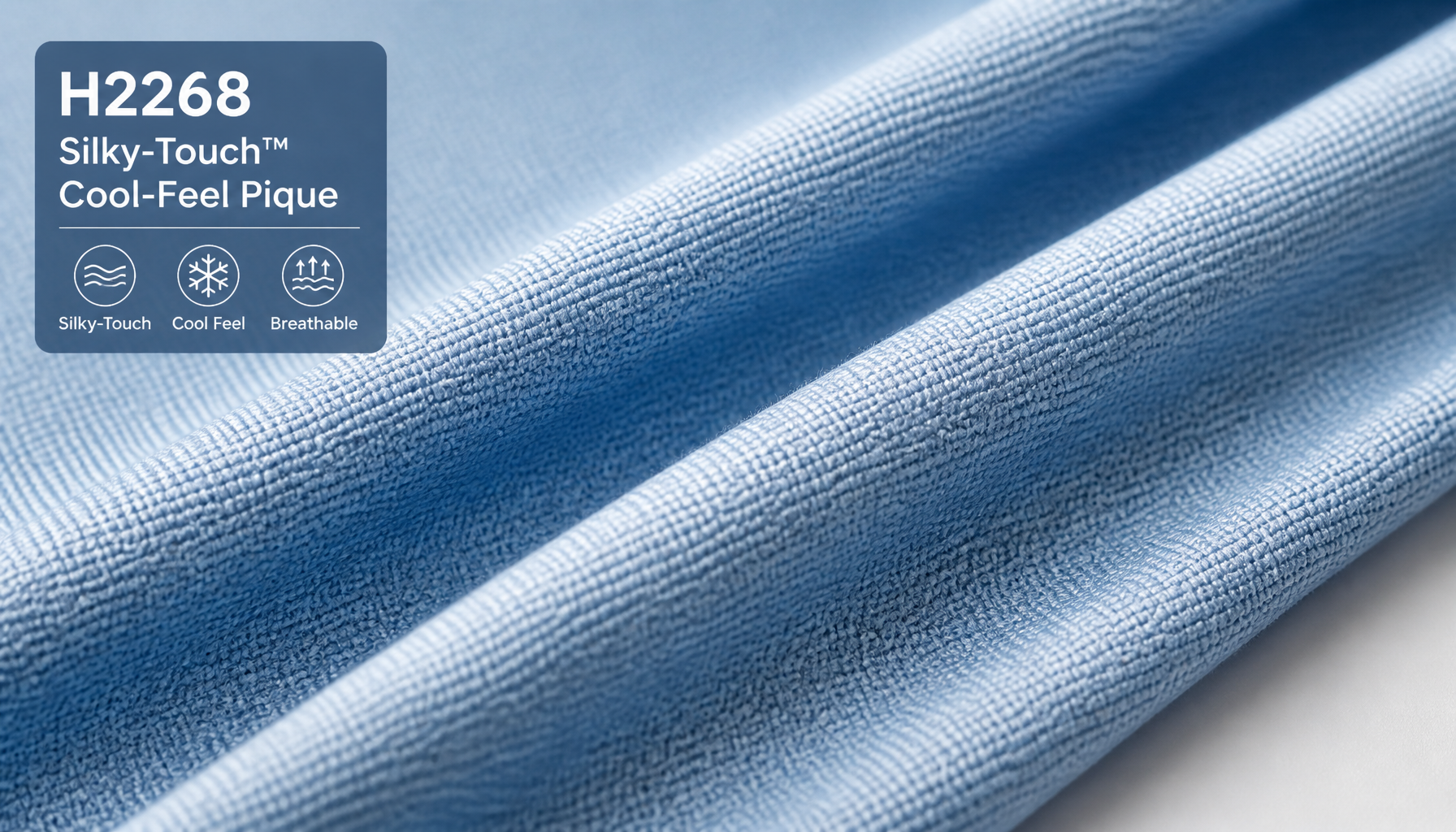
    Pique fabric reference for summer polo development

    Define what the polo must do

    A golf polo, staff uniform, travel polo, and casual fashion polo can share the same silhouette while requiring different fabrics. Record the expected climate, activity level, fit, layering, care route, color range, and target appearance before requesting samples.

    For a fitted performance polo, the body fabric must recover after shoulder and torso movement without making the placket ripple. A uniform programme may place more weight on repeated laundering, shade continuity, and abrasion from bags or equipment. These priorities determine which test results matter.

    Evaluate the pique structure, not just the hand feel

    Pique describes a textured knitted surface, not a fixed level of ventilation or durability. Yarn size, loop geometry, density, thickness, and finishing determine how open the structure is and how it behaves after washing.

    Inspect the face for consistent texture, barre, snagging, and shade variation. Check the reverse against the skin if the polo will be worn without a base layer. After laundering, compare surface fuzzing, dimensional change, spirality, and the alignment of the placket and side seams.

    Require evidence for cooling and moisture claims

    Ask whether “cool feel” refers to initial contact, moisture spreading, drying, air permeability, or another measured property. The supplier should identify the method and provide results for the finished fabric under stated conditioning. If a finish is responsible, confirm how the effect changes after the intended wash cycle.

    A quick water-drop demonstration can show surface wetting, but it does not establish drying time or wearer comfort. Garment fit, ambient humidity, air movement, color, and body coverage also affect the experience.

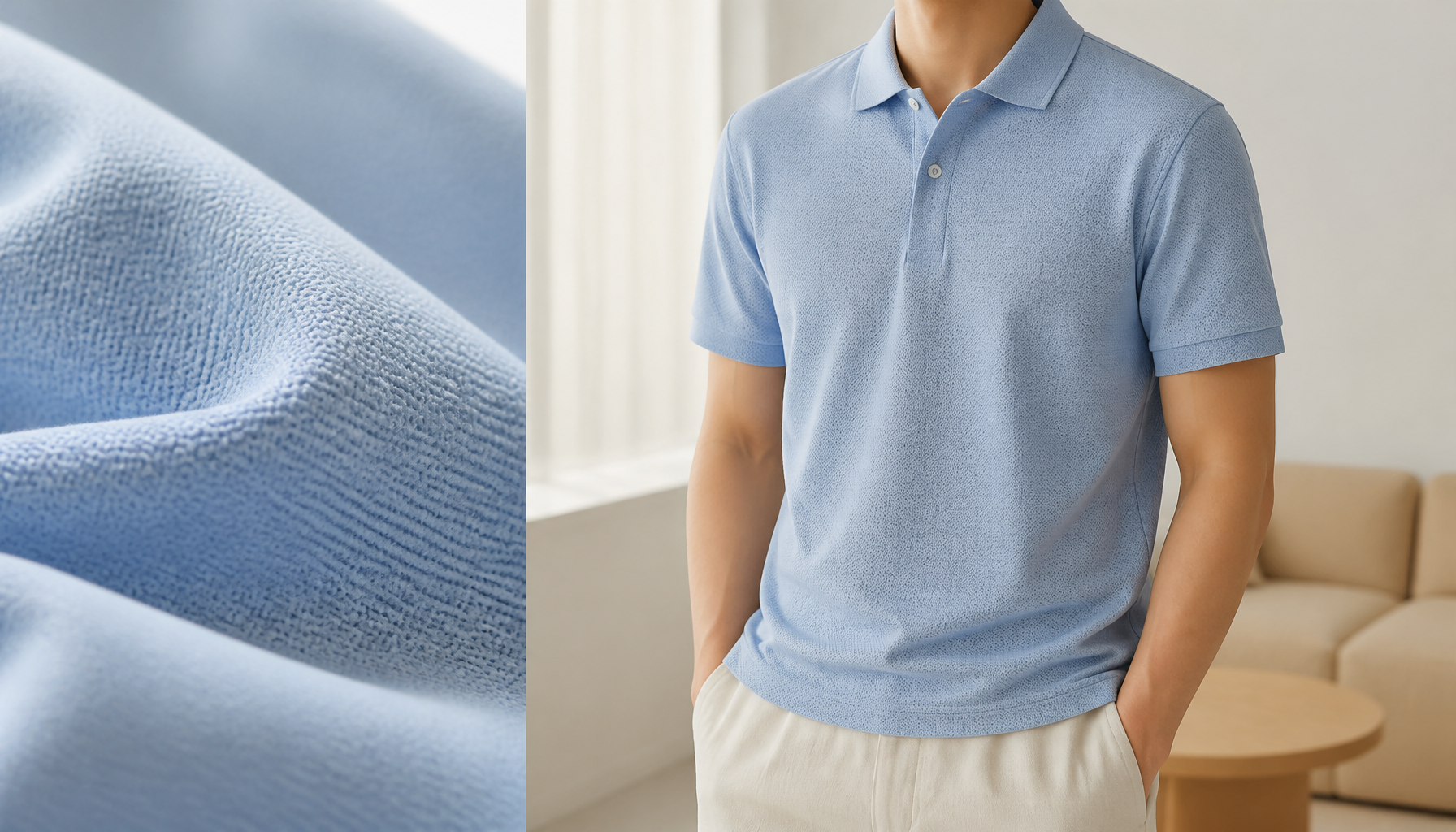
    Cool-feel pique fabric application reference for a polo shirt

    Check collar, placket, and seam compatibility

    The polo body fabric does not automatically provide enough stability for the collar or cuffs. Confirm whether those components require a separate rib, reinforcement, or adjusted construction. Sew the selected fabric with the intended placket, collar, thread, and stitch settings, then inspect puckering, seam growth, skipped stitches, and recovery after washing.

    Compare cost through finished yield

    Request composition, finished GSM, usable width, shrinkage, and edge allowance with the quotation. Two fabrics with similar kilogram prices can produce different garment costs when width, shrinkage, texture alignment, and defect allowance are included. Costing should use conditioned finished measurements rather than nominal greige values.

    Procurement next step

    Send the supplier the polo use case, fit, target GSM and width, texture reference, color range, care cycle, cooling claim, and required appearance tests. Request identified swatches and sufficient yardage for a complete polo, laundering, and placket-collar assessment. Approve bulk only when the sealed sample and written specification describe the same finished fabric.

  • Ice-Silk Technical Twill for Performance Polos and Trousers

    Ice-Silk Technical Twill for Performance Polos and Trousers


    Ice-Silk Technical Twill Jersey is an 86% nylon/14% spandex candidate specified at 165 GSM and 165 cm finished width. For performance polos or trousers, buyers should approve its thermal and moisture behavior, drape, recovery, crease appearance, colorfastness and wash durability rather than rely on the “ice-silk” name or cool first touch.

    Technical twill fabric reference for performance apparel

    Separate cool touch from sustained wear comfort

    A fabric can feel cool at first contact because heat moves quickly from the skin into the material. That sensation does not establish how the garment will behave after the fabric warms, absorbs moisture, or is worn in still air and direct sunlight.

    Ask the supplier to define the cooling claim. It may refer to initial contact cooling, moisture spreading, drying, air permeability, thermal resistance, or a finish. Each mechanism requires a different measurement and gives a different procurement conclusion. The report should identify the method, specimen conditioning, fabric color, and whether the sample was tested before or after laundering.

    Match twill structure to the garment

    A twill-like knitted surface can provide a cleaner diagonal texture and more visual structure than a plain jersey. For a polo, buyers should check collar compatibility, placket stability, drape, and seam puckering. For trousers, the priorities may shift toward seat and knee recovery, abrasion, pocket opening stability, and crease appearance.

    Do not assume one construction is automatically suitable for both. A sample that drapes well in a polo body may lack the recovery needed at the trouser knee, while a more substantial trouser fabric may create excessive bulk in a polo collar or placket.

    Compare candidates under one specification

    Requirement Polo-shirt check Trouser check
    Stretch and recovery Shoulder movement, sleeve opening and hem recovery Seat, thigh and knee extension after wear
    Surface appearance Placket puckering, collar transition and shade Creasing, abrasion and pocket-edge distortion
    Moisture behavior Drying and cling during upper-body activity Comfort at seat and thigh contact zones
    Weight and thickness Drape and layering comfort Coverage, structure and seam bulk
    Dimensional stability Body length and placket alignment after washing Inseam twist, leg length and waistband fit

    Record finished GSM, usable width, construction, composition, finish, and care conditions for every swatch. Without those values, a “cooling twill” comparison is not reproducible.

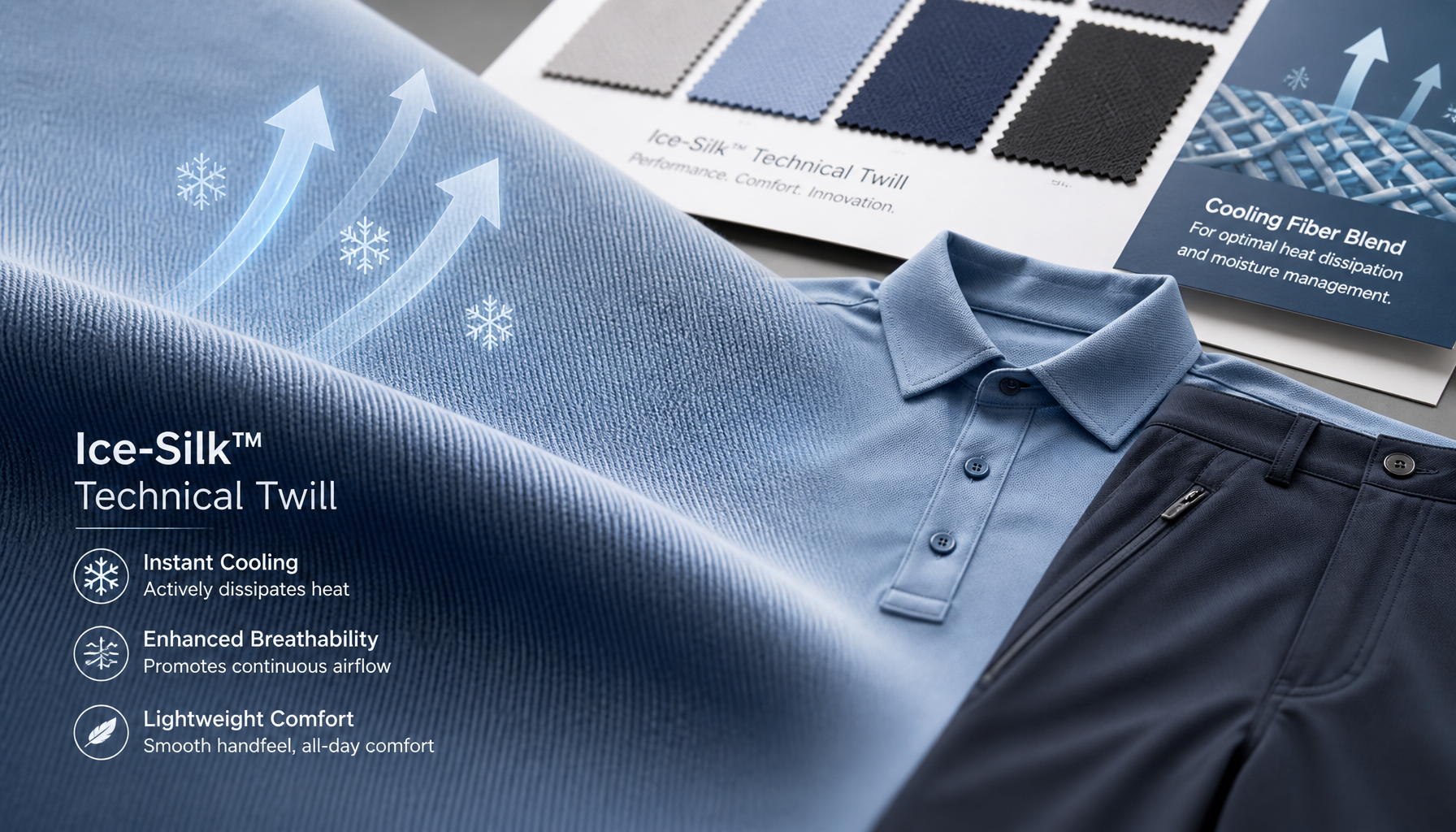
    Cooling twill fabric application reference for polos and trousers

    Verify any finish after the intended care cycle

    If cooling or moisture performance comes from an applied finish, ask whether the quoted result is for an unwashed sample or a specified number of care cycles. Evaluate hand, shade, dimensional stability, and performance after the wash route intended for the garment label. A finish that changes drape or color may create a commercial tradeoff even when its laboratory result is acceptable.

    Color also matters. Dark shades can behave differently in sunlight from pale shades, and dyeing or finishing can affect hand and moisture spreading. Do not extend a result from one color to an entire range without an agreed validation plan.

    Procurement next step

    Prepare separate briefs for the polo and trouser applications. State the target fit, fabric weight and width, stretch direction, care cycle, color range, cooling claim, and required test method. Request identified finished samples, supporting data for the exact construction, and sufficient yardage for sewing and washed-garment trials before approving bulk production.

  • Fortune-Rib Interlock for Performance Sportswear

    Fortune-Rib Interlock for Performance Sportswear


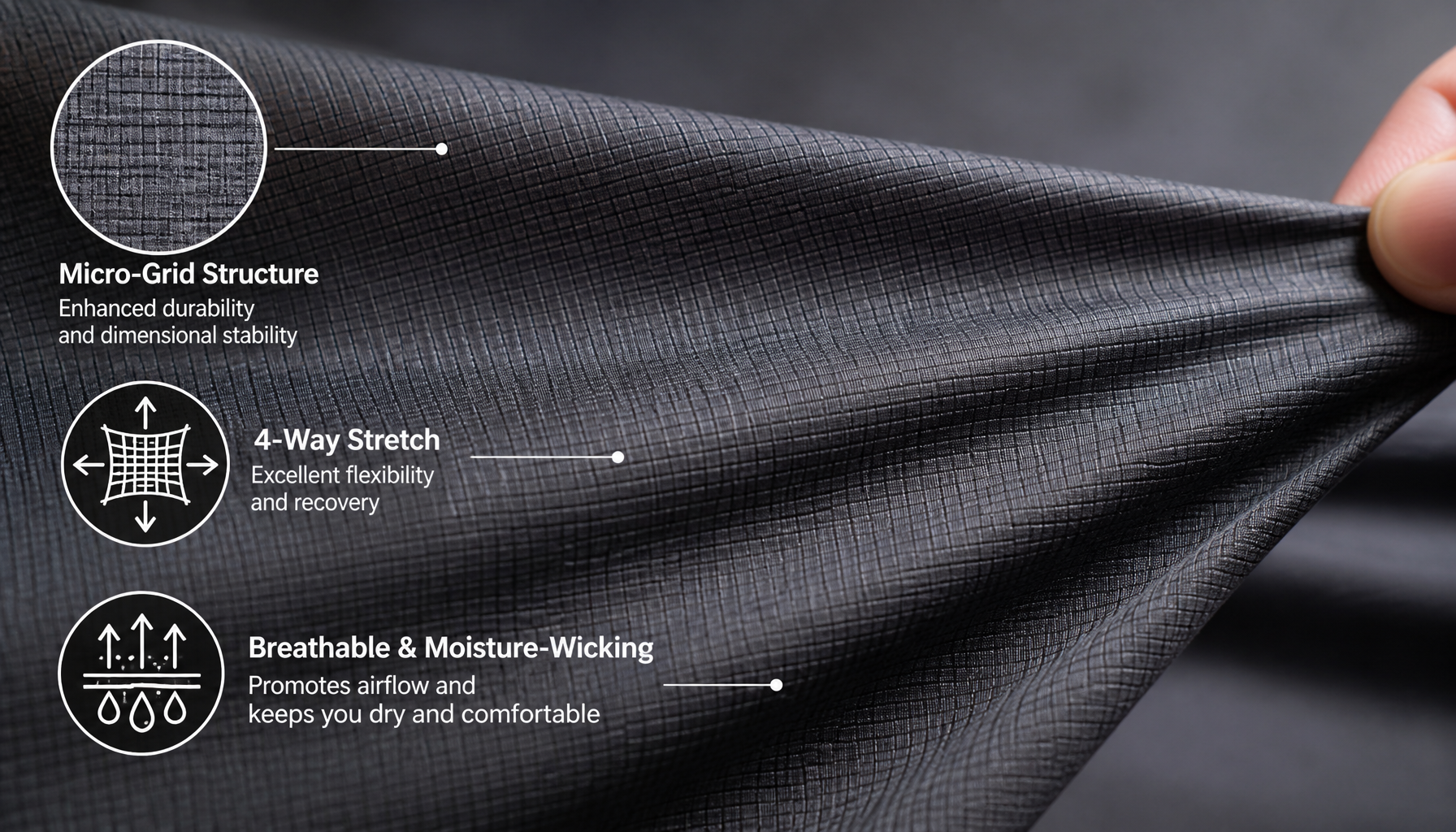
    Fortune-Rib Technical Interlock is a micro-grid interlock candidate for performance sportswear. The current product specification lists 80% nylon/20% spandex, 170 GSM and 170 cm finished width; buyers should still verify stretch recovery, moisture behavior, abrasion resistance and wash stability on the sampled color before approval.

    Close-up reference of micro-grid interlock fabric

    Start with the garment zone and movement pattern

    The same fabric can perform differently in leggings, sports bras, fitted tops, and compression panels. Leggings place repeated extension around the seat and knees; a sports-bra panel combines stretch with seam and elastic loads; a training top may prioritize lower bulk and faster moisture release.

    Before comparing samples, define the garment zone, expected extension, target fit, care cycle, and whether the grid texture will be used as an exterior design feature or a hidden technical surface. This prevents a visually suitable sample from being approved for the wrong mechanical requirement.

    Understand what the micro-grid structure can change

    A grid texture changes surface geometry and may affect visual depth, contact area, drape, and how moisture spreads across the face. Its actual air permeability and drying behavior depend on yarn size, loop density, thickness, finishing, and the openness of the construction.

    Interlock structures are generally more stable than lightweight single knits, but the word “interlock” does not specify recovery, compression, or resistance to pilling. Buyers should compare finished measurements rather than treating the construction name as a performance grade.

    Build a comparable sample review

    Decision area What to record Buyer risk if omitted
    Fabric identity Composition, construction, finished GSM, usable width, finish and color Samples cannot be matched reliably to bulk fabric.
    Stretch response Direction, extension, force or load, hold time, recovery time and post-wash result A flexible sample may bag or feel restrictive in the garment.
    Surface durability Abrasion, pilling and snagging conditions relevant to the end use Raised grid areas may change appearance during wear.
    Moisture behavior Defined wicking, drying or air-permeability method A visible grid may be mistaken for proven ventilation.
    Dimensional stability Wash procedure, shrinkage and spirality by direction Panels may twist or change fit after laundering.

    Hand stretching and water-drop demonstrations can screen candidates, but they do not create comparable acceptance data. Use the same conditioning and test method for every sample under review.

    Micro-grid fabric application reference for fitted sportswear

    Check texture alignment during garment sampling

    Grid direction and panel rotation can create visible differences even when pieces come from the same roll. Mark the approved face and direction, then inspect adjoining panels under the intended lighting. If the marker rotates pieces to improve yield, confirm that the visual result remains acceptable before bulk cutting.

    Sewing trials should examine needle cutting, skipped stitches, seam grin, puckering, and recovery after extension. The correct needle, thread, stitch, and feed settings depend on the actual fabric and seam design; they should not be fixed from the fabric name alone.

    Connect fabric price to usable garment yield

    The lowest price per kilogram may not produce the lowest cost per accepted garment. Usable width, edge loss, shrinkage, shade grouping, grid alignment, and defect allowance affect marker yield. Request finished width and relaxation conditions with the quotation so suppliers are compared on the same basis.

    Procurement next step

    Send the supplier the garment type, panel location, fit intent, expected extension, target GSM and width, color, care cycle, and required durability or moisture tests. Request identified swatches and enough material for garment, washing, and sewing trials. Approve bulk only after the specification and test conditions are linked to a sealed reference sample.

  • Double-Sided Nylon Spandex Fabric for Activewear

    Double-Sided Nylon Spandex Fabric for Activewear


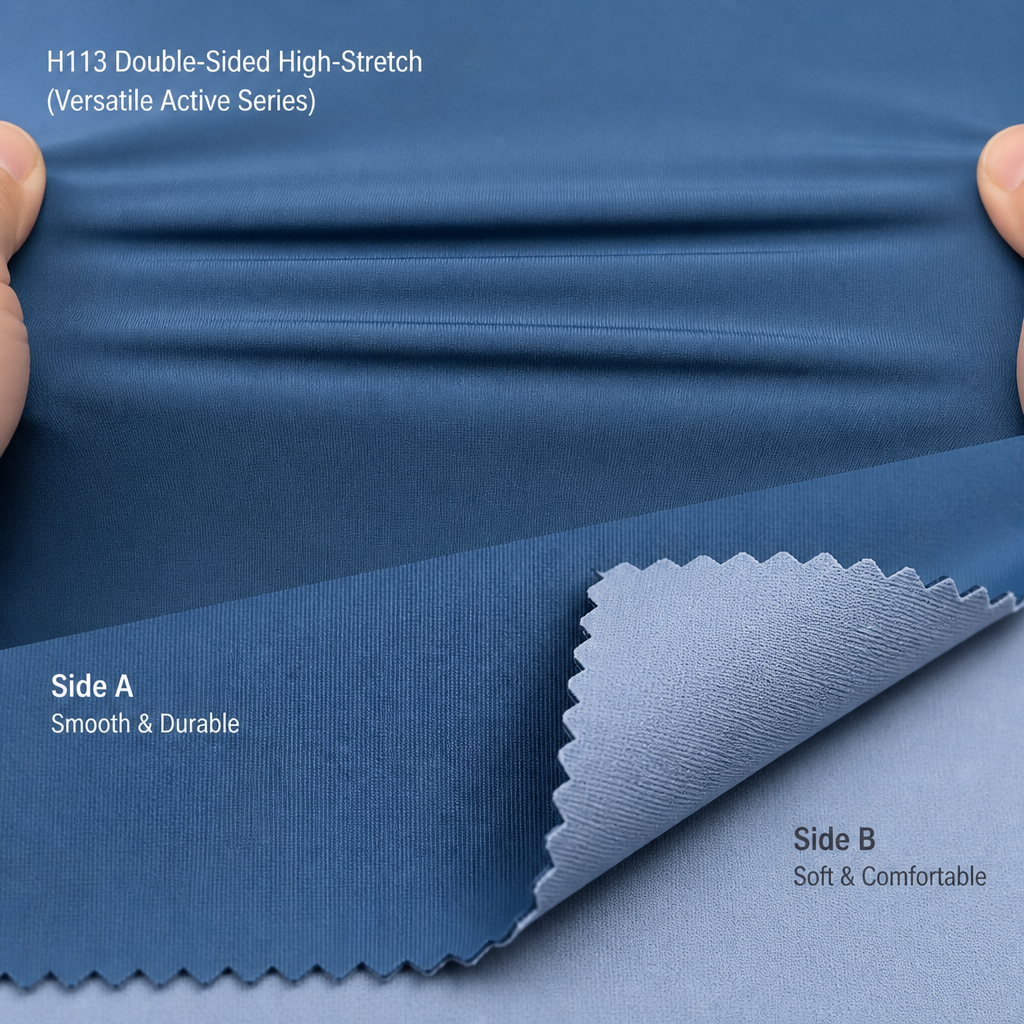
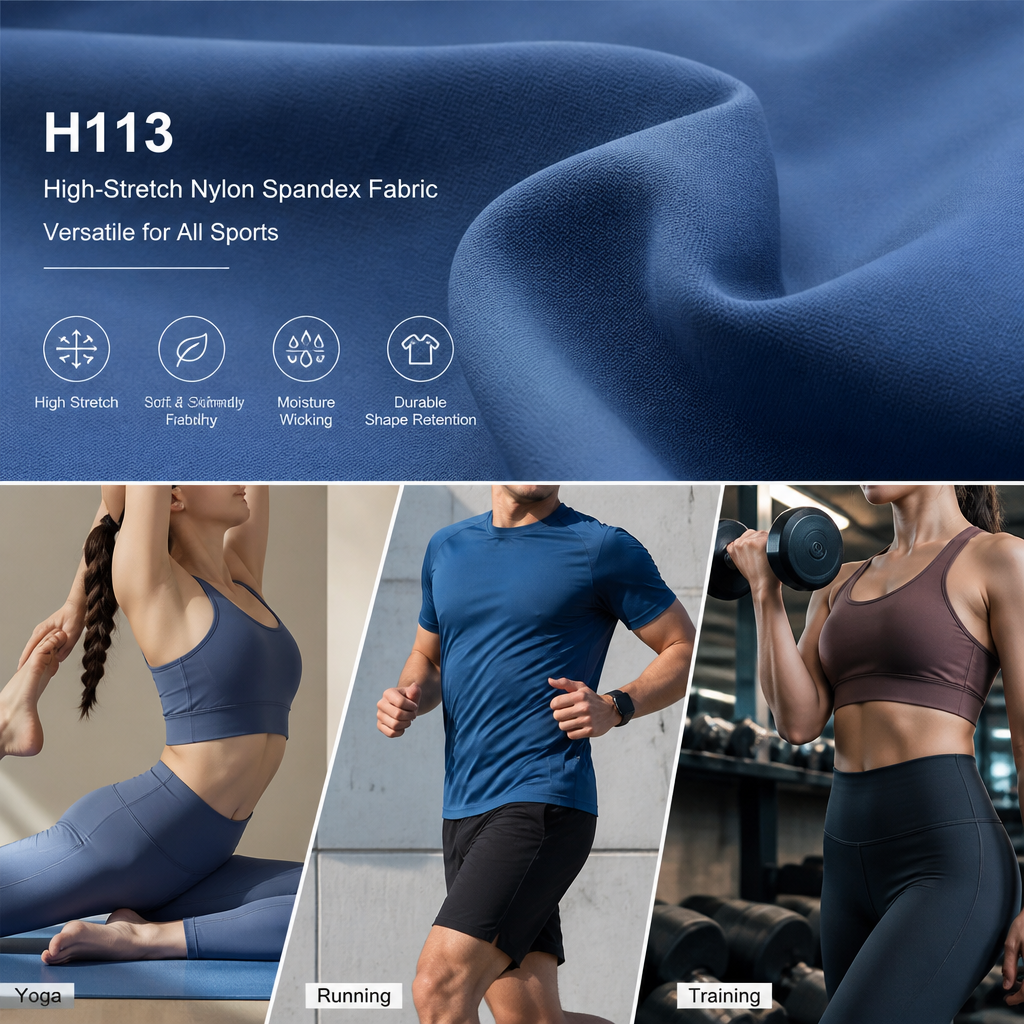
    H113 is a 72% nylon, 28% spandex double-sided fabric specified at 220–230 GSM for fitted activewear. Buyers should treat the composition and weight as a starting point: support, stretch recovery, moisture handling, opacity, and wash durability must be approved on the finished fabric and in the intended garment construction.

    Read the specification as a system

    The supplied product information identifies three relevant variables:

    • 72% nylon / 28% spandex: a high elastane proportion, which signals that stretch and recovery require close control during knitting, finishing, cutting, and sewing.
    • 220–230 GSM: a medium-to-substantial fabric mass for fitted activewear, subject to the garment pattern and end use.
    • Double-sided construction: both faces should be inspected for hand feel, appearance, snagging, and consistency because either side may contact the skin or remain visible in construction details.

    These values do not establish compression level, moisture-wicking performance, colorfastness, or long-term shape retention by themselves. Each claim needs a defined test method and an agreed acceptance requirement.

    Reference image supplied for H113 double-sided fabric

    Match H113 to the garment requirement

    H113 may be considered for yoga leggings, fitted training bottoms, sports tops, and other close-to-body activewear where a smooth two-sided surface and substantial stretch are required. The same fabric can behave differently across these applications because pattern reduction, seam placement, panel orientation, and body-zone extension change the load applied to the material.

    For leggings, assess recovery and coverage at the intended hip and seat extension. For tops, check whether the weight, drape, and moisture conditions are appropriate for the design. A fabric suitable for a supportive bottom is not automatically the right choice for a lightweight training shirt.

    Illustrative garment-weight calculation

    The following is a hypothetical calculation, not ClothFactory production or test data. If a garment consumes 1.20 m² of finished fabric before cutting waste, the fabric mass would be:

    • at 220 GSM: 1.20 m² × 220 g/m² = 264 g;
    • at 230 GSM: 1.20 m² × 230 g/m² = 276 g.

    The 10 GSM difference changes calculated fabric mass by 12 g in this example. It does not indicate which sample will provide better support or comfort; construction, usable width, pattern utilization, and finishing still need to be compared.

    Verify the performance claims

    Use matched test conditions when comparing H113 with another candidate. At minimum, define:

    Decision area Required evidence
    Stretch and recovery Direction, extension level, hold time, recovery time, and test method
    Garment support Prototype fit assessment at the intended pattern reduction; do not infer compression from spandex percentage alone
    Moisture handling Test method, fabric side exposed to liquid, conditioning, and wash state
    Opacity Selected color tested at representative garment extension
    Dimensional stability Agreed wash and drying cycle with length and width change reported separately
    Surface durability Pilling, abrasion, and snagging requirements appropriate to the garment

    One color approval should not be used to approve every shade. Dye concentration and finishing conditions can affect hand, appearance, stretch response, and visual coverage.

    Second reference image supplied for H113 double-sided fabric

    Cutting and sewing controls

    Keep the grain direction consistent across paired and adjacent panels. Before bulk cutting, compare panel dimensions after relaxation because high-stretch fabric can distort when spread under tension.

    Run a sewing trial with the intended needle, elastic thread or stretch-compatible thread, stitch density, seam type, and machine settings. Evaluate the seam both relaxed and extended, then repeat the check after the agreed care cycle. The approval criteria should cover skipped stitches, seam grin, tunneling, thread breakage, puckering, and recovery around the seam.

    What to include in an H113 sample request

    Provide the intended garment, target fit, pattern reduction if known, required finished width, approved GSM tolerance, color, care cycle, and test requirements. Ask the supplier to return exact construction details, usable width, stretch and recovery results by direction, dimensional stability, and any evidence supporting moisture-management or durability claims.

    This creates a comparable sourcing record and prevents the 72/28 composition from being treated as proof of finished-garment performance.

  • High-Stretch Rib Fabric for Activewear

    High-Stretch Rib Fabric for Activewear


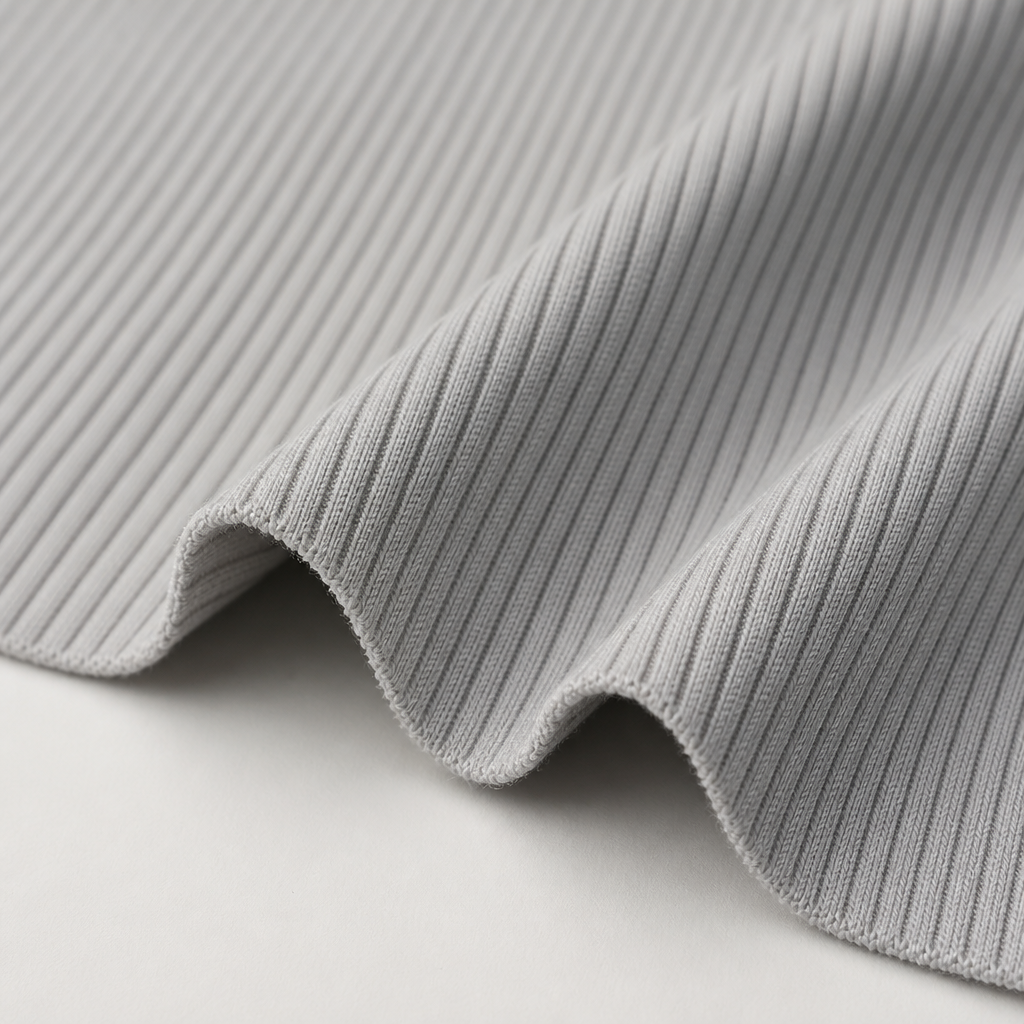
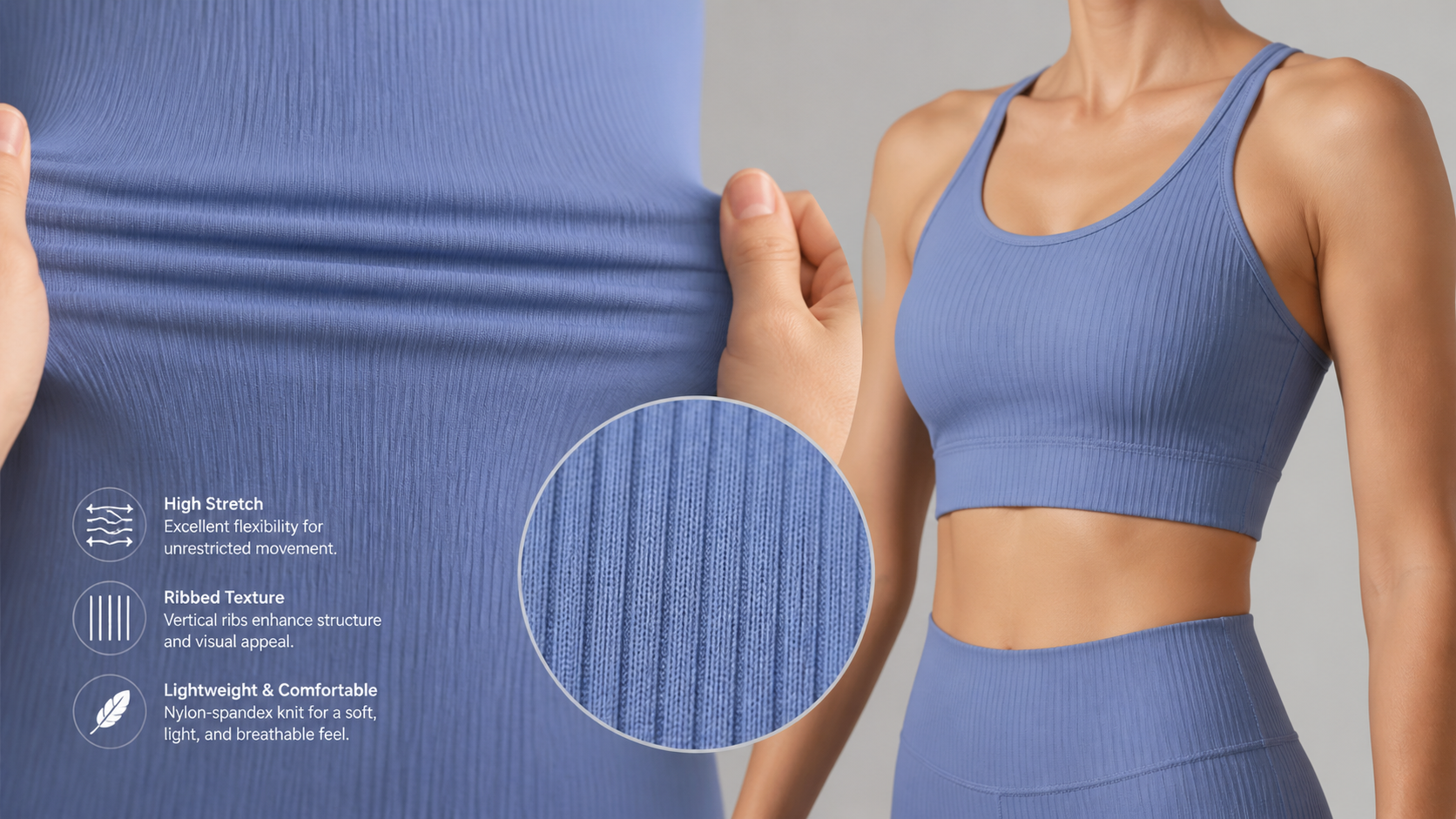
    H3827 should be evaluated as a lightweight nylon-spandex rib candidate for fitted activewear, not approved from fiber type or surface appearance alone. The supplied specification describes an approximately 160 GSM fabric with vertical ribs, but the exact fiber percentages, finished width, stretch data, recovery data, and tested performance must be confirmed before sampling or quotation comparison.

    Reference image supplied for H3827 rib fabric

    What the available specification establishes

    Item Information currently available What the buyer still needs
    Fiber family Nylon-spandex Exact composition by mass
    Construction Rib knit with vertical surface texture Rib repeat, course direction, and finished construction reference
    Nominal weight Approximately 160 GSM Agreed tolerance and conditioned test result
    Finished width Not stated Usable width and width tolerance
    Stretch Described as high stretch Extension and recovery by direction under one agreed test method
    Functional finishes Not stated Any required moisture-management or other finish, including durability conditions

    The distinction matters because “nylon-spandex rib” is not a complete purchasing specification. Two fabrics with the same fiber family and nominal GSM can differ in rib geometry, elastane percentage, usable width, recovery, opacity, hand feel, and sewing behavior.

    How the rib structure affects garment development

    Vertical ribs create alternating raised and recessed lines that give the surface visible depth. The structure can also change how the fabric extends and recovers in each direction, so stretch should be measured in both wale and course directions rather than described only as “four-way stretch.”

    At approximately 160 GSM, H3827 is positioned as a lightweight option. Low fabric mass may reduce garment weight, but it does not prove breathability, moisture transport, opacity, or durability. Those outcomes also depend on stitch density, yarn selection, dyeing and finishing, color, and the amount of extension imposed by the garment pattern.

    Where H3827 may fit

    H3827 may be considered for:

    • lightweight leggings or fitted shorts where a visible rib surface is part of the design;
    • close-fitting tops and coordinated activewear sets;
    • lightweight layering pieces that require stretch without a heavy hand;
    • athleisure styles in which texture is a design feature rather than a printed effect.

    For leggings, assess coverage on the finished color at the intended garment extension. A relaxed swatch can appear opaque while the same fabric becomes visibly more open when stretched over the hip, seat, or knee. Light colors and dark colors should not be assumed to perform identically.

    Second reference image supplied for H3827 rib fabric

    Sampling and production checks

    Rib direction should be marked during pattern placement so corresponding garment panels have a consistent appearance. Before approving raw edges, laser-cut details, or reduced hemming, test the actual dyed and finished fabric: a knit that resists visible fraying can still curl, distort, ladder, or lose stability at a cut edge.

    Sewing trials should reproduce the intended seam type, stitch density, needle, thread, and garment extension. Seam appearance at rest is not enough; inspect the seam while stretched and after the agreed wash cycle for skipped stitches, tunneling, thread breakage, and permanent growth.

    Buyer approval checklist

    Request the following on the sample submission or technical data sheet:

    1. Exact nylon and spandex percentages.
    2. Finished GSM and acceptable tolerance.
    3. Usable width and width tolerance.
    4. Stretch and recovery results in both directions, with the test method and conditions.
    5. Dimensional stability after the intended care cycle.
    6. Opacity assessment in the selected color at the garment's expected extension.
    7. Pilling, abrasion, and colorfastness requirements appropriate to the end use.
    8. A sewing trial using the intended seam construction.

    For a comparable ClothFactory development request, provide the garment type, target fit, preferred color, required usable width, target weight range, care instructions, and acceptance tests. This allows H3827 to be assessed against the finished garment requirement rather than approved from a generic “high-stretch rib” description.

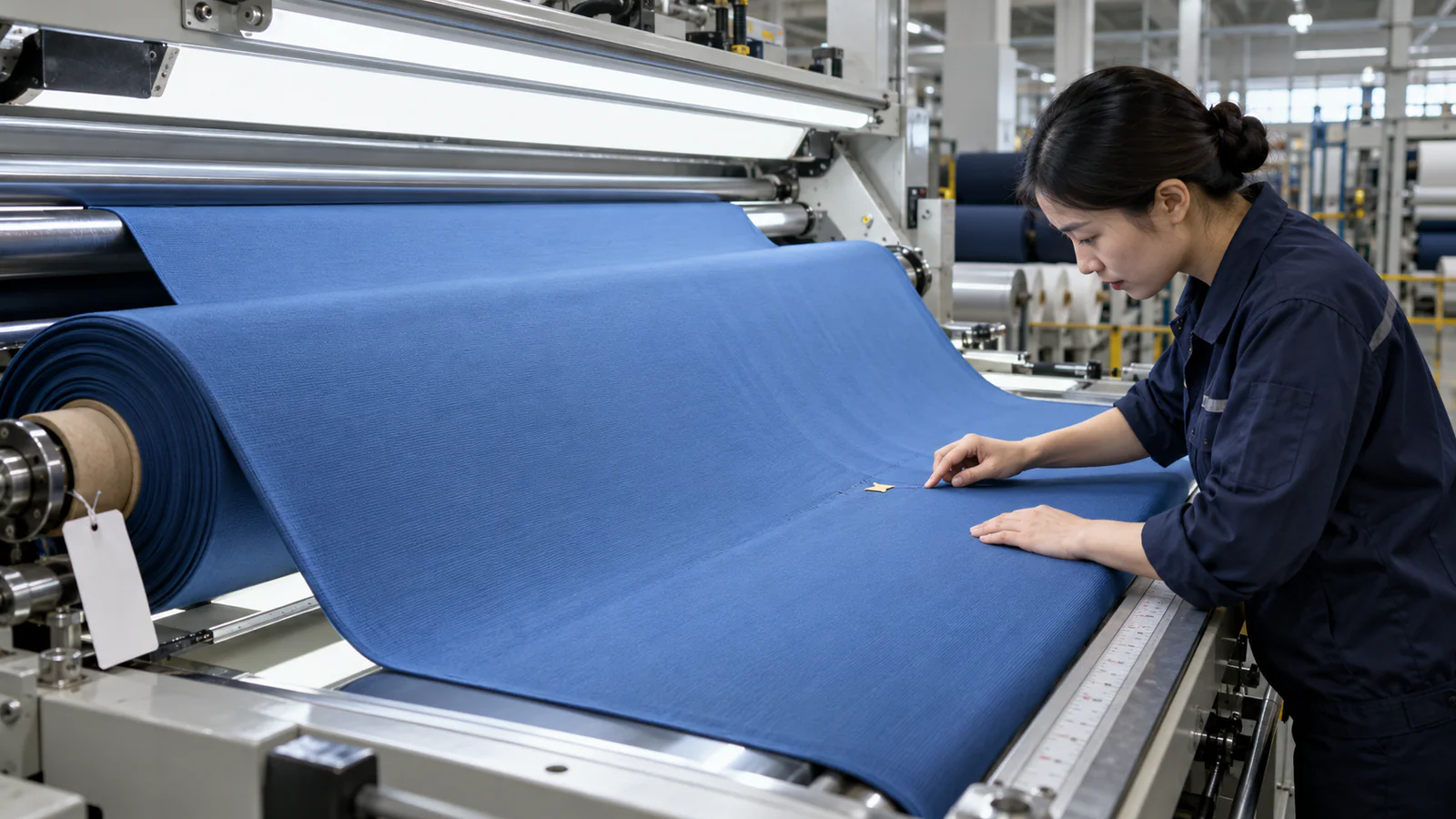
  • Fabric Defect Inspection for Knitted Fabrics

    Fabric Defect Inspection for Knitted Fabrics

    Inspect knitted fabric in two stages: first grade visible defects against an agreed Four-Point limit; then verify GSM, width, stretch recovery, dimensional stability, bursting strength, colorfastness and moisture management with defined tests. Release bulk production only after approving the quality sample, defect limits, inspection scope and test plan.

    Define the acceptance agreement before inspection

    ASTM D5430 covers the visual inspection and grading of fabrics and allows the method to be used for shipment acceptance when the purchaser and supplier agree on the requirements. ASTM also notes that different point-assignment options can produce materially different results. The purchase order should therefore identify the method, point schedule, inspection scope and acceptance limit rather than state only “Four-Point inspection.”

    A workable bulk specification should define:

    • the approved quality sample and color standard;
    • the percentage or number of rolls to inspect;
    • whether rolls are selected randomly or by risk;
    • the point-assignment option and score limit;
    • critical defects that cause automatic roll rejection;
    • permitted shade grouping and roll-to-roll color difference;
    • width, GSM and physical-performance tolerances;
    • the action required after a failed sample inspection.

    There is no single point limit suitable for every order. A buyer may adopt 40 points per 100 square yards, 25 points or another limit, but that number is a commercial acceptance criterion, not proof that the fabric will perform in the garment.

    Use the Four-Point System consistently

    The common Four-Point schedule assigns points from the longest dimension of each visible defect:

    Defect length Penalty
    Up to 3 in (75 mm) 1 point
    Over 3 to 6 in (75–150 mm) 2 points
    Over 6 to 9 in (150–230 mm) 3 points
    Over 9 in (230 mm) 4 points

    No linear yard or meter should receive more than four points. The Cotton Incorporated Four-Point summary also assigns four points to a full-width defect, a seam, or a section whose usable width is below the agreed minimum. Holes, continuous defects and other critical faults should be handled exactly as stated in the buyer–supplier inspection agreement.

    For orders measured in yards and inches, normalize the score as follows:

    Points per 100 yd² = total penalty points × 3,600
                           ÷ (inspected yards × fabric width in inches)
    

    Worked shipment example

    A buyer inspects 800 yards of 60-inch fabric and records 420 points:

    420 × 3,600 ÷ (800 × 60) = 31.5 points per 100 yd²
    

    If the purchase specification allows no more than 25 points per 100 square yards, the inspected lot fails. The correct response is not an immediate argument over the total. First check the defect map: one repeated needle line across several rolls has a different production and cutting impact from many isolated minor marks that produce the same score.

    Classify defects by garment risk

    The inspection report should record defect type, roll number and position. “Fabric defective” is not enough information for containment or cutting decisions.

    Defect Likely production signal Garment risk
    Needle line or drop stitch Damaged needle, incorrect needle setup or unstable knitting condition Visible line, hole growth or panel rejection
    Barre or horizontal banding Yarn-lot, tension, feed or dye-affinity variation Repeating shade bands across garment panels
    Side-to-center or end-to-end shading Uneven dyeing, heat setting or finishing Panels from one roll appear mismatched
    Bow or skew Knitting and finishing distortion Twisted seams, displaced stripes or unstable garment shape
    Crease or heat-set mark Rope crease, folding pressure or finishing condition Permanent line that remains after relaxation or washing
    Oil, contamination or foreign fibre Machine oil, handling or material contamination Stains, dye spots or visible foreign matter
    Snag, pull or surface abrasion Handling, machine contact or unsuitable surface durability Broken appearance and reduced consumer durability
    Hole Needle damage, excessive tension or handling damage Automatic panel loss; may propagate under stretch

    For nylon-spandex and polyester-spandex fabrics, inspect the material both relaxed and under a controlled extension agreed during development. A defect that is difficult to see on a relaxed dark fabric may become obvious when a legging panel is stretched. The extension condition must be recorded; uncontrolled hand stretching does not provide comparable results.

    Inspect rolls with traceable conditions

    The inspection process should make the result repeatable:

    1. Confirm the purchase order, approved sample, color standard and inspection method.
    2. Select rolls across dye lots, production dates and machine positions. Increase coverage when earlier lots, new constructions or dark shades present higher risk.
    3. Condition or relax the fabric as required by the agreed method before measuring width, GSM or distortion.
    4. Inspect on a calibrated machine under consistent lighting. Record the inspection speed instead of relying on an unrecorded “normal speed.”
    5. Mark every defect and record its roll position, point value and defect code.
    6. Check usable width and shade at the beginning, middle and end of each inspected roll.
    7. Calculate the normalized score for each roll and for the inspected lot.
    8. Quarantine failed or doubtful rolls until disposition is agreed.

    The report should retain roll identity. A shipment average can conceal one severely defective roll, while a roll-level record allows cutting teams to segregate material or calculate expected panel loss.

    Separate visual grading from performance testing

    A visually clean roll can still fail in production. Select laboratory tests according to the garment and claim rather than attaching every available method to every order.

    Procurement risk Test direction
    Incorrect fabric weight Mass per unit area, such as ASTM D3776/D3776M
    Width shortage Fabric width, such as ASTM D3774
    Twisting or distorted courses Bow and skew, such as ASTM D3882
    Bagging or poor recovery Stretch and growth under a method suitable for the construction and support level; ASTM D2594/D2594M is one option for low-power knitted fabrics
    Bursting at knees, elbows or tight seams Bursting strength, such as ASTM D3786/D3786M or ASTM D6797
    Surface fuzzing or pills Pilling resistance, such as ASTM D4970/D4970M
    Snagging on textured knits A snagging method selected for the fabric structure, such as ASTM D3939/D3939M or ASTM D5362
    Dye transfer or wash discoloration Agreed AATCC colorfastness methods for crocking, laundering and perspiration
    Moisture-management claim A defined AATCC method such as TM195, TM197, TM198 or TM217, chosen for the claimed behavior

    A pen puncture is not a bursting-strength test, squeezing fabric in a fist is not a recovery test, and timing one water drop is not sufficient evidence for a moisture-wicking claim. These checks may help screen samples, but they should not release bulk fabric or support product claims.

    ASTM D2594/D2594M also cautions that its between-laboratory precision is poor for commercial acceptance. If buyer and supplier laboratories report materially different stretch or growth results, test matched specimens and investigate method, conditioning and equipment bias before deciding which lot is acceptable.

    Write a release rule that protects garment yield

    The release decision should combine four records:

    • roll-level visual inspection scores and defect maps;
    • shade grouping and roll sequence;
    • measured width, GSM and agreed physical-test results;
    • the effect of defects on marker placement and usable garment yield.

    Return to the 800-yard example. A score of 31.5 fails a contractual limit of 25, but the commercial decision still depends on location. If most points come from a continuous needle line through the marker width, panel loss may make the lot unusable. If isolated defects can be mapped and cut around, the parties may agree to replacement yardage, a credit or controlled cutting. Any concession should identify the affected rolls and must not silently change the standard for future lots.

    Information buyers should send with an inspection request

    Provide the fabric code and construction, fiber composition, nominal GSM and usable width, color and dye-lot details, end use, approved quality sample, inspection scope, Four-Point limit, critical-defect list, physical test methods and tolerances. For close-fitting activewear, also state the garment zone, expected extension and whether appearance must be assessed under stretch.

    This information lets the fabric mill inspect against the intended product rather than a generic checklist. It also creates a traceable basis for corrective action before cutting begins.

    References
  • Custom Fabric Options for High-Performance Training Shirts

    Custom Fabric Options for High-Performance Training Shirts

    For high-performance training shirts, define moisture management, cooling, mesh design and odour-control requirements before choosing a fabric. Treat these as separate development options, then select a base construction that meets the shirt’s fit, coverage and cost requirements.

    Four customisation options to define first

    • Moisture wicking: specify how the fabric should absorb and spread sweat, with a separate drying requirement if needed. Evaluate the selected finish after the agreed laundering sequence, not only on an unwashed swatch.
    • Cooling: clarify whether the brief calls for a cool initial touch or comfort during sustained exercise. Approve the yarn or finishing proposal against that objective rather than treating “cooling” as a single guaranteed effect.
    • Jacquard mesh: define the pattern, opening size and placement to balance visual identity, ventilation and coverage. Body-mapped designs require the mesh layout to align with the garment panels; a repeating pattern alone does not provide that alignment.
    • Antibacterial and odour control: agree the intended claim and wash-durability requirement. Do not treat antibacterial activity as proof of odour reduction; AATCC TM211 specifically evaluates bacterial odour reduction on antibacterial-treated textiles.

    For a fitted team-training shirt, prioritise moisture handling and coverage first. Add cooling or odour-control treatments where the brief justifies the extra cost, and approve the combined finish rather than assuming individually approved treatments will perform identically together.

    Why consider H986 as the base fabric?

    H986 Future-Mesh™ Jersey is a candidate for this development route. ClothFactory’s catalogue lists its gradient pinhole construction at 90% nylon / 10% spandex, 180 GSM and 163 cm nominal width.

    \"Concept
    Design illustration based on the H986 fabric reference; not a production sample.

    Its distinguishing feature is the patterned mesh structure: an option for an all-over textured training shirt or selected ventilation panels. The nylon-spandex knit provides a stretch-fabric starting point for movement-oriented designs, while the 180 GSM specification gives buyers a clear basis for garment-weight planning. Neither the mesh appearance nor the spandex percentage establishes a measured airflow or recovery result.

    The catalogue lists cooling, antibacterial, anti-odour and quick-dry finishes as available options. Confirm the required combination for the selected colour and order; these are customisation choices, not evidence that every H986 stock lot includes all four. A bespoke jacquard pattern also needs a separate construction review.

    \"lose-up
    Concept mesh-panel construction; final material and seam details require sample approval.

    Move from a fabric option to an approved sample

    Send ClothFactory the shirt sketch, target fit and weight, colourways, quantity by colour and required functions. Request H986 sampling yardage with the proposed finish, then approve moisture handling, stretch recovery and appearance after washing. Include a coverage check in the intended fit before choosing all-over mesh over a panelled design.

  • H2872 Shark-Skin Brushed Fleece: The Premium Fabric Choice for Functional Autumn-Winter Activewear

    H2872 Shark-Skin Brushed Fleece: The Premium Fabric Choice for Functional Autumn-Winter Activewear

    H2872 should be evaluated as a layered material, not as a generic high-spandex fleece. ClothFactory’s catalogue lists a shark-skin composite brushed fabric at 370 g/m² and 165 cm width, with a face composition of 80% nylon and 20% spandex and a back composition of 95% polyester and 5% spandex. These are nominal catalogue figures. Confirm the actual layer construction, bonding system and finished specification before comparing quotations.

    Read the composition by layer

    Reporting this article simply as “20% spandex” would describe the face but misrepresent the entire composite. An overall composition requires the mass contribution of each relevant component and the applicable labelling basis. Without layer weights, the two percentages cannot be averaged into a defensible whole-fabric claim.

    Ask the supplier to identify the face, backing and joining process on the technical sheet. A swatch can show which surface contacts the skin, but it cannot establish adhesive chemistry, bond coverage or fibre content. Keep the approved construction revision with the sample so a later change in backing or bonding does not pass unnoticed under the same commercial article name.

    Choose the thermal system for the activity

    A winter commuter waiting outdoors and a runner generating heat continuously need different balances of insulation and moisture escape. A substantial brushed backing may suit the first brief while becoming excessive for the second. Garment openings, wind exposure, layering and activity level affect the outcome; fabric weight alone cannot justify a temperature rating such as “suitable for 0–10°C.”

    ISO 11092 measures thermal and water-vapour resistance under controlled steady-state conditions and can address layered assemblies. Use comparable results to screen materials, then assess the intended garment system. A laboratory resistance value is not a promise of comfort at a particular outdoor temperature.

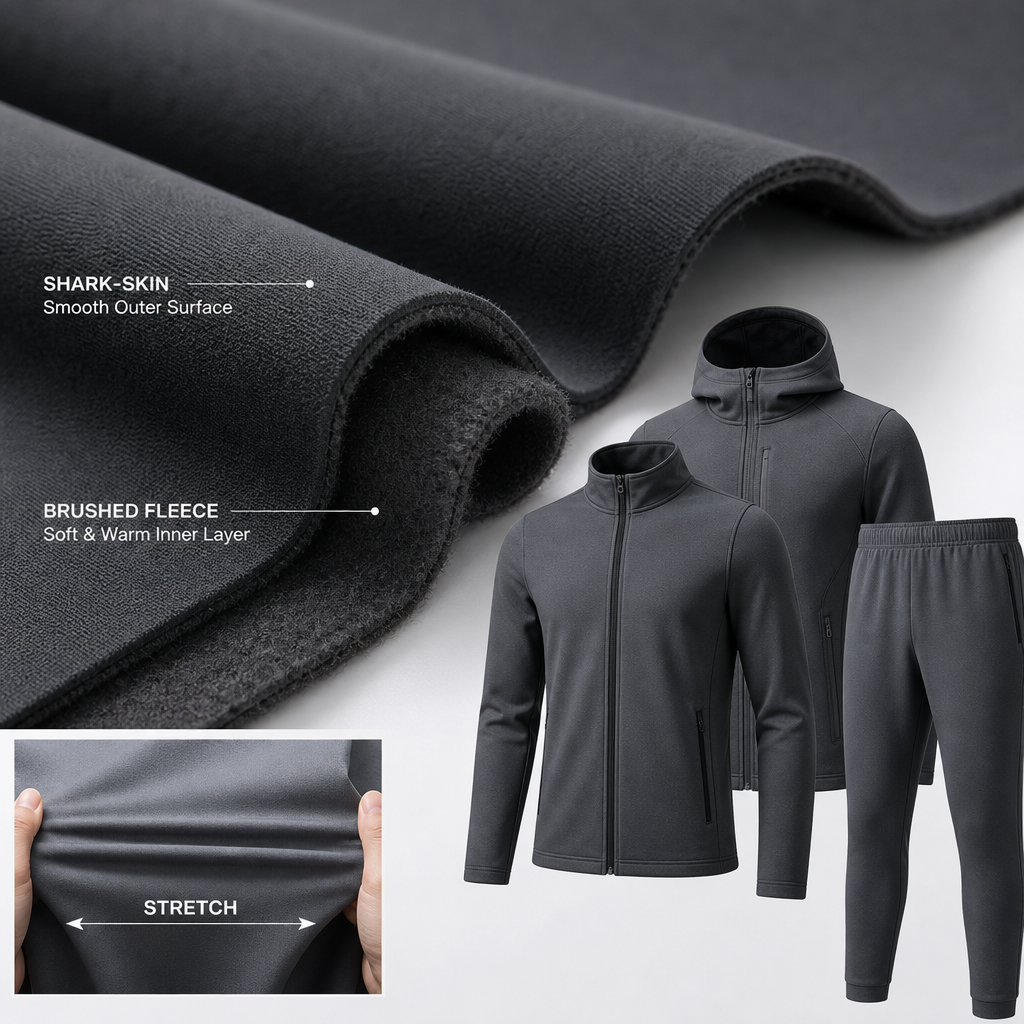
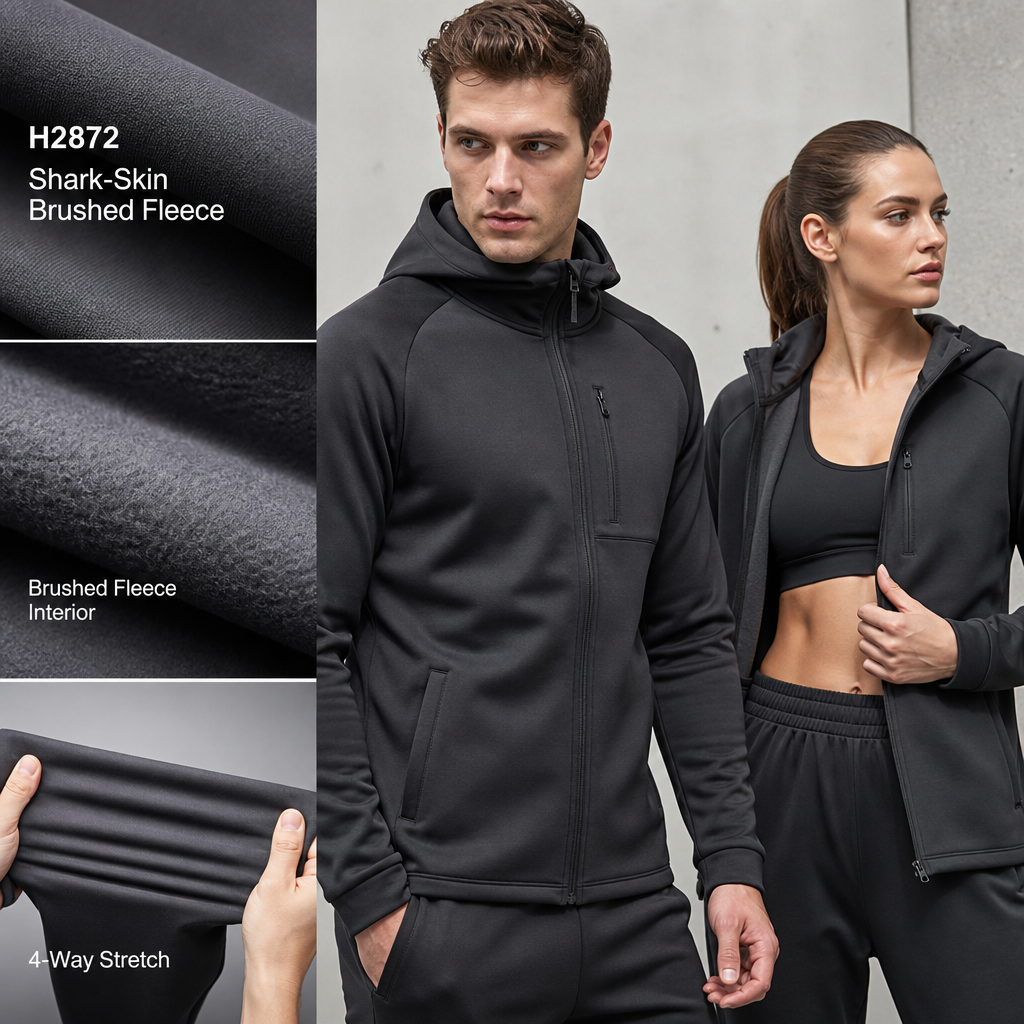
    Black activewear jacket concepts beside smooth-face and brushed-back fabric swatches
    Application illustration. The pictured garments do not establish a temperature rating or verified test performance for H2872.

    Treat the bond as a performance component

    The face and backing can stretch and recover differently. If the joining system restricts one layer, a fabric that feels elastic by hand may resist movement, wrinkle or develop separation in use. Evaluate both directions and inspect the composite after repeated extension and the specified laundering sequence.

    Request an agreed bond-integrity assessment appropriate to the construction. Record visible bubbling, edge separation, local stiffness and any change in hand feel, alongside quantitative bond results where applicable. Specify specimen preparation and care history rather than accepting a single unexplained “peel strength” number. Passing an initial test does not establish durability after washing.

    Build a pilot garment before approving the roll

    At 370 g/m², seam bulk deserves attention around zipper ends, pocket entries, cuffs and intersecting seams. Trial the proposed seam allowance and trimming method on the actual assembly. Inspect whether stitches damage the surface, whether the zipper waves and whether several folded layers create pressure points.

    Check nap direction before marker approval. Reversing panels can change perceived shade or surface appearance even when the colour measurement is acceptable. Review abrasion and pilling at likely contact zones, including underarms and backpack contact areas. Do not claim anti-static performance from a brushed hand feel; that requires separate evidence if it is part of the product brief.

    Price the approved construction, not just the kilogram

    Using nominal dimensions, one linear metre weighs 370 × 1.65 ÷ 1,000 = 0.6105 kg, giving approximately 1.64 m/kg. Usable width, one-way nap layouts and defects determine actual cutting yield. A low kilogram price can be offset by directional cutting restrictions or extra sewing time at bulky intersections.

    For an illustrative material comparison, a marker requiring 1.2 linear metres would contain about 0.733 kg at the nominal full-width mass. That calculation estimates purchased fabric mass, including the marker’s unused area; it is not the finished jacket weight. Use the approved marker and measured roll data for the production budget.

    Define the bulk approval boundary

    Release production only against an identified face-and-back specification, agreed usable width, dimensional-change limits, appearance standard and bond durability requirements. Retain a washed garment as well as an unwashed swatch. If the backing, bonding process or finish changes, review whether the original elasticity, thermal and care approvals still apply.

    H2872 merits consideration where a substantial composite structure supports the garment brief. It should not be selected solely because “shark-skin,” “winter” or “brushed” appears in the name. The relevant purchase is a reproducible material system that survives the intended assembly and care conditions.

  • H213 Cooling Silk-Touch Nylon Spandex Fabric: The Premier Choice for Summer Sun-Protection and Activewear

    H213 Cooling Silk-Touch Nylon Spandex Fabric: The Premier Choice for Summer Sun-Protection and Activewear

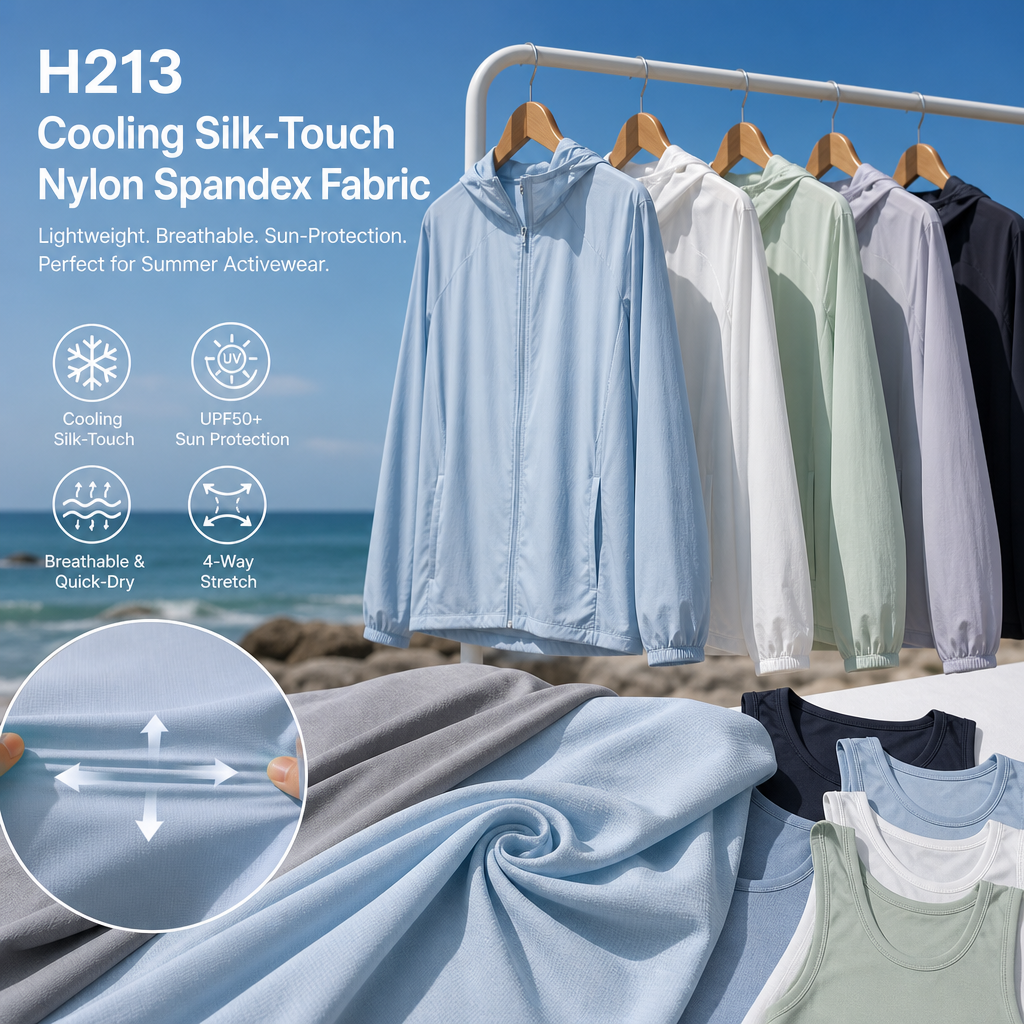
    H213 is positioned as a lightweight, silk-touch nylon-spandex knit. ClothFactory’s catalogue lists 85% nylon, 15% spandex, 120 g/m² and 165 cm width. “Silk-touch” describes a proposed hand feel, not silk fibre content. Buyers should confirm the finished specification and evaluate cooling, drying and sun-protection claims separately before using them in a garment brief or product listing.

    Define what the summer garment must do

    A loose sun-protection top, a fitted sleeve and a running base layer do not share one acceptance standard. The loose top may prioritise drape and coverage. The sleeve needs recovery at the wrist and elbow. The base layer may prioritise sweat handling and low wet cling. Establish the end use before selecting a laboratory test or comparing swatches.

    For a pale, close-fitting garment, assess the material at the strain created by the pattern and inspect it when damp as well as dry. A relaxed swatch can conceal show-through that becomes obvious on a moving body. Low mass can be useful for summer styling, but reducing weight is not a valid improvement if it forces the brand to add lining or abandon the intended colour.

    Separate four commonly confused performance claims

    Contact coolness
    The initial thermal sensation when the material touches skin. It does not establish sustained cooling during exercise.
    Moisture transport
    How liquid spreads or moves through the material under the selected method. A spreading result is not a drying-time result.
    Drying
    Removal of moisture under defined temperature, airflow and water-loading conditions. Compare candidates under the same conditions.
    Air permeability
    Air passing through fabric at a specified pressure difference and test area. It is distinct from water-vapour resistance and ultraviolet transmission.

    Request a named method, sample preparation and measured result for the property supporting the claim. The AATCC moisture-management testing programme distinguishes TM195 liquid-moisture management from TM201 heated-plate drying. ISO 9237 addresses air permeability. None of those results, by itself, certifies UPF.

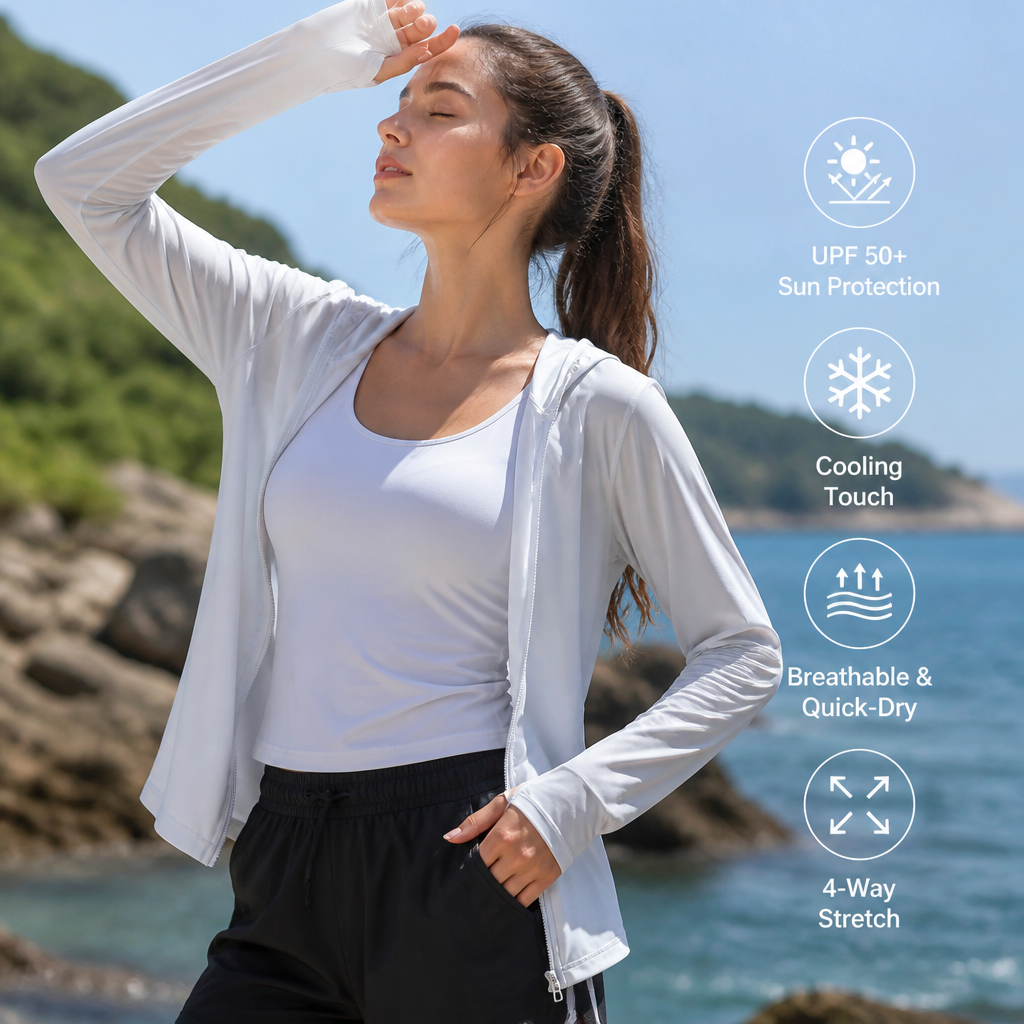
    Lightweight white hooded jacket concept with cooling and sun-protection graphics
    Illustrative artwork only. The UPF, cooling and drying graphics are not supporting test reports for the supplied H213 fabric.

    Require evidence before releasing a UV claim

    The nylon-spandex composition and a lightweight hand feel do not establish UPF 50+. Obtain a relevant ultraviolet-transmission report tied to the actual colour, construction and finish. Check whether specimen preparation covers the stretch, moisture and care conditions relevant to the garment and the intended market’s requirements.

    A fitted sleeve can place more strain on the fabric than a loose jacket panel. If the proposed fit or finish differs from the tested sample, resolve that gap before labelling. Do not infer UV additives, skin-safety certification or durable protection from the article name or an illustration.

    Use weight and width to check the quotation

    At nominal values, 120 × 1.65 ÷ 1,000 = 0.198 kg per linear metre. Theoretical yield is therefore approximately 5.05 m/kg, before cutting losses and width exclusions. This explains why a rough “5 m/kg” estimate may appear plausible, but it does not guarantee delivered yield.

    For example, 100 linear metres at those dimensions represents 19.8 kg of fabric, excluding packaging. A buyer comparing a kilogram quote with a metre quote should use the same weight and full-width basis. Use minimum usable width for marker planning, and confirm whether the purchased edges are included in the invoiced mass.

    Resolve sewing and decoration risks on samples

    Lightweight stretch fabrics can expose seam puckering, feed imbalance and heat-related surface changes. Trial the intended seam, thread, needle system and machine settings on the actual article. Inspect under normal garment tension and after the care sequence. A needle-size recommendation without the needle system, seam construction and trial result is not a production specification.

    Test logos, transfers and bonded details using the decorator’s intended process. Check adhesion, shade change, local stiffness and stretch mismatch. The decoration may become the least flexible area of an otherwise comfortable sleeve or chest panel.

    Approve one controlled specification

    The release file should connect the approved colour and finish to the agreed weight, usable width, dimensional behaviour, garment fit and any claimed performance. Separate required pass criteria from desirable hand-feel preferences. Retain the approved sample and record changes that require another review.

    H213 is worth sampling when a lightweight nylon-spandex knit matches the design brief. Buy it on demonstrated garment performance and repeatable bulk specifications, not on the assumption that a cool first touch guarantees comfort, UV protection and fast drying at the same time.