分类: Technical Articles

  • How Many Samples Should Buyers Test When Checking Colorfastness?

    How Many Samples Should Buyers Test When Checking Colorfastness?

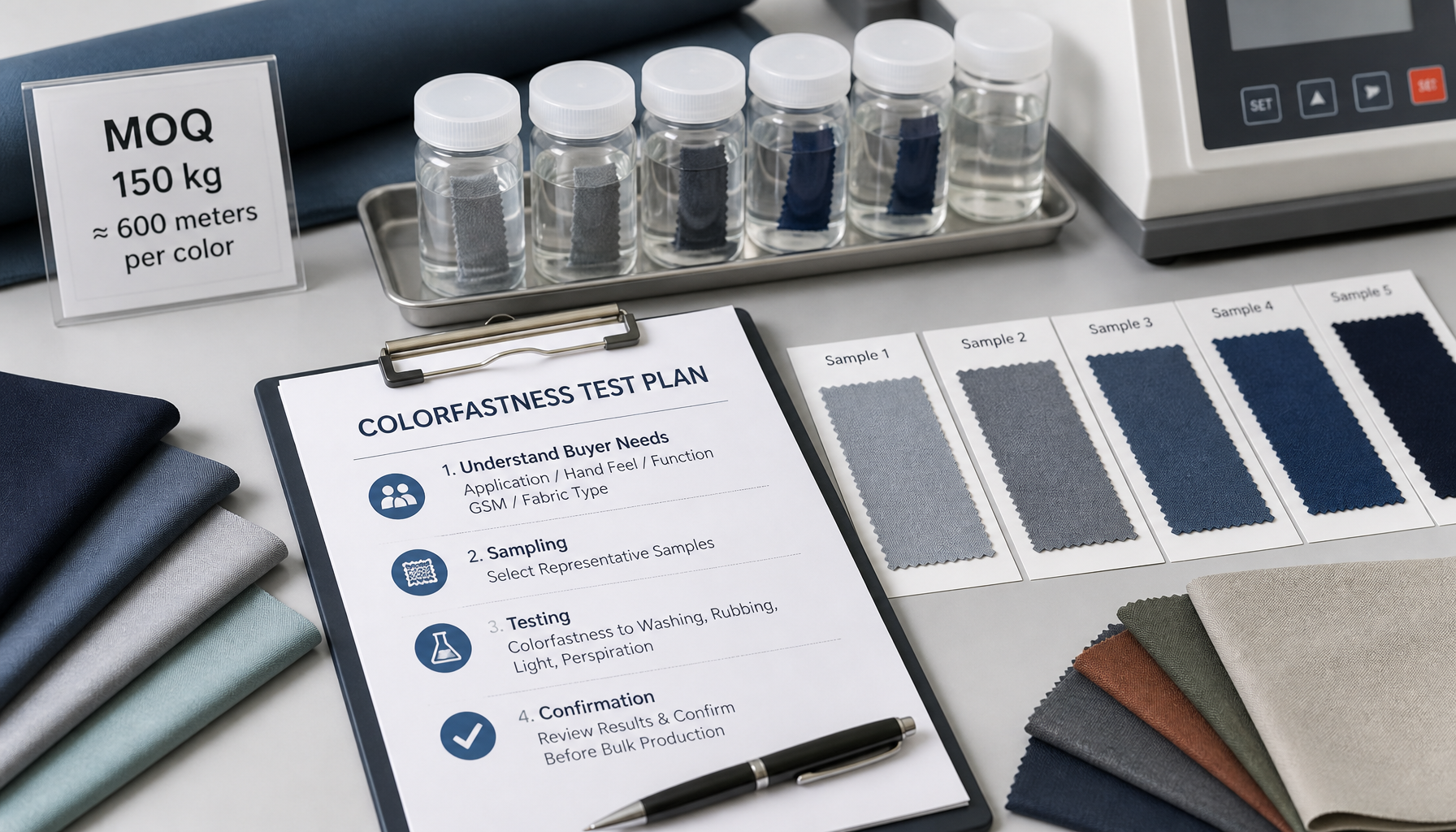
    Colorfastness sample quantity must follow the selected laboratory methods and a sampling plan covering the relevant colors and production lots. MOQ does not determine the number of specimens, and several cuttings from one swatch do not demonstrate consistency across a shipment.

    What does “one sample” mean?

    A submitted fabric piece can provide specimens for several tests, but each test may consume material or require separate preparation. Ask the laboratory for dimensions and quantities for the complete test package, including repeats and retained material. Label every submitted piece with construction, finish, color, dye lot, roll, and cutting position.
    How Many Samples Should Buyers Test When Checking Colorfastness?

    Build the plan from exposure

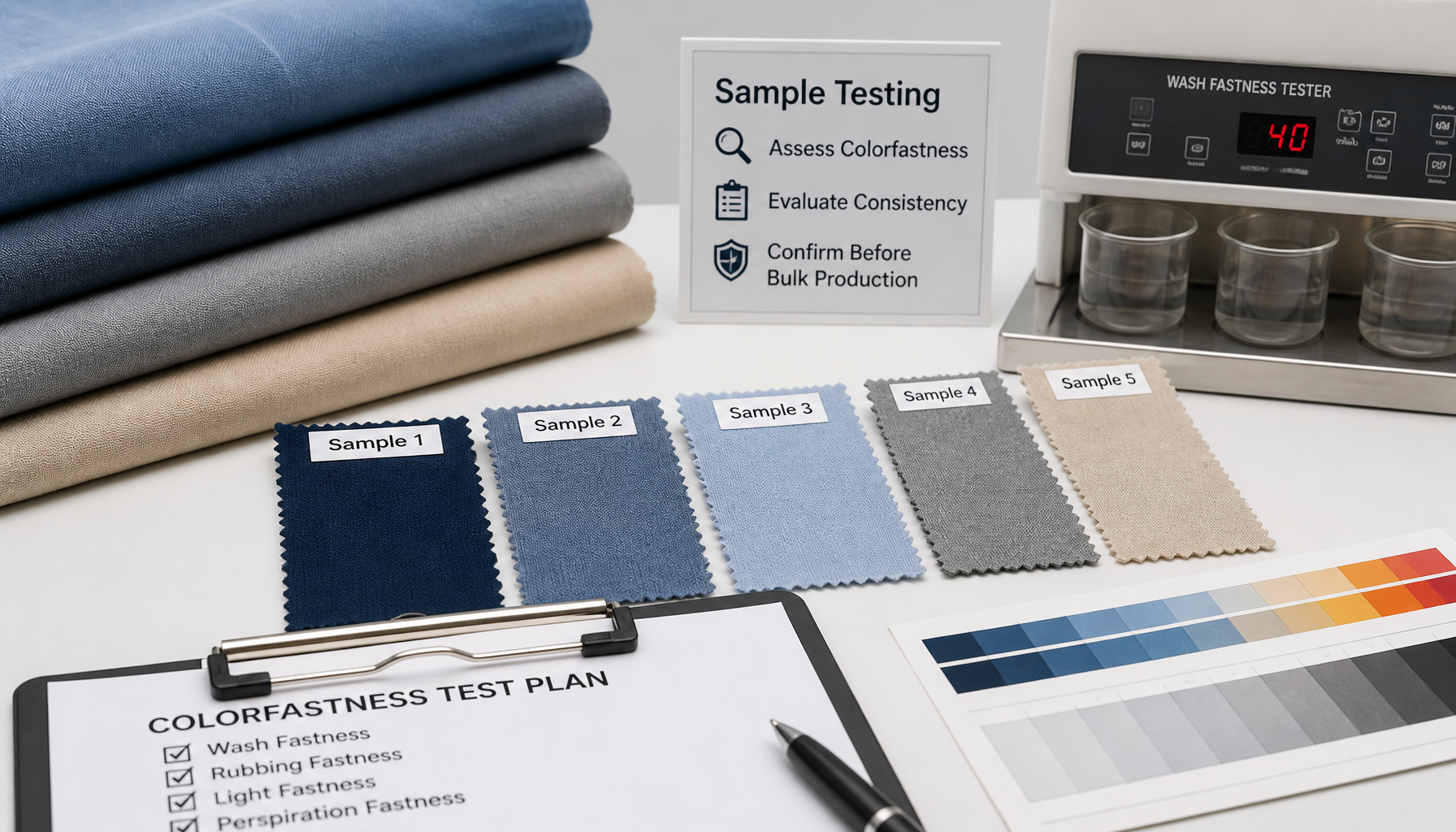
    For dark activewear worn against a light lining, staining deserves attention alongside color change. Washing, perspiration, dry rubbing, wet rubbing, and light exposure are separate evaluations; a satisfactory washing result does not establish the others. Select exposures from the garment’s use and care instructions, then agree on methods and acceptance limits before submitting material.

    Cover variation before adding repetitions

    Hypothetical planning example: an order contains three colors, each produced in two dye lots. That creates six color-lot groups to consider, not three interchangeable samples. If the buyer elects to submit material from every group, the laboratory must still specify the specimen count for each test. This example illustrates coverage; it is not a statistical sampling rule or a mandatory six-sample requirement.
    How Many Samples Should Buyers Test When Checking Colorfastness?

    Sampling only the darkest color can miss a different dye recipe or finish problem in another shade. Any decision to group colors should be documented with its rationale and limitations. Keep results separated by color and lot so an acceptable average cannot conceal a failed group.

    What belongs in the report?

    • The exact method and test conditions, including the relevant washing or exposure procedure.
    • Sample identity and whether the fabric was tested as received or after specified processing.
    • Color change and staining results separately where applicable.
    • Individual results, deviations and the stated acceptance criteria.

    Handle a failure before shipment

    Identify the affected lot and hold its release while investigating dyeing, wash-off, finishing, or sample identification. Additional passing cuttings do not automatically cancel an initial failure. Agree on the retest procedure, whether corrected material requires new testing, and who authorizes release. For color-blocked garments, also check the actual materials together under the intended care conditions.

    Send the laboratory the color-lot map and exposure requirements first. Use its specimen request to instruct the supplier where to cut and how to label the submission; retain matching material for confirmation.
  • What to Ask a Lab About Fabric Stretch Recovery

    What to Ask a Lab About Fabric Stretch Recovery

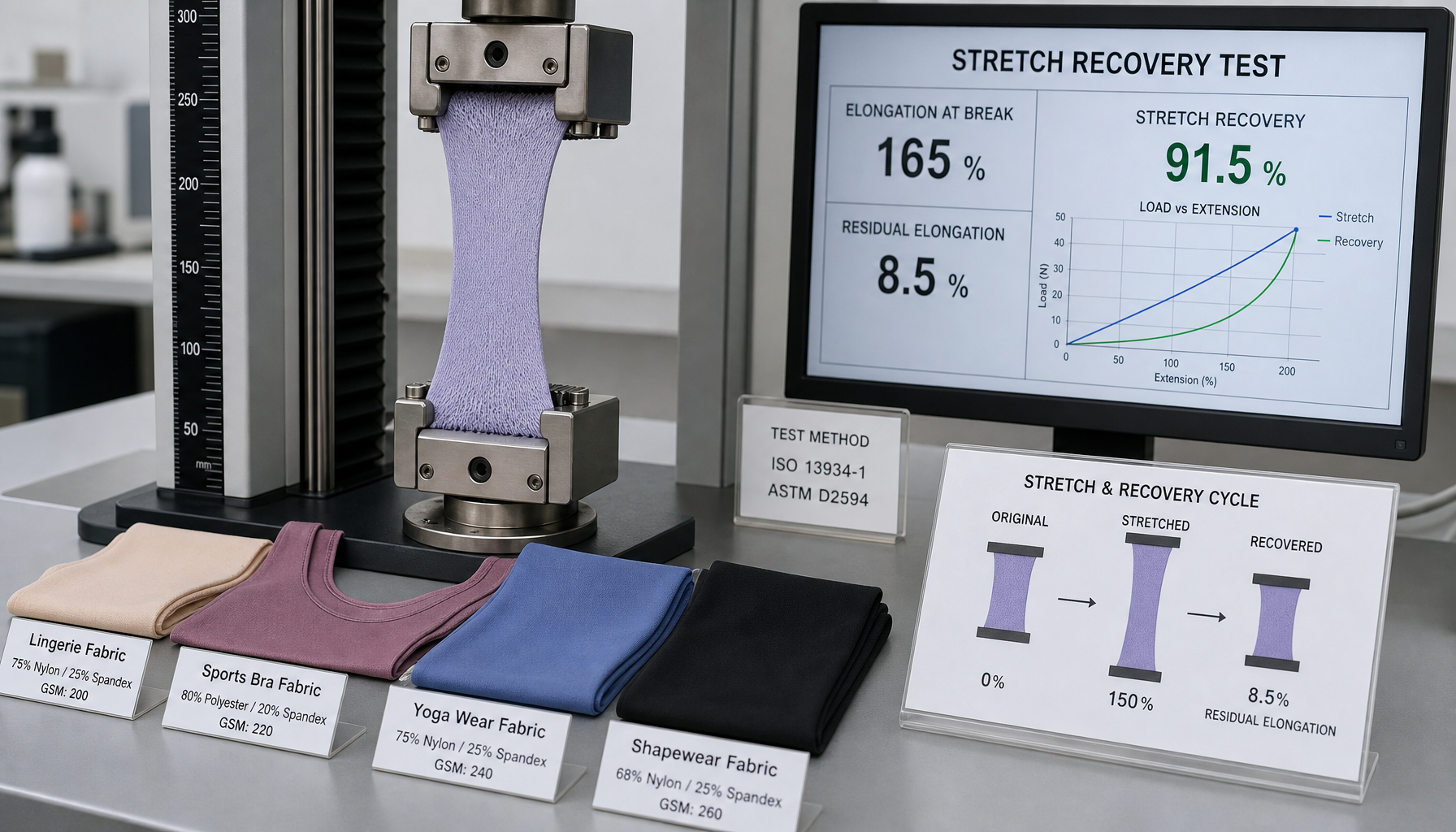
    Ask the independent laboratory to verify more than a single recovery percentage. The request should define the test method, fabric direction, extension or load, cycle count, hold and relaxation periods, conditioning, specimen number, calculation, and reporting unit. Require individual results tied to the fabric lot and sample identity. Without these controls, two laboratories can test the same stretch knit and produce numbers that answer different questions.

    Laboratory evaluation of stretch and recovery in knitted fabric
    Stretch-recovery results are comparable only when direction, extension, load, cycle count, hold time, relaxation, and calculation are defined.

    Define the garment failure the test must address

    Stretch recovery may relate to bagging at knees, waistband growth, loss of compression, restricted movement, seam strain, or size instability. Each failure occurs under different directions and deformation levels. Tell the laboratory whether the fabric is intended for yoga leggings, cycling shorts, sports bras, underwear, or another garment, and identify the critical direction. The lab can then help select an appropriate method, but the brand must set acceptance criteria from product requirements and validated reference materials.

    Ask the laboratory to record every test variable

    • Method name and edition, laboratory environment, conditioning time and specimen state.
    • Course, wale or other test direction and how specimens were cut from the roll.
    • Specified extension or applied load, extension rate, hold time and cycle count.
    • Recovery interval before measurement and the formula used for the reported result.
    • Individual values, average, dispersion, specimen count and any excluded result.
    • Fabric code, color, finish, lot, roll and sampling location.

    Do not confuse extension, growth, and recovery

    Extension describes how far a specimen lengthens under defined force or to a defined elongation. Growth describes retained deformation after the force is removed and a stated relaxation period. Recovery expresses the amount returned under the method’s calculation. Elongation at break is a destructive strength-related measurement and does not substitute for recovery at normal garment strain. Ask the laboratory to define each reported term so purchasing teams do not compare different metrics under one “stretch” heading.

    Require both directions when the garment uses both

    A knitted fabric can behave differently in course and wale directions, while garment panels may be oriented to use one direction for body circumference and the other for length. If a cycling-short panel requires circumferential support and longitudinal movement, a single unspecified result cannot confirm both functions. Provide the intended panel orientation and request direction-specific data. If the fabric is marketed as four-way stretch, that phrase still needs numerical requirements and a defined method for each direction.

    Interpret results with an explicit calculation

    Hypothetical calculation: a marked 100 mm specimen is extended to 150 mm, released, and measures 104 mm after the agreed relaxation period. Residual growth relative to the original gauge length is (104 − 100) ÷ 100 × 100 = 4%. This example is not a universal pass limit and does not prescribe a standard formula; the laboratory must use the selected method’s calculation, and the buyer must establish an acceptable threshold for the garment.

    Test the approved state and relevant aged states

    Recovery can change after dyeing, heat setting, brushing, chemical finishing, printing, laundering, or heat exposure. Specify whether the laboratory tests as-received fabric, conditioned finished fabric, washed fabric, or several states. Use the intended care procedure and record the number of cycles. Results from undyed development fabric should not automatically approve a dark bulk color, and an optional finish should not be assumed durable unless the post-care test confirms the required behavior.

    Review sampling and repeatability

    Several specimens from one small swatch measure test repeatability more than lot uniformity. For bulk acceptance, define how rolls are selected and where specimens are cut while avoiding creases, edges, and known defects unless investigating them. Ask the report to preserve roll-level results instead of presenting only a combined average. If variation is commercially important, agree on maximum individual values or another lot rule so one unstable roll cannot be hidden by conforming material.

    Connect the report to garment approval

    Use laboratory recovery data to compare candidate fabrics and monitor bulk consistency, then verify fit retention in sewn garments under representative movement and care. Waistbands, seams, panel orientation, lining, and garment dimensions alter the strain applied to the fabric. Send the laboratory and ClothFactory the same use case, approved construction, directions, processing route, and acceptance matrix. The report should support the sourcing decision, not replace a production-relevant wear and wash evaluation.

  • How Many Samples Should Buyers Test When Checking Air Permeability?

    How Many Samples Should Buyers Test When Checking Air Permeability?

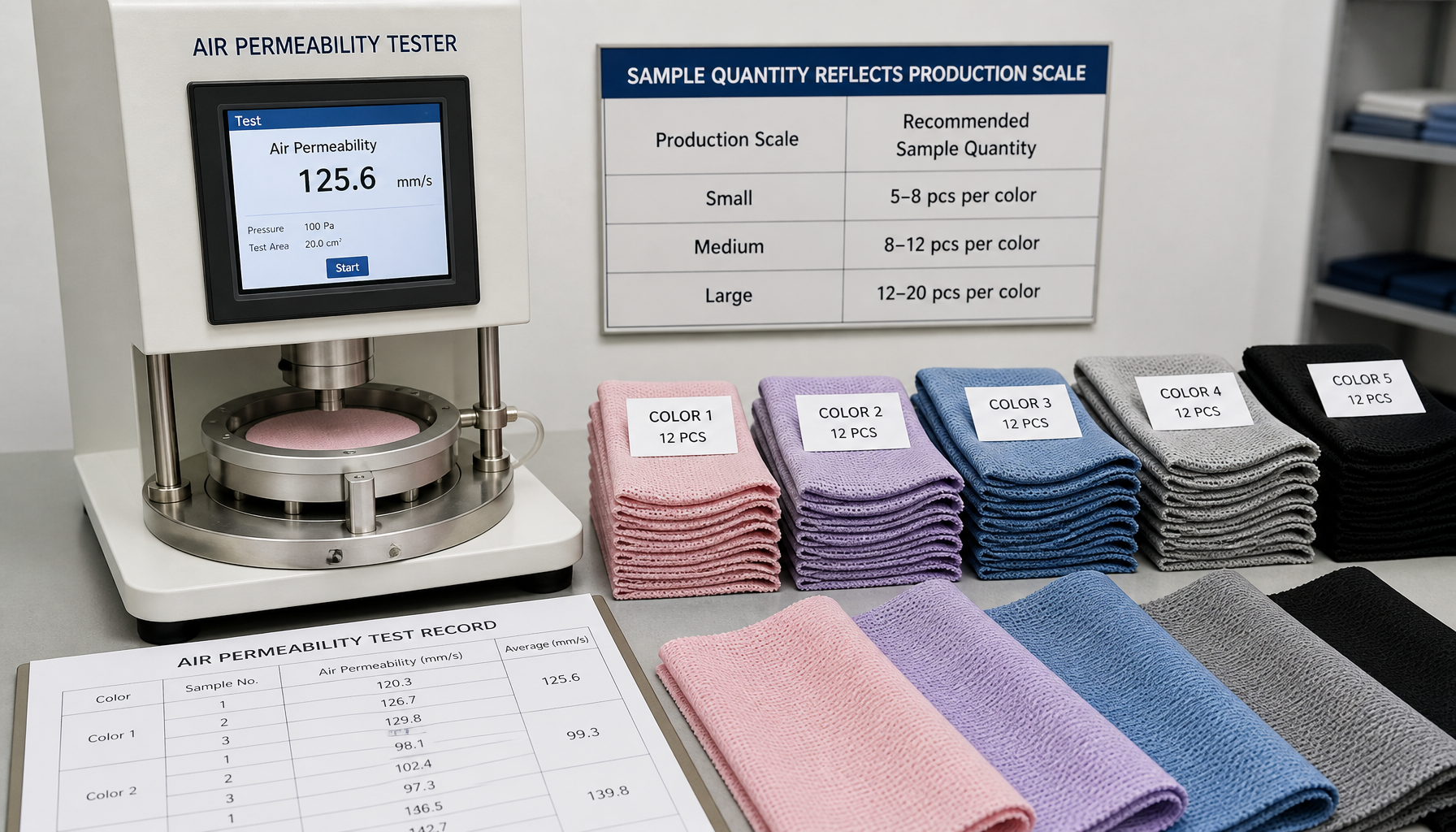
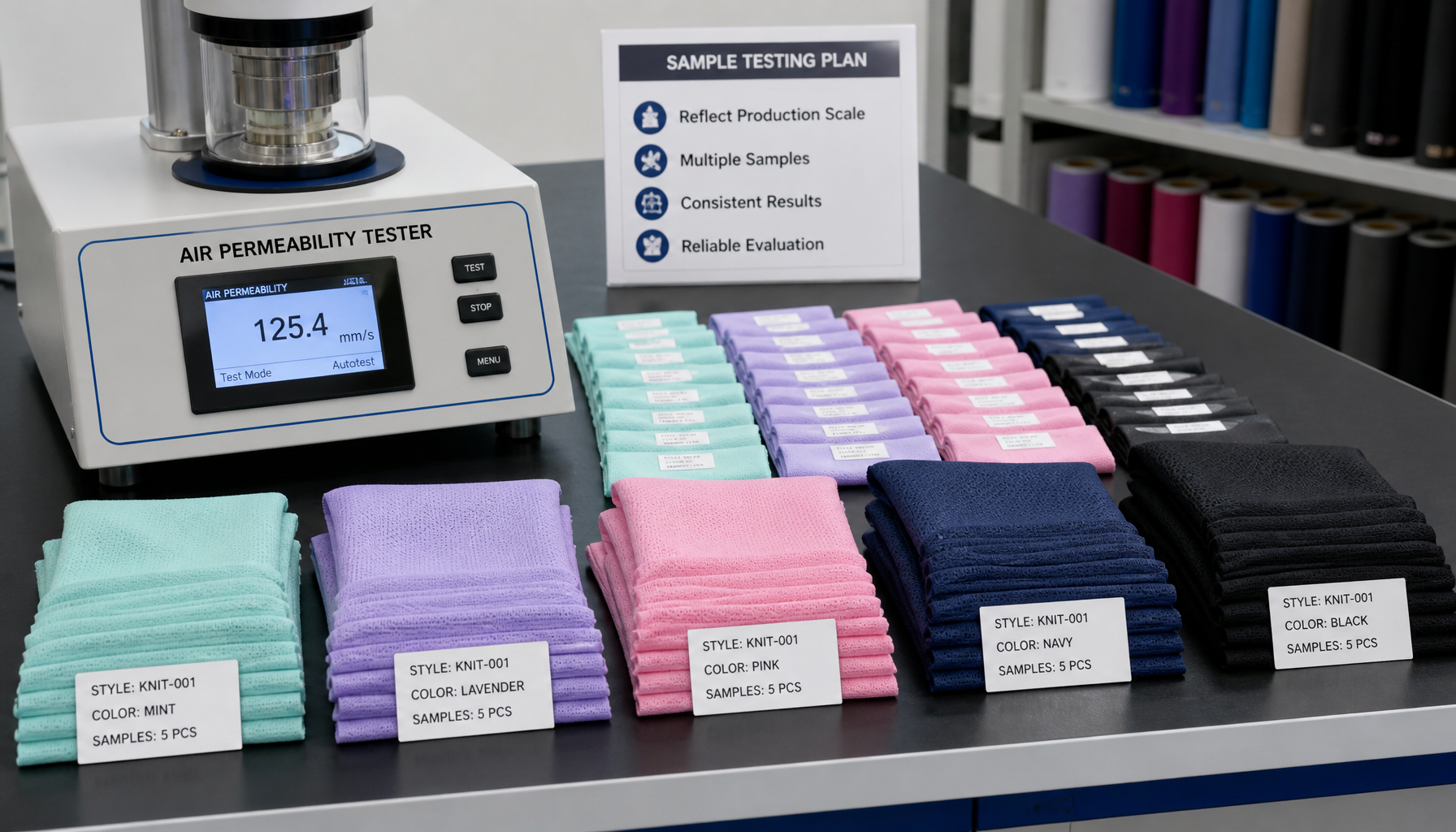
    There is no reliable universal sample count for air-permeability testing. The required number depends on the selected test method, fabric variability, lot structure, and the buyer’s acceptance plan. Buyers should ask the laboratory to state the number of test areas required by the method, then distribute those readings across representative fabric positions and production rolls instead of treating repeated readings from one swatch as proof of lot consistency.

    Technician preparing knitted fabric specimens for air permeability testing
    Air-permeability specimens should be conditioned, identified, and taken from representative positions rather than repeatedly tested from one small area.

    Separate test areas, specimens, and production samples

    These terms are often confused. A laboratory may take several readings from one conditioned specimen, but those readings describe only the submitted piece. Multiple pieces cut from one roll improve knowledge of within-roll variation, while samples from different rolls are needed to assess a production lot. The test report should therefore identify the submitted roll, dye lot, fabric face, test direction where relevant, conditioning procedure, pressure differential, test-head area, and the location and number of readings.

    Build the sampling plan around the decision

    Air-permeability sampling decisions
    Decision Sampling emphasis Limitation
    Screening a new construction Several separated areas from a clearly identified development sample Does not establish bulk consistency
    Approving a pilot lot Beginning, middle, and end positions where accessible Represents only the sampled roll or trial
    Accepting bulk production Rolls selected across the lot using the agreed inspection plan Unsampled rolls retain residual risk
    Investigating a claim Known conforming and disputed garments or rolls under identical conditions Results are invalid if methods differ

    Do not average away unstable fabric

    Hypothetical example: suppose five readings from one area are 210, 215, 208, 212, and 211 in the laboratory’s stated units. Their average is 211.2, but it says nothing about another roll. If five readings from a second roll cluster near 150 under identical settings, combining all ten into one average conceals a material difference. Report results by specimen and roll, review dispersion, and investigate process or sampling causes before deciding whether the lot is acceptable.

    Air passing through a controlled test area of performance knit fabric
    The reported airflow value is meaningful only when pressure differential, test area, conditioning, and specimen preparation are held constant.

    Control variables before comparing results

    Air-permeability values cannot be compared when laboratories use different pressure differentials, test-head areas, conditioning environments, fabric tension, or units. Brushing, calendaring, resin treatment, moisture, relaxation, and laundering can also change the open structure. The purchase specification should name the method edition, test settings, reporting unit, specimen state, face orientation where applicable, number of readings, and pass rule. “Test according to an international standard” leaves too many commercial decisions undefined.

    Connect laboratory data to the garment

    Higher airflow is not automatically better. A team jersey may need ventilation, while a base layer may require a different balance among air exchange, warmth, moisture movement, and wind exposure. Seams, prints, bonded films, double layers, and garment fit can alter the result experienced by the wearer. Use fabric testing to control material consistency, then validate the shortlisted construction in a finished garment under its intended layering and activity conditions.

    What to send the laboratory

    • Fabric code, composition, construction, color, finish, lot and roll identifiers.
    • The agreed method, pressure differential, test area, units and conditioning state.
    • The number and location of submitted pieces and whether edges or defects are excluded.
    • Individual readings, average, variation data and the buyer’s acceptance rule.
    • Instructions for retaining specimens when confirmation or dispute testing may be required.

    Before bulk approval, ask the laboratory to propose a method-compliant specimen plan and ask the supplier for a lot map so the submitted pieces represent production. ClothFactory can provide identified sample yardage for evaluation, but the buyer and laboratory should jointly define the final sampling frequency and acceptance limits. This keeps the result traceable and prevents a small, unusually open or closed swatch from representing an entire order.

  • Fabric Width, Roll Length and GSM Tolerances for Purchase Orders

    Fabric Width, Roll Length and GSM Tolerances for Purchase Orders


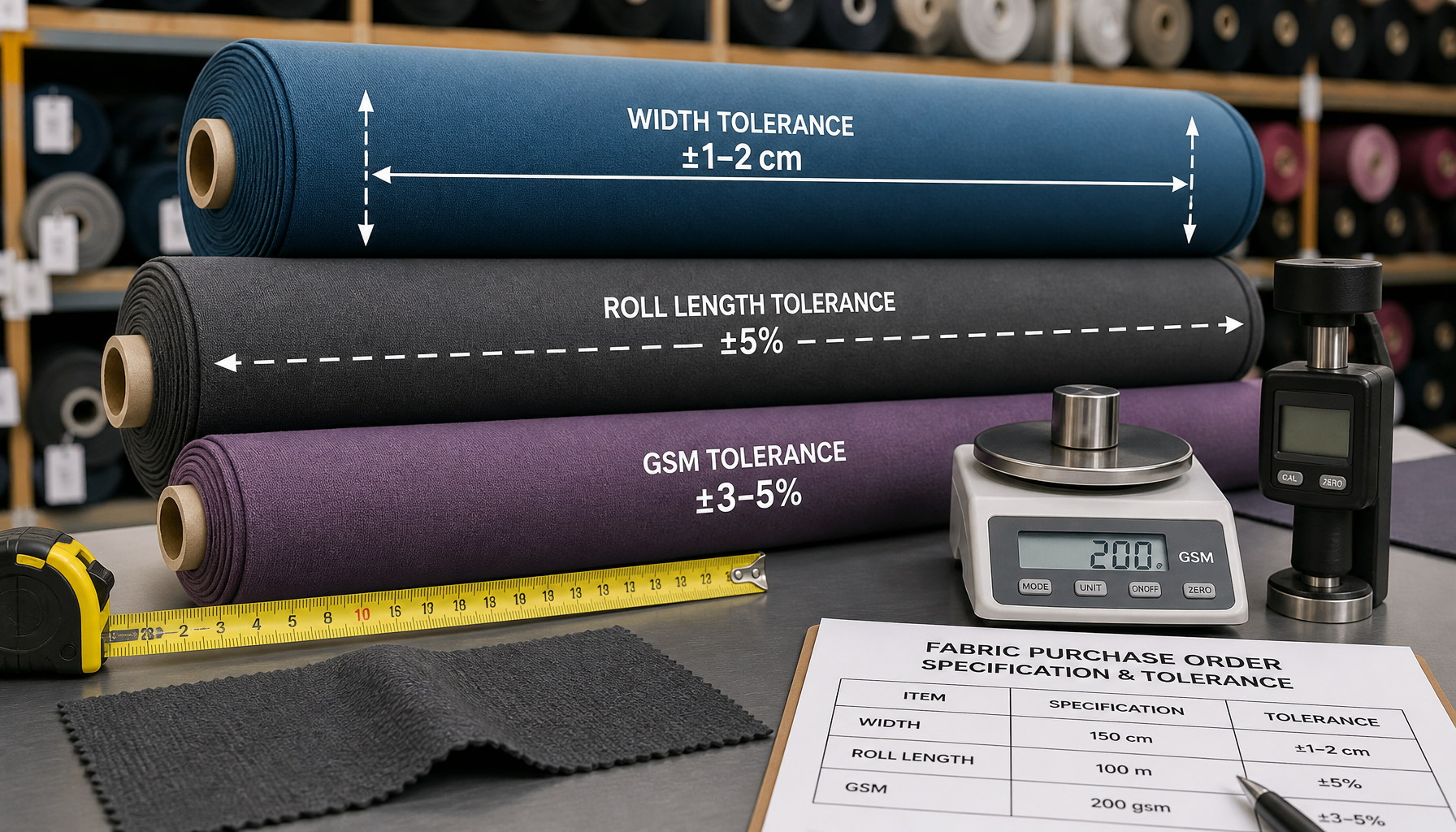
    An activewear fabric purchase order should state target values, tolerances, measurement methods, sampling rules and remedies for usable width, roll length and GSM. A tolerance copied from another fabric is not automatically suitable; the limits must reflect the approved sample, cutting plan, garment sensitivity and supplier’s demonstrated process capability.

    Illustration: Fabric roll specification reviewed for width, length and GSM tolerances
    Illustrative image; not a test record or production evidence.

    Define Width Before Setting a Limit

    State whether the value means total width, cuttable width or usable width after excluding curled, distorted or damaged edges. Also define how the fabric is relaxed, where measurements are taken and how many readings are required per roll. For stretch knits, tension during measurement can create a misleading result, so the agreed procedure matters as much as the numerical tolerance. ISO 22198 covers determination of fabric length and width, and ISO 3801 or ASTM D3776 covers mass per unit area; the purchase order must still define sampling, conditioning and tolerances.

    Treat Roll Length as an Inventory Variable

    Specify the permitted roll-length range, maximum number of short rolls, minimum piece length, joint policy and how actual delivered length is recorded. Total order quantity alone does not protect cutting efficiency. A shipment can meet total meters while creating excessive handling and end loss if it contains many short rolls, so roll distribution should be an explicit acceptance field.

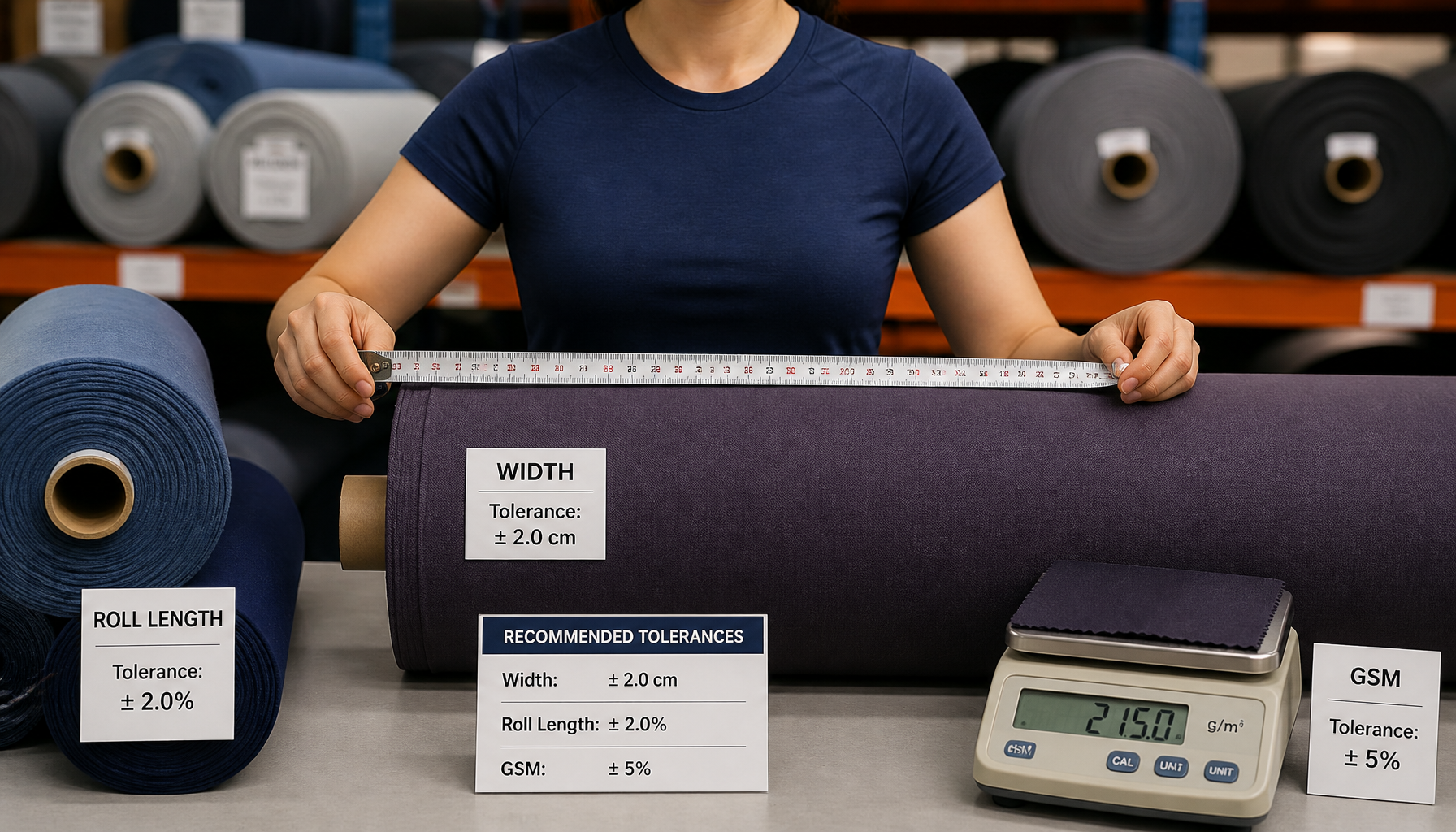
    Illustration: Quality-control measurements recorded for an activewear fabric roll
    Illustrative image; not a test record or production evidence.

    Connect GSM to Garment Risk

    GSM affects garment weight, drape, coverage and material consumption, but it does not independently predict stretch or durability. Define specimen size, conditioning, sampling locations and whether the result is reported per reading or as a lot average. An average can conceal rolls outside the approved range, so the purchase order should distinguish individual-roll limits from any shipment-average requirement. For the deposit-stage check, see how to verify GSM tolerance before paying a fabric deposit.

    Calculate the Commercial Effect

    An illustrative example shows why width matters: if an approved marker requires 1.20 m at a usable width of 160 cm, a roll measuring 156 cm may force a different layout rather than merely creating a 2.5% width loss. The actual consumption increase must be recalculated with the garment pattern. Buyers should therefore connect width tolerance to marker feasibility, not rely on percentage arithmetic alone. The commercial effect is reviewed in comparing fabric quotes when GSM, width and finishing differ.

    Purchase-Order Table

    Control item Purchase order must define Evidence at receipt
    Usable width Target, tolerance, relaxation and measurement points Roll inspection record
    Roll length Range, short-roll limit, joints and recording method Roll ticket and verification
    GSM Target, individual and average limits, specimen method Test report by roll or lot
    Quantity Ordered unit, over/under-delivery rule Packing list and measured total
    Remedy Segregation, replacement, credit or written concession Nonconformance record

    Avoid These PO Gaps

    • Do not mix kilograms and meters without an agreed conversion basis.
    • Do not call selvage-to-selvage width “usable” unless the full width is cuttable.
    • Do not accept unlimited short rolls because total length is correct.
    • Do not use a shipment average to hide out-of-tolerance rolls.
    • Do not specify limits that were never checked on the approved quality.

    Approval Sequence

    Agree the measurement procedure during sampling, confirm the values on production-representative fabric and copy the final specification into the purchase order. ClothFactory and the buyer should retain the approved sample and signed data sheet as comparison references; send the final specification through the contact page so both parties work from the same revision. Any departure should require a documented concession before cutting, not a verbal decision after garments have entered production.

  • How to Interpret Activewear Fabric Drying-Rate Tests

    How to Interpret Activewear Fabric Drying-Rate Tests


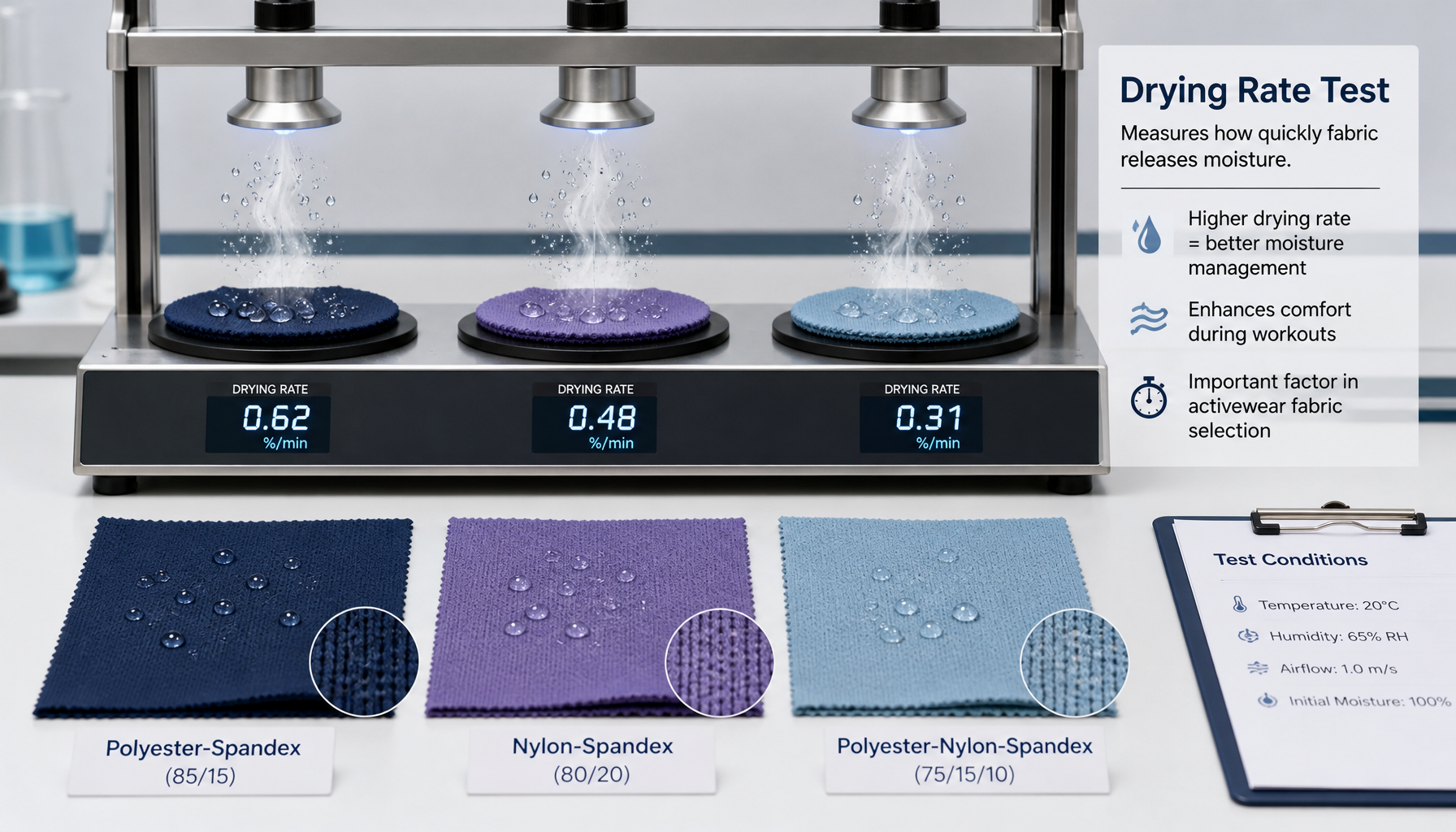
    A drying-rate result is meaningful only when the test method, water dose, specimen size, conditioning, airflow, temperature, humidity and endpoint are known. Buyers should compare fabrics tested under the same procedure and interpret drying together with wet pickup, spreading, garment construction and intended climate rather than treating one short drying time as proof of comfort.

    Illustration: Activewear fabric specimen prepared for a controlled drying-rate test
    Illustrative image; not a test record or production evidence.

    Identify What the Test Measures

    Some procedures track mass loss over time, while others report the time required to reach a defined residual moisture level. A result expressed in minutes cannot be compared with a rate expressed as mass per area per time without the underlying data and calculation. Ask the laboratory to state the endpoint because “dry” may mean a balance reading, a percentage of initial moisture or another defined condition. Liquid-moisture and drying behavior are separate properties; a method such as AATCC 195 does not replace a drying-rate test.

    Control the Comparison Variables

    Specimen area, applied water, fabric mass and exposed surface can change the apparent result. Air movement and environmental conditions are especially influential. Require candidates to be conditioned and tested together where possible, using the same face orientation and number of replicates. If samples differ in GSM or construction, report those differences because the drying result may reflect stored water quantity as much as fiber chemistry. Air permeability, if relevant, should be measured by ISO 9237 or ASTM D737 rather than inferred from drying time.

    Illustration: Moisture loss from activewear fabric measured over a controlled test period
    Illustrative image; not a test record or production evidence.

    Read the Curve, Not Only the Endpoint

    If the laboratory supplies time-series mass data, review how quickly moisture leaves during the early and late stages. An illustrative calculation uses drying rate = change in water mass ÷ exposed area ÷ elapsed time. The result remains valid only for the stated interval and conditions; it should not be presented as a universal garment value or as ClothFactory product data unless it came from a verified report for that product.

    Connect Fabric Data to Wear

    A fast laboratory endpoint does not automatically mean lower skin wetness. Liquid spreading can enlarge the evaporation area, but it can also increase the visibly wet zone. A garment’s fit, layering, ventilation and sweat load change performance. For running shirts, compare fabric results with a sewn wear or simulated-use trial and document whether the fabric clings, darkens, cools or recovers acceptably after wetting. Supplier reports are easier to compare with the checks in comparing supplier reports for moisture management.

    Buyer Risk Check

    • Do not compare results from different methods or environments.
    • Do not infer wicking from drying time alone.
    • Check whether optional finishes were tested before or after laundering.
    • Request replicate results, not only the most favorable specimen.
    • Confirm units and calculations in the original report.
    • Avoid “quick-dry” claims without a product-specific acceptance basis.

    Approval Requirement

    Write the test method, conditioning, laundering state and acceptance rule into the specification before comparing candidates. ClothFactory can help prepare representative fabric samples through the contact page, but the buyer should retain the full report and connect it to the exact quality, color and finish. Reconfirm the result when a finishing route or construction changes because prior data may no longer represent the bulk material.

  • How to Verify Fabric Pilling Resistance With a Laboratory

    How to Verify Fabric Pilling Resistance With a Laboratory


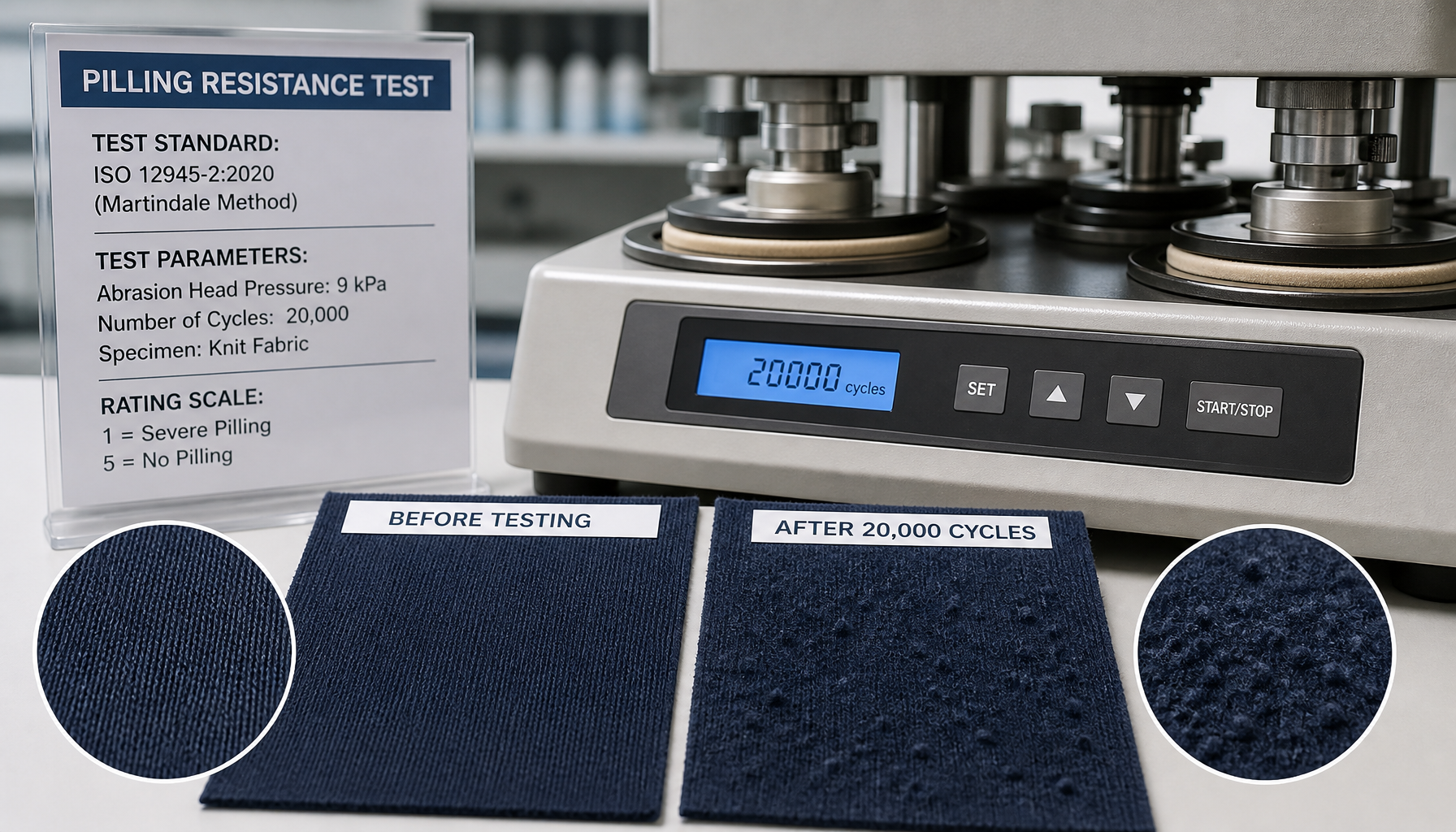
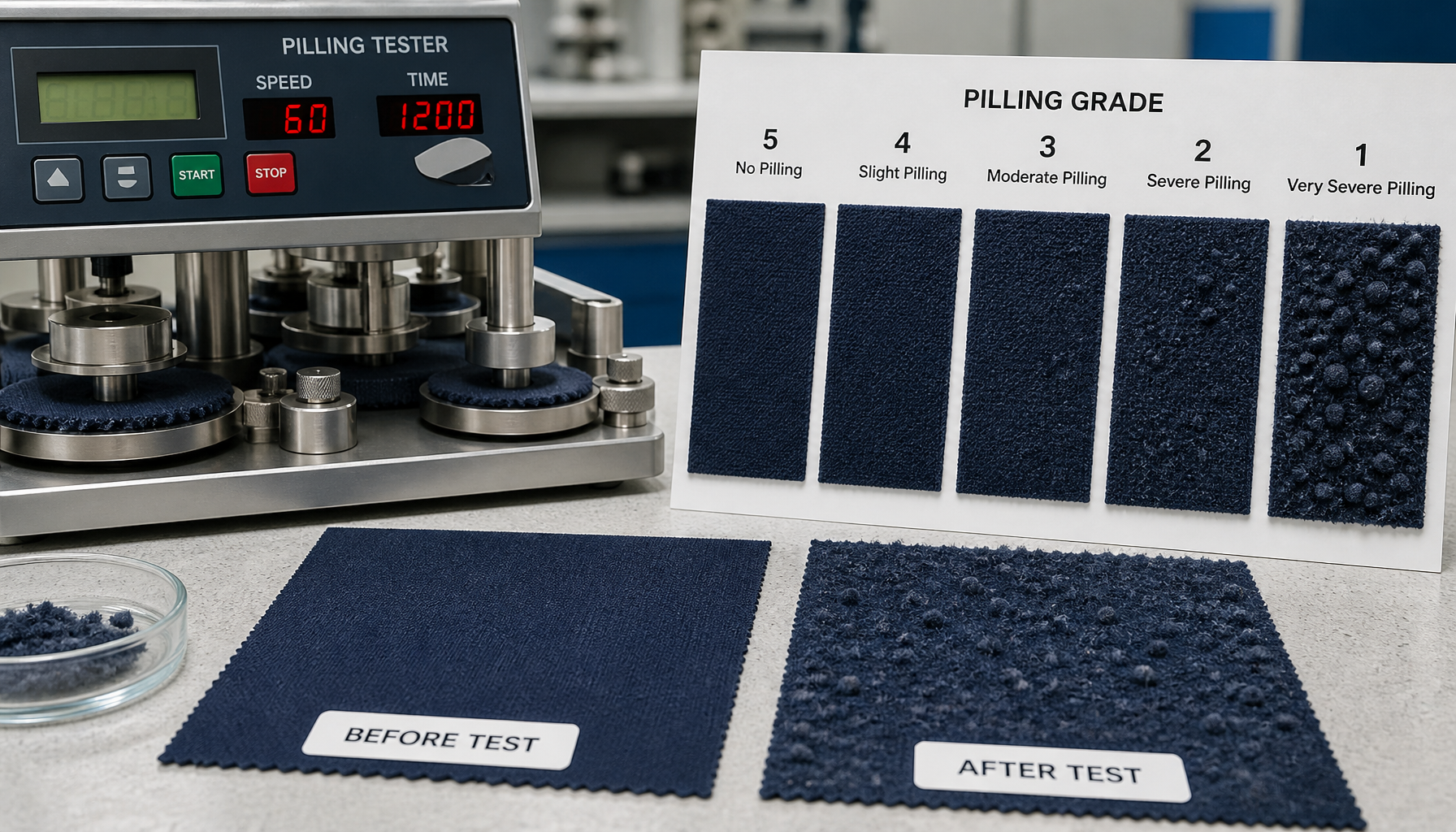
    Ask an independent laboratory to report the exact pilling method, apparatus, specimen preparation, conditioning, abrasion or cycle stage, assessment scale, number of specimens and individual results. A grade without these details cannot be compared reliably, and the buyer must define the acceptance level for the garment rather than assume that the test method provides a universal pass requirement.

    Illustration: Knitted fabric specimens prepared for laboratory pilling-resistance testing
    Illustrative image; not a test record or production evidence.

    Select a Method That Matches the Contract

    Common pilling procedures use different mechanical actions and can produce different rankings. Ask the laboratory to identify the standard and edition, apparatus, loading materials and assessment stages in the quotation and report. If comparing suppliers, submit specimens to the same laboratory under the same method where practical. Results from different procedures should remain separate even when both use a five-grade appearance scale. ISO 12945-2 (Martindale) and ASTM D4970 are common routes; the report must identify the standard, edition and apparatus because grades are not interchangeable across methods.

    Control Specimen History

    Tell the laboratory whether fabric is tested as received, after specified laundering or after another conditioning step. Identify face and back, color, finish, lot and specimen orientation. Applied softeners, brushing and other surface treatments can change fiber movement and pill formation. A result from an untreated development sample should not be presented as evidence for a differently finished bulk quality.

    Illustration: Laboratory comparison of fabric surfaces before and after pilling exposure
    Illustrative image; not a test record or production evidence.

    Request More Than a Final Grade

    The report should include individual specimen ratings, agreed intermediate stages, photographs where available and any deviation from the method. Ask whether assessment was completed by trained observers under the specified viewing conditions. A shipment decision based only on an average can hide one weak specimen, so the buyer should state whether acceptance applies to every specimen, a median, or another agreed rule. For a related surface test, see how many samples buyers should test for snag resistance.

    Connect the Test to the Garment

    Pilling exposure differs between a polo shoulder under a bag strap, leggings at the inner thigh and a lightly worn fashion panel. Define the contact zone, expected wear and visual quality level before choosing acceptance criteria. Laboratory testing accelerates a controlled mechanism; it does not predict an exact number of wears. Garment trials remain useful when seams, body contact or mixed materials create additional friction.

    Laboratory Request Fields

    • Fabric quality, lot, color, face and finish
    • Test standard, edition and apparatus
    • Preconditioning and laundering state
    • Specimen count and orientation
    • Exposure or cycle stages
    • Rating scale and assessment conditions
    • Individual results, summary and photographs
    • Buyer-defined acceptance rule

    Procurement Decision

    Retain the tested sample and original report with the approved specification. If composition, yarn, construction, brushing, softening or another surface finish changes, review whether the earlier result remains representative. ClothFactory can provide traceable samples for testing through the contact page, but the buyer and laboratory must agree on the method and acceptance condition before results are used to approve bulk production or support a durability claim.

  • How to Interpret Spirality and Skew in Activewear Fabric

    How to Interpret Spirality and Skew in Activewear Fabric


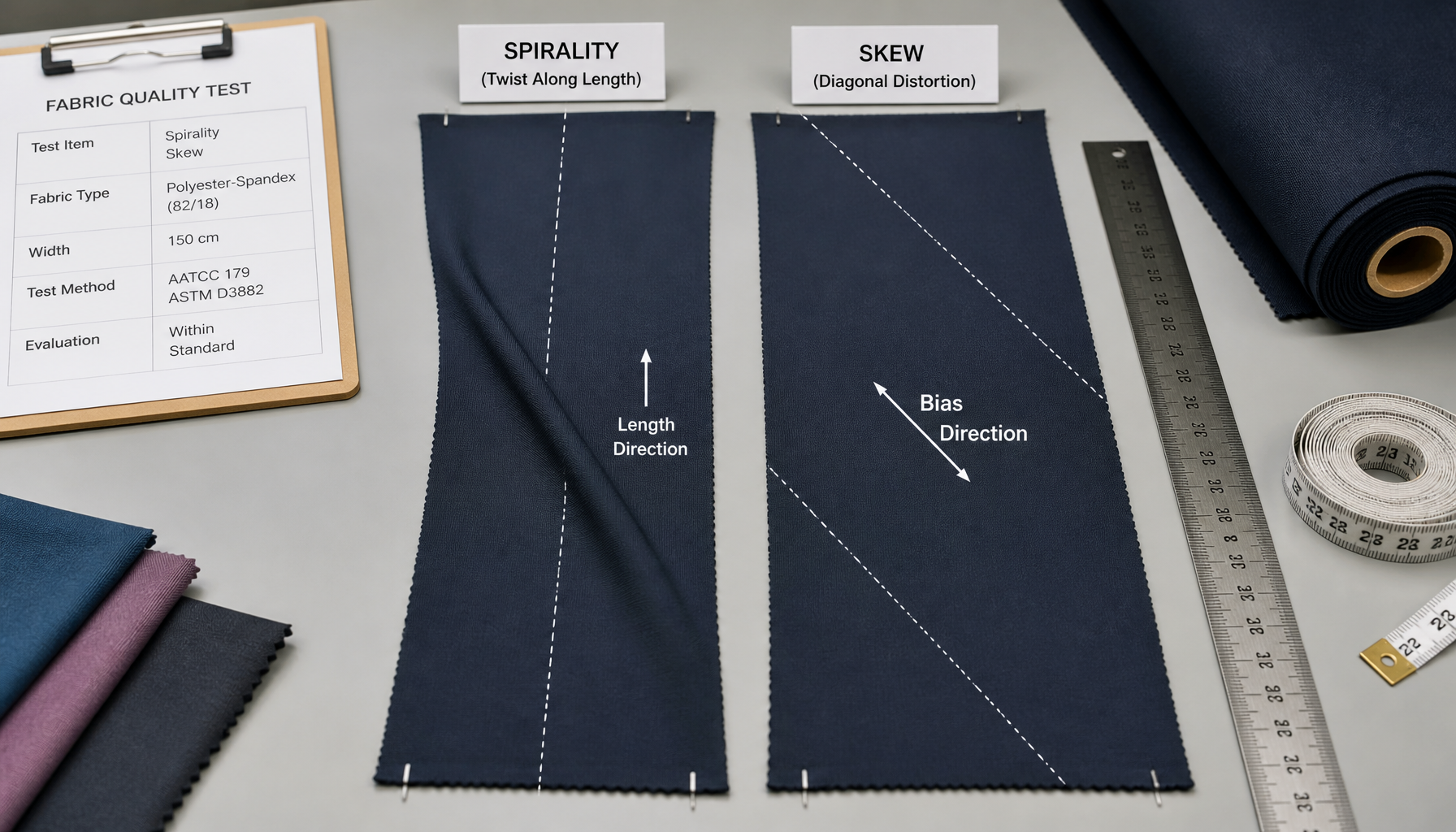
    Spirality and skew results indicate structural distortion, but buyers should interpret them only with the test method, specimen orientation, laundering procedure, measurement formula and garment construction. A single percentage does not establish acceptability: the commercial risk is whether side seams, prints, hems or panel lines move beyond the tolerance defined for the finished style.

    Illustration: Activewear knit specimen marked for spirality and skew measurement
    Illustrative image; not a test record or production evidence.

    Distinguish the Two Conditions

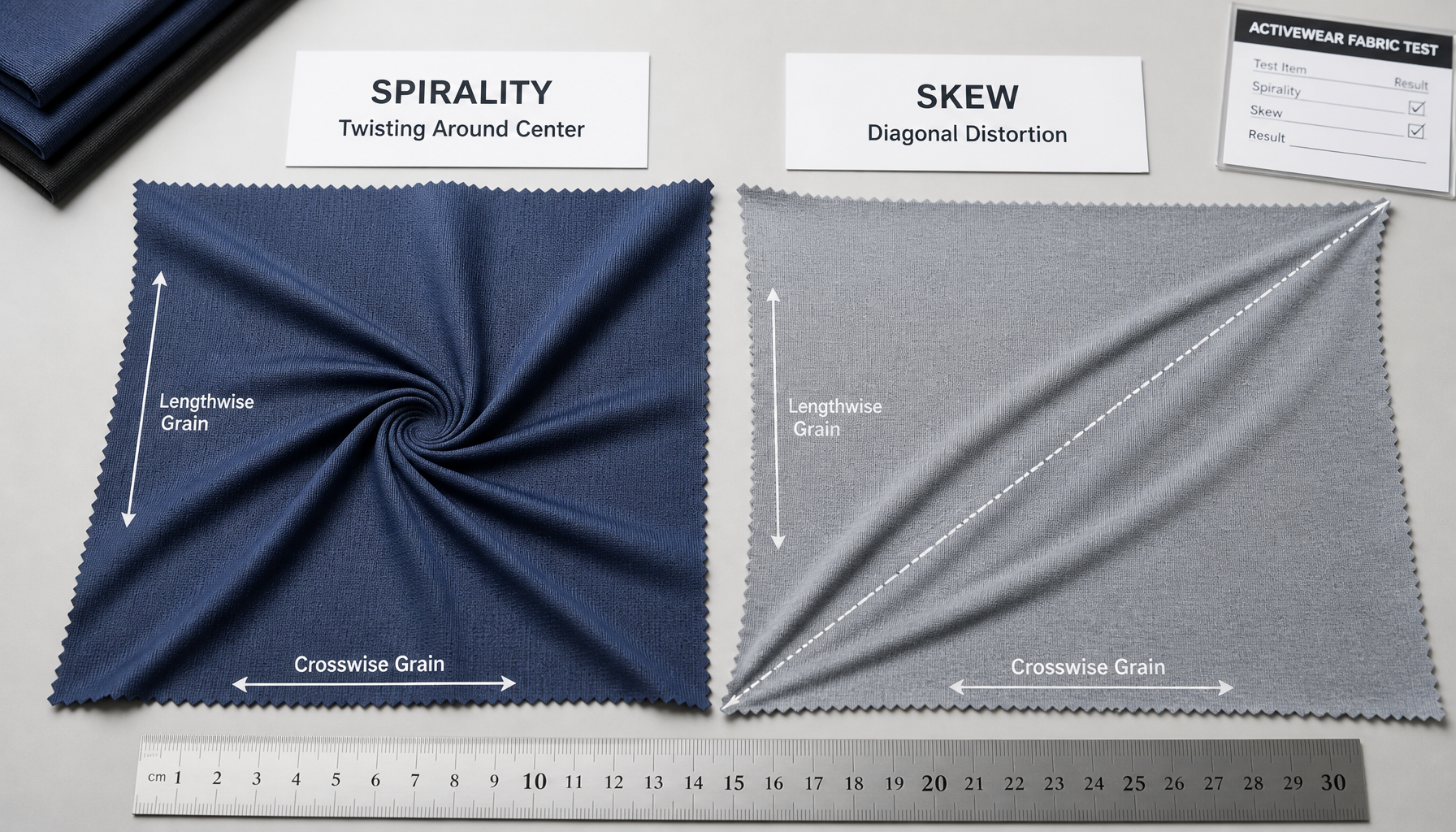
    Skew describes courses or design lines displaced from their intended alignment, while spirality describes twisting that becomes especially visible when a tubular or cut garment no longer hangs straight. Laboratories and factories may use these terms differently, so the report must state the measurement geometry and calculation. Do not compare values from different definitions simply because both are expressed as percentages. The ISO 16322 series defines methods for determining spirality after laundering; confirm which part and edition the laboratory used.

    Check the Test State

    Record whether the specimen is tested before washing, after one care cycle or after several cycles, and whether it is relaxed, conditioned, tumble dried or line dried. Heat, moisture and mechanical action can release knitting and finishing stresses. A satisfactory unwashed result can therefore coexist with visible garment twisting after care, making the laundering procedure central to interpretation.

    Illustration: Fabric alignment compared before and after a controlled wash procedure
    Illustrative image; not a test record or production evidence.

    Convert the Result Into Garment Risk

    Map the fabric direction onto the pattern. A fitted legging with long side seams, a striped polo and a panelled sports bra do not have equal sensitivity to the same distortion. Cut and wash a prototype using the planned grain direction, seam type and panel geometry. For the related change in stretch ratio after washing, see comparing stretch ratio before and after washing. Check seam migration, leg or body twist, asymmetric hems and print alignment rather than treating the fabric percentage as the final product decision.

    Use a Clear Measurement Record

    An illustrative calculation may express displacement as measured offset divided by the relevant specimen dimension, multiplied by 100. That formula is not universal; use only the calculation specified by the agreed method. The report should include original dimensions, marked reference lines, measured displacement, individual specimen results and photographs so that the conclusion can be audited.

    Buyer Risk Check

    • Do not combine skew and spirality into one undefined value.
    • Do not compare washed and unwashed specimens.
    • Verify face, direction and specimen orientation.
    • Review individual results instead of only an average.
    • Repeat evaluation after a change in knitting, heat setting or finishing.
    • Confirm the fabric result with the intended garment pattern.

    Approval Requirement

    Define the test method, care cycle, specimen count and garment acceptance criteria before requesting data. ClothFactory can provide traceable material for the agreed evaluation, but the buyer should retain marked specimens, reports and the approved prototype. If the bulk finishing route changes, repeat the relevant checks because structural stress and post-wash alignment may also change. Share the intended garment construction with ClothFactory through the contact page before sampling.

  • Fabric Tests to Approve Material for Running Shirts

    Fabric Tests to Approve Material for Running Shirts


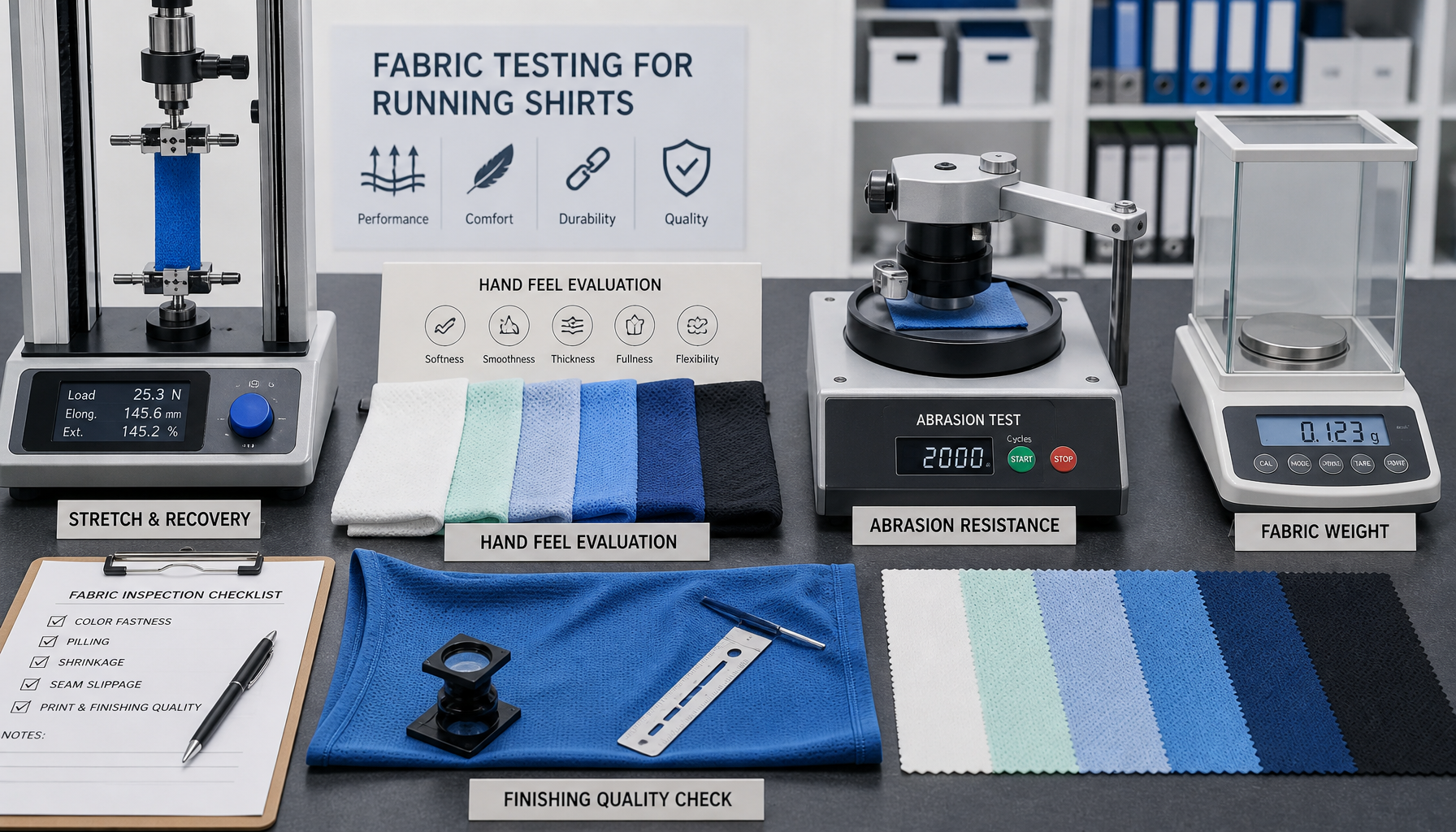
    Running-shirt fabric should be approved through tests tied to heat, perspiration, repeated washing, skin contact and garment construction. The minimum plan normally covers composition and construction, GSM and usable width, dimensional stability, colorfastness, surface durability and the specific moisture or airflow claims the brand intends to make; optional claims require their own verified methods.

    Illustration: Lightweight running-shirt fabric prepared for performance testing
    Illustrative image; not a test record or production evidence.

    Establish the Base Specification

    Confirm fiber composition, knit structure, finished GSM, usable width, appearance and any finish before performance testing. These fields identify what was tested and allow bulk comparison. If the shirt requires mechanical stretch, record stretch and recovery by direction under an agreed procedure. Related training-shirt options are described in custom fabric options for high-performance training shirts. Do not assume an elastane percentage predicts recovery, because yarn type, stitch density, heat setting and finishing influence the result.

    Test Care and Appearance Stability

    Specify the intended wash and drying procedure, then measure dimensional change and inspect twisting, skew, puckering and surface appearance. Add colorfastness tests relevant to laundering, perspiration, rubbing and any color-transfer risk in the garment. Typical routes include ISO 6330 and ISO 3759 for dimensional change, and ISO 105-C06, ISO 105-E04 and ISO 105-X12 for laundering, perspiration and rubbing colorfastness; confirm the current editions and the agreed acceptance values. Bright and dark shades may behave differently, so one development color should not automatically approve the entire range.

    Illustration: Running-shirt knit assessed for dimensional and moisture performance
    Illustrative image; not a test record or production evidence.

    Define the Moisture Question Precisely

    “Moisture management” can refer to liquid spreading, transfer through the fabric, drying rate or another mechanism. Select the measure that supports the product claim and record method, specimen state, unit and acceptance rule. Air permeability is also distinct from drying; ISO 9237 or ASTM D737 can quantify it under a stated pressure differential. Comparing candidates tested under different airflow, humidity, water dose or pressure conditions can produce a confident-looking table with no valid conclusion. For the reporting check, see comparing supplier reports for moisture management.

    Assess Surface and Sewing Durability

    Choose pilling, abrasion or snagging checks according to expected contact points, then test seam compatibility with planned needle, thread and stitch. Lightweight knits can show needle cuts, seam grin or puckering even when fabric-level durability appears acceptable. A sewn and washed prototype should confirm neckline recovery, underarm comfort, hem appearance and any bonding or print adhesion.

    Risk-Based Test Matrix

    Buyer requirement Evidence to request
    Stable fit Dimensional change and recovery data
    Color durability Relevant wash, perspiration and rubbing results
    Low wet discomfort Defined moisture or drying test
    Ventilation Air-permeability test under stated conditions
    Appearance retention Pilling, snagging or abrasion result
    Manufacturability Sewn prototype and wash review

    Approval Conditions

    Request original reports that identify the exact quality, color, finish, method, conditions, units and individual results. ClothFactory can support fabric matching and sample preparation, but acceptance limits belong in the buyer’s specification. Recheck any property affected by a change in construction, color, print, finish or care instruction before releasing bulk fabric. Share the intended test plan with ClothFactory through the contact page before sampling.

  • How to Choose Fabric for Performance Polos and Teamwear

    How to Choose Fabric for Performance Polos and Teamwear


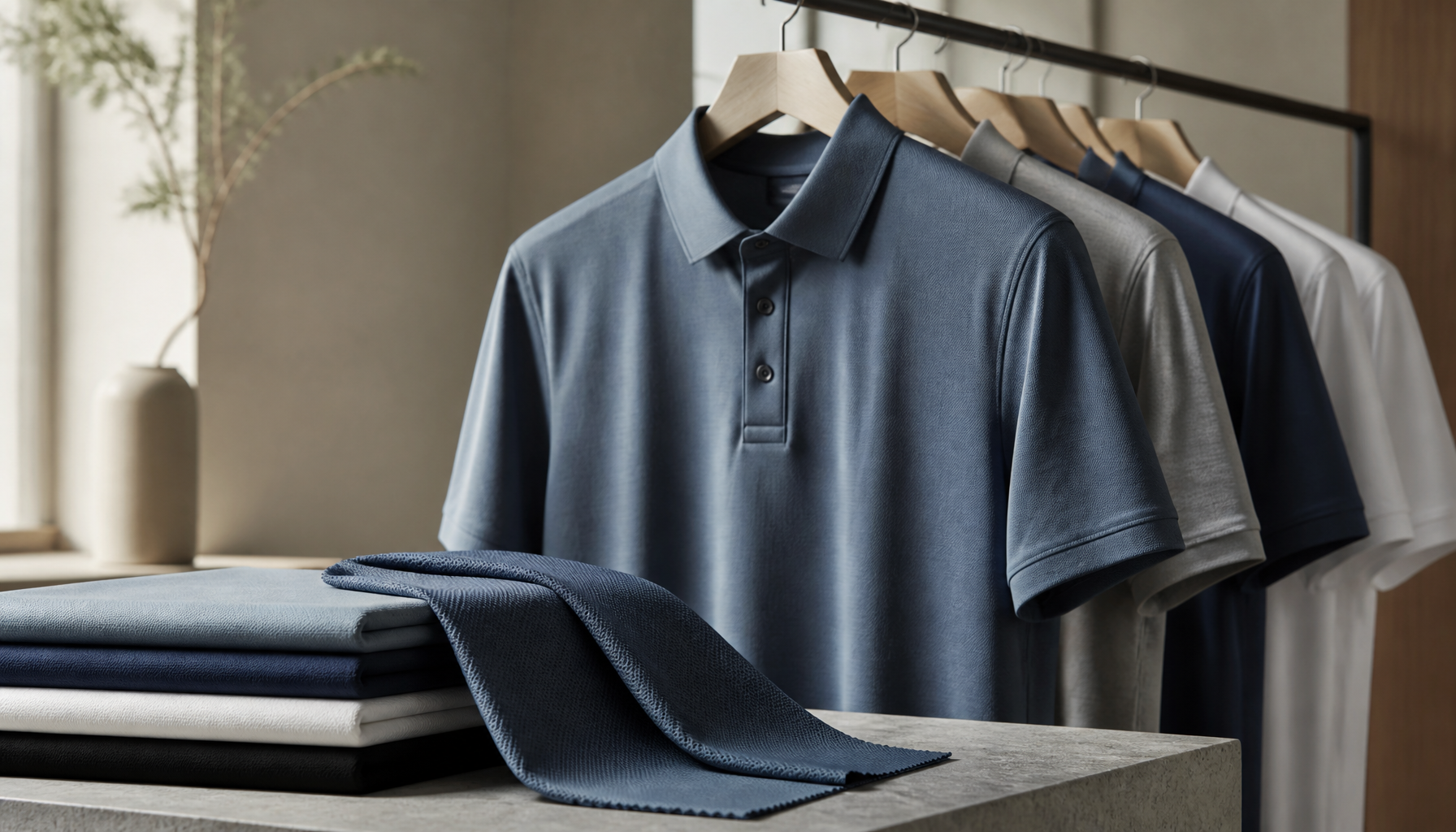
    Choose fabric for performance polos and teamwear by defining the activity, uniform programme, decoration method, care cycle, and required fit before comparing composition or GSM. The selected fabric must maintain movement, appearance, shade, and dimensions under the actual use and laundering conditions.

    Performance polo and teamwear fabric reference

    Separate the polo and teamwear requirements

    A golf polo, staff uniform, training shirt, and competition jersey do not need the same construction. Polos require stable plackets, collars, and hems; teamwear may face higher sweat load, abrasion, numbering, repeated washing, and strict shade matching across sizes and production lots.

    Create a requirement matrix for each garment rather than approve one fabric for the whole programme. Identify the body fabric, collar and cuff material, reinforcement, mesh zones, and decoration locations.

    Compare finished fabrics, not blend labels

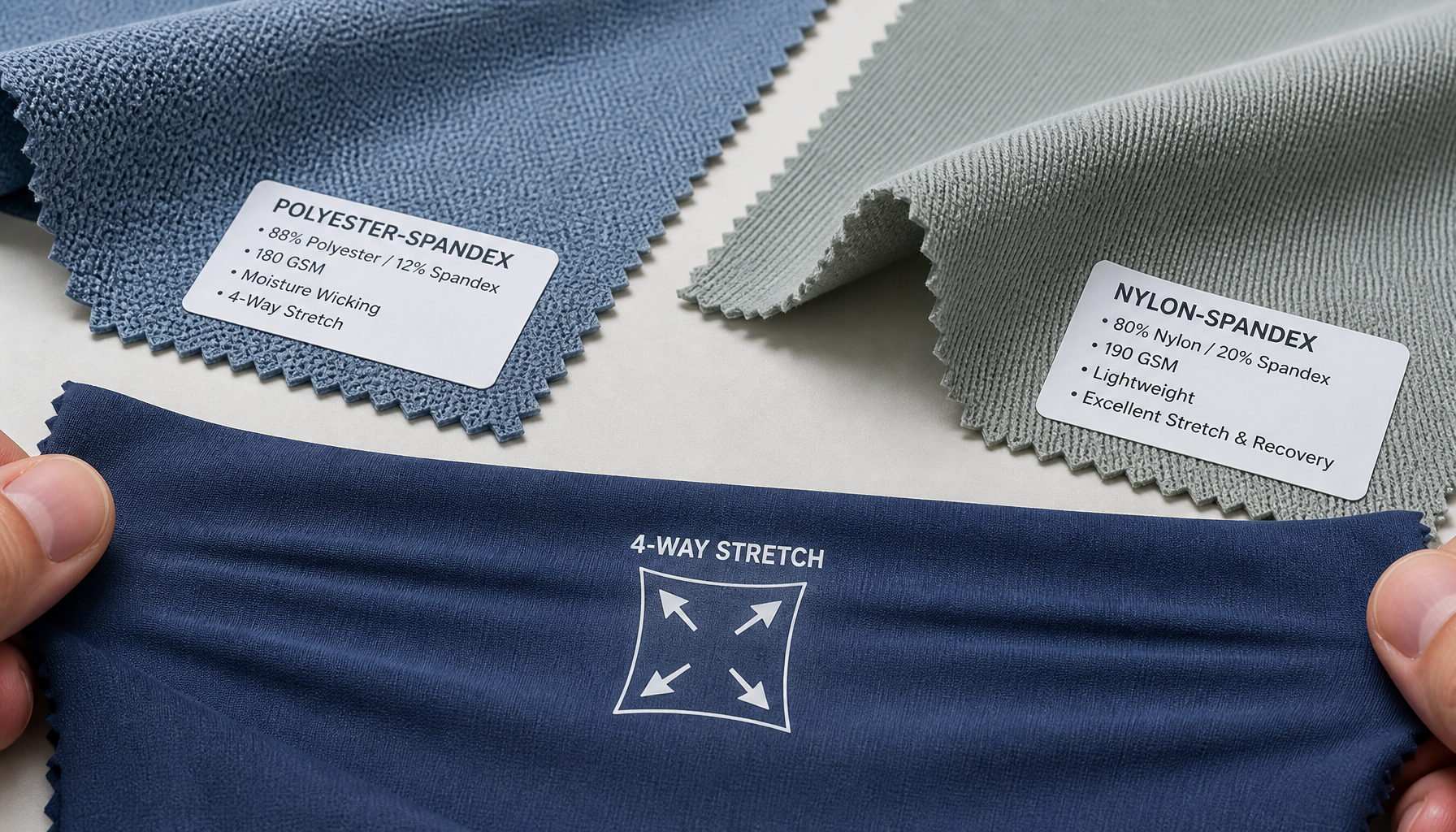
    Polyester-spandex and nylon-spandex can both be developed for performance tops. Nylon-spandex is often shortlisted for a smooth hand, while polyester-spandex may be considered for programmes with particular dyeing or moisture objectives. Construction and finishing can change either result.

    Record composition, knit type, finished GSM, usable width, thickness where relevant, stretch and recovery by direction, and post-wash dimensions. Specify moisture, quick-dry, UV, or anti-odor performance separately and request evidence for the finished material.

    Finished performance polo fabric application reference

    Test decoration and garment components

    Heat transfer, sublimation, screen printing, embroidery, and badges expose fabric to different heat, pressure, needles, and local stiffness. Test the production decoration on the selected color and construction, then inspect shade, migration, distortion, adhesion, and stretch around the decorated area.

    The body fabric may not provide enough stability for the collar or cuffs. Produce a full polo sample with the intended trims and reinforcement, then wash it and check placket puckering, collar shape, side-seam twist, hem growth, and shade compatibility.

    Set durability and color controls

    Define the wash and drying route, cycle count, and acceptance limits for dimensional change, spirality, pilling, abrasion, snagging, and colorfastness. Team programmes also need a shade-control plan so replacement garments and repeat orders remain visually compatible.

    One approved color cannot represent every shade. Dark, bright, and pale colors may react differently to dyeing, heat transfer, crocking, and perspiration.

    Compare total garment cost

    Use finished usable width, shrinkage, edge allowance, defect limits, decoration loss, and marker efficiency when comparing quotations. A cheaper kilogram price can result in higher garment cost if narrow width, shrinkage, or decoration rejection reduces usable yield.

    Procurement next step

    Send the supplier the garment category, activity, fit, panels, decoration method, color range, care cycle, target GSM and width, and required tests. Request identified samples and enough yardage for decoration, sewing, laundering, and wearer-movement trials. Approve bulk against a sealed garment and fabric standard with written tolerances.

  • How to Test Stretch and Recovery in Activewear Fabric

    How to Test Stretch and Recovery in Activewear Fabric


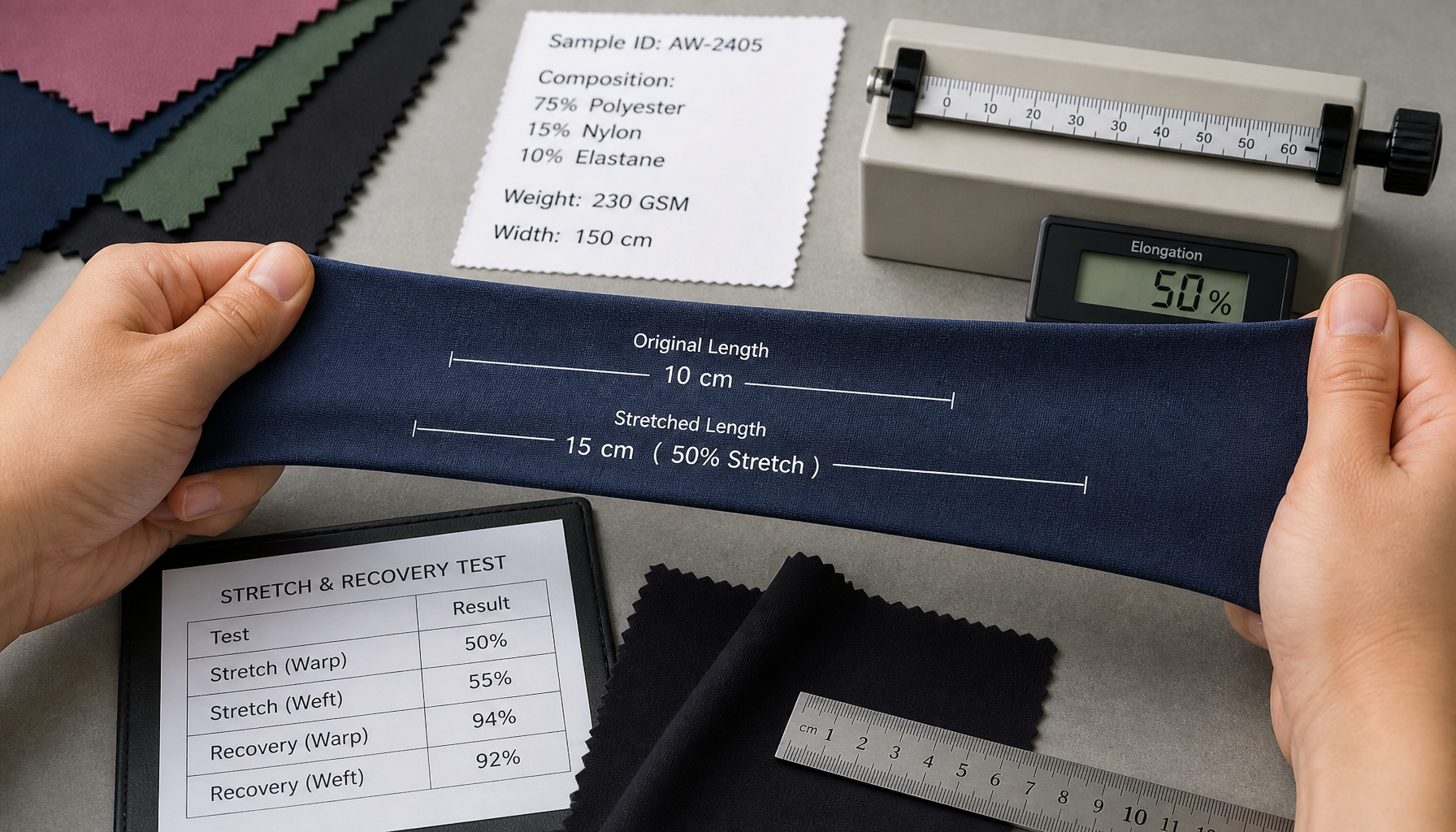
    Buyers should test stretch and recovery with the fabric direction, load or extension, cycles, hold time, recovery time, conditioning, and wash history fixed in advance. Maximum stretch alone is not enough: activewear fit also depends on force at garment extension and residual growth after release.

    Define the measurements separately

    Stretch describes how far a specimen elongates under a stated condition. Recovery describes how closely it returns after the load is removed. Residual growth is the extension that remains after a stated recovery period. A fabric can reach a high extension and still recover poorly.

    For an extension-based calculation:

    Stretch (%) = (extended length − initial length) ÷ initial length × 100

    The report must state the initial gauge length and how the extended length was produced. Results from different loads, specimen sizes, or hold times cannot be compared directly.

    Stretch fabric specimen prepared for controlled evaluation

    Test the directions used by the garment

    Knitted fabrics may behave differently along the course and wale directions. Test both when pattern pieces use both, and record panel orientation. For leggings, sports bras, and fitted tops, define the extension expected at critical body zones so the laboratory result can be connected to the pattern.

    A material may stretch easily but provide too little support, or require excessive force at normal wear extension. If support matters, compare force at a specified extension in addition to maximum stretch and recovery.

    Use one procedure for every candidate

    Keep these variables consistent:

    • specimen direction, size, and gauge length;
    • conditioning temperature and humidity where specified;
    • applied load or target extension;
    • loading cycles and speed;
    • hold and recovery times;
    • wash and drying procedure;
    • calculation and reporting units.

    Hand stretching can identify obvious differences but cannot establish a purchase tolerance. Use matched specimens and documented conditions for supplier comparisons.

    Include washing and garment validation

    Washing can relax the knit, change dimensions, or alter a finish. Measure dimensional change separately, then repeat stretch and recovery after the defined care cycle. Do not mix shrinkage with extension by reusing an uncontrolled marked length.

    Activewear fabric recovery assessment after extension

    The final garment sample should confirm waistband hold, knee and elbow recovery, seam appearance, dressing effort, and comfort. Pattern reduction, elastics, lining, and seams can change fit even when the fabric passes its laboratory limit.

    Interpret common result patterns

    Result Likely procurement concern
    High stretch, high residual growth Bagging or loss of shape after movement
    Low stretch at the required load Restrictive fit or excessive seam stress
    Acceptable recovery before wash but poor after wash Care-cycle instability
    Large difference by direction Panel-orientation and fit imbalance risk
    Wide specimen variation Lot, conditioning, construction or method inconsistency

    There is no universal pass value for every activewear garment. Set limits from the fit, support level, construction, care route, and approved garment sample.

    Procurement next step

    Give the supplier the garment type, critical body-zone extension, panel direction, target force or support, care cycle, and reporting method. Request identified swatches and matched pre- and post-wash data, then validate the selected fabric in a fitted garment before bulk approval.